
A cyclosporiasis lawsuit does not start with the usual food-poisoning timeline: eat a meal, get sick that night, identify the restaurant, plead causation. Cyclospora can take days to announce itself, symptoms can relapse after they seem to improve, and a stool test can be reported negative even though the laboratory never ran the test that would have found the parasite. Those facts make the legal options harder to screen. They also make the 2026 Taco Bell-Taylor Farms outbreak legally unusual, because the public-health evidence has not stayed at the level of a vague produce suspicion.
CDC has reported 1,645 laboratory-confirmed cyclosporiasis cases, 141 hospitalizations, and more than 7,000 total illnesses when probable cases are included, with illnesses spanning 34 states; CDC also warned that confirmed counts lag because of reporting delays and diagnostic undercounting.[1][2] Reuters reported that FDA traceback pointed to Taylor Farms de Mexico, while the outbreak link identified Taco Bell restaurants in five states.[3] That does not make liability automatic. It does give lawyers something many produce cases lack at intake: a named supplier, a named restaurant chain, and a public-health pathway to test against a claimant's own food history.

The Six Theories, And Why They Do Not Do The Same Work
News and law-firm reports describe complaints against Taco Bell and Taylor Farms asserting six familiar theories: negligence, strict product liability, breach of implied warranty of merchantability, breach of express warranty, state consumer-protection or deceptive-practices claims, and negligent infliction of emotional distress.[4][5] The list is useful, but it can mislead if treated as six separate roads of equal width. In a foodborne illness case, the first three usually carry the heaviest evidentiary load because they force the same core questions into view: was the food contaminated, did it reach the plaintiff through the pleaded pathway, and did it cause the illness?
| Theory | Main function in a cyclosporiasis case | Proof pressure point |
|---|---|---|
| Negligence | Tests whether defendants failed to use reasonable care in growing, processing, sourcing, supplying, or serving food | Standard of care, breach, traceback, and medical causation |
| Strict product liability | Focuses on whether the food product was defective or unreasonably dangerous when sold or supplied | Product identification and defect evidence |
| Implied warranty of merchantability | Alleges the food was not fit for ordinary consumption | Contamination, sale or supply chain connection, and state warranty rules |
| Express warranty | Depends on specific representations about safety, quality, sourcing, or freshness | The actual statement and whether the plaintiff can tie it to the transaction |
| Consumer protection | Targets deceptive or unfair marketing, labeling, or safety representations | State statute, reliance or causation requirements, and available remedies |
| Negligent infliction of emotional distress | Addresses emotional harm tied to physical illness or exposure | Jurisdiction-specific limits and medical proof of the underlying event |
The practical sequence is less tidy than the pleading caption. A plaintiff may plead negligence and strict liability in separate counts, but both may live or die on whether the implicated fresh produce item can be tied to the meal, the store, the distribution channel, and the outbreak organism. Warranty claims may preserve state-law remedies, but they still need a sale of food that was allegedly unsafe for ordinary use. Consumer-protection and express-warranty counts may add leverage where a defendant made safety or sourcing claims, yet they become thin if the complaint never identifies the statement that supposedly mattered.
Negligence Starts With The Supply Chain, Not The Fever Chart
Negligence is the theory most likely to absorb the broad factual story: agricultural controls, water and sanitation practices, supplier approval, restaurant sourcing, employee handling, response to illness reports, and traceability. In the 2026 outbreak, the useful allegation is not simply that a diner became ill after eating at Taco Bell. It is that public-health agencies have connected a defined outbreak to Taco Bell restaurants in five states and FDA traceback has reportedly narrowed toward Taylor Farms de Mexico.[3]
That distinction matters at intake. A lawyer who only records “Taco Bell, early summer, diarrhea” has not preserved a negligence case. The stronger file records the restaurant location, date and approximate time, items ordered, receipts or app history, payment records, loyalty-account data, phone-location records if available, other foods consumed during the incubation window, onset date, symptom course, medical visits, lab orders, and whether Cyclospora-specific testing was performed. The defendant's conduct can be investigated later; the plaintiff's exposure timeline often cannot.
Regulatory evidence may also matter, but it should not be inflated. FSMA produce-safety duties, supplier verification, and sanitation obligations can help frame the standard of care; they do not by themselves prove that a particular plaintiff ate contaminated food from a particular shipment. The better use is comparative: what a grower, processor, distributor, or restaurant was supposed to document, and whether those records match the public-health traceback. A fuller discussion of FSMA as standard-of-care evidence belongs in the separate analysis of FSMA compliance and Cyclospora liability.
Strict Liability Turns On Product Identification
Strict product liability is attractive in contaminated-food litigation because the plaintiff does not have to prove ordinary negligence in the same way. The sharper question is whether the food product was defective or unreasonably dangerous when it left the relevant defendant's control. In a Cyclospora outbreak involving fresh produce, that means the complaint should do more than invoke the restaurant brand. It should explain how the allegedly contaminated product moved through the supplier and restaurant chain, and why the plaintiff's meal fits that pathway.
This is where the 2026 outbreak looks stronger than many produce cases. FDA traceback reported by Reuters did not merely say that fresh produce was suspected; it identified Taylor Farms de Mexico, while the restaurant-chain connection focused on Taco Bell locations in five states.[3] A defendant can still dispute whether a particular plaintiff ate the implicated item, whether the meal date falls within the relevant distribution period, whether another exposure explains the illness, or whether the diagnosis is reliable. But the plaintiff is not starting from an anonymous salad bowl.
Strict liability also exposes the weakness of vague symptom-based pleading. A relapsing gastrointestinal illness may be consistent with cyclosporiasis, but consistency is not product identification. The file needs the product route. If a claimant ate at an implicated Taco Bell location during the relevant period but ordered only items that could not have contained the suspected produce component, strict liability becomes harder. If the claimant has a receipt, a menu item containing the implicated produce, a compatible onset window, and a Cyclospora-specific positive test, the same theory becomes much less speculative.
Implied Warranty Is Often The Quiet Workhorse
Breach of the implied warranty of merchantability is less dramatic than negligence or strict liability, but in food cases it often says the thing jurors understand fastest: food sold for human consumption should be fit to eat. If the product carried Cyclospora, it was not fit for ordinary consumption. The warranty count may overlap heavily with strict liability, especially where the defect is contamination rather than design or warning.
The complications are state-law complications. Some jurisdictions fight over privity, notice, disclaimers, restaurant service versus goods, and which seller in the chain can be reached. Those issues cannot be responsibly reduced to one national rule. For intake purposes, the warranty theory still pushes the same documentary discipline: identify the seller, the transaction, the food item, the illness, and the diagnostic basis for calling it Cyclospora rather than an undifferentiated stomach illness.
The Diagnostic Trap Is A Legal Trap
Cyclospora is not reliably captured by a generic stool workup. CDC guidance states that health-care providers should specifically request testing for Cyclospora, and litigation-oriented medical guidance notes that standard ova-and-parasite exams can miss the organism unless PCR or modified acid-fast staining is ordered for Cyclospora.[1][6] That creates a recurring evidentiary problem: a medical record saying “negative stool test” may be incomplete, not exculpatory.
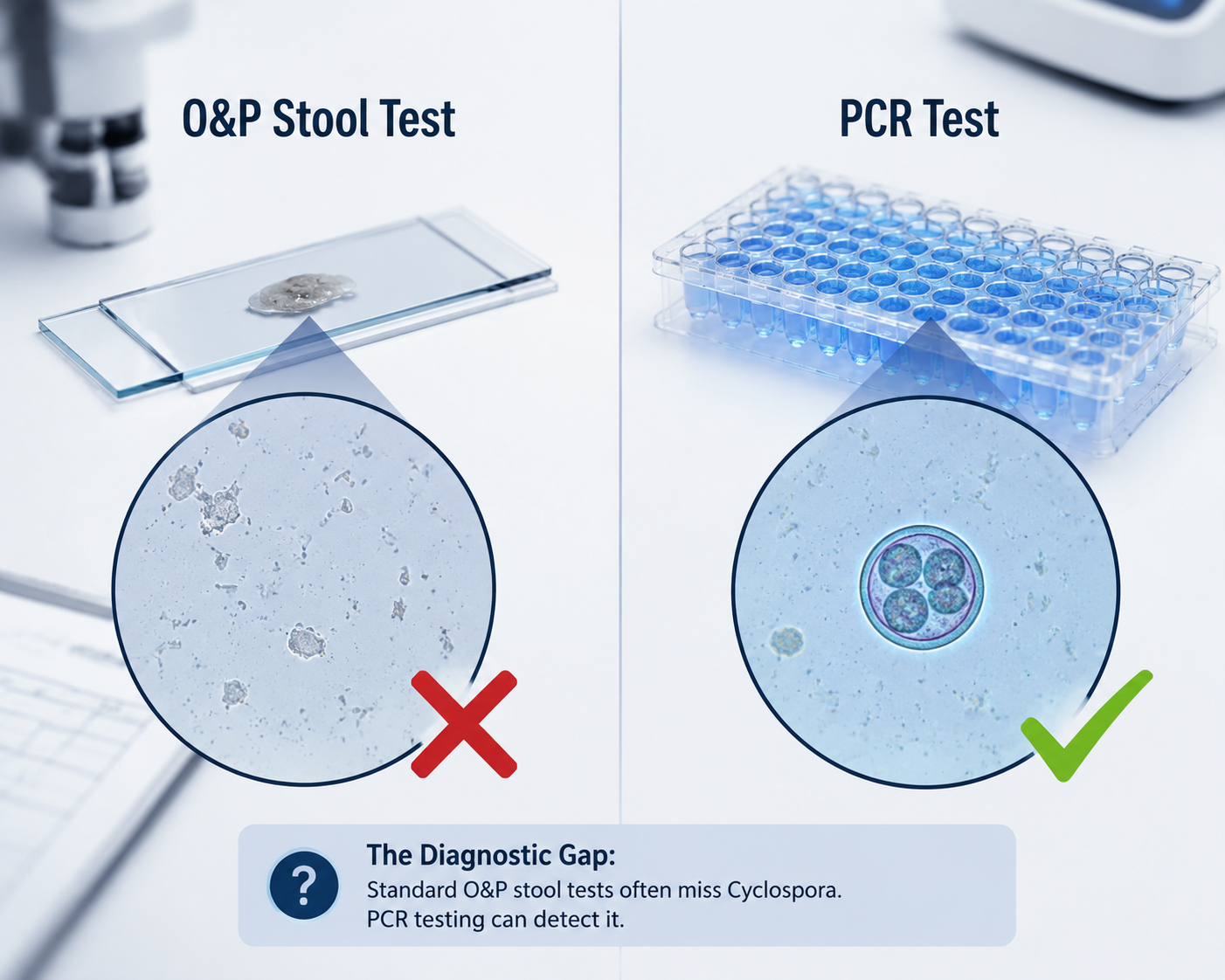
This is not a technical footnote. It changes how lawyers should read medical records. The first pass should not ask only whether the lab result was positive. It should ask what test was ordered, whether the order included Cyclospora, whether the lab used PCR or modified acid-fast staining, when the specimen was collected, whether symptoms had relapsed by then, and whether the treating clinician considered the outbreak notice when ordering tests.
The timing is equally unforgiving. CDC describes cyclosporiasis as having an incubation period that can range from 2 to 14 days, and symptoms may include watery diarrhea, fatigue, loss of appetite, weight loss, cramping, bloating, nausea, and relapsing illness if untreated.[1] A claimant who ate at several restaurants over two weeks may be telling the truth and still have a causation problem. A claimant who tested negative once may still have a viable case if the wrong test was ordered. Neither fact should be treated casually.
What The Intake File Should Preserve
- All food exposures during the 2-to-14-day incubation window, not just the meal the claimant remembers first.
- Receipts, app orders, bank records, loyalty-account records, delivery records, and location data that place the claimant at the implicated restaurant.
- The exact menu items and any substitutions, because product identification may depend on whether the item contained the implicated produce.
- The lab order and methodology, not merely the result, with attention to PCR or modified acid-fast staining for Cyclospora.
- Symptom onset, relapses, treatment, missed work, dehydration, hospitalization, and follow-up care.
- Public-health communications connecting the restaurant, supplier, product, location, and time period.
Express Warranty, Consumer Protection, And Emotional Distress Need State-Law Discipline
The remaining theories can matter, but they should not be made to carry more than they can hold. Express warranty requires an actual representation. A general brand image of freshness or quality may not be enough, depending on the state and the wording. If a complaint identifies specific safety, sourcing, inspection, or freshness statements, the claim has something to work with. If it merely says the food was “represented as safe,” the theory may collapse back into negligence and implied warranty.
Consumer-protection statutes vary even more. Some allow claims based on deceptive or unfair practices; some require reliance; some have special notice provisions, damages limitations, or public-interest requirements. These counts often appear in foodborne illness complaints because they may open additional remedies or settlement leverage under state law. They still need a deceptive act or omission connected to the transaction, not just a contaminated product.
Negligent infliction of emotional distress has the most obvious human appeal in a relapsing parasitic illness. Repeated diarrhea, fatigue, weight loss, and uncertainty about why the body keeps getting sick can be frightening and humiliating. But the legal claim is usually constrained by state rules requiring physical impact, objective symptoms, a zone of danger, or other limiting doctrines. In a cyclosporiasis case, emotional-distress damages may be real while the standalone count remains jurisdictionally fragile.
Prior Outbreaks Are Pattern Evidence, Not A Shortcut
The prior-outbreak history around Taylor Farms is legally relevant, but it has to be handled with care. Forbes and Marler Blog coverage report that the Michigan lawsuit invokes Taylor Farms' 2013 cyclosporiasis outbreak, which involved 631 cases across 25 states, and a 2024 E. coli O157:H7 outbreak as pattern evidence under state analogues to Federal Rule of Evidence 404(b).[4][7] That history may support arguments about notice, knowledge, feasibility of prevention, corporate practice, or punitive-damages theories. It does not prove that the 2026 plaintiff ate contaminated food.
That boundary is important because pattern evidence is tempting. A prior outbreak can help explain why a defendant allegedly should have recognized and controlled a known hazard. It cannot replace the plaintiff's receipt, the product route, the diagnostic test, or the exposure window. The punitive-damages implications of repeat outbreaks are developed separately in the site's piece on Taylor Farms repeat outbreaks and lettuce recall liability; here, the prior incidents are best understood as context that may strengthen notice-based pleading if the present causation evidence is already sound.
Multi-State Claims Create Procedural Friction
The five-state restaurant-chain link simplifies product identification in one sense and complicates litigation in another. Plaintiffs may have eaten in one state, received medical care in another, bought food through a national app, sued a restaurant entity incorporated elsewhere, and alleged contamination by a supplier tied to Mexico. Choice of law, personal jurisdiction, warranty rules, consumer-protection statutes, damages caps, and limitations periods may not point in the same direction.
As of July 20, 2026, the filed complaints discussed in public sources had been reviewed through media reports and law-firm announcements rather than docket text, so the exact pleaded counts, venue allegations, defendants, and factual exhibits need PACER verification before they are treated as fixed. No MDL motion had been filed as of that date. Statute-of-limitations issues also cannot be summarized responsibly across the affected states; lawyers and claimants need jurisdiction-specific advice, especially where notice provisions or shortened limitations periods may apply.
The same caution applies to the outbreak numbers. CDC's confirmed-case count is a surveillance measure, not a ceiling on injury claims, and the agency has warned that reporting lag and diagnostic undercounting mean confirmed numbers are expected to trail actual illness.[1][2] At the same time, a probable outbreak case is not the same thing as a litigation-ready plaintiff. Legal causation still has to be built person by person.
The Practitioner’s Bottom Line
The 2026 Taco Bell-Taylor Farms cyclosporiasis outbreak gives plaintiffs better causation architecture than many produce cases: a named restaurant chain, a reported FDA traceback to a named supplier, CDC surveillance, and a symptom profile that can be matched against specialized testing. That architecture is valuable only if the file preserves the proof Cyclospora cases most often lose: the right lab order, the incubation-window food history, the product pathway, the jurisdictional theory, and the source-linked public-health record.
References
- HAN-00531, Centers for Disease Control and Prevention.
- Cyclosporiasis Outbreak Investigation, Centers for Disease Control and Prevention.
- CDC says lab-confirmed US cases of cyclosporiasis top 1,600, expects count to rise, Reuters, July 14, 2026.
- Taco Bell Hit With Federal Lawsuits Over Cyclosporiasis Infections, Forbes, July 17, 2026.
- Ron Simon & Associates Files First Cyclospora Lawsuit Against Taco Bell and Taylor Farms in One of the Largest Food Poisoning Outbreaks in US History, PRNewswire.
- What to Know About Cyclospora During an Outbreak, Food Poison Journal.
- The Cyclospora Outbreak Now Has Two Names on It: Taylor Farms and Taco Bell. Both Have Been Here Before. And So Have I., Marler Blog.
Comments
Join the discussion with an anonymous comment.