
Forty terabytes is a courtroom problem before it is a headline number. In the Celeste Rivas Hernandez case, prosecutors say they have amassed a record large enough to impress any audience, but size will not convict anyone by itself. The harder question is which pieces of that record can be made to do courtroom work: tying David Anthony Burke, known professionally as D4vd, to a vehicle, a phone, a set of purchases, alleged preparation, possible motive, and conduct after the discovery of remains.
The opening day of the preliminary hearing, which began July 21, 2026, put that problem in unusually sharp form. Deputy District Attorney Beth Silverman described a case built from digital records, physical evidence, autopsy findings, financial testimony, and police-witness accounts, while the defense began testing the seams where those streams had to be collected, preserved, and attributed to the right person.[1]

The evidence that matters is the evidence that crosses formats
The most important early facts are not the most lurid ones. They are the facts that appear to move from one evidentiary universe into another. Prosecutors say an iPhone named “Tranquilizer” last connected to Burke’s Tesla system on July 29, 2025, the same day surveillance allegedly shows him driving the vehicle before abandoning it on Bluebird Avenue.[1] If authenticated, that is not merely phone data and not merely car data; it is a claimed bridge between a device, a vehicle, a date, and observed movement.
The purchase history does a different kind of work. According to reporting on the prosecution’s presentation, Burke allegedly used the names “Trayvion Davis” and “Victoria Mendez” to order a shovel through Postmates on April 24, two chainsaws from Amazon on May 1, a body bag and inflatable pool from Amazon on May 5, and a burn cage from Amazon on July 7.[1][2][3] Those records, if attributed to him, are the preparation trail the prosecution wants jurors to see before they hear arguments about concealment and disposal.
Then comes the fact that gives the digital-shopping evidence its hardest edge: the autopsy reportedly found blue plastic fragments embedded in the cut surfaces of the dismembered body, and prosecutors tied those fragments to the inflatable pool purchase.[1][3] That is the sort of connection that changes how a purchase record lands. A receipt can suggest planning. A material fragment, if properly recovered, tested, and explained, can try to place a purchased object inside the physical mechanics of the crime.
What each data stream is being asked to prove
A tech-heavy homicide case is not one argument repeated through different gadgets. Each source type has a job. Phone and vehicle records place devices and machines into a time sequence. Account records and delivery histories attempt to show preparation. Autopsy details test whether the preparation theory has physical support. Financial testimony supplies a possible special-circumstance motive theory. Body-worn camera footage and messages give the court prior context. Encrypted app behavior may support a consciousness-of-guilt argument, but it cannot carry more weight than the underlying facts allow.
| Evidence stream | Courtroom function | Natural pressure point |
|---|---|---|
| iPhone and Tesla data | Places a named device in relation to a specific vehicle and date | Attribution of device use, extraction method, and interpretation of connection logs |
| Alias purchases | Builds a preparation and object-acquisition sequence | Proof that the suspect controlled the accounts, delivery locations, and payment methods |
| Autopsy and material fragments | Attempts to corroborate the purchase trail with physical findings | Recovery, preservation, testing, and expert explanation of the fragments |
| Encrypted messaging migration | May support an inference about post-discovery conduct | Risk of overreading privacy behavior as guilt without more |
| Financial testimony | Supports the alleged financial-gain motive theory | Connection between earnings, alleged motive, and charged conduct |
| Body-worn camera and texts | Provides prior context for relationship and welfare concerns | Admissibility, relevance, and risk of unfair prejudice |
That division of labor matters because it keeps the case from becoming a fog of metadata. A phone’s connection to a car does not prove what happened to a body. A chainsaw receipt does not prove how a cut was made. A plastic fragment does not identify who placed it there. The prosecution’s burden is to make those narrow propositions fit together without asking any single item to do work it cannot do.
Telemetry can establish a sequence, not a full narrative
The alleged “Tranquilizer” connection is powerful because it is specific. A device name, a Tesla system, and a date are easier for a court to evaluate than a generalized claim that a suspect was “tracked.” But the legal work is still painstaking. Prosecutors must show what the log records actually mean, how the data were collected, whether the device can be attributed to Burke, and whether the vehicle connection indicates use, proximity, prior pairing, or some other technical state.
Surveillance allegedly showing Burke driving the Tesla before abandoning it on Bluebird Avenue gives the telemetry a human frame.[1] That is the kind of pairing jurors understand: machine record, visual record, time point, location. The closer those pieces are in time and the cleaner their authentication, the less the prosecution has to lean on abstraction.
Purchases become more serious when the body answers back
The alleged alias purchases are not all equally important. A shovel, two chainsaws, a body bag, an inflatable pool, and a burn cage create a disturbing sequence when listed together, but the list is still account evidence until it is tied to user identity, delivery, possession, and use. The reported blue plastic fragments are therefore central. They offer prosecutors a route from an online order to the physical condition of the remains.
That route also creates trial work. The court will need to hear how the fragments were observed, collected, preserved, compared, and interpreted. A match-like assertion is only as strong as the testing and documentation behind it. In a case this dependent on sequence, the physical object trail cannot be treated as an illustration of the digital record; it has to stand on its own foundation.
Motive and context sit beside the forensic proof
Benjamin Greger, identified as Burke’s financial manager, testified that Burke generated between $10 million and $11.5 million from 2023 to 2025, testimony reported as part of the prosecution’s financial-gain special-circumstance theory.[1][3] That figure does not prove violence. It gives prosecutors a motive lane, and motive evidence has to be handled carefully because wealth can explain incentive in one argument and unfairly color a defendant in another.
The body-worn camera footage and text messages occupy a similar supporting role. Prosecutors presented footage from a February 17, 2024 welfare check at the residence, along with messages referencing sex, pregnancy, abortion, and Plan B.[1] Those materials may help establish prior context, relationship dynamics, or knowledge. They are not substitutes for proof of charged conduct, and their admissibility and scope may become more contested as the case moves beyond probable cause.
Encrypted apps are evidence of conduct, not a confession
FOX 11 reported testimony that key associates, including Burke’s mother, began using encrypted messaging apps after the victim’s remains were discovered.[2] That is a familiar prosecution move: place a change in communication behavior after a triggering event and argue consciousness of guilt or coordinated concern.
But encrypted messaging is easy to overstate. People use encrypted apps for many reasons, and the mere use of one does not establish the content, purpose, or criminal meaning of a conversation. The probative value depends on timing, participants, surrounding messages, device attribution, and whether investigators can show what changed after discovery rather than merely showing that privacy tools existed.

The defense map is about handoffs, not just doubt
Blair Berk’s cross-examination of LAPD Detective Josh Byers, as reported from the hearing, went where experienced defense counsel usually goes in a sprawling evidence case: not to the horror of the allegations, but to the path each item took before it reached the courtroom.[2] That is not a side issue. In a case built across agencies, platforms, devices, accounts, and physical items, chain of custody is the skeleton underneath the narrative.
The reported handling issues are not, at this stage, judicial findings of contamination or exclusion. They are pressure points. But they are serious pressure points: three responding departments without apparent coordination, destruction of the primary evidence bag without DNA testing, no scene sign-in log, two chainsaws not retained for DNA analysis after negative luminescence results, and a burn cage behind a piano that was not externally tested.[2][3]
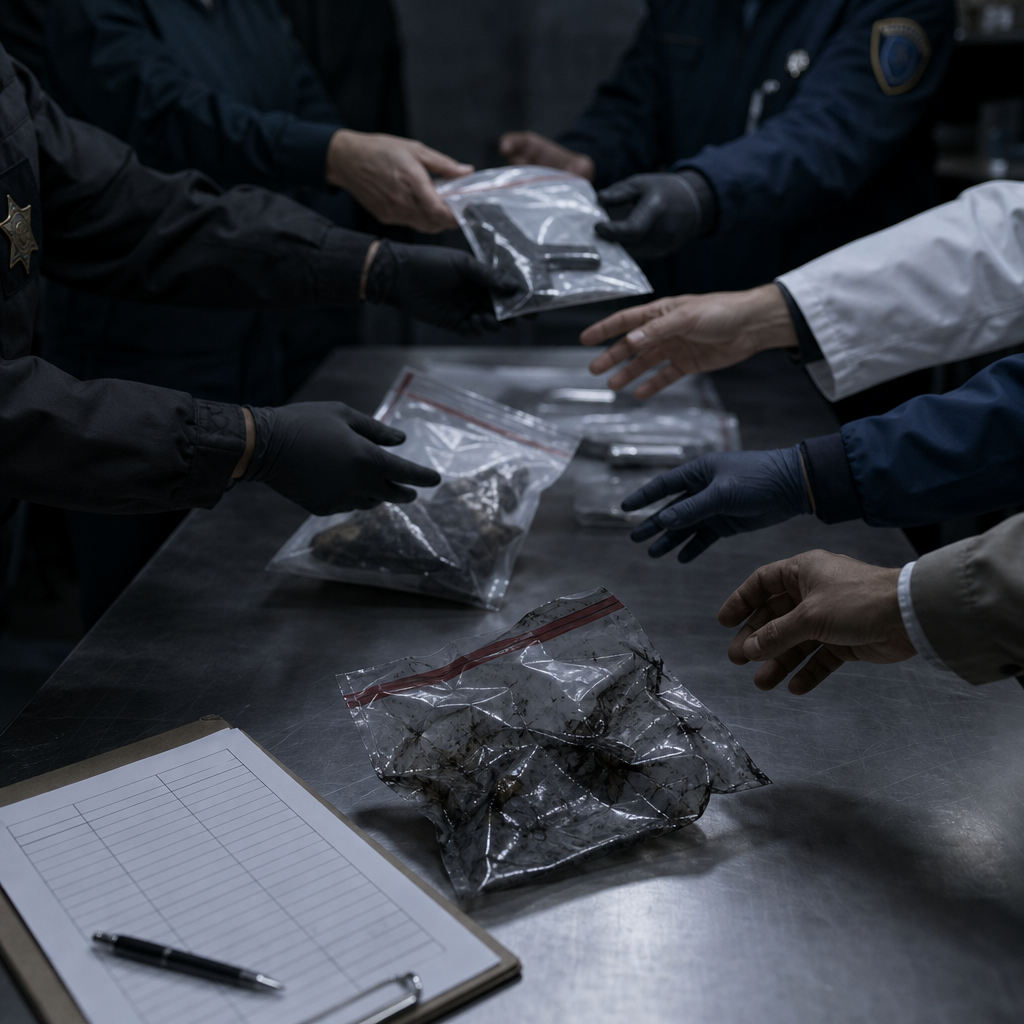
Those facts matter because they attack different parts of the prosecution’s architecture. Uncoordinated response raises questions about who controlled the scene and when. A destroyed primary evidence bag removes a potential testing opportunity. A missing sign-in log leaves the court with less visibility into who entered the scene. Chainsaws not retained after negative luminescence results may invite an argument that investigators stopped too early. A burn cage not externally tested leaves an obvious “what if” sitting in the record.
None of that automatically defeats the prosecution’s case. Courts often admit evidence despite imperfect handling when witnesses can still account for collection, storage, and testing with sufficient reliability. But these are exactly the seams where a broad modern case becomes procedurally vulnerable. The more a theory depends on connecting a receipt to an object, an object to a body, a phone to a car, and a car to a movement, the more each missing log or discarded container matters.
Probable cause is not the same as trial proof
The procedural posture should stay in view. The hearing that began July 21, 2026 is a preliminary hearing, and the available public picture comes largely from early prosecution testimony and media reporting.[1] The defense has not presented its full case. Expert commentary in news coverage is not a court ruling. Evidence that helps establish probable cause may still face suppression motions, admissibility fights, limiting instructions, expert challenges, or exclusion at trial.
That distinction is easy to lose in a case with celebrity gravity and gruesome facts. Preliminary hearings can show the prosecution’s theory at high altitude. Trials require a more durable evidentiary machine. Authentication questions become more granular. Foundation witnesses matter more. Defense counsel gets more room to turn a collection shortcut into a credibility problem.
The 40-terabyte figure therefore cuts both ways. It signals a prosecution with access to a wide digital and physical record, including evidence types that barely existed in older homicide cases. It also signals a case with more handoffs, more platforms, more extraction decisions, more account-attribution questions, and more opportunities for one weak link to infect the confidence of the whole chain.
Modern digital homicide cases are not won simply by collecting more data. They are won, or seriously challenged, by proving that each stream was tied to the right person, preserved through the right process, and connected to physical facts the court can trust.
References
- D4vd murder case: Prosecutors reveal photos of teen's dismembered body, Los Angeles Times, Jul. 21, 2026.
- Courtroom reporting on the D4vd murder case, FOX 11.
- Reporting on the D4vd murder case, BBC.
Comments
Join the discussion with an anonymous comment.