
The most consequential of the D4vd killing case details, at least for lawyers and litigation-support teams, is not a single allegation. It is the production problem now sitting inside a capital murder prosecution: more than 40 terabytes of evidence, gathered across agencies and formats, and a preliminary hearing that was continued three times before reaching a July 21, 2026 start date before Judge Charlaine F. Olmedo.[1][2]
That is the part of the case that changes how the record moves. A homicide file that includes LAPD material, sheriff’s department material, body-worn camera footage, forensic reports, chemical processing records, cellphone and cloud data, surveillance, purchase records, and physical-evidence testing does not behave like a witness-and-report prosecution. It behaves more like a large, fragile e-discovery matter, with criminal discovery obligations, chain-of-custody concerns, and constitutional timing pressure layered on top.

The hearing delay is a discovery story
The preliminary hearing had originally been expected on May 1, 2026, then moved through three continuances before the July 21 hearing date.[1][2] In the ordinary public telling of a murder case, continuances can sound like scheduling debris. Here, they are the procedural signal. The case could not move at the pace of accusation because the evidence set had to be located, processed, disclosed, accessed, and reviewed in a form that counsel and the court could actually use.
Courthouse News Service reported that prosecutors described more than 40 terabytes of evidence, including material from LAPD, the sheriff’s department, body-worn cameras, forensic reports, and chemical processing.[2] Those categories matter because they are not just file labels. Each one usually carries its own custodian, export format, metadata questions, authentication path, and disclosure checkpoint.
A body-worn camera export has different review problems than a lab report. A forensic image of a phone has different access and privilege problems than a surveillance clip. A purchase record has a different foundation than a chemical-processing result. When those materials come from multiple law-enforcement sources, the prosecution’s task is not simply to hand over a hard drive. It must know what was collected, what was processed, what is still pending, what is restricted, what has been disclosed, and what can be used in court without later inviting an avoidable authenticity fight.
For defense counsel, the same volume changes the calendar from the other direction. Access is not review. Receipt is not comprehension. A defense team that receives terabytes of video, phone extractions, cloud material, forensic reports, and agency files still has to load, search, triage, test, and compare those materials against the prosecution’s theory. In a capital-eligible case, missed review is not an inconvenience; it is a due-process problem waiting for a docket entry.
NBC Los Angeles reported that defense attorney Blair Berk argued the prosecution’s nine-page pre-hearing brief was prejudicial and one-sided, and that Judge Olmedo rejected the motion to seal it.[1] That dispute is separate from the raw volume issue, but it sits in the same procedural neighborhood: what the parties can see, what the public can see, and how much weight a pre-hearing filing should carry before testimony and cross-examination begin.
Forty terabytes is not one burden
The phrase “digital evidence” is too blunt for this case. The materials described so far fall into several operationally distinct groups, and each group creates a different kind of delay.
| Evidence type | Operational burden |
|---|---|
| Body-worn camera and surveillance video | Volume, playback time, redaction, identity confirmation, and timestamp reconciliation |
| Cellphone and iCloud material | Forensic extraction, search, account attribution, privacy review, and restricted-content handling |
| Forensic and chemical reports | Expert review, lab documentation, chain of custody, and method challenges |
| Purchase and platform records | Account attribution, date sequencing, vendor response records, and corroboration against physical evidence |
| Physical evidence tied to digital records | Collection documentation, testing results, match claims, and admissibility foundation |
The practical consequence is that no single review workflow fits the file. A team can batch-process video for rough relevance, but it cannot treat child sexual abuse material the same way. It can chart purchase dates, but it still has to prove who used the account and how the purchased item connects to the charged conduct. It can summarize forensic reports, but a summary does not substitute for expert review where testing methodology or sample integrity may matter.
That is how terabytes become continuances. The delay does not have to mean anyone is intentionally slow. It can mean that the evidence set has more gates than the hearing calendar has room for: agency collection, forensic processing, prosecutor intake, defense disclosure, protected-material handling, expert analysis, motion practice, and court review.
Some evidence cannot be made convenient
The most important access issue reported so far concerns the iPhone and iCloud material. BBC News reported that Deputy District Attorney Beth Silverman told the court a “significant amount” of child pornography was found on D4vd’s iPhone and iCloud, and that statutory handling rules for that material contributed to discovery delays.[3]

That point is easy to flatten into another “large discovery” complaint, but it is different. Sensitive contraband content is not delayed merely because lawyers need more hours to review it. It is delayed because the law controls how it may be stored, transferred, viewed, and accessed. Counsel cannot solve that problem by agreeing to a faster file share. The access protocol is part of the evidence environment.
For legal teams, this creates a sequencing problem. Defense counsel may need to review the material to understand the prosecution’s theory, test attribution, evaluate search issues, or prepare motions. Prosecutors may have disclosure obligations. The court may need enough information to rule on timing and access without broadening exposure to illegal material. Everyone is working inside a system where ordinary discovery convenience is not the governing value.
The reported detail that prosecutors said three grand juries heard evidence should be treated carefully. BBC attributed that point to prosecutors in court through CBS reporting, but the available materials do not independently establish it through docket records.[3] For present purposes, the stronger procedural point is narrower and better supported: the court record described statutory handling constraints around alleged child sexual abuse material, and those constraints affected defense access and timing.
The purchase records do a different job
Once the discovery bottleneck is understood, the purchase records show the other side of the same digital-evidence problem. Platform records are not just burdens to produce. They can become the spine of the prosecution’s chronology.
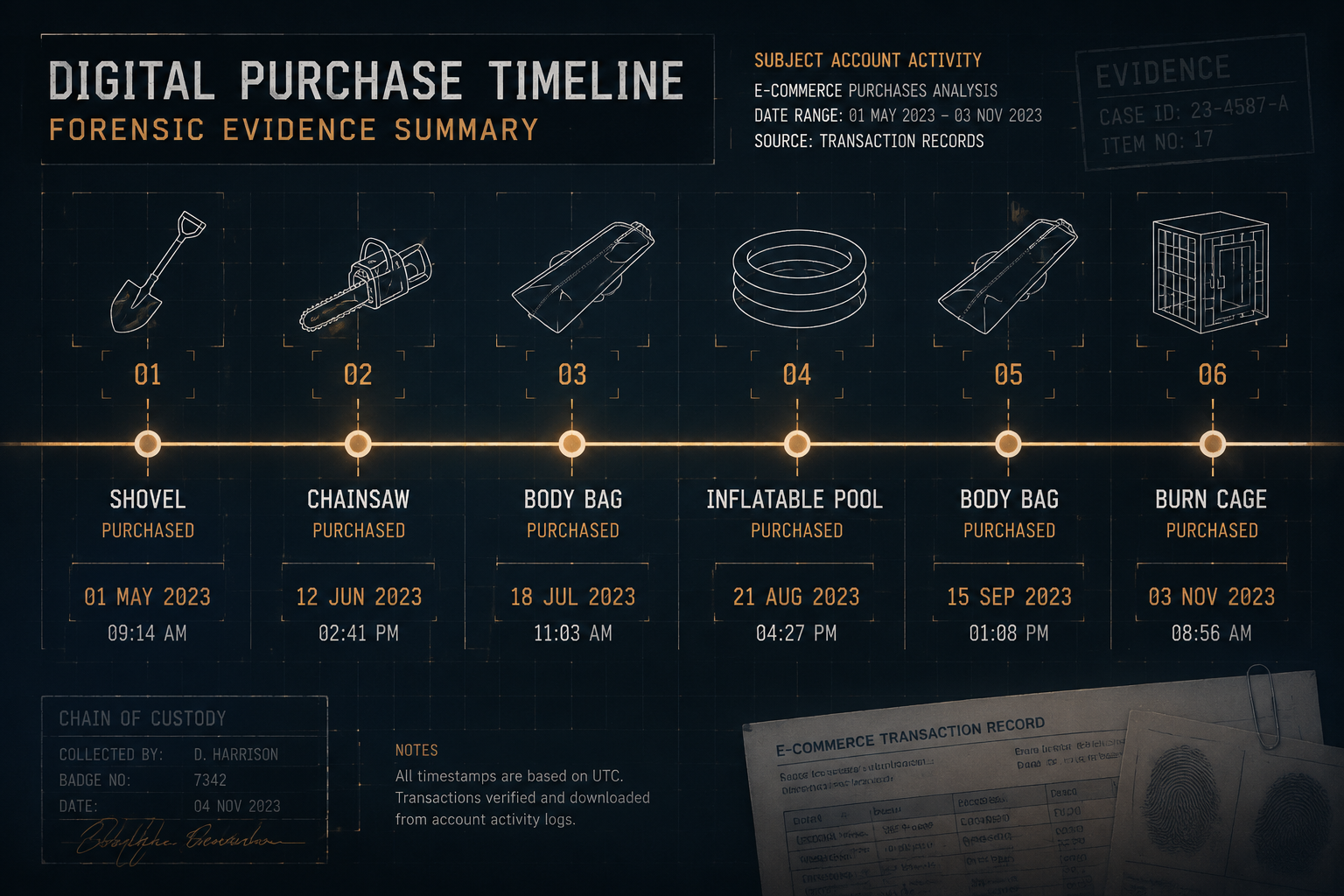
ABC7 reported a sequence of purchases prosecutors tied to the case: a Home Depot shovel order on April 24, 2025 through Postmates; two chainsaws on May 1 through Amazon; a body bag and inflatable pool on May 5 through Amazon; and a burn cage on July 7.[4] The same timeline reported that prosecutors said these purchases were made under the alias “Victoria Mendez.”[4]
| Date | Reported purchase | Platform or vendor detail | Evidentiary use |
|---|---|---|---|
| April 24, 2025 | Shovel | Home Depot order through Postmates | Sequence and preparation |
| May 1, 2025 | Two chainsaws | Amazon | Sequence, intent, and corroboration |
| May 5, 2025 | Body bag and inflatable pool | Amazon | Sequence tied to prosecutors’ theory of dismemberment date |
| July 7, 2025 | Burn cage | Reported purchase record | Later conduct in the prosecution timeline |
The legal value of that sequence is not the product list by itself. A purchase record can help establish timing, but timing still has to be connected to identity, intent, and corroborating evidence. An alias raises attribution questions, not answers. A platform receipt can show an order; it does not automatically prove who clicked, who received, who used, or why.
That is why the physical-evidence claims matter only when they connect back to the digital trail. Prosecutors allege that blood swabs from the garage matched Celeste Rivas Hernandez’s genetic profile and that blue plastic fragments matching the inflatable pool were found embedded in cut surfaces of her remains.[2][5] Those are the kinds of links that can turn a platform transaction from background chronology into corroboration.
The Los Angeles County District Attorney’s Office also said D4vd texted Celeste at 10:30 p.m. on April 23, 2025 asking where she was, after prosecutors allege she was already dead, and characterized the message as part of a premeditated cover-up.[5] That is a prosecutor’s allegation, not a court finding. In an evidentiary architecture, however, it shows how a single message can be used alongside purchase records, location evidence, and physical testing to argue consciousness of guilt or staged uncertainty.
Consumer platforms became part of the case file
The alleged evidence trail runs through ordinary commercial systems: Home Depot, Amazon, Postmates, iCloud, cellphone messaging, geolocation, and surveillance. These are not exotic investigative tools. They are routine consumer and business platforms whose records can become prosecution evidence when identity, time, and conduct are disputed.
That matters for legal operations because each platform record arrives with its own proof problems. A vendor record may need a custodian or certification. A delivery record may need address, account, payment, device, or recipient analysis. Cloud content may raise search, access, and statutory-handling issues. Location and surveillance material may need timestamp reconciliation. A prosecution timeline built from platforms is only as strong as the links between the platform data and the person, place, and act the government says it proves.
PBS NewsHour reported that surveillance confirmed D4vd was the last person to drive the Tesla on July 29, 2025.[6] That fact does not resolve the case, but it shows how vehicle use, camera footage, and timeline evidence may sit beside cloud data and purchase records in one proof structure.
A cleaner analysis would separate those functions. Purchase records help establish a sequence. Messages help establish communication and possible state of mind. Surveillance helps establish movement or control. Physical testing helps establish contact or consistency. The difficulty in a 40-terabyte prosecution is that those functions are scattered across many systems, then compressed into hearing exhibits, witness examinations, and judicial rulings.
What the current record can and cannot say
As of July 21, 2026, the preliminary hearing is beginning, not concluded.[1] The available materials do not establish day-by-day testimony, evidentiary rulings, credibility findings, or a holding order outcome from that hearing. Any account that writes as if those results already exist is moving beyond the present record.
Several details should remain framed as allegations. The prosecution’s claims about the April 23 text, the purchase timeline, the alias, the garage blood swabs, the plastic fragments, and the relationship among those facts are part of the government’s theory unless and until tested through the hearing process and later proceedings.[2][4][5] The defense has not had its full evidentiary answer captured in the materials available for this article.
That caution is not a formality. It is the difference between a case study in legal process and a premature verdict in narrative form. The prosecution may have a large and detailed digital record. The defense may contest attribution, interpretation, admissibility, timing, completeness, or prejudice. The court’s job is not to admire the size of the file; it is to decide what the law permits the parties to do with it.
The legal-operations lesson
The D4vd prosecution is useful to legal professionals because it makes three burdens visible at once. Volume changed the schedule. Sensitive content changed access. Consumer-platform records changed the proof architecture.
Those burdens require different controls. Volume requires intake logs, deduplication, indexing, review prioritization, and defensible disclosure tracking. Sensitive material requires secure access protocols that comply with statute rather than convenience. Platform evidence requires attribution work and corroboration rather than assuming that a receipt, message, or location hit proves the whole chain.
In that sense, the 40-terabyte cache is not a side fact. It is one of the forces shaping how a capital prosecution moves from accusation toward proof. The substantive allegations remain for the court process. The operational lesson is already plain: in modern serious-felony litigation, evidence management can become a case event in its own right.
References
- Preliminary hearing to move ahead for singer D4vd, NBC Los Angeles
- Prosecutors detail grisly evidence in murder case against musician D4vd, Courthouse News Service
- Singer D4vd found with significant amount of child sex abuse images, BBC News
- D4vd charged with murder: Timeline of investigation, ABC7
- Singer D4vd Charged with Capital Murder in the Death of a 14-year-old Girl, Los Angeles County District Attorney’s Office
- Singer D4vd charged with murder of 14-year-old found decomposed in his car, PBS NewsHour
Comments
Join the discussion with an anonymous comment.