
The difficult part of the reaction to graphic photos at D4vd's preliminary hearing is not that anyone in the Los Angeles Airport Courthouse failed to understand the victim impact. The reported scene suggests the opposite. Celeste Rivas Hernandez's parents were in the courtroom on July 21 and 22, 2026, as prosecutors presented crime-scene evidence at a preliminary hearing before Judge Charlaine Olmedo. Deputy District Attorney Beth Silverman questioned LAPD Detective Vazgen Antanosian and a forensic pathologist while images from the scene were displayed in court.[1]
Before the most graphic photographs were shown, Silverman warned the family. During the presentation, she paused to check on Celeste's mother.[2] That pause matters. It was not a legal ruling, and it did not remove the images from the room. But it shows that the human problem was visible to the lawyers before any rule supplied a clean procedural answer.
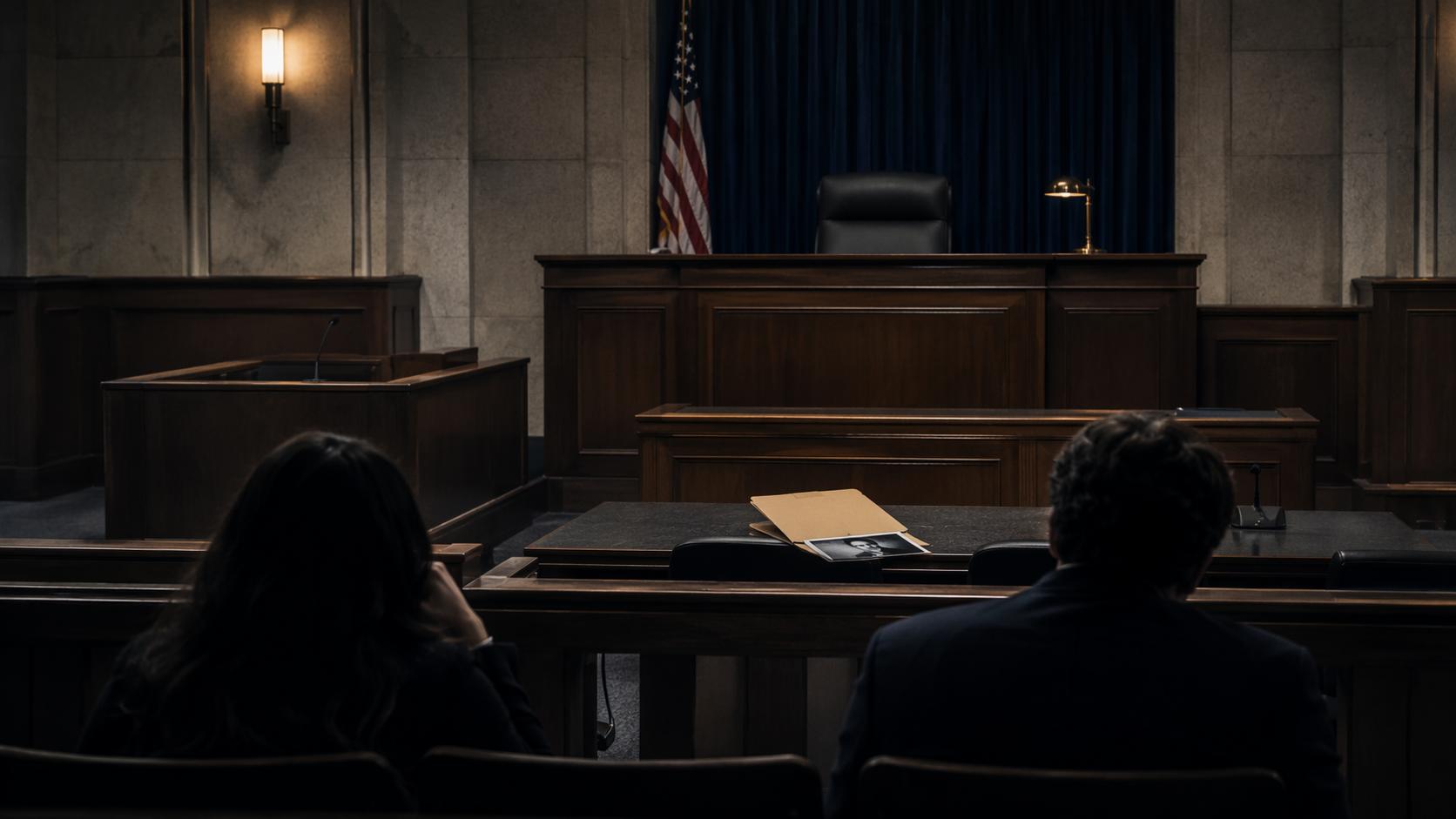
The photos reportedly included images of Celeste's decapitated body at a Downey apartment complex, a detached head on a futon, a kitchen knife, cellular phones, and her driver's license.[3] There is no need to linger over those details to see the legal issue. Their procedural significance is enough: the family had a right to be present, the prosecution had reason to build a probable-cause record, and the preliminary hearing rules did not appear to offer a formal way to let the family attend while shielding them from the harshest exhibits.
The hearing was not broadcast. Cameras were not permitted, and the public record of the courtroom's visual atmosphere came through sketch artists rather than video.[4] That absence of cameras may have reduced spectacle outside the courthouse. It did nothing for the people sitting inside it.
The question is procedural, not just emotional
A trial judge deciding what a jury may see faces a familiar problem: relevance on one side, unfair prejudice or emotional distortion on the other. A preliminary hearing is different. It is not the moment when guilt is decided beyond a reasonable doubt. It is the moment when a judge decides whether there is sufficient cause to believe the defendant committed the charged offense and should be held to answer.[5]
That distinction changes the temperature of the evidentiary room. The question is not whether every exhibit would survive the same scrutiny at trial. It is whether, at this earlier stage, the prosecution can present enough evidence to establish probable cause under a lower threshold. California Penal Code sections 871 and 872 frame that decision: if the showing is insufficient, the defendant is discharged; if sufficient cause appears, the defendant is held to answer.
That lower threshold helps explain why graphic evidence can appear at a preliminary hearing without proving that the same material will necessarily reach a trial jury in the same form. Evidence Code section 352 gives courts a tool to exclude evidence when its probative value is substantially outweighed by risks such as undue prejudice, confusion, or consumption of time. At trial, especially before a jury, that balancing can become sharper. At a preliminary hearing, where the judge is the fact finder for probable cause and the legal task is narrower, the practical gate is often wider.[5]
That does not mean graphic photographs are automatically admissible at a prelim, as if the setting erases all limits. It means the ordinary reasons for showing them may carry more force at this stage than a casual observer expects. A prosecutor may use them to establish identity, the condition and location of the body, cause or manner of death, or links among physical items found at the scene. The pathologist's testimony and the detective's testimony, as reported, put the photographs inside that probable-cause presentation rather than outside it as mere shock material.[1]
Why a preliminary hearing permits a fuller early record
The preliminary hearing occupies an awkward place in criminal procedure. It is serious enough to test the prosecution's case, but not final enough to decide the defendant's guilt. It requires evidence, but it does not replicate a trial. That middle position is exactly why the D4vd hearing produced such a harsh courtroom dynamic.
California also permits a relaxed evidentiary environment at prelims in specific ways. Penal Code section 872(b), as summarized in California preliminary-hearing practice materials, allows certain law-enforcement officers to testify to hearsay statements if statutory conditions are met.[5] That kind of rule is not about graphic photographs by itself. It is about the broader design of the hearing: the prosecution can establish probable cause without presenting the entire trial case through every original witness and every foundation layer that may later be required.
The result is a hearing that can be evidentiary enough to expose a family to raw crime-scene material, but preliminary enough that the ordinary trial conversation about prejudice has not fully arrived. That is the uncomfortable procedural space. The law has reasons for creating it. Witness availability, early screening of charges, and judicial economy all matter. But those reasons do not answer the family member who came to exercise an attendance right and then had to sit through photographs no parent should have to see.
The charges made the prosecution's incentive to build a record even stronger. D4vd faces three special-circumstance allegations: lying in wait, financial gain, and witness murder. Those allegations make the case death-penalty eligible.[1] At a preliminary hearing, that does not require the prosecution to prove the case beyond a reasonable doubt. It does make the architecture of the alleged crime important: what happened, where it happened, what physical evidence connects the alleged acts, and why the charged special circumstances are not merely labels on a complaint.
That is the point easy coverage tends to flatten. The question is not simply why prosecutors would show something so disturbing. In a special-circumstance murder case, prosecutors may have a concrete reason to show the court the condition of the body, the items found nearby, and the physical context in which investigators formed their conclusions. The harder question is why the legal system has so little to say when the people most harmed by the alleged crime are also sitting in the room.
Marsy's Law gives attendance, not insulation
Marsy's Law is often described in empowering terms, and for good reason. California's victim-rights framework gives victims and qualifying family members a right to be present at criminal proceedings. In practice, that right prevents the courtroom from becoming a place where the state, the defendant, and lawyers speak about a person while the person's family is pushed into the hallway.
But an attendance right is blunt. It answers the door question: may the family be in the courtroom? It does not, at least on the materials available from this hearing, answer the exhibit question: what happens when exercising that right means seeing graphic crime-scene photographs displayed to the judge?
That is where the reported warning from Silverman becomes both humane and insufficient. Warning the family before the images were shown gave them notice. Pausing to check on Celeste's mother acknowledged distress in real time.[2] Those were acts of courtroom care. They were not a procedural mechanism. A warning still leaves the same basic choice: stay and witness the evidence, or leave and give up the proceeding while it is happening.
That binary choice is not quoted from a judge's ruling. It is the practical consequence of placing the reported courtroom facts beside the attendance right. Marsy's Law, as relevant here, protects presence. It does not appear to create a separate right to remain present while avoiding particular exhibits, to receive a screened feed, to trigger an automatic balancing of trauma against evidentiary presentation, or to require the court to structure the display of photographs differently for family members in the gallery.
The distinction matters because victim-rights language can make the courtroom sound more accommodating than it is. A right to attend is meaningful. It lets family members hear testimony, observe the lawyers, and see how the court handles the case. Yet when the evidence itself is the injury repeated in visual form, attendance can become exposure. The same rule that keeps the family from being excluded does not necessarily keep them from being made captive to every exhibit.
What the judge had not yet decided
As of July 22, 2026, the hearing was ongoing and Judge Olmedo had not yet entered a probable-cause ruling.[1] That timing limits what can responsibly be said. The hearing had exposed the procedural conflict, but it had not produced a final judicial assessment of whether the charges would proceed, how the evidence would be treated later, or what trial rulings might eventually be made.
It also means the photographs shown at the prelim should not be treated as a preview of everything a jury will necessarily see. Trial admissibility can involve different objections, different foundations, and more pointed Evidence Code section 352 arguments. A judge may decide later that some images are cumulative, more prejudicial than probative, or unnecessary in the form offered. The preliminary hearing does not settle that.
Nor should the family's presence be read as consent to the emotional terms of the presentation. The legal right to attend does not mean the family affirmatively chose to view every image as a personal matter. In a public criminal proceeding, the choices are often coarser than that. A parent may want to hear the evidence, support the prosecution, observe the defendant, or simply refuse to be absent from the first formal testing of the case. None of those reasons answers the narrower problem of graphic display.
The gap exposed by the hearing
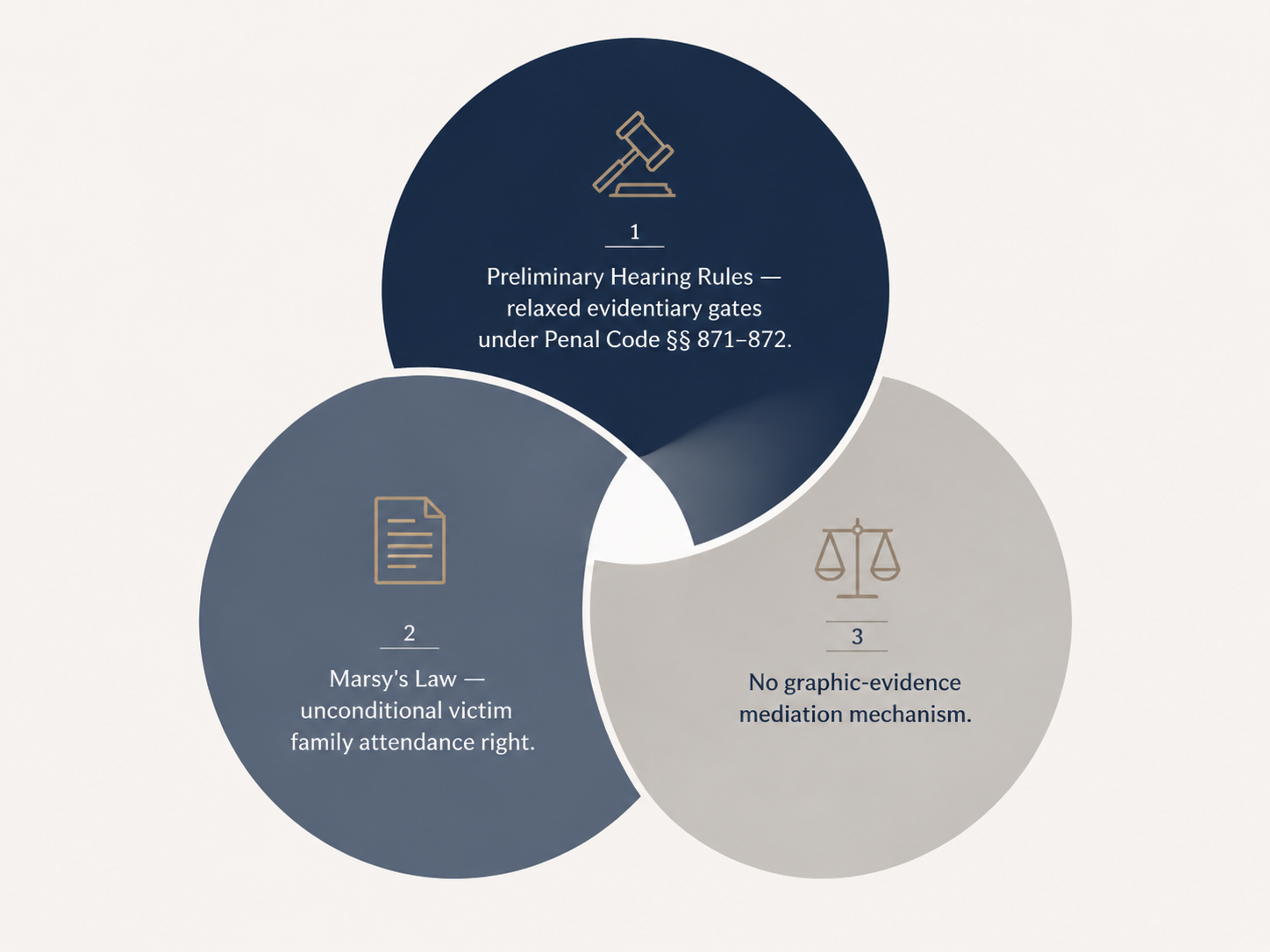
Three rules can each operate as intended and still produce a result no one should be eager to defend as complete. The preliminary hearing standard asks for sufficient cause, not proof beyond a reasonable doubt. The relaxed admissibility environment lets prosecutors build that early record without the full trial apparatus. Marsy's Law lets the victim's family attend. None of those rules is obviously irrational in isolation.
| Rule or practice | What it does | What it does not resolve |
|---|---|---|
| Penal Code sections 871-872 | Sets the probable-cause screening function for holding a defendant to answer | Whether family members can avoid seeing graphic exhibits while remaining present |
| Relaxed preliminary-hearing evidence rules | Allows a narrower early evidentiary showing than a full trial presentation | Whether material that may face sharper trial scrutiny should be displayed in the same way at the prelim |
| Marsy's Law attendance right | Protects the family's ability to be in court | How that right works when attendance exposes the family to traumatic visual evidence |
| Informal warning or pause | Gives humane notice and momentary attention to distress | Creates no clear enforceable procedure for screening, limiting, or restructuring graphic evidence |
That is why the reported courtroom conduct should not be mistaken for either cruelty or cure. Silverman's warning and pause suggest a prosecutor aware of the family's position. The fact that such gestures were necessary suggests the rules had left the human difficulty to be managed in the moment.
The D4vd hearing therefore matters less as a celebrity-crime spectacle than as a procedural exposure. California's preliminary hearing rules and Marsy's Law can both function as written, while a victim's family is left with no clear mechanism to attend without witnessing graphic evidence. That is a narrower conclusion than outrage prefers, but it is the one the courtroom facts support.
References
- Prosecutors detail grisly evidence in murder case against musician D4vd, Courthouse News Service.
- Gruesome images in D4vd hearing are 'worst nightmare' for Celeste Rivas Hernandez's family, BBC.
- Celeste Rivas decapitated body photos displayed at D4vd murder trial, parents look on, New York Post.
- D4vd Murder Case: Graphic Crime Scene Photos Shown at Preliminary Hearing as Victim's Parents Watch, Complex.
- 'Preliminary Hearing' in California — How The Process Works, Shouse Law Group.
Comments
Join the discussion with an anonymous comment.