
Daniel Siad died before French authorities had formally questioned him, before any mise en examen, and before a court could test the allegations that had placed him inside the French branch of the Epstein investigation. That timing is the first legal fact to hold onto. The legal questions raised by Daniel Siad’s death do not begin with a proven cause of death or with a theory about motive. They begin with a procedural gap: complaints were filed in February 2026, Siad spoke publicly in the spring, and by July 20 he was dead at his home in Colombes, France, without having been placed under formal investigation or charged.[1][2]
That distinction matters. Being named in complaints, mentioned in Epstein-related files, or accused publicly is not the same as being formally investigated under French criminal procedure. Mise en examen is a procedural threshold reached when an investigating judge considers there are serious or consistent indications that a person may have participated in an offense. Siad had not reached that status, according to reporting citing his lawyer.[1]

The result is not that the French Epstein probe vanishes. It is that one kind of evidence is gone for good: Siad’s own compelled, procedurally recorded account, subject to follow-up questions, contradiction, confrontation, and comparison with other evidence. For complainants, that is not a symbolic loss. It is a litigation loss.
The five-month gap now has legal weight
The complaints were filed in February 2026. Ebba Karlsson, a Swedish model, filed a rape and trafficking complaint. Juliette G., a former French model, made grooming allegations. Reporting also identified additional complainants, with the number varying by source: Reuters described at least five women, while BBC reporting referred to six women represented by lawyer Anne-Claire Le Jeune.[1][2]
At roughly the same time, French authorities opened two framework investigations connected to Epstein materials released in the United States. Five magistrates were assigned to review a release described as containing 3.5 million Epstein files.[3] Siad’s name reportedly appeared across roughly 1,000 to more than 2,000 declassified Epstein-related files, depending on the source and counting method.[3][4]
Those numbers do not prove the accusations against him. File references can reflect contact, travel, scheduling, correspondence, social proximity, or allegations; they do not, by themselves, establish criminal responsibility. But they do make the absence of formal questioning harder to treat as an administrative footnote. Siad was not an unknown name discovered only after his death. He was visible in the record, visible in press coverage, and visible to lawyers representing complainants.
In spring 2026, Siad gave media interviews, including to CNN and BFMTV, and denied wrongdoing.[1][4] He was therefore available enough to answer journalists. By late July, according to the reports available as of July 22, he still had not been formally questioned by French investigators.[1][2]
Le Jeune’s criticism goes to that sequence, not merely to the emotional shock of the death. She called it “deeply regrettable that the slow pace of the investigation resulted in his death before he could be questioned,” according to BBC reporting.[2] Another lawyer accused the Nanterre prosecutor’s office of “scandalous inaction” and said it showed public authorities’ “contempt for victims of sexual crimes.”[2]
Those are adversarial statements, not judicial findings. They come from lawyers representing complainants, and they should be read as legal criticism from one side of the case. But the underlying question they identify is concrete: when a suspect is public, alive, represented, accused in filed complaints, and connected to a large documentary review, what explains the failure to secure his account before death made that impossible?
What was lost when Siad died
The clearest loss is not a conviction. There was no conviction to lose. There was not even a formal mise en examen. The loss is the procedural possibility of questioning Siad under conditions that could have mattered to multiple legal tracks.
Investigators could have asked about alleged introductions to Epstein, recruitment pathways, travel or meeting logistics, and the nature of Siad’s relationship with Epstein and other figures in the network. They could have put documents to him. They could have compared his answers with complainants’ accounts, records in the Epstein files, and other witness statements. They could have tested whether his public denials held when confronted with specific materials.
That kind of questioning matters even when a suspect denies everything. A denial can narrow issues, expose contradictions, identify other witnesses, explain innocent contact, or produce admissions on peripheral facts. In trafficking and sexual exploitation investigations, peripheral facts can be important: who arranged a meeting, who paid for travel, who knew a person’s age, who introduced whom, and who had access to private spaces.
Siad’s death also removes the possibility of confrontation between him and complainants in the ordinary progression of a case. That does not make complainants’ accounts unusable, and it does not make documents irrelevant. But it changes the evidentiary architecture. A living accused can be questioned, re-questioned, confronted, and procedurally bound to answers. A deceased person leaves denials, interviews, documents, and secondhand accounts, but no future interrogation.
What the French investigation still retains
The broader French Epstein investigation does not collapse because Siad died. The two framework investigations opened in February 2026 remain active, and five magistrates continue to review the large Epstein file release.[3] Victims may also remain civil parties in those broader proceedings, a procedural role that can allow participation in the investigation and access to certain case developments under French practice.[2][5]
The distinction is essential. A case against Siad personally is different from a framework investigation into a wider network, other possible perpetrators, institutional failures, or criminal acts connected to Epstein-linked conduct in France. Siad’s death narrows one path. It does not close every path.
| Legal route | Effect of Siad’s death |
|---|---|
| Criminal action against Siad personally | Cannot proceed toward a posthumous criminal trial under the general French rule that death extinguishes the public criminal action. |
| Civil damages claim against Siad’s estate | May remain available as a civil route, depending on estate issues and the claims pursued. |
| Civil-party participation in broader Epstein proceedings | May continue within the active framework investigations led by magistrates. |
| Investigation of other people or institutional conduct | Can continue if supported by evidence independent of Siad’s testimony. |
Under French criminal procedure, the death of an accused or suspect extinguishes the public criminal action against that person. The state cannot try a dead defendant to conviction. That rule protects basic criminal process: punishment, defense participation, confrontation, and the presumption of innocence all assume a living accused.[5]
Civil consequences are different. Victims may still seek damages from an estate where legally available, and their status as civil parties in broader proceedings is not erased by the death of one person who had been accused but not formally investigated. That is legal information, not a prediction about the value, viability, or strategy of any particular claim.
Cause of death remains an evidentiary boundary
As of July 22, 2026, the cause of Daniel Siad’s death had not been officially determined. The Nanterre prosecutor’s death investigation was ongoing, and an autopsy was pending. Siad’s lawyer reportedly told Reuters that the death was a heart attack, but that explanation had not been confirmed by the official process.[1]
That uncertainty cuts both ways. It is premature to treat the death as suspicious in the absence of evidence. It is also premature to treat the lawyer’s reported explanation as the legal conclusion. In a case already burdened by public mistrust, the autopsy and death investigation are not formalities. They are the boundary between reportable fact and speculation.
The most responsible current statement is narrow: Siad died at home in Colombes before formal questioning; his cause of death remains unconfirmed by autopsy; and the procedural consequence of his death is already real regardless of what the autopsy ultimately finds.[1]
The Epstein-Brunel-Siad pattern is documented, but not self-explaining
The comparison to Jeffrey Epstein and Jean-Luc Brunel is unavoidable, but it needs discipline. These are three deaths connected to accountability processes around the Epstein network. They are not, on the public record, three proven parts of a single causal chain.
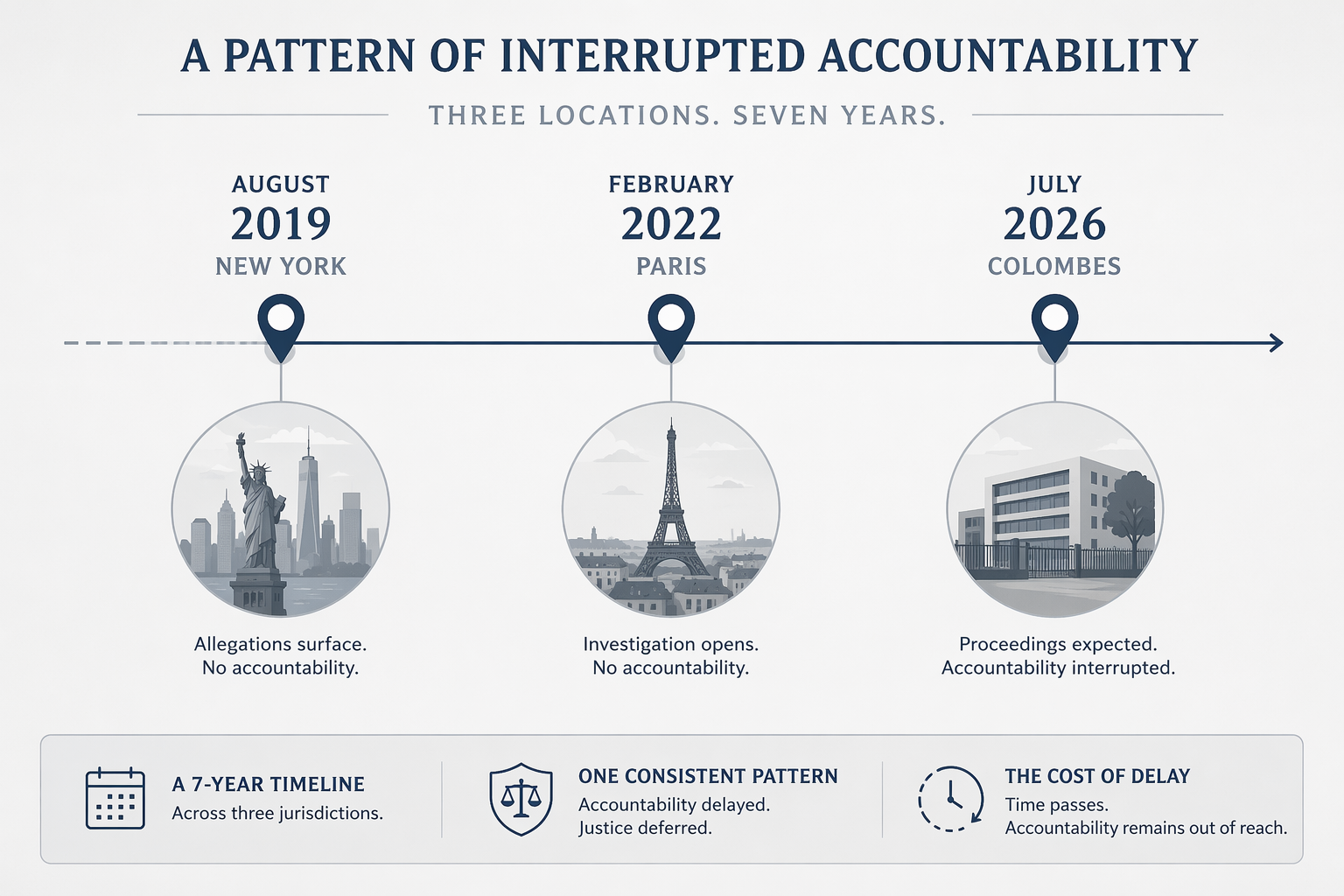
Epstein died by suicide in August 2019 at the Metropolitan Correctional Center in New York while awaiting trial. Two guards were later charged with filing false records, a fact that supports a discussion about custodial failure and institutional recordkeeping, not a shortcut to broader conclusions unsupported by evidence.[6]
Brunel, the French modeling agent accused of rape and trafficking-related conduct, was found hanged in February 2022 in Paris’s Santé prison after 14 months of preventive detention. His lawyers demanded an investigation into the circumstances of his death.[7]
Siad’s case is different in an important way: he died at home, not in custody. That makes the custodial-safety question less direct than in Epstein’s and Brunel’s deaths. The institutional question in Siad’s case is more about investigative timing, suspect monitoring, and whether authorities moved with enough urgency once complaints and file references made his testimony plainly relevant.
A pattern can be troubling without being conspiratorial. Epstein’s death interrupted a U.S. prosecution. Brunel’s death interrupted a French prosecution process after detention. Siad’s death interrupted the possibility of first formal questioning in a French investigation. The common feature is not proven coordination. It is the repeated disappearance of live testimony from men positioned near central allegations.
The unresolved questions now facing French authorities
The first question is chronological: what investigative steps were taken between the February complaints and Siad’s death on July 20? If he was not formally questioned, was he scheduled to be questioned? Were investigators waiting for documentary review, witness consolidation, translation, jurisdictional coordination, or prosecutorial authorization? Delay can have reasons. The public record, as of July 22, does not yet show them.
The second question is prioritization. When a person appears repeatedly in source files and is identified by complainants, how do magistrates decide when to secure that person’s testimony? A 3.5 million-file review is enormous; no serious investigation can process it instantly.[3] But volume is also why triage matters. The existence of a massive archive does not eliminate the need to act on living witnesses and suspects while they remain available.
The third question is communication with civil parties. Victims and their lawyers do not control the state’s criminal investigation. Still, civil-party participation has procedural significance in France, and complaints of inaction become harder to dismiss when the person whose questioning was sought dies before investigators obtain his account.
The fourth question concerns the death investigation itself. The Nanterre prosecutor’s office will need to establish cause and circumstances with enough clarity to separate medical fact from rumor. That does not require theatrical disclosure. It does require enough procedural transparency to avoid letting uncertainty become the dominant public record.
For complainants, the case changes shape rather than ends
The complainants lose the possibility of seeing Siad answer in a criminal process directed at him. They do not lose every legal avenue. Civil claims against an estate may remain possible, and civil-party status in the broader Epstein-related investigations may allow continued participation as magistrates examine other evidence and other possible actors.[2][5]
The practical burden now shifts toward documents, corroborating witnesses, financial or travel records, prior statements, media interviews, and any evidence that does not depend on Siad’s future testimony. His public denials remain part of the record, but they are no substitute for formal questioning. They were not taken under the same conditions, with the same procedural consequences, or with the same access to investigative files.
That is why the death is procedurally devastating even if no foul play is ever found. Criminal investigations are not only about final verdicts. They are also about preserving opportunities to ask questions while answers are still legally obtainable.
Where the record stands on July 22, 2026
Siad had denied wrongdoing. He had not been placed under mise en examen. The cause of death remained unconfirmed pending autopsy. The death investigation was ongoing. The number of complainants varied by source, with Reuters reporting at least five and BBC reporting six represented by Anne-Claire Le Jeune.[1][2]
The broader French Epstein investigation continues through the magistrate-led framework inquiries and the review of the 3.5 million-file release.[3] What cannot continue is a criminal case against Siad personally toward a posthumous trial. What cannot be recovered is his formal account under investigation conditions.
That is the legal consequence now visible without guessing at the autopsy or inventing a motive. Daniel Siad’s death is a serious procedural loss and part of a documented, troubling pattern of interrupted accountability around Epstein-linked figures. It does not end the French investigation, and it does not erase victims’ civil or civil-party options. It does leave French authorities with a narrower record, angrier complainants, and an unavoidable question about why a man this visible was still unexamined when his testimony disappeared.
References
- Reuters report on Daniel Siad’s death and procedural status, Reuters.
- BBC report on Daniel Siad complainants and victims’ lawyers’ criticism, BBC.
- Le Monde report on French Epstein framework investigations and file review, Le Monde, February 2026.
- CNN interview and reporting on Daniel Siad’s denials and Epstein file references, CNN, spring 2026.
- French criminal procedure rules on extinction of public criminal action and civil-party participation, French Code of Criminal Procedure.
- Reuters and BBC reporting on Jeffrey Epstein’s 2019 jail death and guard false-records charges, Reuters and BBC.
- Le Monde report on Jean-Luc Brunel’s 2022 prison death, Le Monde, February 2022.
Comments
Join the discussion with an anonymous comment.