
The investigations into rape and trafficking allegations involving Daniel Siad are now a two-country criminal matter, but not yet a charged case. In France, prosecutors have widened an existing Epstein-related probe after the February 2026 release of U.S. Department of Justice Epstein files that placed Siad, a French model scout, in an unusually dense documentary trail. The Guardian reported that the release contained more than 1,000 emails involving Siad; Hindustan Times, using a different count, put the figure at at least 1,884 documents mentioning him.[1][2] In Poland, prosecutors have opened a separate inquiry into Epstein’s links to the country.[3]
The current posture matters because the public record has moved past rumor but has not reached indictment. Swedish model Ebba Karlsson filed a rape complaint in Paris after recognizing Siad in the released Epstein files, French prosecutors have reported that around 10 new victims came forward, and investigators have carried out a raid connected to the widened French probe.[4][5][6] Those are serious procedural facts. They are not the same thing as proof of rape, proof of trafficking, or a prosecutable case.

What Has Changed Since the Epstein Files Release
The February 2026 release appears to have changed the investigative landscape in three ways. First, it gave complainants and reporters a searchable archive that could connect names, dates, social circles, and introductions. Second, it gave French prosecutors a documentary basis to widen an Epstein-related inquiry that had already existed. Third, it gave Polish authorities enough material to open their own investigation into Epstein’s Poland links.[1][3][6]
The French side is the more developed record. The case now includes Karlsson’s formal Paris complaint, reported new victim accounts, and a prosecutorial raid at the former institute of Jack Lang as part of the widened probe.[4][5][6] Poland’s inquiry is important because it gives the matter a second jurisdiction, but the public material cited here does not yet identify charges, suspects charged in Poland, or a detailed factual theory comparable to the French allegations.[3]
| Jurisdiction | Publicly reported procedural step | What it does and does not show |
|---|---|---|
| France | Existing Epstein-related probe widened; Karlsson filed a Paris rape complaint; prosecutors reported around 10 new victims; investigators conducted a raid. | Shows active investigative movement and complainant participation. Does not show that Siad has been charged. |
| Poland | Prosecutors opened an investigation into Epstein’s Poland links. | Shows a separate national inquiry. Public sources cited here do not yet provide detailed allegations or charging status. |
The Emails Are Evidence, but Not the Whole Case
The most concrete material in the public record is the email traffic reported by The Guardian. Its account describes Siad writing to Jean-Luc Brunel about young models and using language such as “amazing beauty” and “a gift.”[1] That wording is not legally neutral in this context. It sits inside a known Epstein-Brunel orbit, and it appears to document a system in which young women were discussed as access, opportunity, or supply.
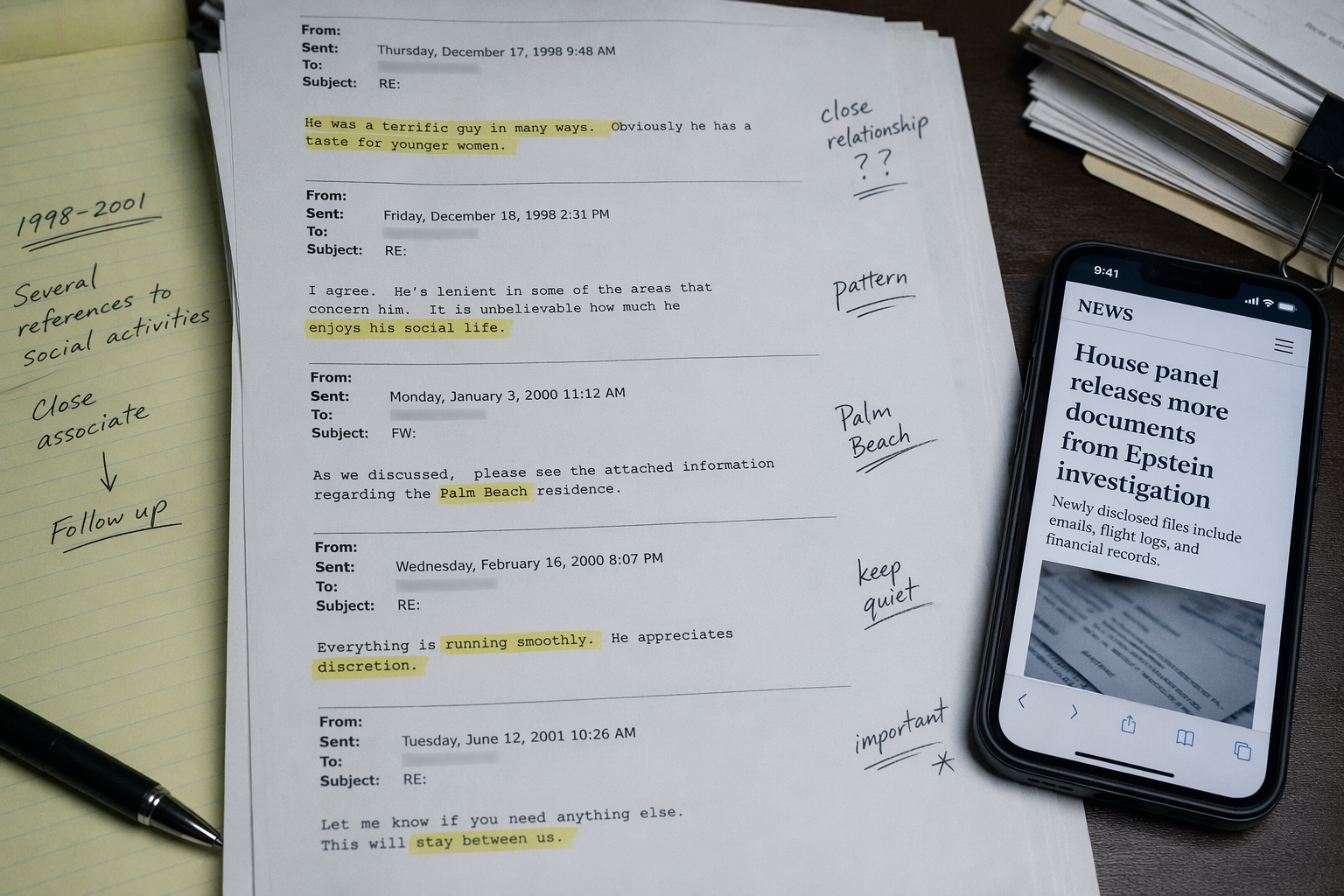
Still, the emails have to be handled for what they can prove. They may help establish relationships, introductions, knowledge, intent, patterns of recruitment, or the credibility of a complainant who later identifies names through the archive. They do not automatically prove a completed rape. They do not automatically prove trafficking. And unless a particular email ties a particular person to a particular act in a chargeable place and time, it remains part of the evidentiary architecture rather than the case itself.
That distinction is not a defense of Siad. It is the difference between exposure and prosecution. The email archive can make old allegations newly legible. It can also make weak procedural theories look stronger than they are if document volume is treated as a substitute for admissible proof. The competing counts — more than 1,000 emails in The Guardian and at least 1,884 documents in Hindustan Times — should therefore be attributed, not blended into a single escalating number.[1][2]
Karlsson’s Complaint Gives the French File Its Sharpest Legal Point
Karlsson’s complaint is the most direct legal trigger in the public record. Le Monde reported that she filed a complaint in Paris after recognizing the man she says raped her in the Epstein files.[4] France24 also reported on Karlsson and Siad, describing him as a modeling scout with close ties to Epstein.[7] The fact that a complainant used newly released documents to identify an alleged assailant is materially different from a general allegation that an archive contains troubling names.
A formal complaint does several things. It identifies an alleged victim, an alleged perpetrator, and a claimed offense. It gives investigators an account to test against records, travel, witnesses, correspondence, and prior statements. It may also allow prosecutors to place old documentary material into a live procedural file. But it remains a complaint unless and until prosecutors or investigating judges take further charging steps.
The reported timing is also hard. The core allegation attributed to Karlsson concerns a rape said to have occurred in 1990.[4] That date is not a background detail; it may determine whether French authorities can prosecute the alleged offense at all.
The Reported Victim Accounts Broaden the Inquiry, With Different Legal Weight
The Paris prosecutor’s report that around 10 new victims had come forward is significant, but the number should not be made to carry more than it can.[5] “Victims came forward” can mean accounts of different conduct, different dates, different jurisdictions, different ages, and different degrees of corroboration. Some accounts may support rape allegations. Others may support grooming, recruitment, trafficking theories, witness evidence, or pattern evidence. Some may be too old or too geographically distant to prosecute in France.
France24 separately reported in May 2026 that a former model accused Siad of grooming her for Epstein.[8] That account is important because grooming allegations may illuminate how access was allegedly created, who controlled introductions, and whether modeling opportunities were used as a route toward sexual exploitation. They are not the same allegation as Karlsson’s rape complaint, and collapsing them would make the file seem cleaner than it is.
CNN’s June 2026 reporting adds another layer because it included direct reporting on Siad and on how model-scout practices operated around Epstein’s fashion-world connections.[9] CNN’s published material should be treated as reporting, not as a transcript of the full interview. Its value is in describing the recruitment environment and Siad’s place in it; any legally decisive admission would need to be assessed from the exact published words and the underlying record.
Why the French Statute of Limitations May Decide the Rape Allegation
The French limitation problem is not procedural housekeeping. If the alleged rape occurred in 1990 and the applicable adult-rape limitation period was 10 years under the law then in force, the period may have expired around 2000 unless a tolling rule, interruption, reclassification, continuing-offense theory, minority-related provision, or other procedural route applies. The research available here flags that issue through secondary legal commentary, not through a definitive analysis of the French Code de procédure pénale as applied to Karlsson’s complaint.

That uncertainty leaves several questions that prosecutors cannot avoid. What precise offense is being investigated? What was the complainant’s age at the time? Which limitation period applied in 1990? Did any act interrupt prescription? Can later-discovered documents affect admissibility or proof without reviving an expired prosecution period? Are there other alleged acts within a still-open period? None of the cited public sources resolves those questions.
New evidence often changes what investigators can see. It does not automatically change what the state is allowed to prosecute. That is why the Epstein files can be both transformative and legally insufficient. They may identify alleged perpetrators, corroborate networks, and explain why a complainant recognized a name decades later. If prescription has run on a specific rape allegation, however, that evidentiary improvement may arrive too late for a criminal charge on that offense.
The Raid Shows Movement, Not an Outcome
The raid reported by Euronews at Jack Lang’s former institute belongs in the procedural column.[6] It shows that French authorities are not merely receiving complaints; they are taking investigative steps within the widened Epstein probe. A search can locate documents, devices, correspondence, calendars, visitor records, or institutional files. It may also come up empty or produce material that is useful only as background.
There is a temptation in Epstein-related cases to turn every famous-adjacent location into a symbolic scene. That is not useful here. The legal question is narrower: did the raid produce evidence that connects Siad, Epstein, Brunel, alleged victims, and alleged conduct in a way that survives jurisdiction, limitation periods, and admissibility? Public reporting has not yet answered that.
Poland’s Inquiry Is Real but Still Thinly Described
Polish prosecutors’ investigation into Epstein’s Poland links gives the matter a second national track.[3] That matters because cross-border abuse and trafficking allegations often depend on movement: where people were recruited, where they traveled, where meetings occurred, where records were kept, and which authorities can compel evidence.
But Poland’s publicly reported role remains less developed than France’s. The available source confirms an inquiry into Epstein’s Poland links; it does not, on its own, establish a Polish charge against Siad, a Polish complainant, a named trafficking count, or a completed theory of jurisdiction.[3] The safer conclusion is that Poland has opened a potentially important parallel investigation whose factual reach is still not public.
Where the Case Stands in Q3 2026
As of Q3 2026, the public record supports a restrained but serious conclusion. The Epstein files have materially changed the investigative environment around Daniel Siad. They helped surface a formal rape complaint in Paris, prompted French prosecutors to widen an Epstein-related probe, coincided with reports of around 10 new victims coming forward, and led to a separate Polish inquiry into Epstein’s links to Poland.[3][4][5][6]
The same record does not confirm that Siad has been charged in France or Poland. It does not prove that every reported account is legally actionable. It does not resolve the French prescription problem for alleged conduct dating to 1990. For the most serious French rape allegation, that may be the decisive distance between a complaint that deserves investigation and a prosecution the law still permits.
References
- Really a lot of amazing beauty: emails show how model scout connected Epstein with young women, The Guardian, Feb. 26, 2026
- Who is Daniel Siad? Epstein trafficker's photo with Woody Allen, emails with Jean-Luc Brunel viral, Hindustan Times
- Poland launches investigation into Epstein files, TVP World, Feb. 2026
- Swedish woman files complaint in Paris after recognizing rapist in Epstein files, Le Monde, Feb. 10, 2026
- New Epstein victims turn up in French probe — prosecutor, DW
- French prosecutors widen Epstein probe with raid on Jack Lang's former institute, Euronews, Feb. 16, 2026
- Daniel Siad, the modelling scout with close ties to Epstein, France24, Feb. 11, 2026
- Former model accuses French scout of grooming her for Epstein, France24, May 5, 2026
- She's a gift: How Epstein exploited his fashion world connections, CNN, June 13, 2026
Comments
Join the discussion with an anonymous comment.