
The live problem in the David Allan Coe probate case is not whether his will sounded final. It did. The problem is that the estate now sits under a creditor deadline with reported assets of roughly $500,000 to $1.5 million, two support claims that already totaled $735,702.82 as of March 2017 before asserted 12% annual compounding interest, and a separate federal restitution obligation reported at about $981,000. On those numbers, the estate appears likely insolvent before the probate court even finishes identifying the full creditor pool.
As of July 21, 2026, the Hamilton County matter remains open. Coe died on April 29, 2026, the estate was opened on June 9, Kimberly Hastings Coe was appointed executor on June 26, and the key creditor-claims date still ahead is October 29, 2026.[1] That date matters more than most public-facing accounts of a celebrity estate tend to admit. Until the six-month claims window closes, the court does not yet have the final liability universe it must classify, allow, reject, or pay.
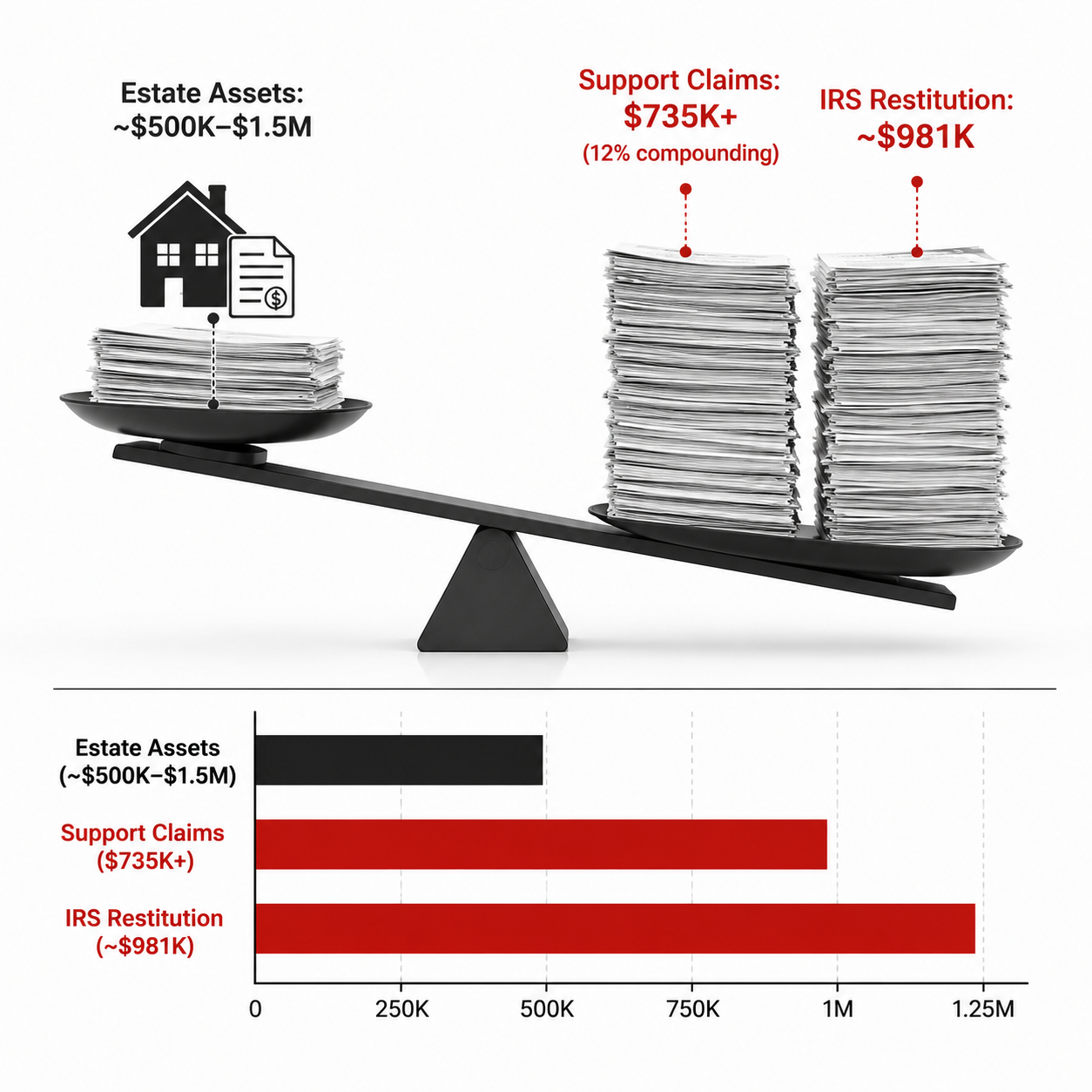
The imbalance is already visible
The two support claims filed July 14 are the center of the current estate dispute. Jody Lynn Coe filed one claim for delinquent child support of $540,820.72 as of March 2017, plus 12% annual interest compounded after that date, and a second claim for spousal support of $194,882.10 as of March 2017, again plus 12% annual compounding interest.[2][3] The probate docket confirms two claims filed that day, although the original claim PDFs were not directly reviewed for this article; the dollar figures and interest assertions come from journalistic summaries of the court filings.
Even before interest, those support claims exceed $735,000. The interest allegation is not decorative. If allowed as asserted, it would move the support-debt figure well past the face amounts reported from 2017. The estate must also be viewed against Coe’s federal tax case: in 2016 he pleaded guilty to obstructing the IRS after failing to file tax returns for 2009 through 2013, and the government said he owed approximately $981,000 in restitution.[4] He later served 18 months in federal prison in connection with that case.[5]
The public asset estimates are less sturdy than the docketed dates and filed claims. Celebrity Net Worth places Coe’s net worth at $500,000, while Hollywood Life has reported a $1.5 million estimate.[6][7] Those figures should not be mistaken for a probate inventory. They are useful only as a working range, and only because the range points in the same direction either way: the known debt stack appears to outrun the likely estate value.
| Item | Reported amount or date | Why it matters |
|---|---|---|
| Estimated estate value | $500,000 to $1.5 million | A working public range, not a court inventory |
| Child-support claim | $540,820.72 as of March 2017, plus asserted 12% annual compounding interest | A filed creditor claim, not a request to inherit under the will |
| Spousal-support claim | $194,882.10 as of March 2017, plus asserted 12% annual compounding interest | Part of the same support-debt pressure on the estate |
| Federal restitution | Approximately $981,000 | Adds another major creditor issue to an already strained estate |
| Creditor deadline | October 29, 2026 | The date that frames the full claims universe |
The will clause does less work than it seems to
Coe’s will, signed November 25, 2025, reportedly states: “I have intentionally not provided for any of my children or their heirs in this Last Will & Testament, and their omission is not the result of accident or oversight.”[2] That language matters. It is the kind of clause a drafter uses to make clear that an omitted child was not accidentally forgotten.
But it does not answer the support claims. A disinheritance clause addresses who takes as a beneficiary under the will. It does not, by itself, extinguish obligations that already existed outside the will. If a claimant is trying to receive a testamentary gift, the clause is central. If a claimant is trying to enforce unpaid support as a debt of the decedent, the inquiry moves to allowance, proof, priority, limitations, interest, and available assets.
That distinction is easy to lose in a public estate story because “children cut out of will” is legible in a way “support arrearage filed as probate claim” is not. The filings reported so far are better understood as creditor activity. Jody Lynn Coe is not merely asking the probate court to rewrite the will’s family-distribution plan; she is asserting that the estate remains liable for support amounts that existed before death.
The family history still matters at the proof level. Support orders, divorce documents, any judgments, prior enforcement efforts, payment credits, accrued interest, and the identity of obligees will all shape what is actually allowed. But the will’s exclusionary language is not the controlling obstacle if the claims are enforceable debts.
The probate calendar is doing real work
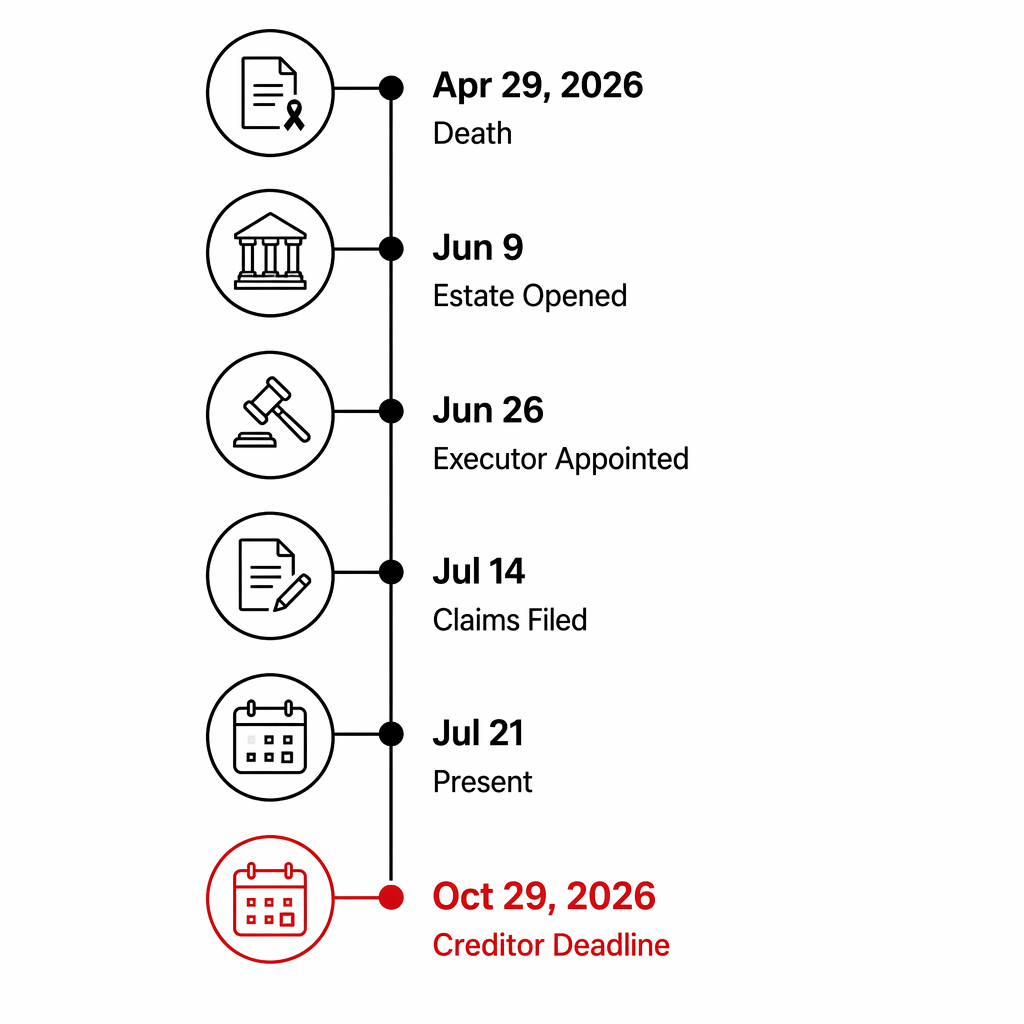
The useful timeline is short, and it is procedural:
| Date | Event |
|---|---|
| April 29, 2026 | David Allan Coe died at age 86 |
| June 9, 2026 | Estate opened in Hamilton County Probate Court |
| June 26, 2026 | Kimberly Hastings Coe appointed executor |
| July 14, 2026 | Two support claims filed |
| July 21, 2026 | Case remains open and creditor period remains active |
| October 29, 2026 | Creditor-claims deadline |
Ohio’s creditor-claim statute supplies the October date. Under Ohio Revised Code 2117.06, claims against an estate generally must be presented within six months after the decedent’s death; the Hamilton County case detail identifies October 29, 2026, as the creditor-claims deadline in this estate.[1][8] That deadline is not a mere administrative bookmark. It determines who gets into the claims process at all, subject to the statute’s requirements and any claim-specific issues.
For the executor, the timing creates a practical bind. Kimberly Hastings Coe is serving as executor of an estate that appears to face large support claims, possible federal debt pressure, and a will that favors neither children nor their heirs. Her task is not to vindicate the decedent’s public image or to make the family history coherent. It is to administer the estate under probate rules: identify assets, evaluate claims, preserve objections where appropriate, classify liabilities, and distribute only as the court and statute permit.
That is where celebrity coverage often misreads the assignment. The estate representative is not simply choosing sides in a family fight. If the estate is insolvent, every allowance decision and priority classification can affect another creditor’s recovery. A dollar paid to one claimant may be a dollar unavailable to another claimant of equal or lower priority.
Why priority matters when there may not be enough money
In a solvent estate, classification disputes can still matter, but they do not usually determine whether a valid creditor receives anything. In an insolvent estate, priority is the case. Ohio Revised Code 2117.25 sets a ten-class order for payment of estate debts, with higher classes paid before lower classes.[9] If assets run out before a lower class is reached, valid claims in that lower class may receive reduced payment or no payment.
The exact classification of the support arrearage claims is one of the unresolved legal points to watch. The statute does not expressly name domestic support arrearages among the higher enumerated classes described in the research record, which suggests that the claims may fall into the general unsecured category unless another basis for priority exists. That conclusion should be held carefully. If any support amounts were reduced to judgment, secured by lien, or otherwise given a status not yet visible in the public summaries, the priority analysis could change.
The IRS restitution debt introduces additional pressure. The federal tax case is not a side anecdote; it may affect the payment landscape if the government has an enforceable claim and priority position. The available materials establish the 2016 guilty plea, the failure to file returns from 2009 to 2013, and the roughly $981,000 restitution figure.[4] They do not, standing alone, establish exactly how that debt will be presented, classified, or paid in the Hamilton County estate.
That distinction is not fussy. It is the difference between knowing that a liability exists and knowing where it lands in the probate payment order. The estate may be insolvent either way, but the distribution mechanics depend on claim presentation, objections, allowed amounts, and priority rulings.
The support claims will turn on proof, not publicity
The reported support figures are precise enough to frame the dispute but not enough to finish it. A claim for $540,820.72 in delinquent child support as of March 2017 plus 12% annual compounding interest will invite questions about the source order, the accounting period, payment history, interest authority, and whether the claimed compounding rate is enforceable in probate.[2][3] The spousal-support claim raises the same kind of questions, though from a different obligation source.
Those proof questions do not make the claims weak. They make them probate claims. Executors review, allow, reject, or negotiate claims based on documentation and legal status. Creditors then preserve rights through the procedures Ohio law supplies. The docket date tells us the claims were filed; the reported amounts tell us why they matter; the court process will decide what is allowed and in what priority.
There is also a reporting caveat around the family structure. Some accounts describe legal documents referring to eight children, while other reporting has used “at least five.” The difference may turn on whether stepchildren or other family relationships are being counted. Nothing in the present analysis requires resolving that discrepancy. The operative issue is narrower: surviving children from multiple marriages were expressly excluded by the will, while support-related claims have now been filed against the estate.
Possible next moves before October 29
Between July 21 and October 29, the estate can still change shape. Additional creditors may appear. Existing claimants may supplement documentation. The executor may object to claims in whole or in part. The probate court may eventually need to resolve allowance, interest, classification, and payment issues. A will contest or a surviving-spouse election issue could also emerge, though the present record supplied for this analysis does not establish that either has been filed.
The known facts already make one conclusion hard to avoid. The reported asset range cannot comfortably absorb the two support claims even before post-2017 compounding is accounted for, and it looks still less capable of absorbing those claims plus the roughly $981,000 federal restitution debt. That is not a prediction of exact distributions. It is an insolvency reading based on the claim amounts now in view.
The disinheritance clause will remain an important estate-planning fact, especially if anyone asserts a beneficiary-based theory. But for the filed support claims, the sharper question is whether enforceable obligations survived Coe’s death and can be allowed against the estate. Testamentary freedom does not normally include the freedom to make valid debts disappear by omitting creditors from a will.
As of July 21, 2026, the David Allan Coe estate dispute is therefore less a fight over outlaw-country mythology than a creditor-priority problem in an apparently underfunded probate. The October 29, 2026 deadline is the next date that will tell the court, the executor, and the claimants how crowded that problem really is.
References
- Case Detail, Hamilton County Probate Court
- David Allan Coe’s Kids File Claim Against His Estate Over Unpaid Child Support, Taste of Country
- Country icon’s kids vow to make estate pay for family obligations he ‘walked away from’, AL.com, July 2026
- Country music star pleads guilty to obstructing the IRS, U.S. Department of Justice
- David Allan Coe Sentenced to Prison for Income Tax Evasion, The Boot
- David Allan Coe Net Worth, Celebrity Net Worth
- David Allan Coe Net Worth, Hollywood Life
- Section 2117.06 | Presentation and allowance of creditor claims, Ohio Revised Code
- Section 2117.25 | Order in which debts to be paid, Ohio Revised Code
Comments
Join the discussion with an anonymous comment.