
The unsettling fact in the Brouillette case is not that warnings existed. It is that one part of the system reportedly returned a clean criminal history while another part kept producing page after page of civil family-court material: protective orders, abuse allegations, repeated threats, and a voicemail threatening to slit an ex-wife's throat. The Maine Department of Public Safety check found no criminal records for David Brouillette, even as Augusta District Court files held the paper trail that family members later said should have changed the answer. [1][2]

The clean check and the civil file
The family-court record described far more than a single accusation. Reporting said the file included allegations that Brouillette tackled and dragged a teenage daughter, smashed spaghetti in her hair, and called an ex-wife nearly 200 times in two days. The same reporting described a 2021 temporary protective order that stripped him of his firearms based on allegations by his second ex-wife. [2]
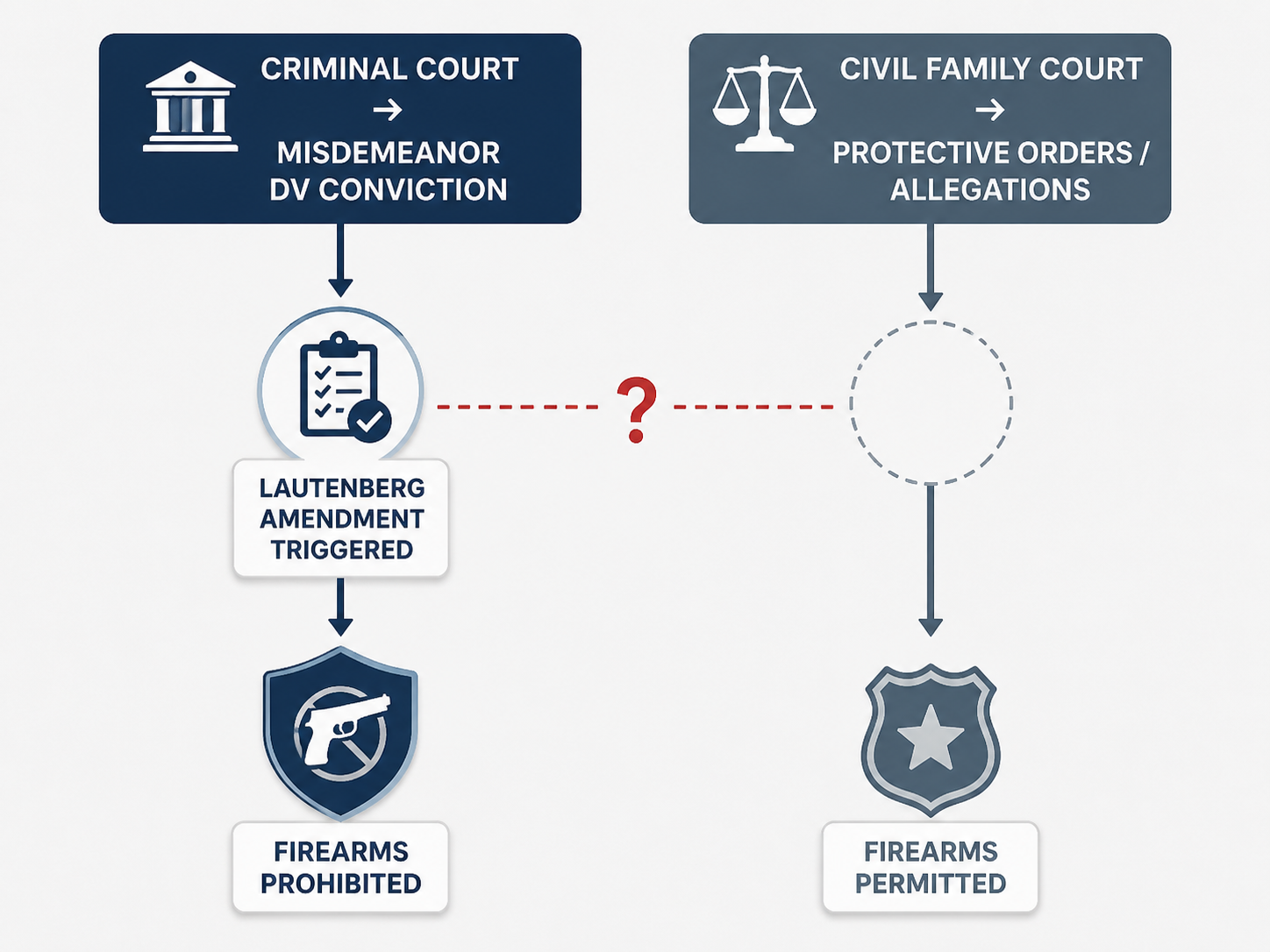
That matters because the relevant federal firearms rule is not built around civil family-court warnings. The Lautenberg Amendment turns on a misdemeanor domestic-violence conviction, so a person can generate a substantial civil record and still avoid the statutory trigger if the conduct never becomes a qualifying criminal case. In this case, the legal trouble sat in the wrong file for the check that appears to have been used. [4]
Ashley Brouillette told NPR that during their 2009 divorce she tried to warn military superiors about his mental-health issues and was brushed off as a 'petty ex-wife.' Lucinda Brouillette gave her own warning to the Boston Globe: 'I have feared for a long time that his anger, aggression, and escalating behavior would eventually result in severe, life threatening violence.' The point is not that one account explains everything. It is that multiple warnings lived in places where a criminal-record check could pass straight past them. [3][2]
Why the federal screen never tripped
ICE has a published Lautenberg Amendment compliance policy, but the case suggests that the hiring and screening process did not surface the civil family-court material at issue here. That is the administrative gap: the agency can comply with a conviction-based disqualification rule and still miss a person whose documented violence lives outside the criminal channels the rule is designed to catch. [4][1]
That should not be confused with proof about the July 13 shooting itself. Brouillette has not been charged in relation to the shooting, and ICE has not officially confirmed him as the officer involved. A July 16, 2026 protective-order petition by Lucinda Brouillette was also denied after a judge found insufficient evidence of immediate and present danger. [1][2]
The Brouillette case is therefore less a failure of one dramatic warning than a failure of routing. Protective orders, allegations, and civil firearm restrictions were all present in one legal track, while the conviction-based federal bar waited in another. For anyone who reads court systems for the places where danger gets translated into action, that split is the story. [1][2][4]
References
- Report on David Brouillette and the Maine shooting, Associated Press
- ICE agent's second ex-wife and the family-court record, The Boston Globe
- Maine ICE shooting and Brouillette background, NPR
- Domestic Violence/Lautenberg Amendment Compliance Policy, ICE
Comments
Join the discussion with an anonymous comment.