
The current David Hearn trial date in 2026 is Sept. 28, with a readiness hearing set for Sept. 11 before D.C. Superior Court Judge Todd Edelman; like any criminal trial date, it can move if the court grants a continuance or another motion changes the posture of the case. Hearn, a former U.S. Olympic canoeist, has pleaded not guilty in the Lincoln Memorial Reflecting Pool case, but the trial calendar is only the first answer. The more important one is why this case is being treated as a felony at all. [1]
Under D.C. Code § 22-303, the line between misdemeanor and felony destruction of property turns on value: damage of $1,000 or more can support the felony charge, while damage below that amount is treated as a misdemeanor. The reported exposure tracks that divide sharply: up to 10 years for the felony, compared with up to 180 days for the misdemeanor. [2]

That means the September trial is unlikely to be a general referendum on whether the Reflecting Pool is important, whether the blue coating looked damaged, or whether public officials were angry about it. For the felony count, the government needs a narrower showing: that the damage legally attributable to Hearn reaches the $1,000 threshold.
The felony charge depends on a repair number, not just a damaged surface
Property-damage thresholds often sound clerical until they decide the seriousness of the charge. Here, the number is doing real work. If jurors accept that the relevant repair cost is $1,000 or more, the felony theory remains available. If the government cannot prove that amount beyond the necessary legal standard, the case looks materially different.
Prosecutors reportedly plan to use an expert witness to establish that repairing the alleged damage would cost more than $1,000. [3] That is not a court finding yet. It is the government’s anticipated proof. The distinction matters because valuation testimony can be attacked in several ways: what repair was priced, whether that repair was necessary because of this defendant’s conduct, whether the estimate includes broader work, and whether the underlying condition was already defective.
The physical allegation is small in scale. Hearn is accused of damaging approximately two square feet of sealant with his bare hands, with no tools used. [4] That does not automatically make the repair cheap. Public-property repairs can involve mobilization costs, specialized materials, contractor minimums, site restrictions, or preservation requirements. A small patch can still carry a large invoice. But the reverse is also true: a large institutional repair estimate does not automatically prove that this defendant caused $1,000 or more in legally cognizable damage.
The useful question is not whether “two square feet” sounds trivial. It is what the expert is valuing. If the estimate prices a discrete repair to a discrete area allegedly pulled loose by Hearn, the government’s theory is cleaner. If the estimate folds in surface preparation, replacement of already-failing coating, broader contractor work, or repairs that would have been needed anyway, the defense has a more obvious causation and attribution argument.
The pool’s pre-existing condition gives the defense something concrete to test
The renovation history is not a side issue if the government’s felony theory depends on repair value. CNBC reported that the broader Reflecting Pool renovation had already become a troubled project: an initial estimate of $1.5 million to $1.8 million had grown to more than $16 million, the blue coating was peeling throughout the pool, and algae blooms had plagued the project. [5]
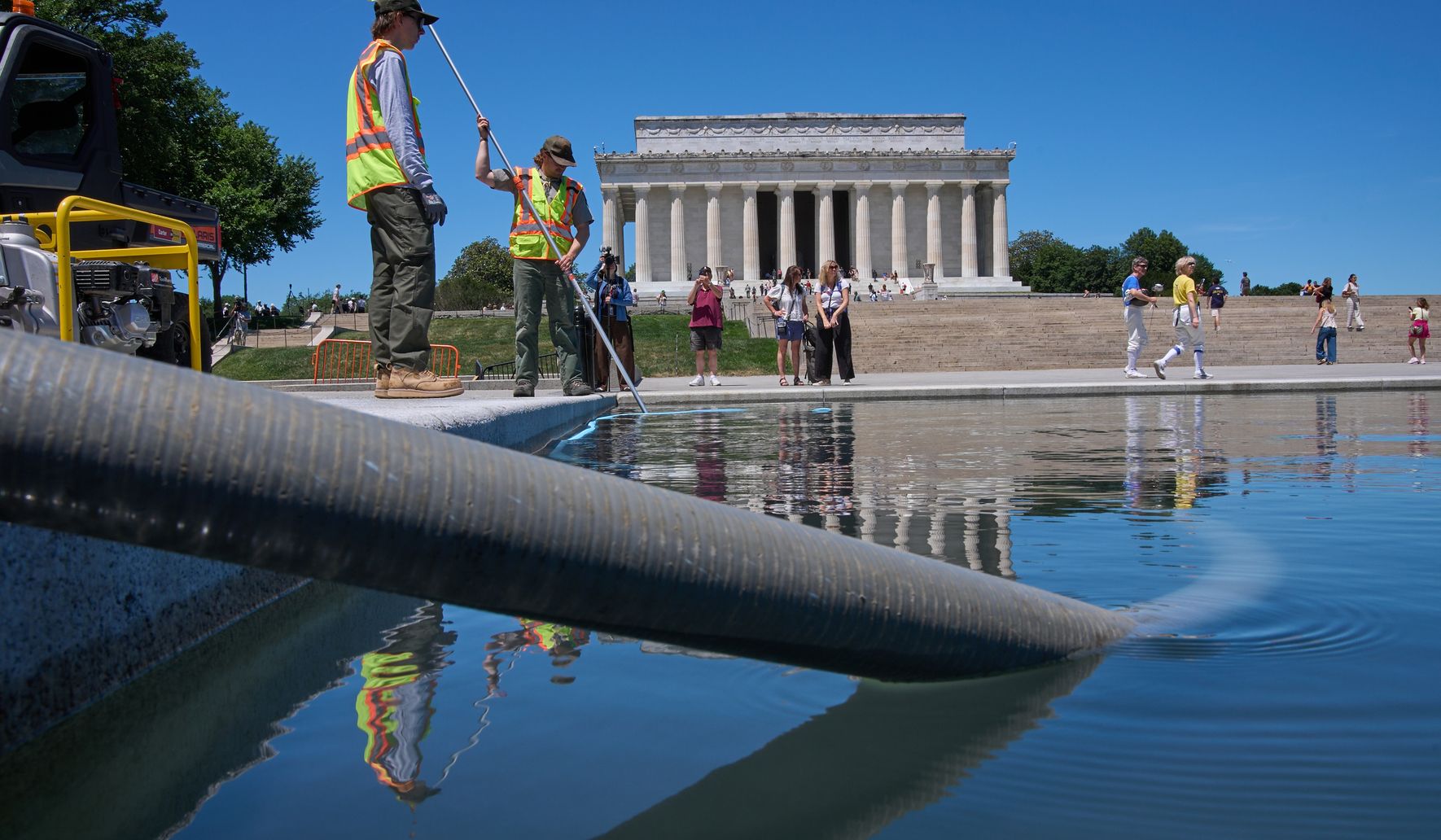
Those facts do not prove that Hearn did nothing. They also do not prove that any damage he caused was worth less than $1,000. They do, however, make the valuation contestable in a way that a clean, newly intact surface would not. When coating is already peeling throughout a project, the jury may have to separate new damage from pre-existing failure rather than simply price whatever work the government says followed the incident.
That separation is where expert testimony can become vulnerable. A repair professional may be able to explain that even detached or failing material must be fixed through a process that costs more than $1,000. But the defense can press whether the claimed cost reflects damage newly caused by Hearn or the expense of correcting a surface that was already coming apart. The felony threshold does not ask whether the pool had expensive problems. It asks whether the charged damage crosses the statutory line.
The lack of tools also matters only in a disciplined way. It is not a complete defense to property damage; bare hands can cause damage. But if the alleged conduct involved pulling or handling sealant that was already detached, the defense can use the no-tools fact to argue that the government is overstating what was newly caused. The more the alleged act resembles removal of loose material from an already-failing coating system, the harder the prosecution may have to work to tie its repair figure to Hearn personally.
What jurors may need to hear from the government’s expert
A persuasive valuation opinion would likely have to do more than announce a total. It would need to identify the damaged area, describe the repair method, explain why that repair was necessary because of the charged conduct, and distinguish defendant-specific work from maintenance or renovation failures that existed before the incident.
| Issue | Why it matters to the felony threshold |
|---|---|
| Scope of repair | A price for a broad pool repair is different from a price for the specific area attributed to Hearn. |
| Condition before the incident | Already-peeling coating may complicate whether the repair cost was newly caused damage. |
| Method and labor assumptions | A small physical area can exceed $1,000 if the repair process reasonably requires specialized work. |
| Exclusions from the estimate | The defense can ask whether the estimate excludes costs that would have been incurred anyway. |
The defense does not need to prove that a two-square-foot sealant repair must be inexpensive in every setting. A narrower attack may be more effective: that this particular estimate does not reliably measure this particular defendant’s damage. That is why the already-failing coating and algae-plagued renovation history are not merely embarrassing background. They go to attribution.
For readers who want the broader element-by-element map of the prosecution, the related analysis of three contested elements in Hearn’s Reflecting Pool charges places valuation alongside malice and causation. In this case, though, valuation is the pressure point that changes the charging category.
The misdemeanor comparison is relevant, but it does not decide the case
The charging-disparity point is hard to ignore. AP reported that at least three other people charged in D.C. Superior Court with removing pieces of paint from the Reflecting Pool were charged with misdemeanors rather than felonies, and all pleaded not guilty. [2]
That comparison does not, by itself, make Hearn’s felony charge legally invalid. Prosecutors can make different charging decisions if the facts, alleged damage, proof, or repair estimates differ. But the comparison gives the defense a practical theme: if similar alleged conduct involving Reflecting Pool coating was treated as misdemeanor-level damage in other cases, why does Hearn’s alleged two-square-foot, bare-hands incident cross the felony line?
The answer may be in the government’s expert valuation. Or the answer may be that the government is stretching a repair number across a factual record that is less tidy than the charge suggests. The misdemeanor cases will not substitute for cross-examination of the expert, but they may sharpen jurors’ attention to the statutory threshold.
The political overlay belongs in that same limited category. Hearn’s legal team includes Norman Eisen, and the Democracy Defenders Fund publicly condemned the indictment as politically motivated. [6] Those claims may explain why the case is receiving attention, but they do not relieve the court of the ordinary evidentiary task: deciding what proof the government may present and whether a jury can find the $1,000 element satisfied.
For additional context on that prosecutorial-discretion issue, see the separate discussion of Hearn’s not guilty plea and the limits of charging discretion.
A separate evidence motion could still affect the path to trial
There is also a procedural track running beside the valuation fight. The defense argued that the government destroyed evidence by draining the pool, but that motion to dismiss was denied without prejudice on July 20, 2026, meaning it could be refiled. [1] That issue could affect the case before jurors ever hear the repair-cost testimony, especially if the defense renews the argument with a fuller record.
Still, the drained-pool issue is not the central merits question. If the case reaches the Sept. 28 trial date without a dispositive procedural ruling or schedule change, the felony count will likely turn on a narrower dispute: whether jurors accept that repairing the specific sealant damage attributed to Hearn exceeds $1,000, despite the pool’s documented pre-existing defects and the government’s different misdemeanor treatment of other people accused of removing Reflecting Pool material.
References
- Ex-Olympian charged with damaging Reflecting Pool gets Sept. 28 trial date, ClickOrlando, July 20, 2026
- Former Olympian pleads not guilty in Reflecting Pool damage case after Trump alleged vandalism, AP News
- Reflecting Pool case: Olympian David Hearn pleads not guilty, CNBC
- U.S. Olympic canoeist David Hearn charged with damaging Lincoln Memorial Reflecting Pool, NBC News
- Democrats probe Trump's troubled $16 million reflecting pool renovation, CNBC
- 07.02.26-pr_2, Democracy Defenders Fund
Comments
Join the discussion with an anonymous comment.