
David Hearn’s not guilty plea in the Reflecting Pool case looked less like the public reckoning promised from a lectern than an ordinary first appearance in a case that still has to survive proof. On July 9, Judge Carmen McLean took the plea, denied the government’s request for a stay-away order, and released Hearn without bail or supervision after a hearing reported to have lasted 13 minutes.[1] That is not an acquittal, and it is not a judicial finding that the prosecution is defective. It is, however, the first place where the case’s public posture met courtroom control.

The difference matters. Outside court, the case had already been given a vocabulary of force, vandalism, and public shame. Inside court, the first concrete government request was narrower: keep Hearn away from the Lincoln Memorial Reflecting Pool. The judge declined it.[1] For a felony property-damage case built around an iconic public site, that procedural result is modest but revealing. Conditions of release are not the trial, yet they often show how much immediate danger or continuing risk the government can persuade a judge actually exists.
Hearn, a former U.S. Olympic kayaker, is charged with one felony count of destruction of property of $1,000 or more under D.C. Code § 22–303. The allegation is not that he destroyed the Lincoln Memorial or drained a monument. The reported factual core is that he removed roughly two square feet of sealant from the Reflecting Pool, sealant that photos reportedly showed was already peeling the day before.[2] That small physical allegation sits awkwardly beside the felony treatment and the political attention the case received.
The case accelerated before the evidence was tested
The compressed timeline is the first reason the case deserves close attention. The National Park Service reported liner damage on June 9. Hearn was arrested on June 19. On June 20, President Trump publicly blamed vandals and claimed, without evidence cited in the available reporting, that fertilizer had been dumped and that the liner had been cut with a box cutter. A grand jury indicted Hearn on July 2.[3]
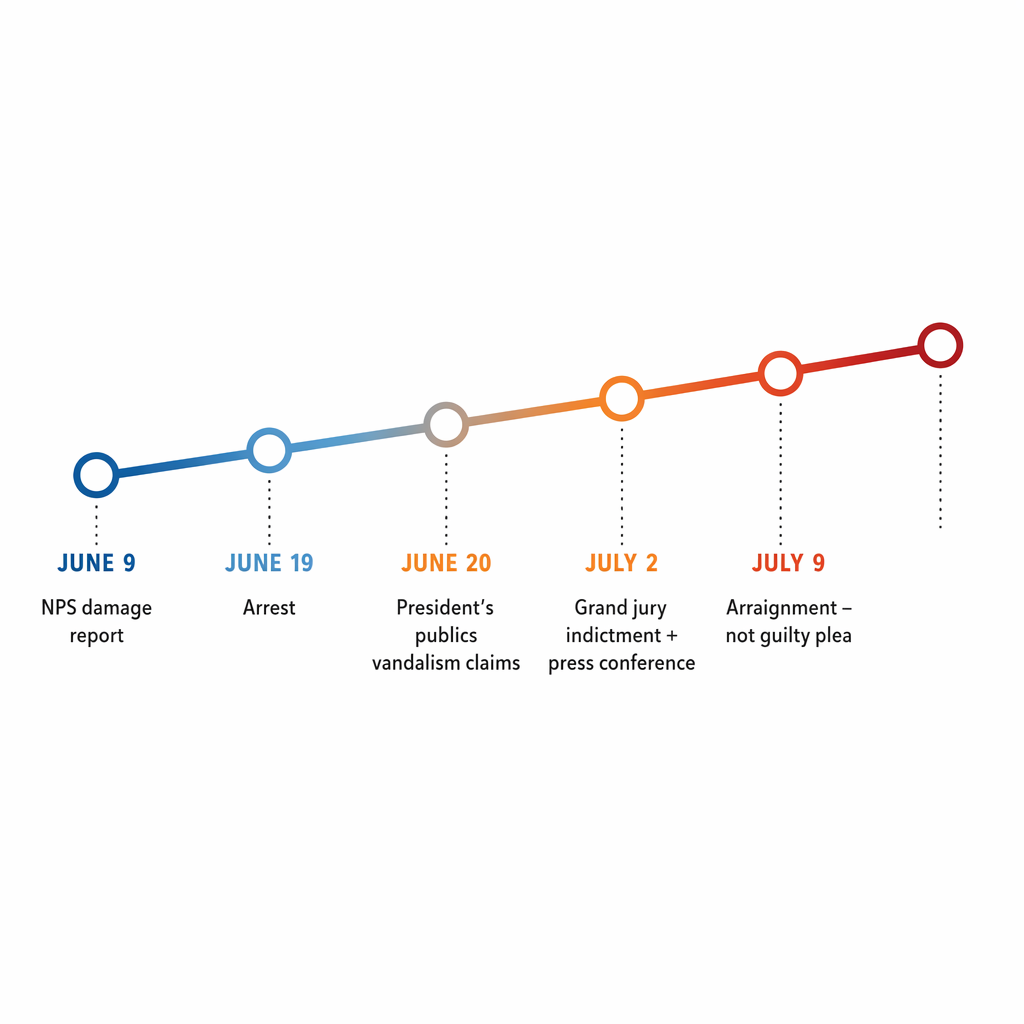
That sequence does not, by itself, prove political interference. Charging decisions often move quickly when public property is involved, and prosecutors are entitled to pursue felony counts where they believe the evidence supports them. But the order of events is still important: the public narrative hardened before the damage theory had been tested in court, and before the government had publicly shown how the alleged act crossed the felony threshold.
The July 2 announcement sharpened that tension. U.S. Attorney Jeanine Pirro described Hearn as having “forcefully and violently” removed sealant from the pool, while available reporting also notes photographs from the day before that showed the sealant already peeling.[2] Those two facts can coexist only if the government can prove that Hearn’s conduct caused legally significant additional damage, not merely that he touched or pulled at material already failing.
The felony count turns on damage, not symbolism
The statute supplies the pressure point. Under the charged theory, the property damage must reach at least $1,000 to support the felony count, which carries a potential penalty of up to 10 years.[2] That threshold is not satisfied by outrage, embarrassment, or the fact that the Reflecting Pool is a nationally recognizable place. The government must connect Hearn’s conduct to damage that meets the statutory amount.
That is where the reported condition of the sealant becomes more than a defense talking point. If photographs from the day before show peeling, then the central question is not whether the pool looked bad afterward. It is what additional harm Hearn allegedly caused, how that harm is measured, and whether the incremental damage attributable to him reaches $1,000. In a property case, causation and valuation do the work that adjectives cannot.
The government may have an answer. It may present repair estimates, expert testimony on liner integrity, or evidence that removing even a small visible portion compromised a larger protective system. None of that can be ruled out from the outside. But the publicly reported theory is thin at precisely the point where a felony requires thickness: bare hands removing already-peeling sealant must become $1,000 or more in legally attributable damage.
Pirro’s response to questions about proving the pool was not already damaged did not add much public clarity. Asked about that issue, she reportedly told reporters to “come to the trial” and repeated that “he damaged this pool.”[4] That may be a defensible litigation posture; prosecutors are not required to preview their expert case at a press conference. But when the office has chosen to make a high-profile announcement, the refusal to explain the evidentiary bridge leaves the felony theory resting publicly on assertion.
| Question | Why it matters |
|---|---|
| Was the sealant already peeling? | Pre-existing deterioration complicates proof that Hearn caused the relevant damage. |
| What damage is attributed specifically to Hearn? | The felony count depends on the defendant’s conduct, not the general condition of the project. |
| How is the $1,000 threshold calculated? | Repair cost, expert assessment, and causation will determine whether the charge fits the statute. |
| Did the alleged removal affect a larger system? | A small visible area could matter more if the government proves broader functional harm. |
The disparity question is harder to brush aside
Charging discretion always includes line-drawing. Not every participant in a related event receives the same charge, and different facts can justify different treatment. Still, the known comparison group makes Hearn’s felony posture conspicuous. Three other named defendants — Sophie Elaine Dennison-Gibby, Justin Toribio Carreno, and Cameron Michael Thiers — were charged with misdemeanors and pleaded not guilty on July 8.[5]
Pirro also referred more broadly to “about a half-dozen” cases connected to the Reflecting Pool.[5] The available record does not establish that all of those defendants did precisely the same thing as Hearn, caused the same alleged damage, or occupied the same evidentiary posture. That caution matters. A disparity is not automatically discrimination, and a felony count is not automatically improper simply because others face misdemeanors.
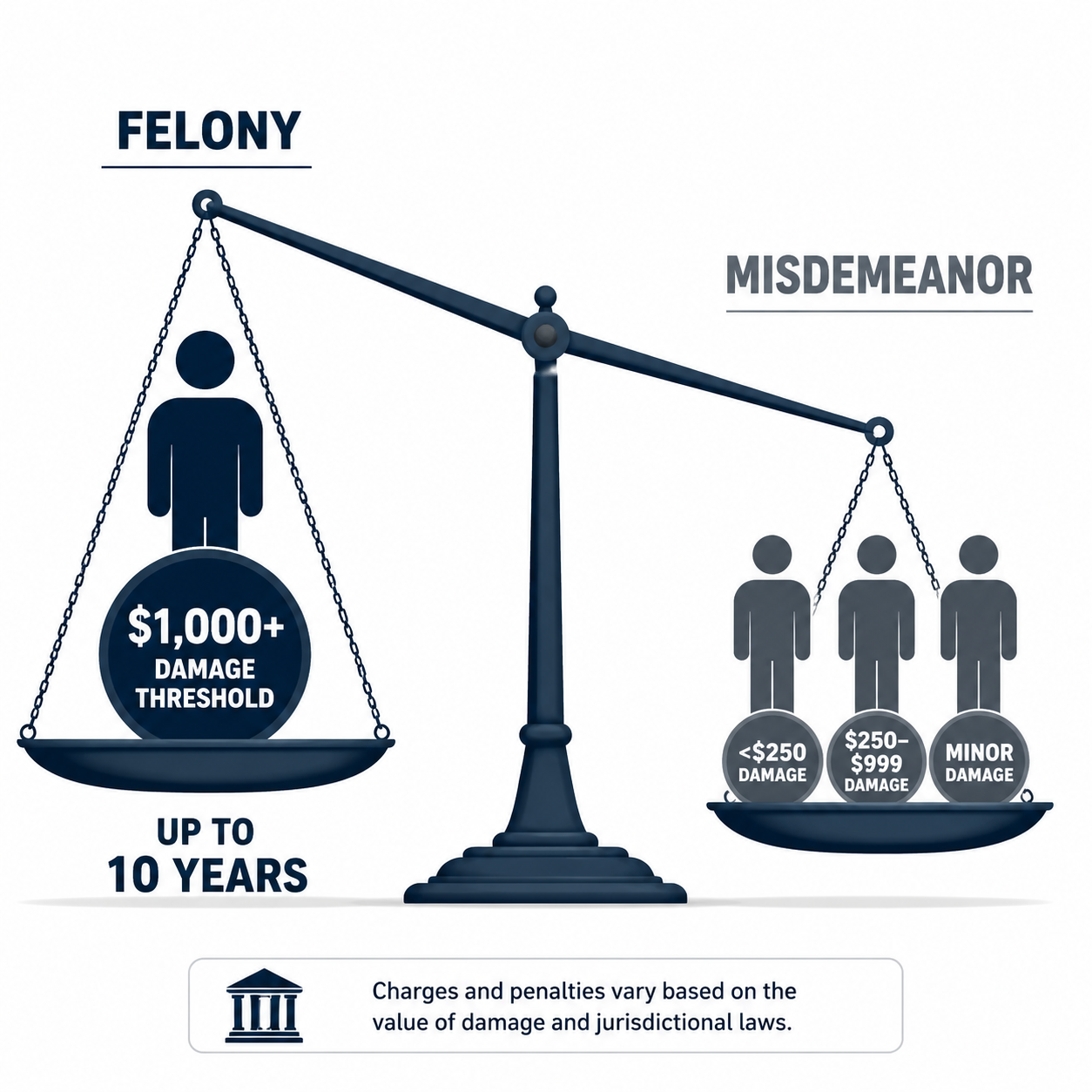
But disparity becomes relevant when the government’s distinguishing fact is not yet publicly clear. If Hearn’s case is different because his conduct caused more than $1,000 in damage and the others did not, the prosecution should eventually be able to show that through evidence. If the distinction is instead that Hearn became a better vessel for a public message — because of his Olympic identity, because of timing, or because the renovation had become politically embarrassing — then the charging decision deserves much closer scrutiny.
The most useful comparison is not moral. It is administrative. Prosecutors sort defendants every day by provable conduct, loss amount, record, role, intent, cooperation, and trial posture. When a felony charge appears to depart from the treatment of nearby defendants, the responsible question is not whether the defendant is sympathetic. It is what fact, capable of proof, explains the departure.
The renovation context made a small case politically useful
The Reflecting Pool renovation was already carrying political weight before Hearn’s indictment. CBS News reported that the project had grown beyond $14 million after an initial estimate under $2 million, and that a $1.7 million no-bid cleaning contract went to Green Water Solutions, a company owned by Trump donor John J. Cafaro.[6] Reporting also documented peeling “American Flag Blue” sealant and algae blooms.[6]
Those procurement and maintenance facts do not decide Hearn’s guilt. A troubled renovation does not give anyone license to damage public property. Nor does a donor-linked contract prove that prosecutors acted in bad faith. The point is narrower: the surrounding facts created an incentive to locate blame elsewhere, and the public narrative of vandalism served that purpose more cleanly than a discussion of project management, materials, algae, costs, and contractors.
That is why Norm Eisen’s defense framing has traction without ending the inquiry. Eisen argued that the indictment reflected “the administration’s effort to scapegoat Davey and to shift blame for their own failures.”[7] A defense lawyer’s characterization is advocacy, not evidence. But it names the institutional risk visible in the sequence: a weak or at least unproven damage theory can become useful when officials need a human explanation for a public failure.
What the arraignment did, and did not, settle
The July 9 arraignment did not test expert proof, repair estimates, causation, or the credibility of witnesses. Hearn pleaded not guilty, as defendants commonly do at that stage. The judge’s refusal to impose a stay-away order did not dismiss the indictment. It did, however, deny the prosecution its first practical request for restraint beyond ordinary release, and Hearn left without bail or supervision.[1]
That limited courtroom result sits uneasily with the public language around the case. If Hearn presents an ongoing threat to the Reflecting Pool, the government did not persuade the judge to impose the requested stay-away condition. If the evidence is strong enough for a felony, the public record has not yet shown how the government gets from roughly two square feet of already-peeling sealant to the statutory amount. If similar conduct produced misdemeanors for others, the government has not yet publicly explained the charging line.
None of those points requires the conclusion that the prosecution is abusive or unlawful. The case is ongoing, the next status hearing is set for August 5, 2026, and no trial date has been set.[3] The government may still produce a coherent expert account that makes the felony charge look less dramatic than it now appears. Courts often receive the evidence long after public officials have finished their strongest sentences.
The problem is what charging discretion can accomplish before that happens. A felony indictment changes the defendant’s burden in practical terms: public identification, litigation cost, employment risk, reputational harm, and the leverage created by exposure to a severe statutory penalty. Those consequences arrive before a judge or jury decides whether the damage theory is sound.
The narrow lesson from the Hearn case
The Hearn case is important because it shows how quickly a modest property-damage allegation can be made to carry a larger public story. The alleged act is small. The felony threshold is specific. The evidence of pre-existing peeling is material. The treatment of other defendants raises a comparison problem. The renovation’s political atmosphere gives the charging decision a use beyond ordinary property enforcement.
The fairest judgment is provisional. This record does not prove prosecutorial misconduct. It does show why moral certainty at the press conference stage is a poor substitute for proof. If the government can establish $1,000 or more in damage attributable to Hearn, the case will look different. If it cannot, the indictment will stand as an example of how much discretion can do before trial when political narrative, contestable damage evidence, and unequal charging choices converge.
References
- Reflecting Pool case: Olympian David Hearn pleads not guilty, CNBC.
- U.S. Olympian David Hearn pleads not guilty in Reflecting Pool vandalism case, NBC News.
- Ex-Olympian David Hearn pleads not guilty in Reflecting Pool damage case after Trump alleged vandalism, AP News.
- DOJ Loses Its First Big Ask in Reflecting Pool 'Vandalism' Case, New Republic.
- Former US Olympian pleads not guilty to damaging reflecting pool amid Trump's renovation, The Guardian.
- Company owned by Trump donor won $1.7 million no-bid Reflecting Pool cleaning contract, CBS News.
- Attorney for former Olympian accused of Reflecting Pool vandalism: Not a crime to 'touch water', The Hill.
Comments
Join the discussion with an anonymous comment.