
The unsettling part of David Leroy French’s probation record is not that it was full of warnings. It is that, as publicly described so far, it was not. French was serving a four-year standard probation term after a May 2025 sentencing for aggravated assault with a deadly weapon when he was arrested after the July 19, 2026 Downtown Tucson shooting. Pima County Attorney Laura Conover said he was still under supervision “without any documented infractions in the court file” when the incident occurred, according to Tucson Sentinel reporting on the new charges and the prior case record.[1]
That sentence matters because it is legally meaningful and easy to overread. A clean court file can mean a person complied with every condition. It can also mean the supervision tools in place did not detect, document, and bring forward a violation. In the legal record now being scrutinized, that distinction is the center of the problem.

The record looked supervised, but not intensively supervised
The reported sentencing split is the first hard place to look. Tucson Sentinel reported that the Pima County Probation Department assessed French as meeting criteria for intensive probation, described in the reporting as the highest level of community supervision, but Judge J. Alan Goodwin ordered standard probation instead.[1]
That is not the same as saying the sentencing judge acted outside lawful authority. The available materials support a narrower point: the department recommended a denser supervision tier, and the court imposed a less dense one. Once that happened, the practical job shifted to standard probation mechanics — monthly reporting, conditions, officer review, and the possibility of searches — rather than the more demanding structure associated with intensive supervision.
Arizona’s intensive probation statute contemplates tighter control than ordinary probation. ARS 13-913 requires intensive probationers to be supervised under strict conditions, including requirements set by the court and supervision standards tied to the intensive program.[2] The statute is useful here not because it proves what would have happened had French been placed on intensive probation, but because it shows that Arizona law recognizes a separate category for people judged to require more restrictive community supervision.
| Issue in French’s reported record | What it can show | What it cannot show by itself |
|---|---|---|
| Probation Department recommended intensive probation | A higher supervision tier was assessed as appropriate | That intensive probation would have prevented the later alleged offense |
| Judge ordered standard probation | The court selected a lawful community-supervision structure reported as less intensive | That the judge knew or ignored a specific future risk |
| No documented infractions in the court file | No violation had been formally recorded in the file as reported | That no violation occurred or that supervision was necessarily sufficient |
What standard felony probation could actually catch
Standard probation can sound formidable when read from a sentencing minute entry. A person may be prohibited from possessing firearms, required to maintain employment, ordered to report to a probation officer, and subject to warrantless search conditions. Those are real constraints. They give the supervising officer authority and give the court a basis to revoke or modify probation if a violation is established.
But authority is not the same thing as constant visibility. In the standard probation structure described in the available reporting, an officer may supervise up to 65 adults, and the ordinary contact point is monthly in-person reporting.[1] A monthly report can reveal missed appointments, unstable employment, drug-test issues if testing is ordered and administered, address changes, or statements that raise concern. It is much less reliable as a tool for detecting concealed conduct between appointments, particularly conduct that leaves no administrative trace unless someone reports it, law enforcement encounters it, or the officer has reason and opportunity to search.
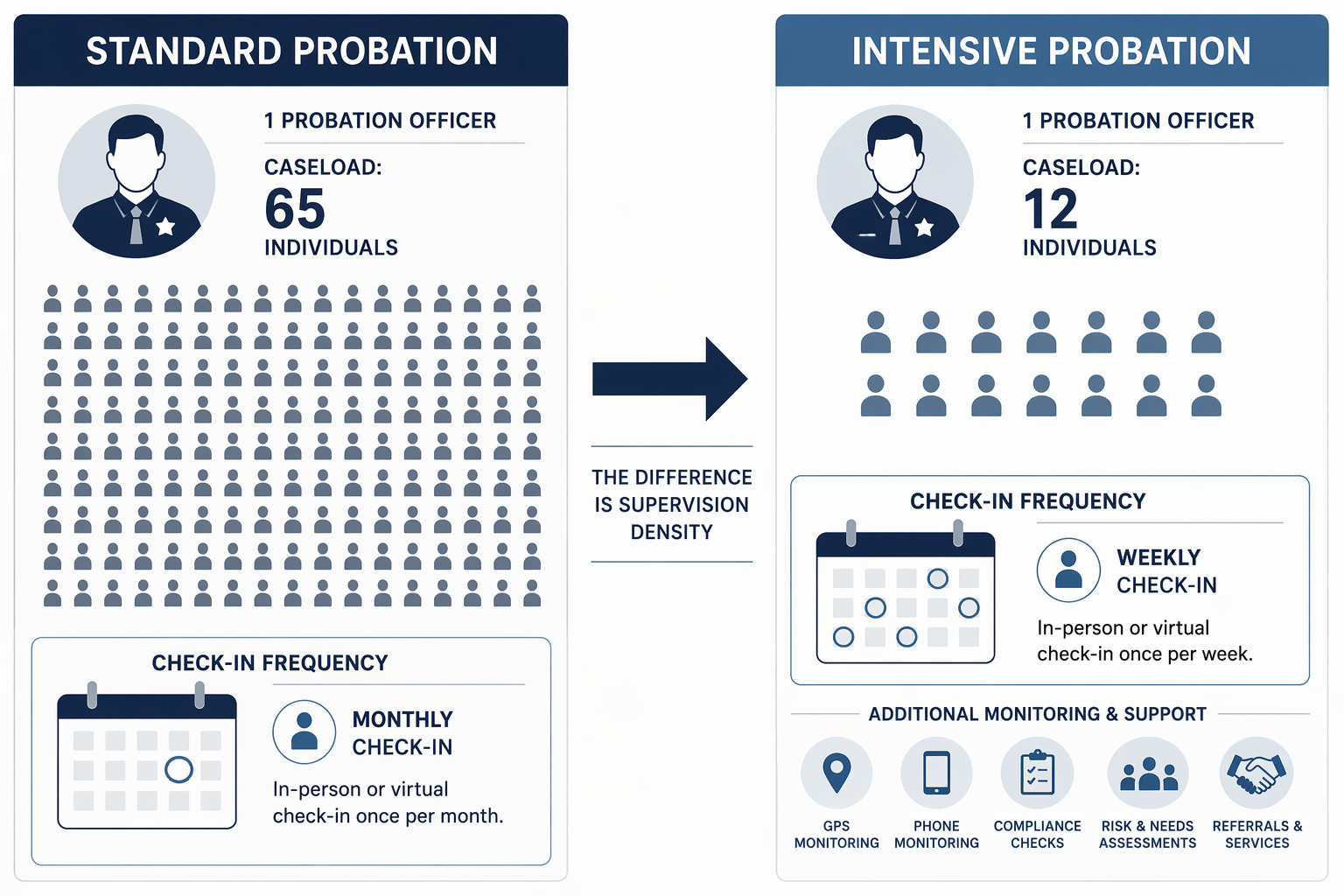
The firearm condition is the clearest example. A prohibition tells the probationer what is forbidden and gives the court leverage if a firearm is found. It does not, by itself, create an electronic alert when a person obtains or handles a gun. A warrantless search condition can matter a great deal when an officer has information, scheduling capacity, field support, and a location to search. It does not mean every probationer is searched continuously or even frequently enough to make undetected possession impossible.
That is the supervision gap in its least dramatic form: a person can be formally under court control, can remain obligated to obey significant conditions, and can still pass through the standard system without generating a violation report. The gap becomes more consequential when the underlying conviction involved aggravated assault with a deadly weapon and the later allegation also involves weapons violence.
The four-year term was not the disputed legal limit
The public question naturally turns to why French was in the community at all. The available materials do not support collapsing that question into a claim that probation was unavailable. Arizona law permits probation terms for felony convictions within statutory limits, and ARS 13-902 sets maximum probation periods by felony class, including a five-year cap for a Class 3 felony unless another statute provides otherwise.[3] French’s reported four-year standard probation term therefore fits within the type of sentencing framework Arizona law allows for covered felony cases.
That point does not answer whether standard probation was wise in this case. It only keeps the legal question clean. The sharper issue is not whether the court had some authority to impose a probationary term; it is why, after an intensive probation assessment, the order placed French on standard probation and what that meant for actual monitoring after he left the courtroom.
A clean file is a procedural fact, not a behavioral biography
Conover’s reported statement that French had no documented infractions in the court file is important precisely because it is limited.[1] It tells the public that, as of the point described, the file did not contain a recorded probation violation. It does not tell the public that French was searched, that he never possessed a weapon, that every monthly report captured his real conduct, or that every possible warning sign was investigated and ruled out.
A probation violation has to travel a path before it becomes a court-file event. Someone has to detect conduct that appears to violate a condition. The officer or agency has to document it. The matter has to be brought forward in the form used by that jurisdiction and that case. Only then does the outside reader see a violation entry rather than a quiet docket.
That path can fail for benign reasons, troubling reasons, or no identifiable reason at all. A probationer may actually be complying. A violation may be too minor to bring to court immediately. A suspected violation may lack proof. A serious violation may remain hidden until a new arrest exposes it. The court file records what was formally put before the court; it is not a live feed of everything happening in the probationer’s life.
For legal professionals, this is the caution point. “No documented infractions” is useful when resisting unsupported claims that probation had already failed in a visible, ignored way. It is not useful as proof that standard supervision was adequate to the risk the department had assessed.
The new charges triggered the scrutiny, but they do not answer the supervision question
The July 2026 arrest is the reason the probation file is being examined. Tucson Sentinel reported that French was charged with 18 assault counts after a Downtown Tucson shooting that injured nine people.[1] Those allegations are serious, and they rightly sharpen public attention on the earlier deadly-weapon case. But the new case cannot be used backward as automatic proof that every earlier supervision decision was negligent.
The responsible inference is narrower. French was reportedly assessed for intensive probation, placed on standard probation, and then accused of weapons-related violence while still on that standard probation term and while the court file showed no documented infractions.[1] That sequence is enough to examine supervision capacity. It is not enough, at least on the present public record, to assign a complete causal chain to the judge, the probation department, or any individual officer.
The co-defendant context stays in the background
The 2024 incident also involved co-defendant Ernesto Camacho, and the parallel handling of that case helps confirm that the prior prosecution was not an isolated administrative footnote.[1] It should not, however, pull the analysis away from French’s supervision status. The public safety question now attached to French turns on his own sentencing order, his own recommended supervision tier, and the conditions actually operating when the July 2026 allegations arose.
What the case can fairly be used to show
French’s case is a useful probation case study because it resists the clean explanations people tend to reach for first. If the file had been full of missed reports, failed tests, ignored weapons tips, or repeated violation petitions, the public discussion would be simpler. The reported problem is more difficult: the file was clean in the way a court file can be clean, while the supervision structure may still have left too much unseen.
For defense attorneys, that means advising clients that standard probation is real court control even when contact feels periodic. For prosecutors, it means understanding that conditions without detection mechanisms may not surface risk until after a new offense. For judges and policy analysts, the point is sharper: when a department recommends intensive probation and standard probation is imposed instead, the record should be read with attention to the monitoring capacity that decision actually buys.
As of July 21, 2026, the public record described in the available reporting remains developing. Later filings may clarify the original probation conditions, officer contacts, any searches, any missed opportunities, or the reasons for imposing standard rather than intensive probation. On the present materials, the careful conclusion is that French’s case illustrates a supervision gap: standard probation can satisfy formal court supervision while still failing to detect alleged weapons possession, especially where intensive probation was recommended but not imposed.
References
- Man charged with 18 assault counts after Downtown Tucson shooting injures 9, Tucson Sentinel, July 20, 2026.
- ARS 13-913, Arizona Legislature.
- ARS 13-902, Arizona Legislature.
Comments
Join the discussion with an anonymous comment.