
The July 20 order does not create a fresh statutory China sourcing ban for defense contractors. It tightens the waiver regime under 10 U.S.C. § 4872(c)(1), which is the part that governs whether a contractor can keep relying on an exception instead of fixing the supply chain problem. Reuters framed it the same way: a tightening of waiver rules, not a brand-new prohibition [1][2].

What Changed In Practice
The practical change is that routine waiver renewals are no longer supposed to function like a standing business process. The order sets January 1, 2027 as the cutoff for that habit, which means the next waiver request has to read like a remediation record, not a rollover request [1].
That shift matters because the order changes the burden of proof. Contractors now have to show more than a sourcing inconvenience. They need to show why a compliant source is not yet available, what they did to find one, and why the work is still moving rather than drifting.
- Identify every non-compliant source tied to the waiver request and explain why it remains in the chain [1].
- Document exhaustive alternative-search efforts instead of relying on a general statement that replacement is difficult [1].
- Set out a strict removal timeline so the waiver file shows a path off the covered source, not an open-ended exception [1].
- Show active, adequately funded, and ongoing qualification work for a domestic source before calling the source 'non-available' [1].
That last point is the one procurement teams will feel first. Under the order, failure to qualify a domestic source does not automatically make the source 'non-available' for waiver purposes. The contractor has to prove that it is actually doing the qualification work, with money, personnel, and momentum behind it [1].
The Bill Of Materials Goes Deeper
The order also pushes supply-chain visibility far past the level many defense teams are used to. It calls for an 'indentured' Bill of Materials that traces every component, part, software module, and material back to raw-material origin [1]. That is not the same thing as ordinary tier 1 or tier 2 tracing, where a contractor can stop once it has identified immediate suppliers and a few upstream links.
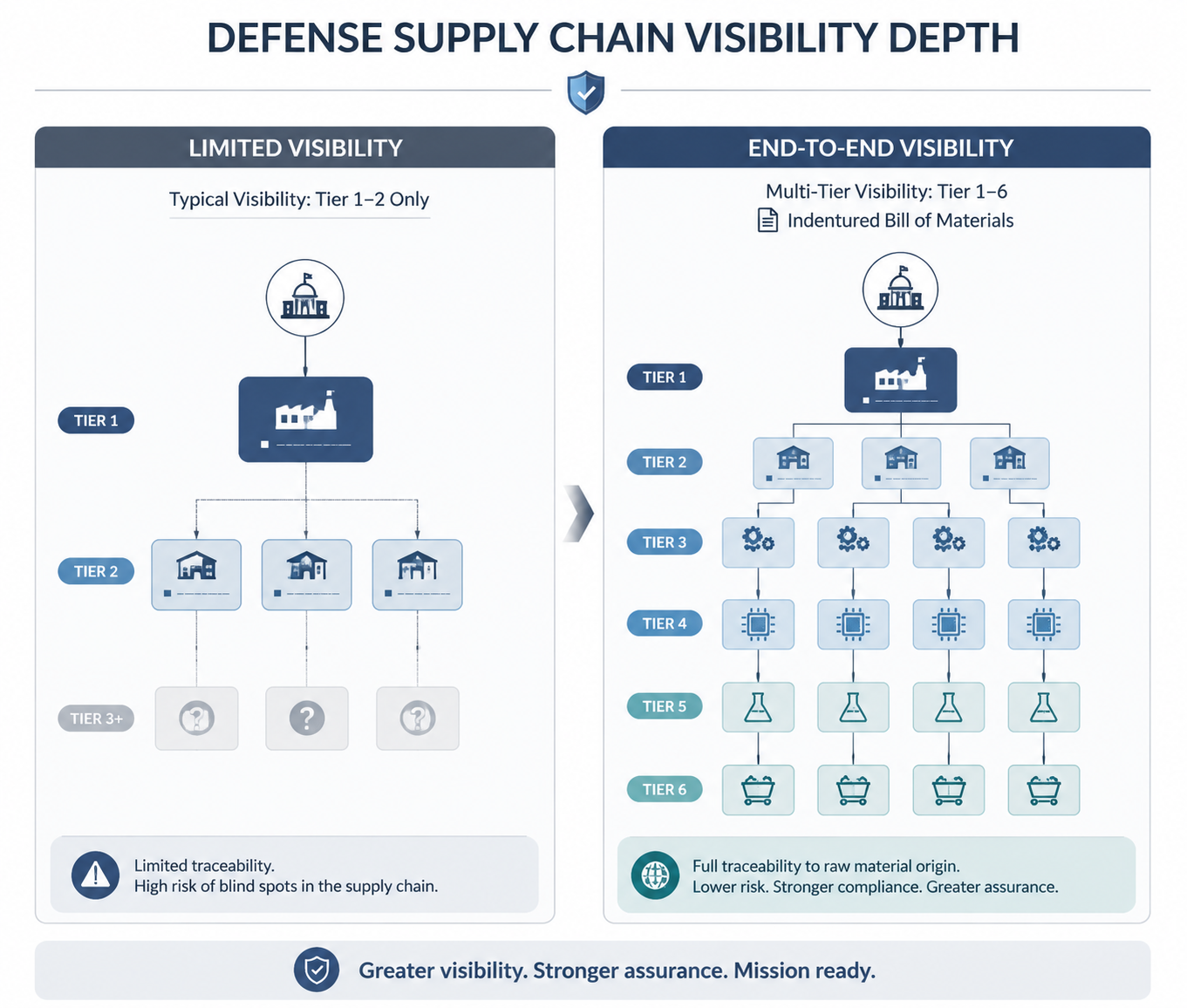
For compliance purposes, the point is not just to know who sold what last. It is to build a chain of custody that can survive scrutiny when a customer, auditor, or enforcement lawyer asks where a suspect item actually came from. In practice, that means visibility can reach roughly tier 5 or tier 6, which is where many teams discover they do not yet have the data they thought they had [1].
Supplier Vetting Is Now A Three-Category Exercise
The order also gives supplier screening a more formal shape. Vetting has to address three risk categories: financial vulnerability, foreign ownership/control/influence, and manufacturing or supply capacity [1].
- Financial vulnerability: whether the supplier's balance sheet or cash position makes continuity fragile [1].
- Foreign ownership/control/influence: whether control or influence could compromise compliance, continuity, or remediation [1].
- Manufacturing and supply capacity: whether the supplier can actually deliver, rework, or scale when the plan requires it [1].
The reporting cadence matters too. The order ties the process to a 15-day initial notice, a 45-day corrective action plan, and a closeout report [1]. Those are not just bureaucratic timestamps. They are the points at which a supplier issue becomes a documented remediation track, or a missed deadline that procurement and legal will have to explain.
The Compliance Calendar Is Already Crowded
The order lands before its own implementing rules exist, so the sharpest details are still prospective. The regulatory deadlines for action fall in January 2027, which means contractors are being asked to prepare before the process is fully written [1].
That uncertainty is not isolated. A separate Government Contracts Law analysis had already described China supply-chain compliance as a 'whack-a-mole' problem because the defense sector is trying to keep track of overlapping sourcing restrictions, including Section 889, Section 1260H, and the still-unfinalized Section 5949 semiconductor rule [3].
There is also the FY 2026 NDAA Section 833 waiver framework to watch, which runs through January 1, 2028 [5]. The interaction between that framework and the new order has not been clearly resolved in published guidance, so contractors should not assume the executive order simply replaces the NDAA process. It may end up sitting beside it, adding another layer of proof and another place for inconsistency to surface [5].
The calendar is even tighter because adjacent compliance dates are already arriving. Skadden noted that the Section 851 lobbyist prohibition became effective on June 30, 2026, which is a reminder that defense contractors are not dealing with one China-focused rule change but a stack of them [4].
What Teams Should Do Now
The fastest response is not to wait for the final rulemaking package. It is to map the parts of the portfolio that depend on China-linked sources, identify which contracts or programs may need waivers, and start building the record that the order now expects: supplier attestations, raw-material tracing, funded qualification plans, and an escalation path for when a source fails review.
That work needs to be coordinated across legal, procurement, supply-chain, and program management. If each team keeps its own version of the sourcing story, the waiver file will not hold together when the cutoff arrives. The contractor that can show active remediation, clear alternatives analysis, and a credible removal timeline will be in a much better position than the one still assembling spreadsheets after January 1, 2027.
References
- Securing America's Defense Supply Chains and Ensuring Domestic Acquisition of Critical Materials, The White House, July 20, 2026, official order
- Trump orders tightening defense supply chain waiver rules, Reuters, July 20, 2026, analysis
- China Supply Chain Compliance Is Becoming Whack-a-Mole, Government Contracts Law, June 2026, analysis
- Reminder: Effective June 30, Companies Barred From Defense, Skadden, April 2026, insight
- FY2026 NDAA Sourcing Restrictions: Critical Minerals, Advanced Batteries, Pillsbury, analysis
Comments
Join the discussion with an anonymous comment.