
Denise Oliver-Velez left a legal legacy without practicing law. That is the reason a publication read by lawyers, legal technologists, and regulatory professionals should pause over her death on July 15, 2026, rather than file it away as movement history outside the profession’s lane.[1]
This is a news-and-analysis reflection, not legal advice and not a memorial written to sand down the hard edges. Oliver-Velez was not an attorney. Reliable public accounts describe her education through Howard University, SUNY Old Westbury, and SUNY New Paltz, not through law school; claims that try to retrofit a legal credential onto her life miss the more useful point.[2] She made law matter by pressuring the institutions that administered it, by organizing people who lived under it, and by forcing movements themselves to answer for the hierarchies they carried inside.

Legal professionals in 2026 have more instruments than prior generations could have imagined: litigation analytics, compliance dashboards, AI-assisted document review, automated risk scoring, searchable police-misconduct databases, and regulatory frameworks that promise disciplined governance. Those tools can matter. They can help lawyers build records, compare jurisdictions, and expose patterns that once stayed buried in courthouse basements. But accountability still often begins before a pleading is drafted, and sometimes before any institution agrees that there is a legal problem at all.
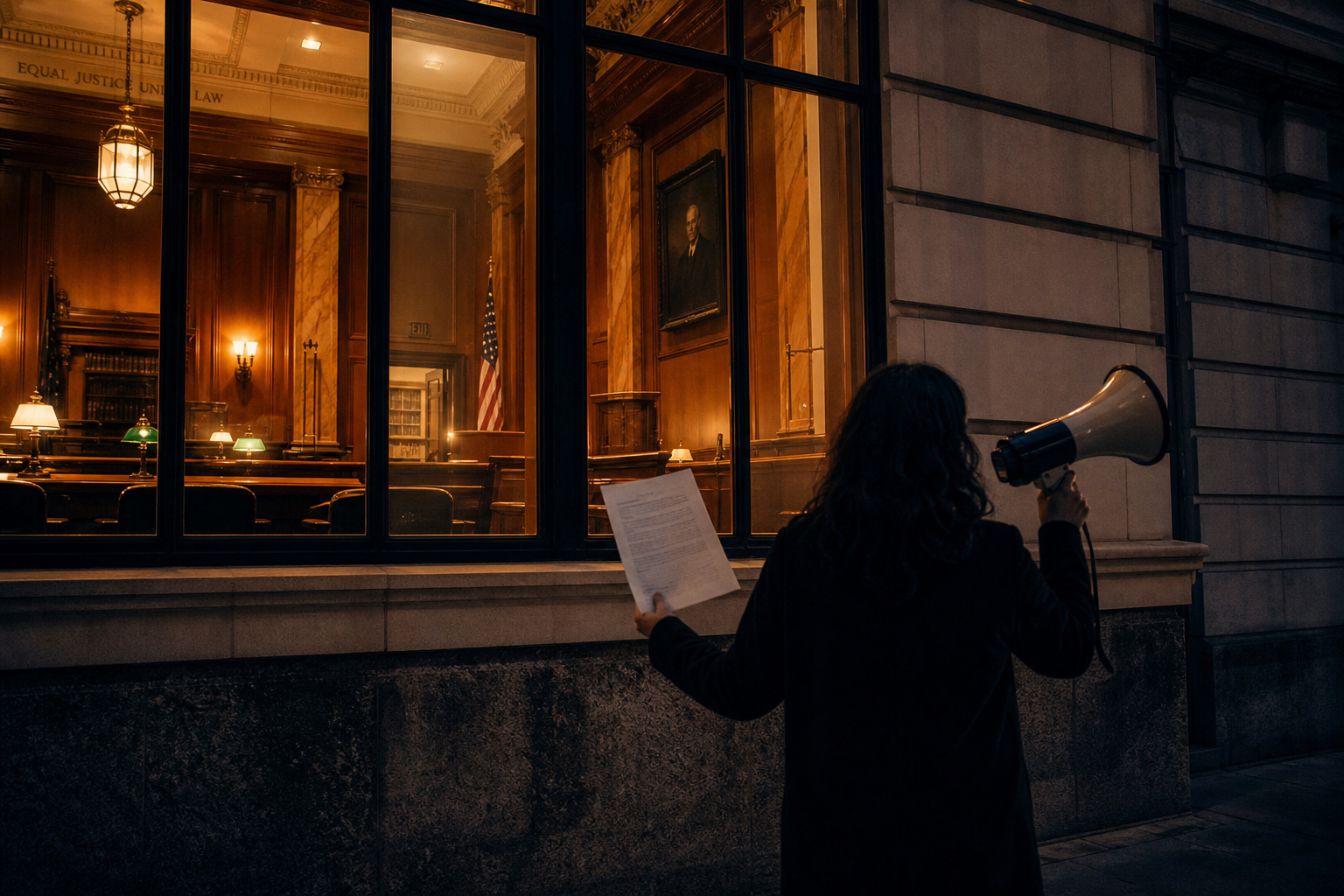
Oliver-Velez’s work belongs in that earlier, messier space: the picket line, the caucus meeting, the community radio booth, the prison-support campaign, the research interview, the internal vote where people decide whether their own organization will live by the language it asks the state to respect.
Rights Enforcement Before the Lawsuit
Oliver-Velez began civil disobedience at 16 through the NAACP Queens branch under Judge William Booth, according to a 2022 profile.[3] That fact can look like a biographical opener, but for lawyers it is more specific than that. It shows a young organizer learning that rights are not self-executing. Someone has to create the confrontation that makes denial visible.
The same profile places her at the 1963 Rochdale Village bulldozer blockade, where protesters demanded Black worker hiring.[3] A hiring demand at a construction site is not a courtroom victory. It is not a consent decree. It does not come wrapped in the procedural comforts lawyers are trained to trust. But it performs a related function: it identifies an exclusion, names the remedy, applies pressure at the point of decision, and forces someone with power to respond.
That distinction matters for current legal work. In police-accountability litigation, immigration enforcement disputes, employment discrimination, and health-access fights, lawyers often arrive after someone else has already gathered the names, found the witnesses, explained the harm in ordinary language, and kept frightened people from disappearing into silence. Tools like litigation analytics in police shooting cases may sharpen the formal claim. They do not replace the organizing that makes a claim possible.
The Young Lords Fight That Legal Professionals Should Study Closely
The Young Lords women’s caucus is the center of Oliver-Velez’s legal activism legacy because it compresses the whole problem of rights language into one internal fight. The organization had a platform. It had revolutionary commitments. It had public claims about liberation. It also had women inside the organization who were expected to carry unequal labor while men kept ideological control.
The original Young Lords 13-Point Program stated: “We want equality for women. Machismo must be revolutionary…not oppressive.” The women’s caucus forced that language to become: “We want equality for women. Down with machismo and male chauvinism.”[4]
That change was not cosmetic. “Revolutionary machismo” tried to preserve the category and regulate only its bad uses. The rewritten plank rejected the category. It took a compromise phrase and made it answerable to the people who bore its consequences.
Lawyers should recognize the structure of the intervention even if it happened outside law. A governing text contained a loophole. A constituency organized around the harm. The demand was formal, not merely expressive. The text changed. Then the monitors of that change had to keep watching, because new words did not immediately redistribute work.
Black Women Radicals reports that the Central Committee promoted women only after the caucus issued formal demands threatening action, and that even after the platform change, women were still disproportionately assigned secretarial and childcare tasks.[4] That is the sober lesson. Text matters. Text is not mere performance. Text also does not enforce itself.
Oliver-Velez’s position inside the Young Lords gave that lesson teeth. She became the first woman elected to the organization’s Central Committee and served as Minister of Economic Development.[2] A Democracy Now! tribute described her as Officer of the Day with authority to discipline anyone, including Central Committee members, and said she used that authority regardless of rank.[1] The same tribute recounted that she and the women’s caucus demoted the entire Central Committee when it attempted to ally with a nationalist group that treated women poorly.[1]
There is an institutional lesson here that lawyers should not reduce to a soft word like “inclusion.” The women’s caucus did not merely ask to be represented. It challenged the rule, the leadership structure, the labor allocation, and the proposed alliance. It treated internal governance as a site of justice work.
That is directly relevant to law offices, legal aid organizations, impact-litigation shops, public-interest nonprofits, bar committees, and legal technology companies that speak the language of access to justice while reproducing hierarchy in staffing, authorship, credit, and risk. A rights project can be correct about the state and evasive about itself. Oliver-Velez’s example leaves little room for that comfort.
What Changed, and What Did Not
| Young Lords episode | Legal-professional lesson |
|---|---|
| Women named the harm inside their own organization. | Accountability begins with affected people defining the injury. |
| The caucus issued organized demands rather than relying on private persuasion. | Internal reform needs procedure, pressure, and consequences. |
| The 13-Point Program language changed. | Rights language can be an enforceable organizing target. |
| Unequal labor assignments persisted after the textual change. | Formal revision is a beginning, not proof of compliance. |
The Position Paper on Women, co-authored in 1970, also deserves attention because it did not separate sexism from race and class.[2] FEM Newsmagazine describes the paper as theorizing the intersection of race and class in women of color’s lives before the term “intersectionality” existed, and as treating capitalism, racism, and sexism as an interlocking system.[5] That is not a reason to turn Oliver-Velez into a footnote to later academic language. It is a reminder that community theory often arrives before professional vocabulary catches up.
Oliver-Velez later warned young organizers about academic jargon that distances people from community, and said, “Nothing is a substitute for face-to-face actual organizing.”[6] Lawyers do not need to be hostile to theory to hear the warning. The question is whether the people most affected can use the language, contest it, and hold its users accountable.
Coalition as Legal Strategy, Not Atmosphere
Oliver-Velez’s work with the Young Lords also resists a tidy racial or organizational box. She described the group’s African American-Puerto Rican coalition work this way: “We broke down a lot of barriers between groups.”[4] In legal writing, coalition is often praised as a value. In practice, it is more like jurisdictional work: deciding who is inside the claim, who is authorized to speak, which injuries are treated as connected, and which remedies are pursued together.
When the Young Lords Central Committee voted in 1971 to relocate to Puerto Rico, Oliver-Velez left and joined the Black Panther Party’s Harlem office immediately, according to public biographical accounts.[2] The detail is worth including not because organization-hopping is inherently noble, but because it shows a political method. She moved toward the place where the work, the relationships, and the accountability structure made sense.
Her later Black Panther solidarity work included international travel with Kathleen Cleaver after the East Coast contingent was targeted, according to an intergenerational conversation published by Black Women Radicals.[6] People’s World has also documented Oliver-Velez and Ericka Huggins sharing Black Panther experiences with a new generation of organizers.[7] These are not merely commemorative details. They show the movement-lawyering problem that formal advocates still face: repression, surveillance, incarceration, exile, and public narrative are not separate files. They interact.
The Democracy Now! tribute noted that close friends of Oliver-Velez were killed amid COINTELPRO federal surveillance and disruption operations.[1] That is a narrow fact, not a license to flatten every government action into the same category. But it is enough to explain why political education, media control, and prisoner defense were not side projects. For organizers who lived through state disruption, record-making was survival work.
Media Work as Record-Making
Oliver-Velez later co-founded WPFW-FM, Pacifica’s first minority-controlled station, and became the first Black female program director in public radio.[2] Those are prestige markers only if they are detached from method. Kept in context, they show another legal-adjacent practice: controlling the record before official institutions define it.
Community media can preserve names, sequence events, identify decision-makers, and give harmed people a forum before litigation, legislation, or administrative review recognizes them. It can also discipline movements by making internal debates public enough that leaders cannot quietly bury them. That is not the same as discovery, but lawyers who have worked with thin records know the difference between a community that has documented itself and one that has been documented only by police, agencies, employers, landlords, or hospitals.
Her approximately two decades as a contributing editor at Daily Kos continued that political-education function in a different medium.[2] Markos Moulitsas, the site’s founder, said in the Democracy Now! tribute: “For literal decades, every difficult decision about the direction of Daily Kos has included the same question: What is Denise going to think about this?”[1] That is an unusually compact description of accountability. A person does not need officeholding power to become the standard against which institutional decisions are tested.
Health Justice Research and the Legal Status of Risk
The later HIV/AIDS research may look, at first glance, like a turn away from legal activism. It was not. Democracy Now! described Oliver-Velez’s ethnographic research with Puerto Rican drug users as examining how incarceration and undocumented legal status shaped transmission risk.[1]
That formulation is careful and important. It does not say incarceration or undocumented status alone caused transmission. It says those legal and institutional conditions shaped risk. For legal professionals, that is exactly the kind of distinction that should matter: a jail policy, immigration status, fear of authorities, access to treatment, and the credibility assigned to a drug user’s testimony can all change the practical ability to stay alive.
The connection to current practice is not hard to see. Lawyers now litigate and advise around immigration threats, policing technologies, detention conditions, public health access, and data systems that sort people by perceived risk. When an airline employee threatens to call ICE, for example, the legal claims may turn on discrimination, contractual duties, state law, and federal immigration preemption; but the human risk begins in the same place Oliver-Velez studied, where legal status changes behavior long before a court sees a case. Our analysis of legal claims arising from ICE threats sits in that modern field of consequences.
Oliver-Velez also advocated for political prisoners including Chip Fitzgerald, Albert Woodfox of the Angola 3, and Robert King, according to the Democracy Now! tribute.[1] Prisoner advocacy is one of the clearest places where the profession’s strengths and limits meet. Lawyers can challenge convictions, conditions, parole decisions, and procedural violations. Outside advocates keep names alive, maintain correspondence, build public pressure, and refuse the disappearance that incarceration is designed to produce.
Five Principles, Unevenly Weighted
Oliver-Velez’s legacy can be translated into five principles for legal professionals, provided the translation does not make them too neat.
- Moral clarity is part of professional integrity. It is the discipline of naming the injury plainly before institutional language dilutes it.
- Direct action can be rights enforcement. A blockade, demand letter, tenant meeting, press conference, or prison-support campaign may create the factual and political conditions that make formal relief possible.
- Coalition is a legal strategy when it changes who is included in the claim and who can enforce the remedy.
- Internal reform requires organized demands. A justice organization that will not submit to accountability at home loses authority when it demands accountability elsewhere.
- Sustainability is not decorative. Long participation requires care, political education, and relationships strong enough to survive defeat, conflict, and grief.
The first two principles can be learned quickly from her NAACP civil disobedience and Rochdale Village action. The third and fourth require staying longer with the Young Lords and Black Panther material because coalition and internal challenge are where many professional institutions still prefer general praise over enforceable change. The fifth should not be converted into wellness branding. In Oliver-Velez’s life, sustainability meant remaining useful across movements, media, research, teaching, and political education for decades.
Juan González said in the Democracy Now! tribute that Oliver-Velez “was never afraid to speak her mind, to challenge authority and to tell her comrades what they needed to hear — not what they wanted to hear — and she always did it with love and kindness.”[1] Because the transcript was published as a rush transcript, that wording should be treated with ordinary source caution until final copy or video review confirms it. The substance, however, matches the record that runs through the rest of her work: accountability did not require contempt, and solidarity did not require silence.
What This Does, and Does Not, Ask of Lawyers
There is a lazy version of this argument that would tell lawyers to get out of the way. That is not the lesson. Formal advocacy can protect people when the state is violent, when employers retaliate, when police departments conceal records, when immigration threats are used as leverage, when prison officials isolate dissenters, or when federal agencies try to disable professional oversight. Legal work matters precisely because power often knows how to wait out outrage.
But the opposite error is more common inside the profession: treating organizing as background, context, client development, or narrative support for the real work. Oliver-Velez’s life makes that hierarchy hard to defend. The caucus demand, the platform rewrite, the blockade, the radio station, the prisoner campaign, the HIV/AIDS fieldwork, and the political education all operated as accountability mechanisms. Some made formal law more usable. Some did what formal law would not do.
That should also discipline how legal technology is discussed. A dashboard can identify patterns in police shooting litigation. Automated license plate reader errors can create evidence trails and liability theories, as in our coverage of Flock ALPR false positives and legal risk. Bar investigations and federal pressure on professional discipline, as in DOJ efforts to sideline state bar ethics investigations, can define institutional power. None of that removes the need for people outside the formal system to ask who is harmed, who benefits, who is afraid to speak, and who gets to decide when a remedy is enough.
Oliver-Velez does not teach lawyers to abandon formal advocacy, and her life should not be used to romanticize work outside institutions as automatically purer. She teaches something harder and more useful: legal change is often made possible by people who pressure, discipline, document, translate, and organize before lawyers can win anything durable.
References
- Denise Oliver-Velez, Democracy Now!, July 17, 2026.
- Denise Oliver-Velez, Wikipedia.
- Denise Oliver-Velez: Anthropologist Activist Writer, MICHEAUX PUBLISHING, January 31, 2022.
- Machismo Will Never Be Fucking Revolutionary: On the Radical Rebelliousness of Denise Oliver-Velez, Black Women Radicals.
- Feminist Theorist Thursdays: Denise Oliver-Velez, FEM Newsmagazine.
- An Intergenerational Conversation with Denise Oliver-Velez and Ericka Huggins, Black Women Radicals.
- Black Panther veterans Denise Oliver-Velez, Ericka Huggins share experiences with new generation, People's World.
Comments
Join the discussion with an anonymous comment.