
Judge Samuel Chung’s ruling on Denny Blaine Park did not give either side the clean instrument it asked for. The King County Superior Court judge refused to close the park and refused to impose a blanket nudity ban, while also finding that Seattle must abate conduct the court treated as a public nuisance: masturbation, sex acts, voyeurism, trespass, and related behavior reported around the park and adjacent properties. As reported by KOMO News, the clothing-optional lower beach remains open, toplessness remains lawful throughout the park under Washington law, and the city is now under a permanent injunction requiring targeted controls rather than closure.[1]
That is the useful part of the ruling. It does not pretend that lawful nude presence and illegal sexual conduct are the same problem. It also does not pretend that the existence of a historically queer clothing-optional space makes every complaint legally irrelevant. The decision, as reported, turns on a category distinction that municipal lawyers often need but do not always get: bodies may be lawfully present; particular acts may still be enjoined.
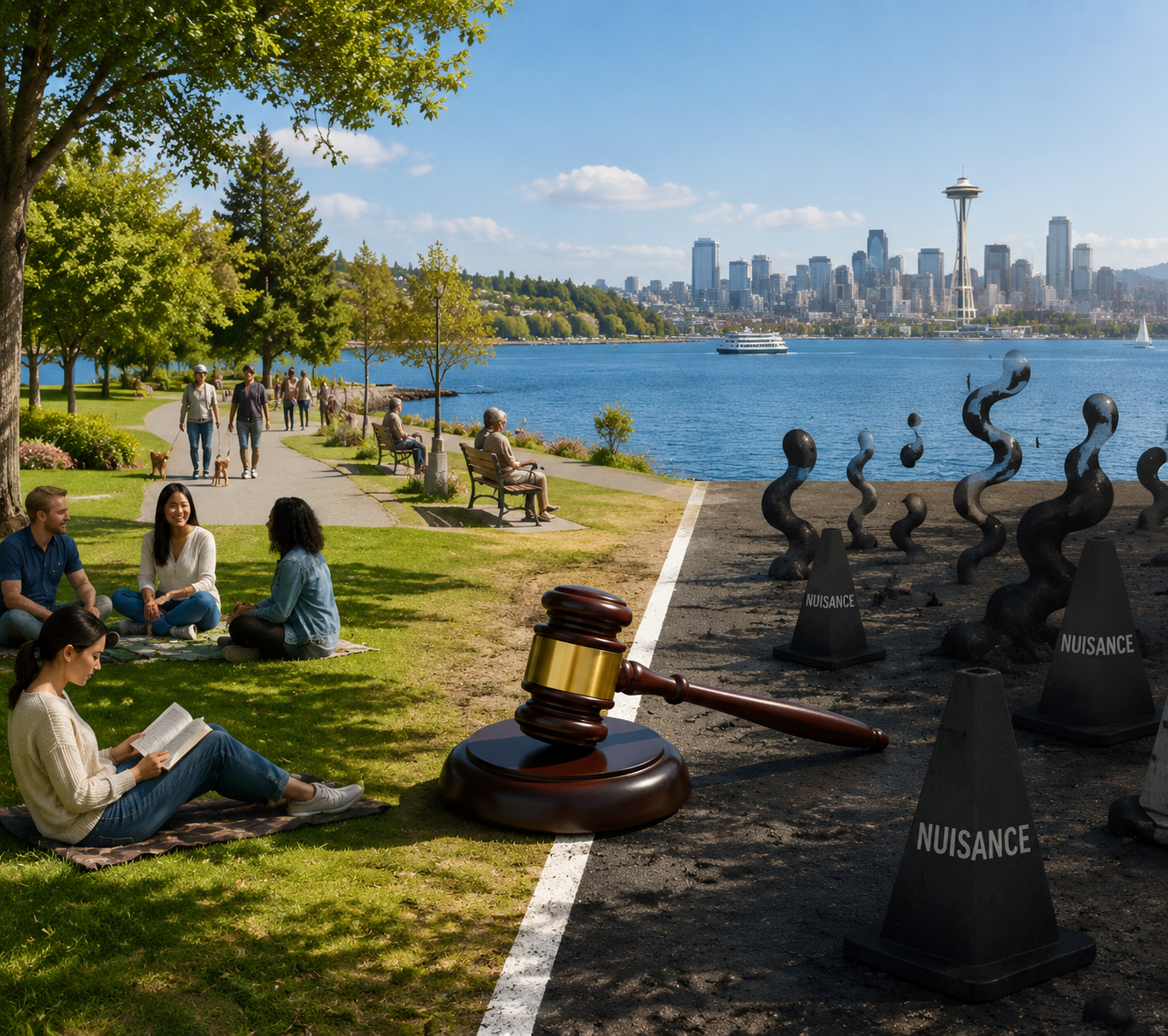
The Line the Court Drew
The starting point is Washington law’s treatment of simple nudity. Seattle v. Johnson, a 1990 Washington Court of Appeals decision, held that mere public nudity is not, by itself, lewd conduct.[2] That baseline matters because it prevents the nuisance analysis from quietly converting discomfort with nude bodies into a sex-offense theory. Once that premise is fixed, the legal question becomes narrower and more administrable: what conduct, beyond mere nudity, did the city know about, what did it fail to address, and what remedy fits that conduct?
According to KOMO’s account of the 14-page order, Chung found that nudity at Denny Blaine dates to the 1970s and that the park has long functioned as a queer- and trans-friendly clothing-optional space.[1] The Stranger likewise reported that the ruling preserved nude use at the lower beach while rejecting the plaintiffs’ requested ban.[3] Those findings did real legal work. They made the beach’s social use part of the nuisance balance rather than a colorful aside.
The conduct on the other side of the line was different in kind. The court found, according to KOMO, that post-2010 and post-COVID escalation included masturbation, sex acts, voyeurism, and trespassing.[1] Those allegations do not depend on whether a visitor is clothed or unclothed. A person can be nude without committing a nuisance; a person can commit a nuisance without the legality of nude sunbathing doing any protective work for that conduct.
That separation is what kept the remedy from becoming overbroad. If the nuisance were defined as nudity, the cure would naturally move toward clothing rules, closure, or displacement. If the nuisance is defined as specific conduct interfering with public use and neighboring property, the remedy can be aimed at supervision, sightlines, boundaries, staff authority, and clear notice.
Why the Beach’s History Mattered Without Deciding Everything
Denny Blaine’s history was not treated merely as ambience. The park has been known as an unofficial clothing-optional beach and LGBTQ+ gathering place since the 1970s, including under the name “Dykekiki Beach.”[4] Trial coverage from Real Change described testimony from visitors who tied the beach to eating-disorder recovery, comfort after top surgery, and community formation.[5] The Stranger also emphasized the court’s recognition of the park’s value to queer and trans users.[3]
Those accounts are easy to mishandle. Treated sentimentally, they can become a reason to ignore conduct that public agencies still have to regulate. Treated dismissively, they erase why a blanket ban would burden more than a weekend recreation preference. Chung’s reported approach did neither. The court weighed the social value of the clothing-optional use against nuisance evidence, then preserved the former while requiring the city to address the latter.[1][3]
That matters for municipal practice because public-space disputes often arrive already flattened. Neighbors describe a place as out of control. Regular users describe enforcement as a pretext for exclusion. Agencies try to avoid saying anything too definite, which makes everyone’s position harder to test. The Denny Blaine ruling, at least as reported, gives the city a more defensible vocabulary: protect lawful community use; document and abate specific unlawful conduct.
The City’s Problem Was Not Just Visitor Conduct
The most operationally important part of the ruling may be its treatment of city non-enforcement. KOMO reported that the court found Seattle Parks employees were discouraged from confronting inappropriate behavior at Denny Blaine, and that Seattle police officers needed supervisory approval before responding to incidents at the park.[1] Real Change’s trial coverage similarly described internal hesitation shaped by fear of bias allegations and potential litigation.[5]
That finding is not a small administrative footnote. A city can announce tolerance, sensitivity, de-escalation, or equity as general values. But staff still need to know what they may say to a person masturbating in public, what they may do when someone crosses onto private property, who calls police, when police respond, and what gets documented. If front-line employees are left to guess, the policy is not careful; it is unstable.
The reported record also shows why “just enforce the law” is not a serious municipal instruction. In contested spaces, enforcement choices carry legal and political risk. Staff may fear discriminatory application. Police may fear escalation. Department lawyers may fear that a poorly trained response will create the next lawsuit. Those are real risks, but if they result in a special zone where employees avoid responding to conduct they would address elsewhere, the city has created a different problem.
Chung’s injunction appears to respond to that governance failure as much as to visitor behavior. The court did not merely tell beachgoers to behave. It ordered Seattle to build a structure that allows employees to distinguish protected nudity from prohibited conduct in the field.
The 39% Reduction Cut Both Ways
Seattle had already taken some steps before the permanent injunction. After a July 2025 preliminary injunction, the city implemented measures including fencing, signage, and increased patrols. Real Change reported that city lawyer Joseph Groshong told the court those measures had reduced nuisance calls by 39%.[5] KOMO also reported the 39% figure in its coverage of the ruling.[1]
That number is important because it does not support a simple story. For the city, it showed that targeted measures can work without closing the beach. For the plaintiffs, it also showed that nuisance calls had not disappeared and that earlier measures were not enough. For the court, the reported reduction seems to have confirmed both propositions: Seattle could reduce the problem through administration, and Seattle still needed a more complete abatement plan.
The caution is that the 39% figure is a measure of calls, not necessarily a complete measure of conduct. Calls can fall because conduct falls, because reporting behavior changes, because patrols deter some incidents, or because residents conclude reporting is futile. The available reporting does not justify treating the number as a controlled effectiveness study. It is still useful evidence that the court and parties could work with: an administrative intervention produced a measurable change, but not enough to end the nuisance finding.
What the Five Abatement Measures Actually Do
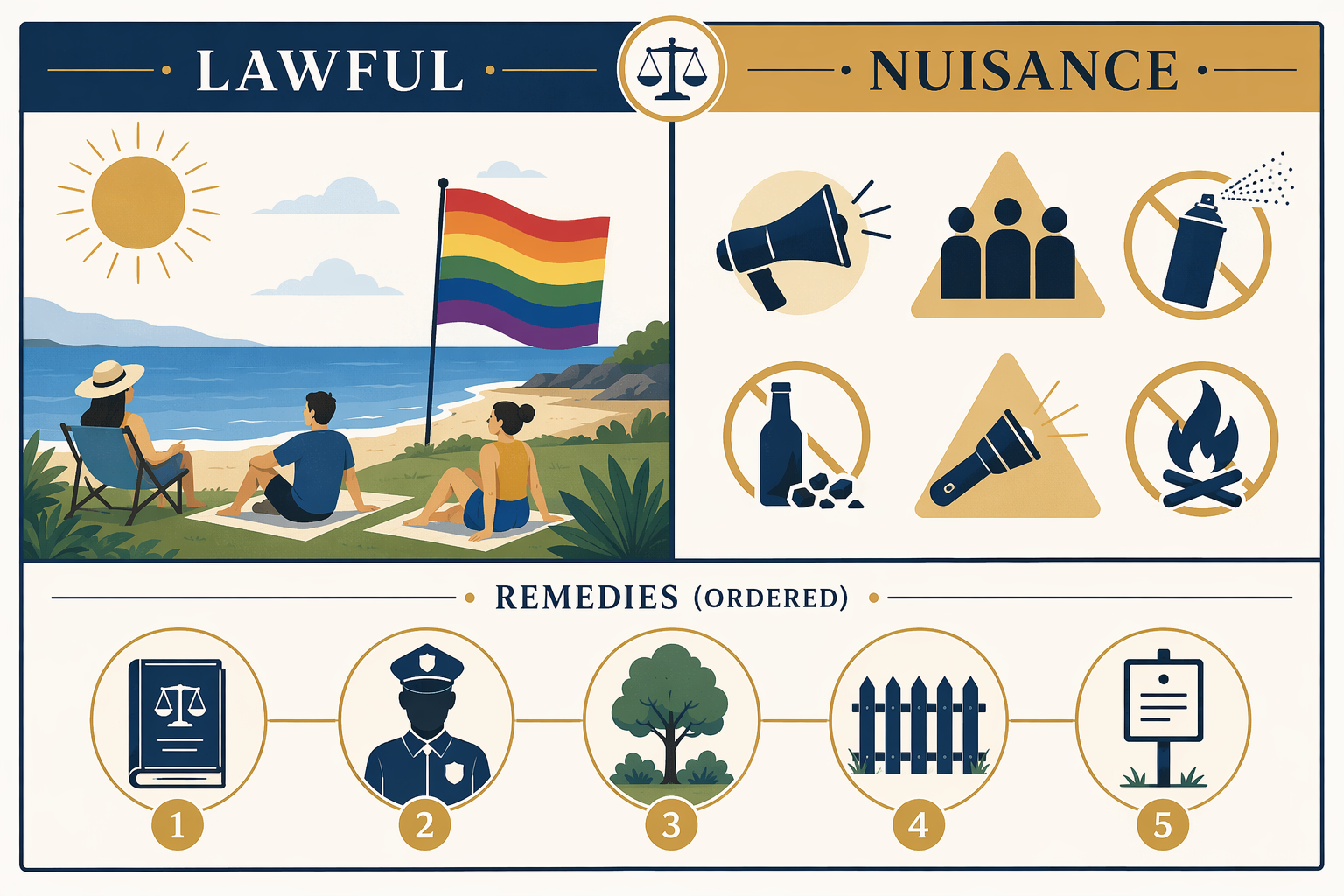
As reported by KOMO, the permanent injunction requires five measures: a code-of-conduct or user plan, dedicated staffing to monitor conduct, vegetation maintenance, buffers or boundaries from adjacent properties, and signage.[1] Seattle Gay News also reported that the court ordered the city to further abate public-nuisance activities while allowing the park to remain open.[6] Read together, the measures are not a generic civility program. They are the machinery that lets the city enforce the court’s distinction.
| Measure | Administrative Function |
|---|---|
| Code of conduct or user plan | Turns the legal line into visitor-facing rules that staff can apply without treating nudity itself as misconduct. |
| Dedicated staffing | Creates an identifiable monitoring responsibility instead of leaving enforcement to occasional complaint response. |
| Vegetation maintenance | Reduces concealed areas associated with lewd conduct while avoiding a rule against clothing-optional use. |
| Buffers or boundaries | Separates park use from adjacent private property and trespass concerns. |
| Signage | Gives notice to visitors and helps staff justify consistent intervention when conduct crosses the line. |
The code-of-conduct piece is especially important. A park rule that says “no nudity” would be easy to understand and legally overinclusive in this setting. A rule that says “do not engage in sexual conduct, voyeurism, trespass, harassment, or other prohibited behavior” requires more judgment but tracks the nuisance finding more closely. That is the price of preserving a lawful use while regulating unlawful acts.
Dedicated staffing addresses a different failure: the absence of an accountable enforcement channel. If employees are present only episodically, or if every response depends on ad hoc escalation, the city cannot reliably distinguish between a nude sunbather and a person creating a nuisance. Staffing does not require theatrical policing. It requires someone with authority, training, and a script that does not change depending on who complained last.
Vegetation, boundaries, and signage are more physical tools, but they also serve legal functions. Sightlines can make prohibited conduct harder to conceal. Boundaries can reduce trespass conflicts with adjacent owners. Signs can tell visitors, residents, staff, and responding officers what the city itself understands the rules to be. None of those measures depends on pretending that nude presence is the nuisance.
Neighborhood Pressure Belonged in the Record, Not at the Center
The plaintiffs were led by Stuart Sloan, the former QFC owner whose adjacent mansion has been reported as worth more than $20 million.[6] Seattle Gay News reported that Sloan texted Mayor Bruce Harrell photos of nude visitors and had pledged $1 million for a playground proposal that was later scrapped after public outcry.[6] Those facts explain why the dispute became public and politically charged. They do not, by themselves, answer the nuisance question.
Wealthy-property-owner pressure is relevant when it helps explain city behavior, proposed changes, or the suspicion among beach users that enforcement might become displacement. It is less useful as a substitute for legal analysis. A nuisance can be real even when an unpopular plaintiff raises it. A remedy can be overbroad even when neighbors have legitimate complaints. The ruling’s value is that it did not need to make Sloan the protagonist in order to decide what Seattle must do.
Seattle’s Acceptance Does Not End the Legal Uncertainty
The Mayor’s office issued a July 16, 2026 statement saying the city would comply with the court’s order.[7] That matters for implementation, but it does not mean every affected group accepts the ruling’s factual findings or remedial boundaries. The Stranger reported that Friends of Denny Blaine “respectfully disagrees” with portions of the findings and is evaluating an appeal to restore full clothing-optional status across the entire park.[3] That should be treated as a live possibility, not as a filed appellate event.
There is also a source limitation. The full 14-page order was not available in the provided research materials. The analysis here relies on quoted and summarized portions from KOMO, The Stranger, Real Change, Seattle Gay News, the City of Seattle statement, and historical background sources. Until the order is available directly, the safest formulation is that the court found these facts as reported by those outlets, not that every phrase quoted in coverage has been independently checked against the signed order.
The Practical Template for Other Cities
The Denny Blaine decision is not a national precedent and should not be described as one. It is a King County Superior Court ruling applying Washington law to a specific record. But it can still serve as a practical template for municipalities managing contested parks, beaches, plazas, encampment-adjacent spaces, or other public areas where lawful presence is being conflated with abatable misconduct.
The template has several parts. First, define the lawful use with care. At Denny Blaine, that meant recognizing simple nudity and the beach’s long-standing queer and trans community use. Second, define the nuisance conduct separately and concretely. Third, document the city’s knowledge and response, including any internal instructions that make enforcement less predictable. Fourth, choose remedies that correspond to the misconduct rather than suppressing the lawful use that happens nearby.
For municipal defendants, the uncomfortable lesson is that avoidance may become evidence. If a city discourages staff from responding because the facts are politically sensitive, the eventual record may show not neutrality but differential non-enforcement. For plaintiffs, the lesson is equally sharp: evidence of specific illegal conduct may support abatement, but it does not automatically justify erasing a protected or historically significant public use.
The administrable line is the point. Nude bodies were not treated as the nuisance. Sex acts, masturbation, voyeurism, trespass, and a city enforcement structure unable or unwilling to respond consistently were treated as abatable. That is a narrower ruling than either side’s rhetoric might prefer, and for that reason it is more useful.
References
- Seattle ordered to further curb nuisance nudity at Denny Blaine Park, beach to remain open, KOMO News.
- Seattle v. Johnson, Washington Court of Appeals, 1990.
- Denny Blaine Park Stays Open and Naked, Judge Rules, The Stranger.
- Denny Blaine Park, Wikipedia.
- The trial of Denny Blaine | July 8-14, 2026, Real Change, July 8-14, 2026.
- Judge allows Denny Blaine Park to remain open but orders city to further abate 'public nuisance' activities, Seattle Gay News.
- City of Seattle Statement, Mayor's Office, July 16, 2026.
Comments
Join the discussion with an anonymous comment.