
The legally interesting number in Devonte Wyatt’s new Packers extension is not the $57 million headline. It is the $20 million reportedly guaranteed at signing, because that figure does much more work than the press-release shorthand suggests. NFL Network reported that Green Bay and Wyatt agreed to a three-year, $57 million extension with a $20 million signing bonus and $20 million guaranteed at signing, making the initial guarantee 35.1% of the stated contract value.[1]
That is a very different guarantee profile from the one Wyatt entered the league with. Spotrac lists his rookie contract as a four-year, $12.86 million deal that was fully guaranteed at signing.[2] One player, two Green Bay contracts, and two sharply different approaches to downside: the first-round rookie regime gave Wyatt a 100% guarantee baseline; the veteran extension leaves most of the stated value outside the reported guaranteed-at-signing amount.
That contrast is the right entry point for a legal analysis of Wyatt’s NFL contract terms because “guaranteed” is not a single legal condition in NFL contracting. It is a shorthand label attached to several different protections, and the omitted detail often determines who bears the risk if the player is injured, declines, becomes cap-expensive, or is released before the stated term runs out.
What “guaranteed” can mean in an NFL contract
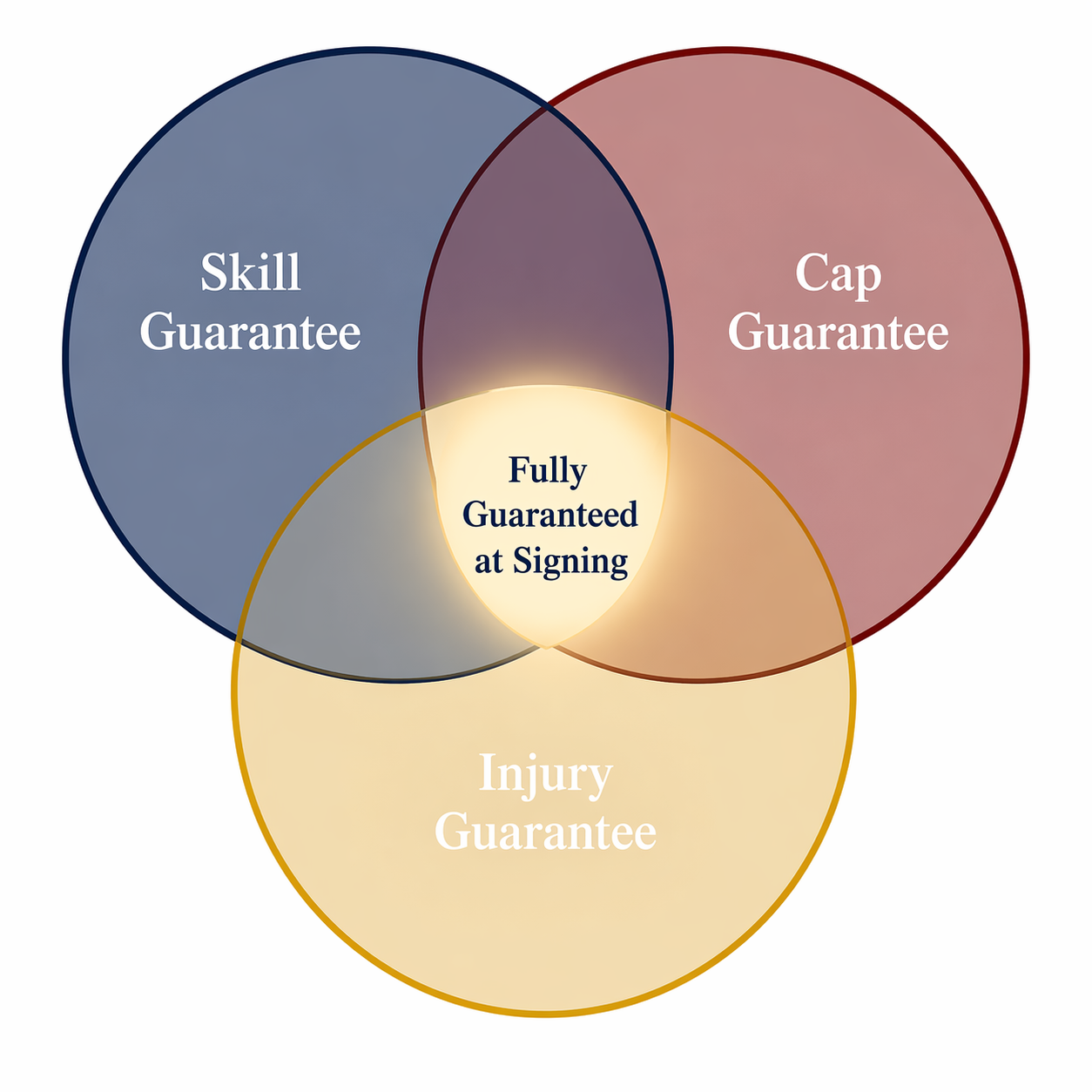
NFL Football Operations’ contract-language guide separates guarantees into three categories: skill, cap, and injury.[3] Those are not stylistic variations. They respond to different termination risks.
| Guarantee type | Risk it addresses | Practical effect |
|---|---|---|
| Skill guarantee | The club releases the player because it concludes he lacks the requisite football skill. | The protected amount remains payable even if the team says the player is no longer good enough to keep. |
| Cap guarantee | The club releases the player for salary-cap reasons. | The protected amount remains payable even if the team wants cap room rather than the contract. |
| Injury guarantee | The player cannot perform because of a football-related injury. | The protected amount remains payable if the covered injury prevents the player from passing a physical or performing under the contract. |
Money protected by all three is commonly treated as fully guaranteed at signing. Money protected only for injury is narrower. It may protect the player if he is hurt, but not necessarily if he is healthy and the club releases him for performance or cap reasons. Money protected for skill and cap but not injury would allocate a different slice of risk. The label “guaranteed money” therefore tells the reader less than it appears to tell unless the pillar coverage is known.
That distinction matters especially with Wyatt because the publicly reported extension terms disclose the reported dollar amount guaranteed at signing, not the full contract language. As of July 21, 2026, the available reporting does not confirm whether every dollar of the $20 million is protected by skill, cap, and injury, or whether some later amounts become protected only if Wyatt remains on the roster, passes a physical, reaches a vesting date, or satisfies another condition. The $20 million number is a starting point, not the contract.
Wyatt’s move from rookie certainty to veteran risk pricing
Wyatt’s rookie deal illustrates how the first-round contract structure can produce a clean guarantee profile. His four-year, $12.86 million rookie contract is listed as fully guaranteed.[2] At that stage, the legal architecture is heavily shaped by draft slotting and the rookie-contract system, not by a free negotiation over a mature injury record, leverage, and replacement cost.
The veteran extension is different because it arrives after Green Bay has seen the player absorb NFL wear, miss time, and occupy a known role in the defense. Packers Wire reported that Wyatt missed 10 of 34 regular-season games in 2024 and 2025, a 70.6% availability rate, after a fractured fibula and torn ankle ligaments ended his 2024 season on injured reserve.[4] Those facts do not prove the Packers’ internal pricing rationale. They do, however, supply the obvious risk-allocation context for why a club might prefer a lower fully protected percentage, a signing-bonus-heavy structure, or later-year compensation that requires continued availability.
Between the rookie deal and the extension sat the fifth-year option. Green Bay exercised Wyatt’s option in April 2025 at $12.93 million, with Acme Packing Company reporting that he fell into the default option tier based on his first three seasons of snap counts, including roughly 1,107 defensive snaps and about 29.5% of team plays.[5] The option gave the Packers a one-year bridge on a controlled price. The extension then replaced a short-term decision with a longer allocation of injury, performance, and cap risk.
That sequence explains why the comparison between 100% and 35.1% is useful but must be handled carefully. The rookie guarantee rate and the extension guarantee rate are not two offers made in the same market at the same legal moment. They are products of different regimes. Still, for the player, the practical transition is stark: the first contract protected the whole stated value at signing; the extension, as publicly reported, protects barely more than one-third of the stated value at signing.
Why the $20 million signing bonus matters
The reported structure puts the signing bonus at the center of the guarantee analysis. NFL Network described the deal as including a $20 million signing bonus and $20 million guaranteed at signing.[1] If those figures are coextensive, the principal guaranteed-at-signing protection may be the bonus itself rather than future base salary locked in through all three guarantee pillars.
That matters because a signing bonus is earned upon signing, while its salary-cap treatment is spread over the contract term through proration. A $20 million bonus on a three-year deal would create roughly $6.67 million per year in prorated cap charge under the ordinary cap-math treatment described in signing-bonus explainers.[8] The player receives the economic security of an earned bonus; the club accepts cap consequences that may accelerate if the player is later released or traded, depending on timing and structure.
That is not the same thing as saying the remaining $37 million is meaningless. Non-guaranteed salary can still be very real if the player remains healthy, performs, and stays on the roster. But from a legal-risk standpoint, future non-guaranteed compensation is conditional in a way a fully earned signing bonus is not. The player has the stated upside; the team keeps termination leverage over the unprotected portion.
The missing contract language is not a technicality
Public contract reporting often compresses legal structure into a few numbers: years, total value, signing bonus, guaranteed at signing, and sometimes total guarantees. That compression is useful for speed and comparability, but it omits the terms that determine how the deal behaves under stress.
- Are the reported guaranteed dollars protected for skill, cap, and injury, or only through the mechanics of an earned signing bonus?
- Do any later salaries vest into full guarantees on future dates?
- Are there per-game roster bonuses, workout bonuses, incentives, escalators, or de-escalators that change the practical value?
- If future salary is injury-guaranteed first, when, if ever, does it convert to skill-and-cap protection?
- Does the deal contain offset language affecting the club’s obligation if Wyatt is released and later signs elsewhere?
Offset language is a good example of why a guarantee number may overstate a player’s practical recovery. In general terms, offset provisions allow a team owing guaranteed money to reduce that obligation by the amount the player earns from a new club after release.[9] Over the Cap has also discussed offset language in the first-round rookie context, where teams have used it to prevent so-called double recovery after a released player signs elsewhere.[10] Whether Wyatt’s veteran extension includes comparable offset treatment has not been publicly confirmed.
The same caution applies to any claim that the extension is “fully guaranteed” for $20 million. It may be accurate in common usage if the $20 million signing bonus is earned immediately. But for a lawyer reading the deal, the next question is whether the protection is generated by bonus mechanics, by express skill-cap-injury language, or by some combination of both.
What the guarantee rate signals in context
Wyatt’s 35.1% guaranteed-at-signing rate sits close to, but below, reported leaguewide veteran guarantee benchmarks. Over the Cap’s guarantee-growth analysis placed veteran full skill/cap/injury guarantees at about 37% in 2024 and injury-only guarantees at about 46%, while noting that full SIC guarantees had risen from 31.4% in 2016.[7] Those figures are not a position-specific valuation model for Wyatt. They are useful because they show that his initial guarantee percentage is not unusually rich by broader veteran standards.
The more pointed comparison is John Franklin-Myers. Over the Cap lists Wyatt’s extension alongside a much higher guarantee profile for Franklin-Myers: three years, $63 million, with $42 million guaranteed, or 66.7%.[6] Against Wyatt’s reported 35.1%, that is a gap of about 31.6 percentage points. No public source establishes a single cause for that difference, and it would be too neat to attribute it all to Wyatt’s injury history. Age, market timing, role, negotiating leverage, club needs, and structure can all affect guarantees. But the gap is large enough to make Wyatt’s injury-limited availability relevant to the analysis rather than incidental.
This is where the legal reading differs from a fan reading. The fan sees whether the Packers kept a defensive lineman. The contract reader asks which future bad facts the club refused to prepay for. If the player remains healthy and productive, the unguaranteed portions may be earned in the ordinary course. If the injury record worsens, the current public terms suggest Green Bay has preserved more exit flexibility than it would have preserved in a deal with a higher percentage of fully protected salary.
There is also some Packers-specific context for using contingent value with players carrying health questions. Zone Coverage described Christian Watson’s 2025 one-year, incentive-laden extension before his later four-year, $92 million deal in 2026 as a possible model for Wyatt.[11] That example should not be overread; wide receiver and defensive tackle markets are not the same, and Watson’s later contract followed its own facts. It does, however, fit the broader pattern of using lower guarantees or incentive-heavy structures when the club wants upside exposure without assuming the full availability risk on day one.
The legal consequence of the rookie-to-extension drop
The drop from a fully guaranteed rookie contract to a 35.1% guaranteed-at-signing extension should not be treated as a moral verdict on Wyatt or as a mystery. It is the ordinary hardening of contract risk once a player exits the rookie framework and his compensation is negotiated against a live professional record.
For Wyatt, the player-side tradeoff is clear enough from the public numbers. He receives a large signing bonus and a new-money extension before completing the option year. In exchange, the reported structure appears to leave a majority of the stated value dependent on future roster status, performance, health, or undisclosed vesting provisions. The deal gives him immediate security, but it does not replicate the blanket protection of his first-round rookie contract.
For Green Bay, the public structure is equally legible. The Packers obtain contractual control over a player they wanted to keep while avoiding a guarantee profile that would make them absorb most of the downside if Wyatt’s 2024–2025 availability issues recur. That is risk allocation, not clairvoyance. The available record supports the conclusion that injury history is relevant context; it does not support a claim that the precise $20 million figure can be reverse-engineered from that history.
What can be concluded as of July 21, 2026
Wyatt’s extension is a useful teaching document precisely because it is not yet a fully visible one. The public terms show a three-year, $57 million deal, a $20 million signing bonus, and $20 million guaranteed at signing.[1] They also show a player moving from a 100% guaranteed rookie baseline into a veteran contract where the guaranteed-at-signing percentage is much lower.[2]
What the public terms do not show is the complete allocation among skill, cap, and injury protection. Without the actual contract language, the safest legal judgment is limited: the deal demonstrates how NFL guarantees operate as layered protections rather than a binary promise, and it suggests that Green Bay retained meaningful downside protection in light of Wyatt’s recent missed time. It does not allow anyone outside the contract to say with certainty which dollars are protected by skill, by cap, by injury, or by all three.
This is contract-structure analysis, not legal advice. The final legal answer would come from the signed agreement, the applicable CBA provisions, and any relevant addenda. Until those materials are public, “$20 million guaranteed” should be read as an important reported term, not as the end of the analysis.
References
- NFL Network: Packers, DT Devonte Wyatt agree to terms on three-year, $57M extension
- Spotrac: Devonte Wyatt Contract, Salary & Cap Hit 2026
- NFL Football Operations: NFL Football Operations — Contract Language Guide
- Packers Wire: Packers face conundrum with Devonte Wyatt contract entering 2026
- Acme Packing Company: Packers exercise 5th-year option on Devonte Wyatt
- Over the Cap: Devonte Wyatt Contract Details
- Over the Cap: Looking at Guaranteed Salary Growth in the NFL
- SportsOrca: Signing Bonus Proration Explained: NFL Cap Math for 2026
- Pro Football Rumors: NFL Offset Language, Explained
- Over the Cap: Offset Language Should Never Cause Players to Miss Time
- Zone Coverage: Is Watson's Extension A Blueprint For Devonte Wyatt's Next Contract?
Comments
Join the discussion with an anonymous comment.