
The phrase “DHS vetting legal standards after shooting” can point in several directions in 2026: screening after the D.C. National Guard attack, immigration adjudication holds, or national-security vetting. But the sharper legal problem exposed by the 2025–2026 shootings is narrower and harder to solve. When ICE or CBP officers use deadly force, the governing rules are not one rule. They are a constitutional minimum, an internal DHS policy that sounds more demanding, and a remedial system that often gives the injured person’s family no civil route comparable to the one available after a state or local police shooting.
That mismatch matters because the public record is no longer theoretical. By July 2026, The Guardian reported that 10 people had been fatally shot by immigration officials during President Trump’s second term.[1] TIME separately examined 13 vehicle-shooting incidents involving immigration agents from July 2025 through January 2026, including episodes in which DHS accounts were later challenged by video or other reporting.[2] Those numbers do not make every shooting legally identical. They do make the legal architecture visible.
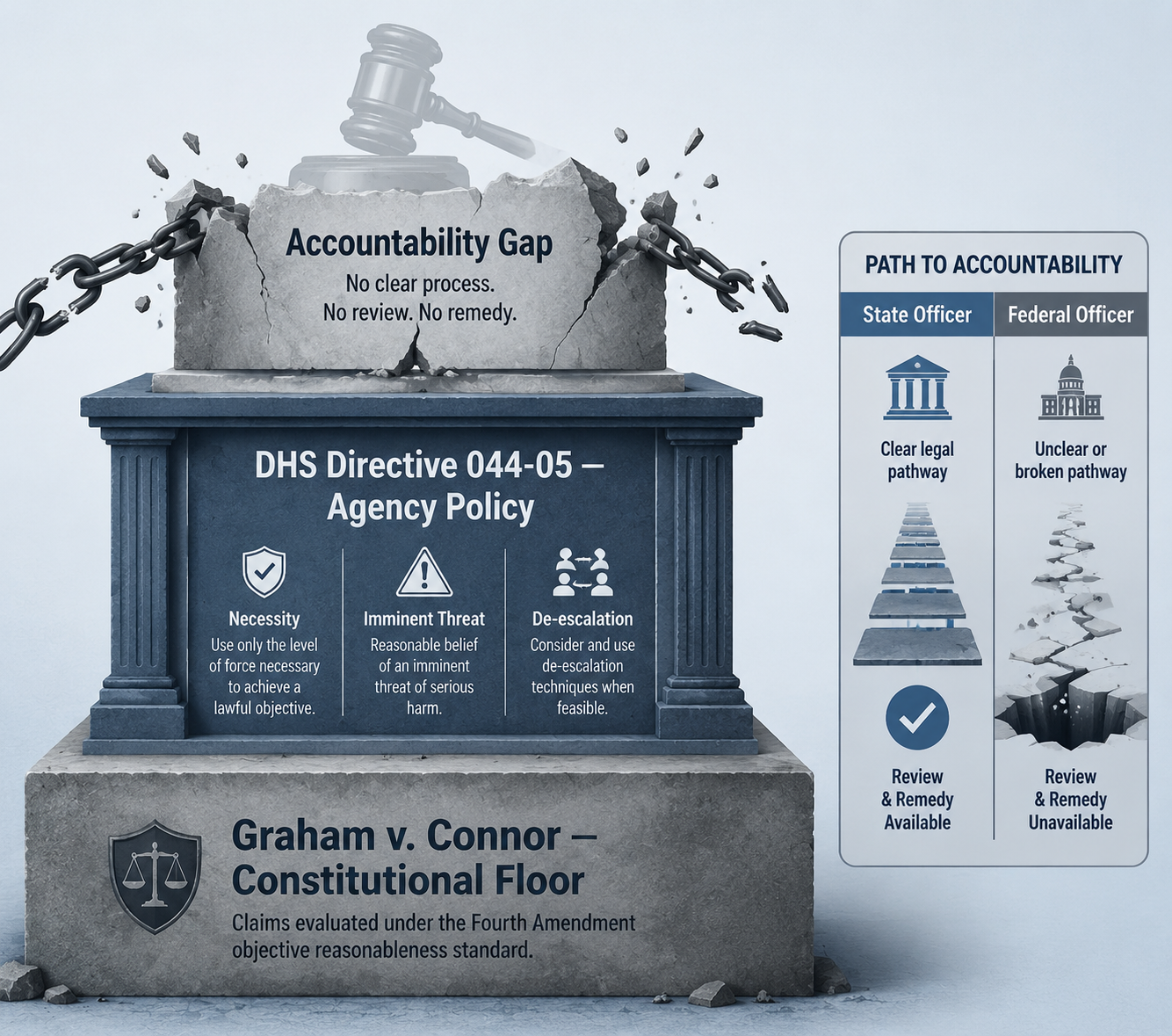
The constitutional floor is Graham, and it is a low floor
The starting point for any federal use-of-force analysis is still Graham v. Connor. In 1989, the Supreme Court held that claims that officers used excessive force during an arrest, investigatory stop, or other seizure are analyzed under the Fourth Amendment’s “objective reasonableness” standard, not under a generalized substantive-due-process test.[3]
The operative words are “objective” and “reasonable,” but Graham gives those words a particular orientation. Courts must judge the use of force from the perspective of a reasonable officer on the scene, rather than with “the 20/20 vision of hindsight.” The inquiry allows for the fact that officers often make split-second judgments in tense, uncertain, rapidly evolving circumstances.[3]
For lawyers, that language does two things at once. It prevents the government from defending force merely by pointing to an officer’s subjective good faith. But it also builds deference into the test before the facts are even applied. The court is not asking whether a later reviewer would have waited, retreated, used cover, sought backup, or handled the stop differently. The court asks whether the force used was objectively unreasonable from the officer’s on-scene perspective.
Graham also names factors that commonly matter: the severity of the crime, whether the person posed an immediate threat, and whether the person was actively resisting arrest or attempting to flee.[3] In a vehicle-shooting case, that tends to put immense pressure on a few seconds of evidence: the angle of the vehicle, the officer’s position, whether the car was moving toward someone or away, whether other officers were nearby, and whether the threat was still imminent when shots were fired.
That is why video matters so much. A DHS press release may say an officer was dragged, surrounded, or placed in danger. A complaint may say the opposite. Graham does not decide which account is true. It decides what kind of factual dispute will matter once the record is built, and it often makes the officer’s claimed perception the center of gravity.
DHS’s own policy says more than Graham
DHS Directive 044-05, updated in 2023, does not read like a policy content to rest at Graham’s constitutional floor. It states that law-enforcement officers and agents may use force only when necessary and may use deadly force only when the officer or agent has a reasonable belief that the subject poses an imminent threat of death or serious bodily injury to the officer, the agent, or another person.[4]
That language is doing work. “Necessary” is not the same as “not unconstitutional.” “Imminent” is not the same as inconvenient, evasive, or noncompliant. “Reasonable belief” is not a blank check; it is a belief that must be tested against the facts available at the time. The Directive also includes de-escalation language, medical-assistance expectations, reporting and review requirements, and annual training obligations.[4]
The moving-vehicle provision is especially important given the recent reporting. Directive 044-05 restricts shooting at a moving vehicle unless the vehicle poses an imminent threat of death or serious bodily injury and deadly force is the only reasonable means available to stop the threat.[4] A fleeing car is not automatically an imminent deadly threat. A car that has already passed the officer may present a different question than a car bearing down on a person trapped in its path. The policy requires the distinction.
| Layer | What it asks | What it does not itself guarantee |
|---|---|---|
| Graham v. Connor | Was the force objectively reasonable under the Fourth Amendment from the officer’s on-scene perspective? | A damages remedy against a federal officer |
| DHS Directive 044-05 | Was deadly force necessary, based on a reasonable belief of an imminent threat, and consistent with DHS policy limits? | Independent public enforcement or a private cause of action |
| Post-Egbert remedies | Is there a recognized cause of action for damages against the federal officer? | A federal analogue to § 1983 |
The legal tension is therefore not whether DHS has words on paper. It does. The tension is what follows when those words are breached. A policy violation can matter administratively. It can matter evidentially. It can matter to public credibility. But unless it also maps onto a viable constitutional claim with a viable remedy, the family may find itself litigating a locked door.
Federal officers stand in a different remedial posture
If a city police officer violates the Constitution, the usual civil-rights statute is 42 U.S.C. § 1983. It creates a cause of action against state and local officials who, under color of state law, deprive a person of federal rights. Qualified immunity may still defeat the claim. Municipal-liability doctrine may still narrow the case. State-law immunities may still complicate the pleading. But the plaintiff at least begins with a statutory vehicle.
There is no general federal-officer analogue to § 1983. Stanford Law’s January 2026 interview with Robert Weisberg described the resulting asymmetry: federal officers may face weaker accountability than state officers because constitutional damages claims against them depend on Bivens, and Bivens has been sharply narrowed by the Supreme Court.[5]
That narrowing became especially consequential after Egbert v. Boule in 2022. Egbert involved a Border Patrol agent and left lower courts with a strong signal not to extend Bivens into new contexts where Congress has not authorized a damages remedy. For immigration-enforcement shootings, the practical result is that the constitutional right and the civil remedy are no longer the same conversation. A lawyer can believe the force was unconstitutional and still have to tell the client that the federal damages claim may not exist.
Sheffield’s ACS Expert Forum essay puts the statutory problem directly: federal officers operate in an accountability deficit because Congress has never enacted a § 1983-style cause of action for constitutional violations by federal officials.[6] The essay’s sharpest phrase is also its legal point: without a damages remedy, federal officers can acquire a “practical license to violate the constitution with impunity.”[6]
State criminal prosecution does not neatly fill the gap. Weisberg also identifies supremacy-clause immunity as a major barrier: when federal officers act within the scope of federal duties and have a plausible federal justification, state prosecution can be blocked.[5] That does not mean federal officers can never be prosecuted. It means that a local district attorney is not situated like a prosecutor reviewing a purely local police shooting.
Federal prosecution remains possible in theory, and internal discipline remains possible in practice. But both routes depend on institutions that are not controlled by the injured person or family. A civil cause of action is different. It gives the claimant a procedural vehicle to demand documents, test testimony, obtain video, retain experts, and force a public adjudication. Without it, the legal system may recognize a constitutional boundary while withholding the tool normally used to enforce it.
The vehicle cases show why the first account cannot be the last account
The TIME investigation into immigration-agent authority after the shootings is useful because it does not ask readers to assume that all DHS accounts are false. It shows something more lawyerly and more troubling: several incidents turned on official descriptions that later had to be measured against video, witness accounts, or other reporting.[2]
In vehicle shootings, verbs decide cases. “Drove at” is different from “drove away from.” “Dragged” is different from “brushed.” “Pinned” is different from “near.” Under Graham, those verbs can determine whether an officer reasonably perceived an immediate threat. Under Directive 044-05, they can determine whether deadly force was necessary and whether the vehicle was the only reasonable means of stopping an imminent deadly threat.[3][4]
The Renee Good shooting in Minneapolis illustrates the stakes of that evidentiary sequence. TIME reported on initial DHS claims and video evidence that complicated or contradicted parts of the government’s account.[7] The legal significance is not that media reporting resolves the merits. It is that a family, a court, or the public cannot evaluate necessity, imminence, and reasonableness if the operative record remains inside the agency that employed the shooter.
This is where internal review is structurally inadequate even when it is earnest. An internal process may identify training failures, policy violations, or factual inconsistencies. It may also protect investigative integrity in the early stages. But it is not the same as adversarial discovery, independent civil litigation, or a public judicial finding. The difference becomes decisive when the official narrative is later narrowed, corrected, or contradicted.

DHS policy is not unusually weak on paper
One reason the DHS problem can be misdescribed is that the written policy already contains much of the vocabulary reformers often seek. Necessity. Imminence. De-escalation. Restrictions on shooting at vehicles. Training. Reporting. Review. The policy is not simply Graham copied into an agency manual.[4]
A Stanford Center for Racial Justice policy brief published in February 2026 found that 48% of the 100 largest U.S. cities require force to be both necessary and proportionate, moving beyond Graham’s constitutional floor.[8] That municipal comparison should be used carefully. City police departments, DHS components, border operations, and immigration fugitive operations do not present identical settings. Local reform language also does not guarantee local accountability.
Still, the comparison matters. Many large-city policies have recognized that Graham is too blunt as a governance standard. DHS has also adopted policy language that purports to demand more. The missing element is not only drafting. It is enforceability by someone outside the chain of command.
What reform would have to reach
S.3470, the Accountability for Federal Law Enforcement Act, was introduced in December 2025 by Senator Alex Padilla and referred to the Senate Judiciary Committee.[9] The bill would create a federal cause of action against federal officers for constitutional violations, addressing the missing statutory analogue to § 1983.[9] Its introduction is not evidence that it will pass. It is evidence that the remedial gap has become a legislative target rather than only an academic complaint.
The politically narrower compromise associated with Erwin Chemerinsky would create a federal § 1983 analogue while retaining qualified immunity.[6] Civil-rights lawyers may object that qualified immunity already blocks too many meritorious claims. Agency lawyers may object that any new damages action will chill enforcement. But the compromise identifies the central missing piece: a statutory vehicle that lets a court hear the claim at all.
A serious reform path would have to distinguish at least three questions that often get collapsed:
- Policy content: whether DHS’s written use-of-force rules adequately define necessity, imminence, proportionality, de-escalation, vehicle shootings, reporting, and training.
- Record production: whether families, counsel, journalists, and reviewing bodies can obtain enough evidence to test the initial account.
- External remedy: whether a person injured by a federal officer’s unconstitutional force has a cause of action comparable to the one available against state and local officers.
The first question is partly answered already. DHS has a stricter policy vocabulary than Graham in important respects. The second and third questions remain the harder ones. A rule that cannot be tested against a public record, and cannot be enforced by the person harmed, is a rule whose practical force depends heavily on the agency’s willingness to police itself.
The accountability gap is the legal standard in operation
It is tempting to end the analysis by saying that DHS officers are governed by Graham and Directive 044-05. Formally, that is true. Operationally, it is incomplete. A standard means less when violation of the standard does not reliably produce an external consequence.
The post-shooting legal question is therefore not only whether a particular officer’s fear was reasonable or whether a particular vehicle created an imminent deadly threat. It is also who gets to test those assertions, with what evidence, before what tribunal, and under what cause of action. After Egbert, that last phrase does much of the damage.
For legal professionals evaluating the 2025–2026 DHS shooting record, the point is structural rather than advisory. Graham supplies the constitutional floor. Directive 044-05 supplies a more demanding internal rule. The unresolved federal-law question is whether Congress or the courts will provide an external damages remedy, or some comparable accountability mechanism, when federal immigration officers cross constitutional limits.
References
- 10 people fatally shot by immigration officials in Trump’s second term, The Guardian, July 2026
- What Immigration Agents Can—and Can’t—Do Under the Law, TIME
- Graham v. Connor, 490 U.S. 386 (1989), Justia
- Department Policy on the Use of Force, Department of Homeland Security, 2023
- Can ICE Agents Be Prosecuted? Stanford Law’s Robert Weisberg Explains Federal Shootings and Constitutional Limits, Stanford Law School, January 27, 2026
- DHS Reforms Must Make Federal Officers Liable for Constitutional Rights Violations, ACS Expert Forum
- Fatal ICE Shooting Sparks Scrutiny of Killings, TIME
- The Brief: Raising the Standard for Using Force, Stanford Center for Racial Justice, February 2026
- S.3470 - Accountability for Federal Law Enforcement Act, Congress.gov, 119th Congress
Comments
Join the discussion with an anonymous comment.