
DOJ Pushes to Sideline State Bar Ethics Investigations
The DOJ's March 2026 proposed rule would let the attorney general indefinitely suspend state bar ethics investigations into its attorneys, directly challenging the McDade Amendment and decades of attorney accountability. This article examines the rule's mechanics, the unprecedented public opposition, and the prospects for litigation and state bar resistance.
- Hallucination rate
- Not measured / undisclosed
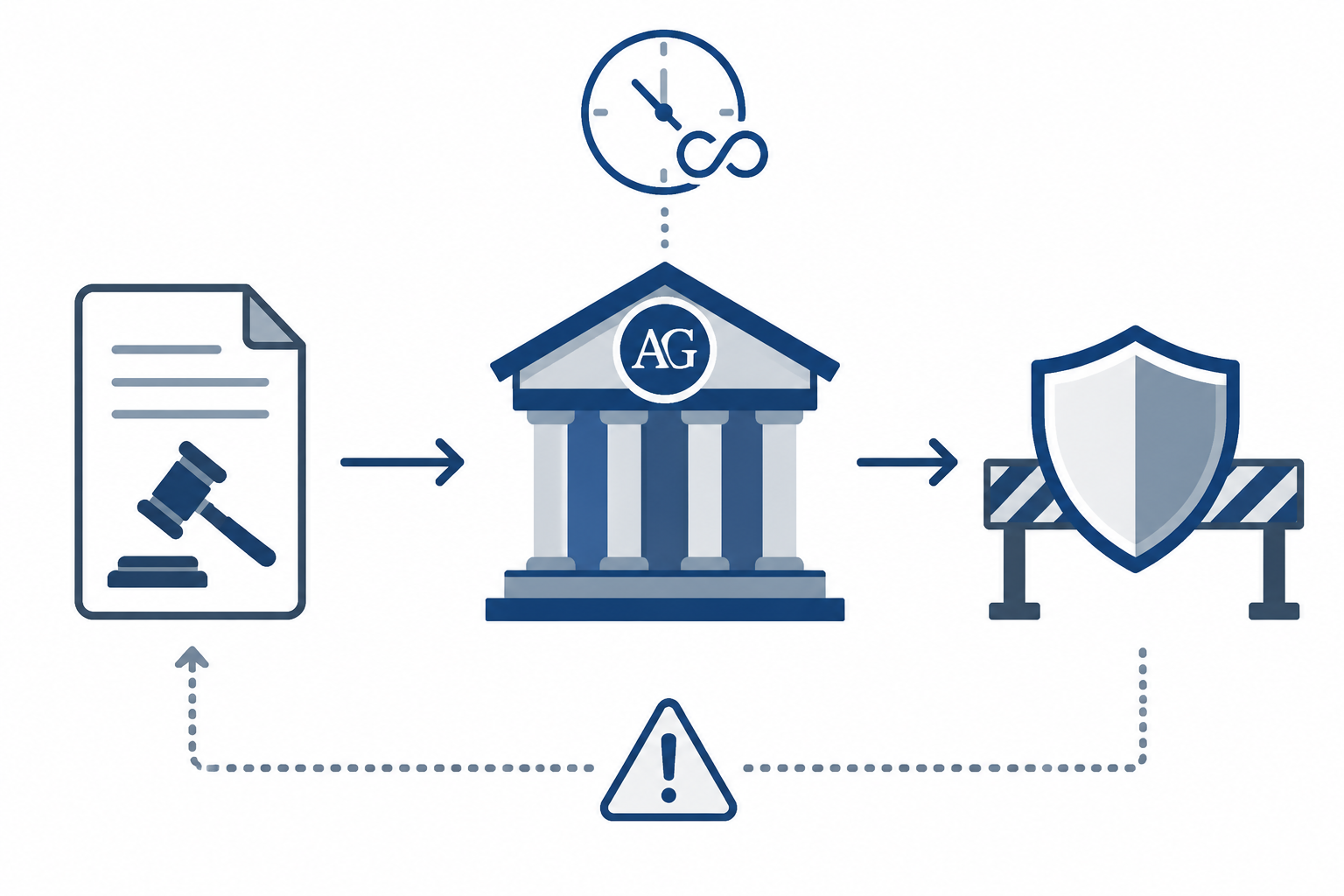
The most important part of the Justice Department’s March 2026 proposed rule is not its vocabulary about political targeting. It is the pause button. Under the proposal, when a state bar receives an ethics complaint against a current or former DOJ attorney, the attorney general could demand the right to review the matter “in the first instance.” The bar would then be expected to suspend its own disciplinary process while DOJ conducts that review, with no clear deadline for when the attorney general must finish. If a bar proceeds anyway, the rule says the department may take “appropriate action.”[1]
That mechanism matters because attorney discipline often turns less on grand constitutional declarations than on who controls intake, timing, and jurisdiction. A complaint that cannot move is not an active complaint in any practical sense. A disciplinary body that must wait indefinitely while the lawyer’s own employer decides whether review may continue is not exercising ordinary first-instance authority. For lawyers outside government, that would be an extraordinary privilege. For federal prosecutors and other DOJ lawyers, it runs straight into the statute Congress enacted to prevent precisely this kind of exceptionalism.
The McDade Amendment Is the Load-Bearing Statute
The legal conflict begins with 28 U.S.C. § 530B, commonly known as the McDade Amendment. Enacted in 1998, it provides that DOJ attorneys are subject to state laws and rules, and local federal court rules, governing attorneys “to the same extent and in the same manner as other attorneys” in the state where the attorney performs duties.[1]
That language was not ornamental. The McDade Amendment followed years of conflict over whether federal prosecutors could claim immunity from state ethics rules when carrying out federal law-enforcement functions. Congress answered by preserving state ethics authority over DOJ lawyers rather than leaving the department to define the reach of its own professional obligations.[1]
The proposed rule does not openly say that state bars lose jurisdiction. That is part of what makes the design worth close attention. It works procedurally. The attorney general receives the first review; the state process waits; no firm deadline appears; and a state disciplinary authority that declines to wait faces the possibility of DOJ action. The result is not a formal repeal of McDade. It is a federal gate placed in front of the state disciplinary system Congress chose to preserve.
There is, so far, no reported court ruling on this exact review mechanism. That matters. The statutory objection is strong in principle, but the litigation question would likely turn on how a court characterizes the rule: as a permissible internal DOJ procedure for responding to complaints, or as an unlawful obstruction of state disciplinary authority. The department will almost certainly describe it as the former. State bars and opponents will describe it as the latter.
A Suspension Without a Clock Is Not a Minor Administrative Step
In ordinary disciplinary administration, timing is not a technical afterthought. Witnesses leave jobs. Memories decay. Related litigation ends. Public officials move on. A complaint against a government lawyer may involve conduct tied to an investigation, charging decision, court representation, or advice to an agency head. If the disciplinary file is frozen while the lawyer’s own department conducts a first-instance review, the bar loses control of the stage where factual preservation and threshold screening usually occur.
The proposed rule’s defenders can fairly say that not every complaint deserves immediate bar machinery. Political actors have learned that disciplinary complaints can be used as press releases with letterhead. A bar complaint can burden a government lawyer even when it has little chance of producing discipline. That concern is real enough to deserve more than a dismissive footnote.
But there is a difference between screening frivolous complaints and giving the attorney general an indefinite first-instance hold over outside review. State bars already have intake procedures. Courts and disciplinary agencies already distinguish grievance rhetoric from rule violations. The DOJ proposal does something else: it centralizes the timing decision in the same institution whose lawyers are being complained about.
| Feature of the proposal | Practical effect |
|---|---|
| Attorney general review “in the first instance” | Moves the first meaningful review away from the state disciplinary body |
| No clear deadline for completing review | Allows a complaint to remain suspended for an undefined period |
| Expected state-bar suspension during DOJ review | Delays ordinary complaint intake and investigation |
| Threat of “appropriate action” if a bar proceeds | Raises the cost of state disciplinary independence |
The Profession Read the Rule as an Accountability Problem
The public response was unusually large for a rule about attorney discipline. Across two dockets, the comment period drew 48,803 submissions, reported as the largest number in Regulations.gov history for a DOJ rulemaking. Of those, Protect Democracy reported only 34 supportive comments, or about 0.1 percent.[2]
The raw number should not be treated as a plebiscite on legality. Comment campaigns can inflate volume, and Protect Democracy is an advocacy organization with an identified position against the rule. Still, the response is difficult to dismiss as routine partisan noise because many of the objectors were not merely interested observers. State bar associations, including those in Illinois and New York, publicly opposed the proposal, along with bar organizations in multiple other jurisdictions.[3]
That distinction matters. State bars are not just commentators in this dispute. They are the oversight bodies whose authority would be displaced or delayed. When those institutions object, they are defending the working jurisdiction of the disciplinary system, not simply expressing a view about DOJ management.
That divide explains why the dispute is only partly about political targeting. The department frames the rule around the targeting of its lawyers. The legal ethics profession, judging from the available comments and bar responses, appears to have focused on a more durable question: whether a federal agency may use rulemaking to decide when state professional regulators are allowed to proceed against that agency’s attorneys.
The Weaponization Concern Is Real, but the Cure Is Doing Different Work
DOJ’s stated justification rests on what it called the “unprecedented weaponization of the State bar complaint process.” The concern is not invented from nothing. Recent political-ethics fights have included organized complaint efforts from groups across ideological lines, including the 65 Project and Campaign for Accountability on one side of the political spectrum and America First Legal on another.[5]
A serious version of DOJ’s argument would begin there. Lawyers in government should not face professional jeopardy merely because their work occurs in politically charged cases. State bars should not become auxiliary campaign instruments. A complaint system that permits anyone to file also needs a way to dispose of allegations that are plainly retaliatory, duplicative, or jurisdictionally defective.
The proposed rule, however, is not limited to complaint triage. It does not appear to require a threshold showing that a complaint is politically motivated. It does not merely create a notice process, a coordination channel, or a request for temporary deferral tied to a pending federal proceeding. It gives the attorney general first-instance review authority over complaints against DOJ lawyers and pairs that with an undefined suspension period. That is a structural remedy for a narrower abuse problem.
This is where the rule departs from ordinary concern about politicized discipline. The professional responsibility system can be abused, but the answer to abuse is usually better screening by the regulator, clearer standards for summary dismissal, or sanctions for knowingly false complaints. Placing the initial review inside the respondent lawyer’s chain of institutional command changes who controls the disciplinary door.
The OPR Context Makes the Outside Check More Important, Not Less
The proposed rule did not arrive in an institutional vacuum. Brennan Center reporting describes a broader weakening of DOJ’s Office of Professional Responsibility, including changes affecting career ethics officials and the department’s internal accountability structure.[4]
That source is also an advocacy source, and its interpretation should be read with that in mind. But the institutional point does not depend on accepting every rhetorical conclusion. If DOJ is simultaneously narrowing the practical force of outside state-bar review and weakening internal professional-responsibility capacity, the accountability gap grows from both directions. Internal review becomes less reassuring precisely when the department is asking state regulators to stand down.
That is why the issue should not be reduced to whether one trusts a particular attorney general. Ethics systems are built for succession. They are supposed to remain usable when the officeholder is unpopular, when the complainant is opportunistic, and when the accused lawyer occupies a powerful public role. A procedure that depends on the good faith of the official who controls the pause is a weak substitute for a jurisdictional rule that can survive bad incentives.
What Could Happen Next
The rule’s current posture should be checked before reliance, because the cited reports address the proposal as of March 2026 and the rule may have been advanced, modified, withdrawn, or challenged since then. As a legal matter, several paths are plausible, but none should be treated as inevitable.
- Litigation: A state bar, bar official, affected complainant, or other party may attempt to challenge a final rule, but standing, ripeness, and the precise agency action would shape the case.
- Congressional action: Congress could use oversight, appropriations conditions, or clarifying legislation to reaffirm McDade’s application to DOJ attorneys.
- State-bar resistance: Disciplinary bodies could refuse to treat DOJ review as a basis for indefinite suspension, inviting a direct conflict over federal authority.
- Agency narrowing: DOJ could revise the rule into a shorter deferral process with deadlines, notice requirements, and a more specific standard for politically motivated complaints.
The least disruptive version of DOJ’s concern would address abusive complaints without displacing state disciplinary authority. That could mean notification to DOJ when a complaint concerns official duties, expedited state-bar screening for complaints that appear retaliatory on their face, or defined temporary deferrals tied to active criminal or national-security matters. Those tools would still raise questions, but they would not so plainly invert the McDade arrangement.
The March 2026 proposal goes further. Unless withdrawn or substantially narrowed, it functions as a direct test of whether DOJ can use rulemaking to neutralize the state-bar accountability system Congress preserved through the McDade Amendment.
References
- Justice Department Attempts to Shield Its Lawyers from Accountability for Misconduct, Brennan Center for Justice
- A new proposed DOJ rule suspending state bar investigations is deeply unpopular, Protect Democracy
- Trump DOJ Pushes to Sideline State Bar Ethics Investigations (3), Bloomberg Law
- The Department of Justice's Broken Accountability System, Brennan Center for Justice
- The Perilous War Over Legal Ethics in Government and Politics, Executive Functions
Chronological incident history
No sanction cases have named this tool in the tracked record set to date. This does not imply the tool is safe — see Risk Digest for ongoing monitoring.
← Compare peer toolsReport a correction or tip
Spotted an outdated figure, a misstated fact, or a ruling this tool profile should reflect? Public comments are disabled for this content given the professional cost of a misreported case outcome, penalty amount, or rule text — use the structured correction channel instead.
Report a correction or tip for this record →