
A search for “recalled garlic powder Dollarama legal action” starts in a sensible place: a food product was recalled, the regulator used a risk classification, and consumers want to know whether that means a lawsuit is next. In July 2026, the Canadian Food Inspection Agency posted a recall for Heavenly Spices Garlic Powder sold at Dollarama because of Bacillus cereus contamination and classified it as a Class 2 recall.[1] That sounds serious enough to unsettle anyone who bought the product. It is not, however, the same thing as a civil claim.
The load-bearing fact is easy to miss because it is less dramatic than the word “recall”: as of the recall reporting on July 15, 2026, no illnesses had been reported to either the CFIA or Dollarama.[1][2] Without reported illness, the legal analysis remains mostly hypothetical. A recall can tell consumers not to use a product and tell retailers to remove it from sale. It does not, by itself, prove that a particular person consumed the product, became ill, and suffered compensable loss because of it.

What the Class 2 label does, and does not, prove
The CFIA recall classification is a food-safety tool, not a pleading. In the Government of Canada recall framework, a Class 2 recall means there is “a moderate risk that consuming the food may lead to short-term or non-life-threatening health problems.”[1] That classification sits below a Class 1 recall, which is used where there is a high risk of serious health problems or death, and above a Class 3 recall, which concerns products unlikely to cause adverse health consequences.[1]
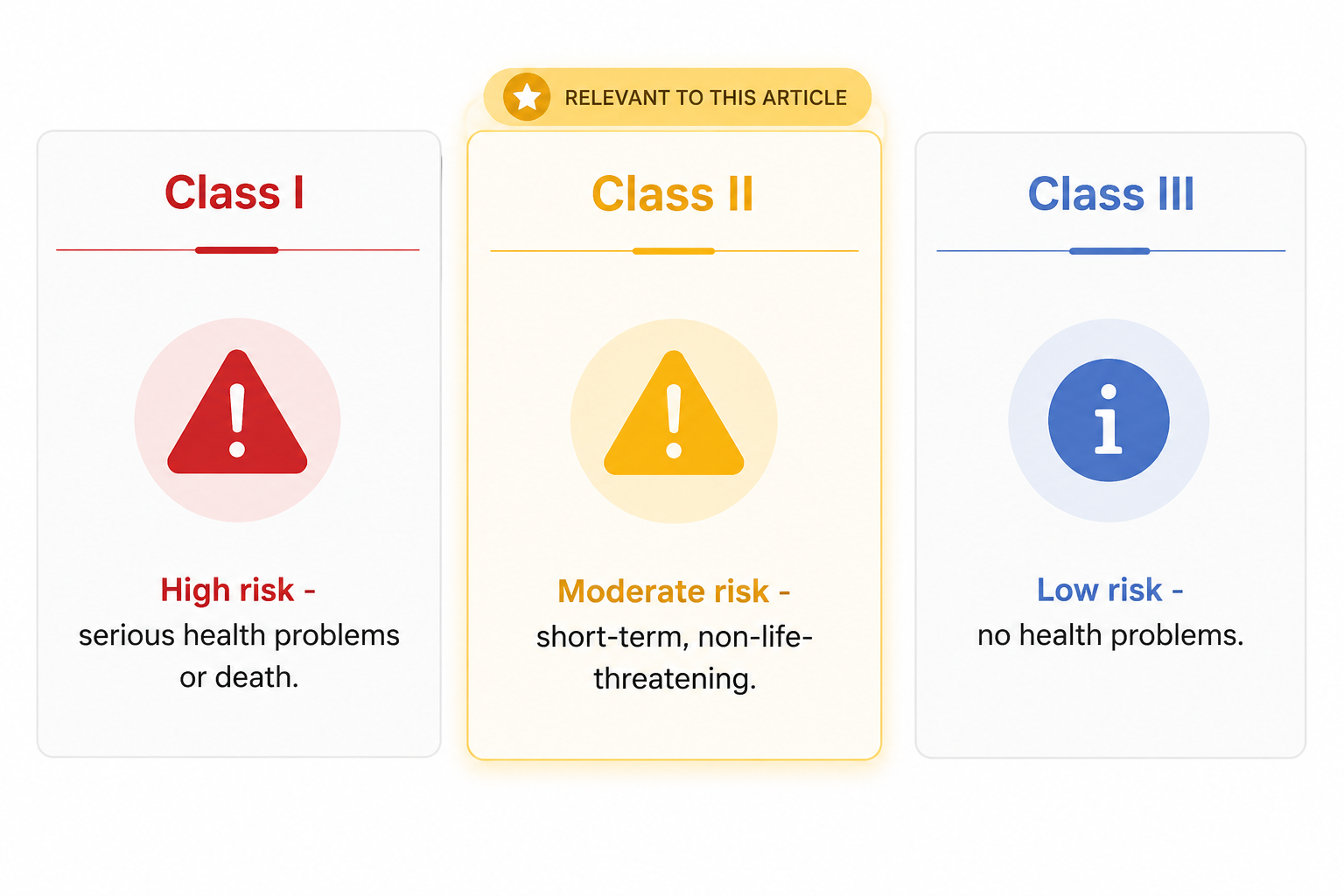
That distinction matters because public discussion often treats the classification as if it answers the liability question. It does not. A Class 2 designation says the regulator has enough food-safety concern to trigger a recall at a moderate-risk level. It does not identify an injured plaintiff, measure that plaintiff’s loss, or connect a specific illness to a specific jar of garlic powder.
For a retailer or manufacturer, the notice is still operationally significant. Product must be pulled, customers must be informed, records may need review, and communications have to be kept consistent. But civil exposure turns on a different set of questions. The regulator can act before anyone is sick; civil litigation generally needs someone who can prove they were harmed.
The missing steps between a recall and a product liability claim
Canadian product liability analysis usually asks for more than proof that a product was recalled. A plaintiff must connect the product to the person, the person to the injury, and the injury to a measurable loss. A practitioner summary of Canadian product recall rights describes the basic path in similar terms: defective product, injury or loss, causation, and damages remain central to the claim.[3]
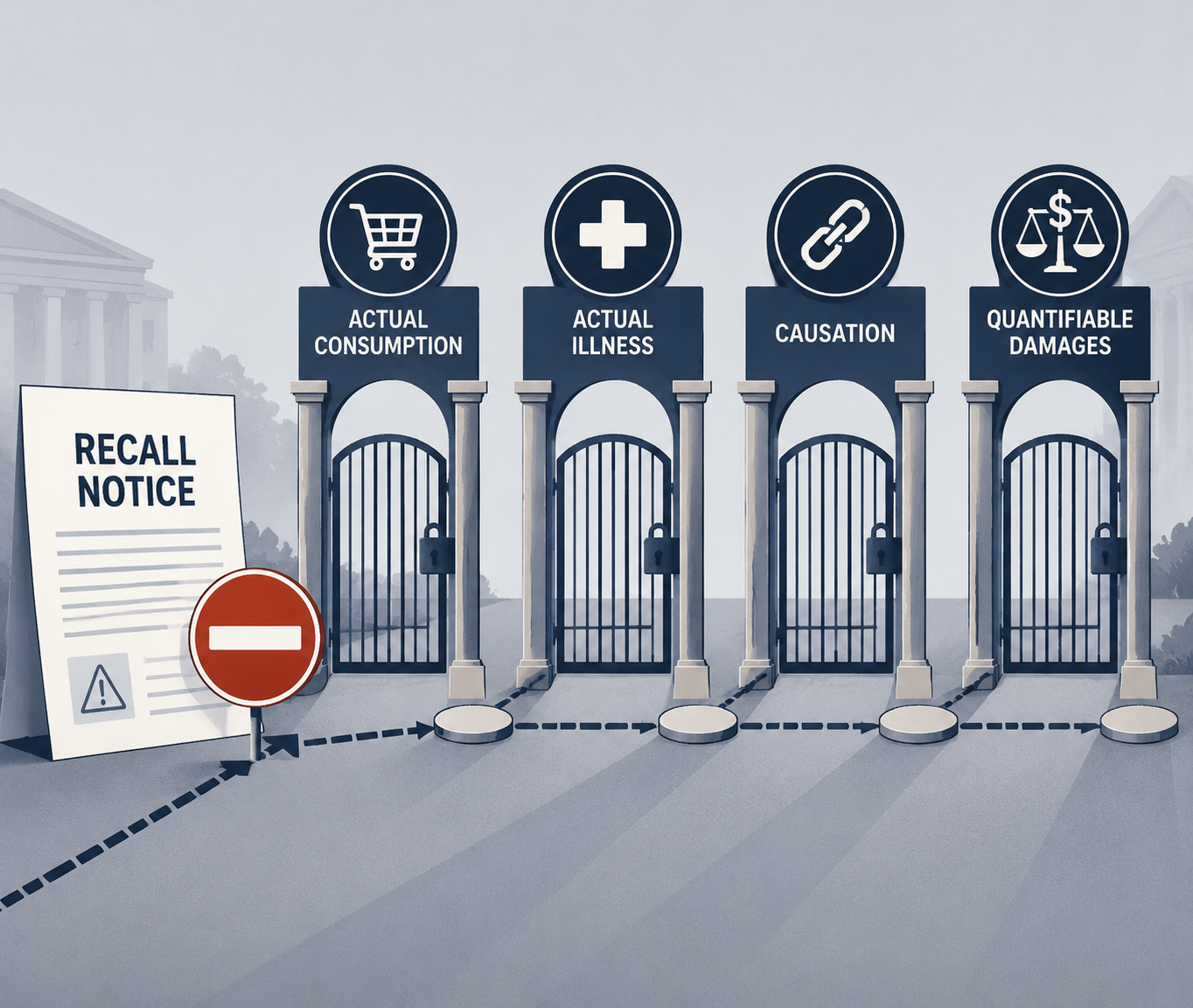
In this recall, the practical proof path would likely look like this:
| Question | Why it matters |
|---|---|
| Did the person buy the recalled Heavenly Spices Garlic Powder from Dollarama? | A purchase record may place the product in the household, but it does not prove exposure. |
| Did the person consume that specific product? | A recalled item sitting unopened in a cupboard creates inconvenience, not a bodily injury claim. |
| Did the person become ill? | A claim needs an injury or loss beyond the existence of the recall. |
| Can the illness be linked to Bacillus cereus from this garlic powder? | Timing, symptoms, alternative food exposures, and any medical or laboratory evidence would matter. |
| Were there quantifiable damages? | Medical costs, lost wages, or other measurable losses are different from frustration or discarded groceries. |
The recall notice itself does not answer any of those questions for an individual claimant. It identifies a regulatory problem with a product lot or product line. It does not show that a given consumer opened the jar, used it in food, developed symptoms, sought treatment, missed work, or incurred expense.
That is why the no-illnesses fact carries so much legal weight. If illnesses had been reported, counsel would still need to test causation and damages, but there would at least be a factual starting point for injury. As of July 15, 2026, the public record described no illnesses reported to the CFIA or Dollarama.[1][2] As of July 21, 2026, no class action specific to this Dollarama garlic powder recall had been publicly identified in the available public record. The recall was still recent, so that statement should not be mistaken for a prediction that no filing could ever appear.
Bacillus cereus affects the damages analysis
Bacillus cereus is not a harmless label on a laboratory report. The Government of Canada pathogen safety data sheet describes two main illness patterns. The vomiting form has an incubation period of about 30 minutes to 5 hours, while the diarrheal form has an incubation period of about 8 to 16 hours.[4] The same government profile states that symptoms usually resolve in less than 24 hours.[4]
For civil liability, that profile cuts in two directions. It supports the regulator’s concern that contaminated food can make people sick. It also affects the likely size and proof of damages where symptoms are short-lived, do not require treatment, and are difficult to distinguish from other brief gastrointestinal illnesses without stronger evidence.
The limitation should not be overstated. Public Health Agency of Canada material notes that severe instances can, in rare circumstances, lead to more serious complications or death, with elderly individuals and people with lower stomach acidity facing higher risk.[4] If a vulnerable person consumed the recalled garlic powder and developed a medically documented severe outcome, the damages analysis would not look like the analysis for an unopened $2 product. But that is a narrower scenario than the recall notice itself establishes.
The incubation periods also show why causation would be fact-intensive. A person who used the garlic powder in a meal and became sick within a compatible window would have a more coherent factual narrative than someone who only bought the product, cannot remember using it, or experienced symptoms days later after multiple other food exposures. A class action theory would have to manage those individual differences rather than assume that every purchaser stands in the same legal position.
The $2 e-gift card belongs in customer response, not liability proof
Dollarama’s reported response included offering a $2.00 e-gift card to affected customers.[2] For a consumer who bought the garlic powder, that amount may feel small but not irrelevant. A recall imposes a real chore: find the product, check whether it matches the notice, stop using it, decide whether to return it, and replace it if needed. Customer service measures address that inconvenience.
It would be a mistake, on the sources available, to turn the e-gift card into an admission of liability. Retailers often compensate or refund customers during recalls because it is faster, clearer, and safer than debating individual exposure at the store level. That posture can coexist with regulatory cooperation and consumer goodwill without conceding that any purchaser has a viable injury claim.
Why other food recall class actions are weak analogies
Food recall class actions can succeed. The point is not that recalls are legally meaningless. The point is that the successful or serious examples tend to have facts this recall does not yet have in the public record.
The public record offers two useful contrasts: litigation connected to the Quaker Oats recall, including a $6.75 million U.S. settlement and a Canada-wide class action filed by Slater Vecchio in January 2024, and the Silk/Great Value listeria recall, which involved a $6.5 million Canadian settlement.[5][6] Those matters involved Class I recalls and documented serious illnesses, making them poor direct analogues for a Class 2 recall with no reported illnesses as of the key July 2026 reporting date.[1][2]
The difference is not cosmetic. A Class I recall starts from a higher risk classification. Documented illnesses give plaintiffs a factual injury base. Serious outcomes make damages less abstract. None of that eliminates the need to prove causation, but it changes the evidentiary terrain. By comparison, the Dollarama garlic powder recall presently supplies a regulatory alert and a consumer inconvenience record, not a public illness cluster.
What counsel should take from the current record
For compliance teams, the recall should be treated as a real event even if the civil claim theory is thin. The CFIA classification, product identification, customer communication, withdrawal process, and documentation all matter. A weak damages picture does not excuse sloppy recall execution.
For litigation analysis, the current public facts point the other way. The recall does not establish actual consumption. It does not establish illness. It does not establish that Bacillus cereus from the recalled garlic powder caused any person’s symptoms. It does not establish quantifiable damages. The absence of reported illnesses as of July 15, 2026 is not merely background; it is the fact that keeps the lawsuit discussion from becoming concrete.[1][2]
That conclusion is necessarily time-limited. If illness reports later emerge, if testing connects illnesses to the recalled product, or if a filed claim identifies plaintiffs with documented injury, the analysis changes. Based on the record available as of July 21, 2026, though, the Dollarama garlic powder recall is best understood as a regulatory and operational event, not as a self-contained foundation for viable civil litigation.
References
- Heavenly Spices Garlic Powder recalled due to Bacillus cereus, Government of Canada / Canadian Food Inspection Agency, July 2026.
- Dollarama recalls garlic powder due to possible Bacillus cereus contamination, CBC News, July 15, 2026.
- Understanding Product Recalls and Your Legal Rights in Canada, Wagners Law Firm.
- Pathogen Safety Data Sheets: Infectious Substances – Bacillus cereus, Government of Canada / Public Health Agency of Canada.
- Quaker Oats Recall Class Action, Slater Vecchio, January 2024.
- Silk and Great Value plant-based refrigerated beverages recall and settlement reporting, CTV News.
Comments
Join the discussion with an anonymous comment.