
The practical problem in the Dollarama garlic powder recall is not that a discount retailer has a strict return policy. Retailers can, and often do, decline ordinary returns. The problem is the fit between four things that do not sit comfortably together: a federal food safety recall, a product customers are told not to use, a reported $2 e-gift card remedy, and Dollarama’s own posted rule saying “No exchange, no return” except for defective products.
The Canadian Food Inspection Agency recall covers Heavenly Spices brand Garlic Powder, 70 g, recalled because of Bacillus cereus contamination. The CFIA notice was published in mid-July 2026 and classifies the recall as Class 2, meaning the product presents a moderate health risk rather than the highest-risk Class 1 category.[1] Bacillus cereus is not a label technicality; it can cause vomiting and diarrhea, which is enough to explain why a food safety agency would tell consumers not to use the product without turning the issue into a medical drama.[2]
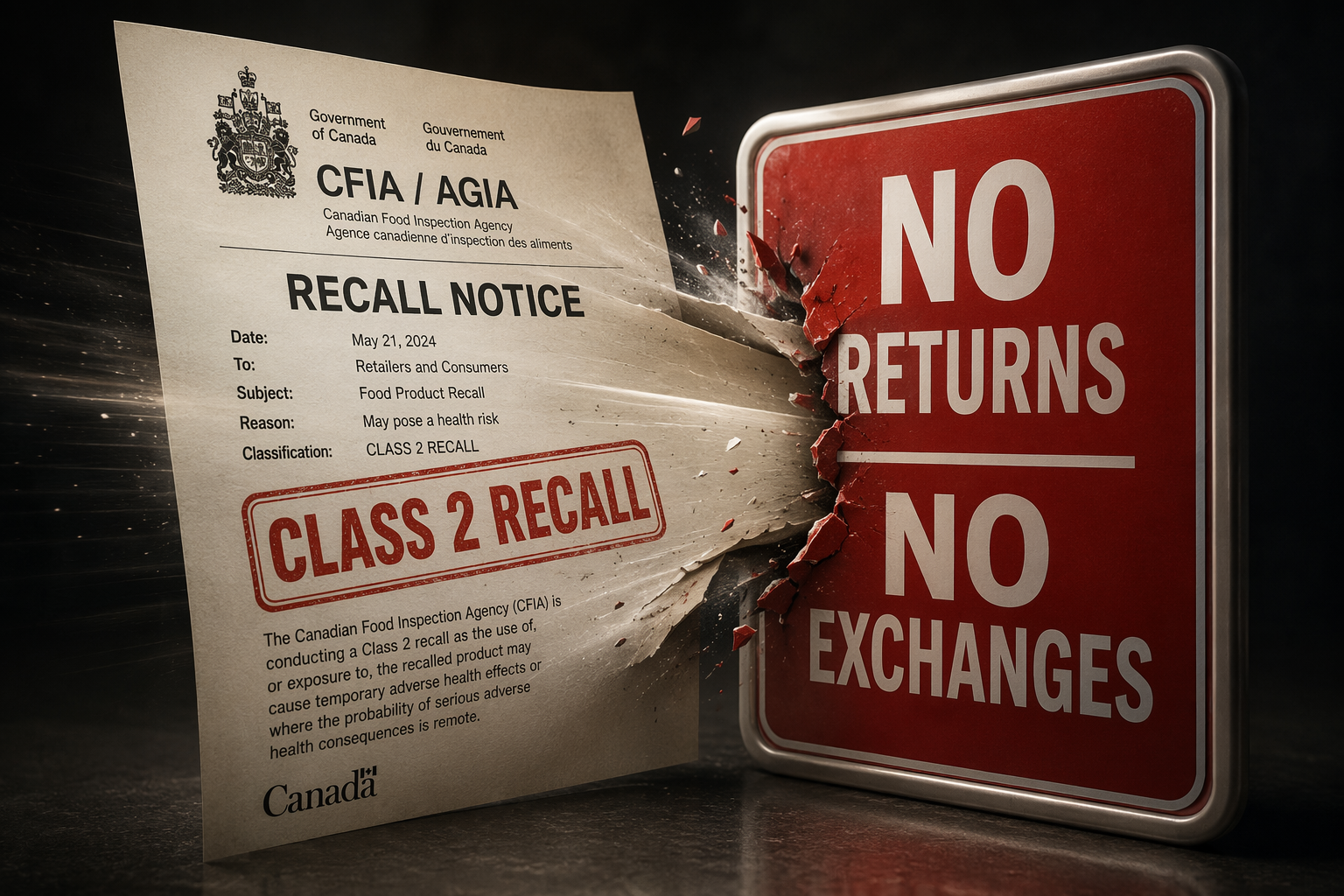
CTV reported that Dollarama said affected customers could receive a $2 e-gift card by contacting the company by email or phone, and that customers were told to dispose of the product.[3] That distinction matters. A shopper cannot reasonably be expected to preserve, return, or prove continued possession of a food item the recall process itself tells them to throw away. The evidence problem is created by the safety instruction, not by customer convenience.
There is also a source problem. Dollarama’s official product recall page lists the recalled product and directs customers to contact customer service, but it does not itself state the $2 e-gift card term.[4] The $2 figure comes from media reporting attributed to Dollarama’s spokesperson, not from the recall page currently doing the public-facing work. That does not make the report irrelevant. It does mean the remedy should be analyzed as reported, with the caveat that the public recall page leaves the amount and terms unstated.
A Recall Is Not Buyer’s Remorse
The baseline is simple and often missed. Canada does not have a general federal rule giving consumers an automatic right to return goods because they changed their minds. Innovation, Science and Economic Development Canada’s consumer guidance places ordinary refunds and exchanges largely in the terrain of store policy and provincial rules.[6] That is the part retailers understandably emphasize: if a customer bought the wrong item, disliked it, or found it cheaper elsewhere, the posted policy often does most of the work.
A recalled food product sits in a different category. The customer is not asking Dollarama to unwind a satisfactory sale as a courtesy. The customer bought garlic powder for ordinary household food use, and a federal agency later identified contamination serious enough to justify a Class 2 recall.[1] That converts the conversation from voluntary return administration into defect remedy.
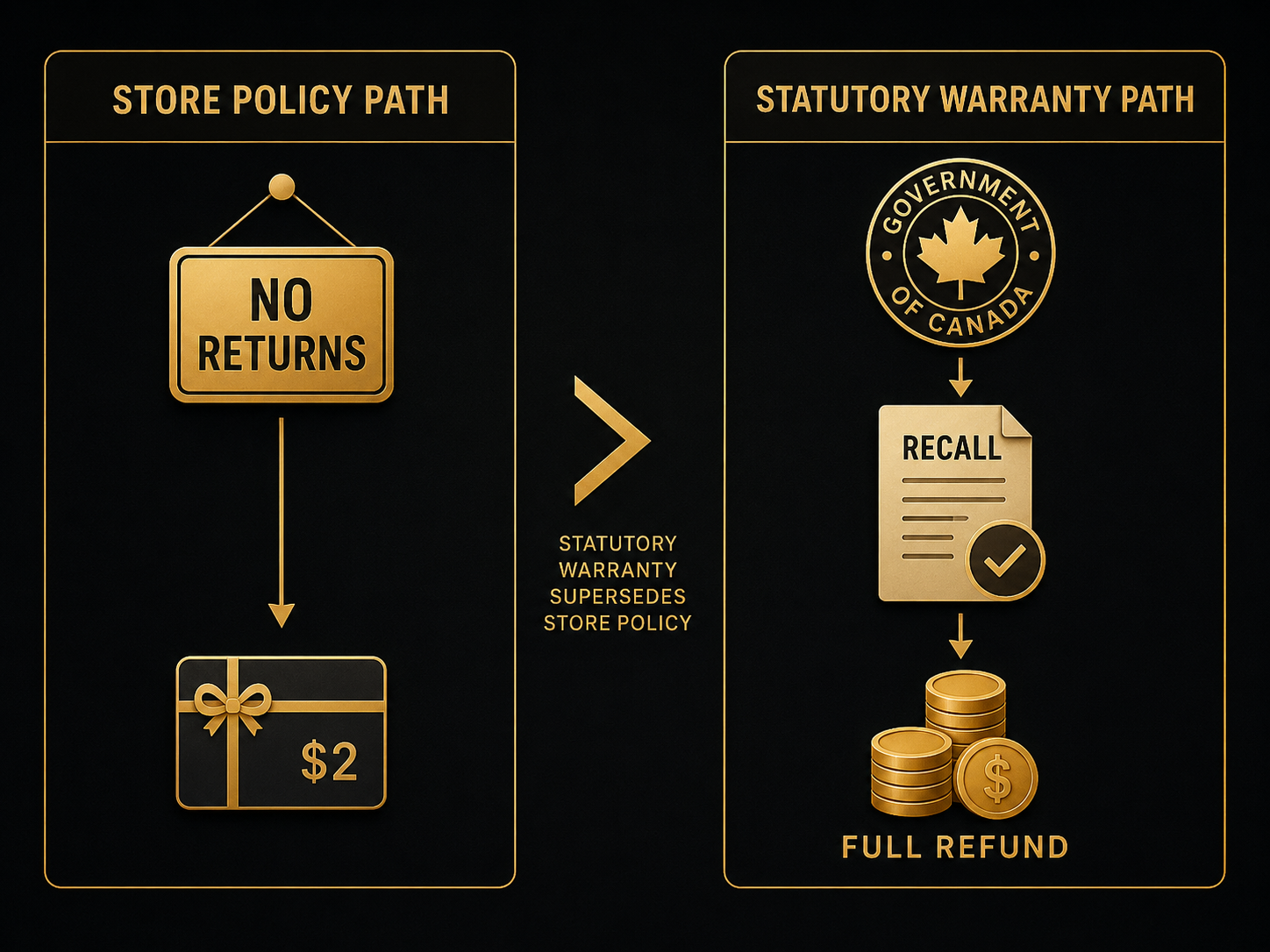
Dollarama’s own public return language appears to recognize that distinction. Its FAQ states a “No exchange, no return” policy, but also states an exception for defective products.[5] The exception is doing a lot of work. Once the product is recalled for contamination, the retailer’s public position cannot fairly be reduced to “no returns.” The more precise question is whether the offered recall remedy satisfies the defective-product exception and the statutory obligations that sit behind it.
The Legal Hinge: Store Policy Versus Implied Warranty
For a U.S. lawyer looking north, the useful comparison is not a one-to-one importation of Article 2 doctrine. The better starting point is that Canadian consumer sale disputes are largely provincial. In common-law provinces, Sale of Goods Act concepts commonly include implied conditions or warranties that goods sold must be fit for their ordinary purpose where the buyer relies on the seller in the ordinary retail transaction. Consumer-facing explanations of Canadian defective goods law describe the same basic point: defective goods can trigger rights beyond a retailer’s goodwill policy.[7]
Garlic powder has a plain ordinary purpose. It is supposed to be used in food. A product recalled for bacterial contamination is unusually clean evidence that the product failed that purpose. The customer does not need to prove from scratch that the spice tasted bad, that the container broke, or that the retailer personally knew of the contamination at the cash register. The recall supplies an official defect signal from the competent food safety authority.
That is why Dollarama’s defective-product exception matters more than the “no return” headline. If the product is defective, the exception is not a courtesy carveout. It aligns with a deeper legal structure under which the seller of consumer goods may owe a remedy because the goods were not what the law assumes ordinary retail goods will be. A posted sign or FAQ can structure how customers make claims, but it is much harder for it to erase the substance of a statutory defect remedy.
Quebec should be handled separately, not squeezed into the common-law phrasing. Its consumer law and civil-law warranty framework do not turn on the same statutory vocabulary as Ontario or other common-law provinces. British Columbia, Ontario, and other provinces also have their own consumer protection statutes and sale-of-goods legislation. The point for present purposes is narrower: across Canadian jurisdictions, the legal analysis does not end at the retailer’s ordinary return policy once the product has been officially recalled as unsafe or contaminated.
Why The $2 Form Of Remedy Matters
The reported $2 e-gift card should not be treated as automatically unlawful on the present record. The exact retail price of the 70 g garlic powder has not been verified from the available sources. Dollarama’s official recall page does not state the $2 amount. The media report attributes the remedy to a company spokesperson, and that is enough to analyze the issue, not enough to pretend every term is settled.[3][4]
Still, the form of the remedy is not a minor administrative detail. If the recalled garlic powder sold for $2, and the e-gift card is freely usable, does not expire in a way that undermines the remedy, and imposes no practical purchase condition, then Dollarama would have a better argument that the card functionally restores the customer’s purchase value. That would still leave questions about proof of purchase and access for customers who do not use email or who cannot easily navigate customer service, but the refund measure itself would be closer to defensible.
If the product cost more than $2, the analysis changes. A capped store credit below the purchase price looks less like a refund and more like a retailer-controlled compromise. It asks the consumer to absorb the shortfall created by the sale of defective food. It also keeps the value inside Dollarama’s ecosystem rather than returning money to the buyer. For low-dollar items, that distinction is easy to dismiss and precisely where the practical enforcement problem lives.
| Remedy Characterization | Why It Matters |
|---|---|
| Full refund | Restores the purchase price of a defective recalled product and most closely matches the ordinary expectation of a defect remedy. |
| Equal-value store credit | May be practically acceptable in some cases, but still restricts the consumer to the retailer rather than returning cash. |
| Below-price e-gift card | Creates the sharpest legal risk because the retailer keeps part of the value after selling goods later deemed unfit for ordinary use. |
| Courtesy coupon | Does not answer the implied warranty problem if it is framed as goodwill rather than compensation for a defective product. |
That last category is the one retailers should avoid in recall communications. Once a government recall has identified a defect, the remedy should not sound like a promotional concession. It should identify the product, the safety instruction, what the customer must do, what proof is required, and how the compensation maps to the purchase price.
The Recall Changes The Proof Problem
In an ordinary defective-goods dispute, a retailer may be entitled to ask basic questions. Was the product actually defective? Was it damaged after sale? Is this the same item? Food recalls are different because the government notice answers the central defect question for the class of product. The CFIA notice identifies the brand, product size, contamination, and recall classification.[1]
That does not eliminate every proof issue. A retailer can still ask whether the customer bought the affected product from its stores, whether the package matches the recall, and whether duplicate claims are being submitted. But the retailer is no longer dealing with a customer’s unsupported assertion that something seemed wrong. It is dealing with a product line that the food safety regulator says should not be used.
That evidentiary shift matters for counsel. The most defensible recall process is usually the one that separates fraud control from remedy reduction. A retailer may standardize intake, require reasonable identifying information, and use customer service channels. It should be much more cautious about using administrative standardization to cap compensation below the amount needed to make consumers whole.
Small Dollar Claims Still Aggregate
The garlic powder recall should not be inflated into proof of a broader corporate pattern. The available record supports analysis of this recall remedy, not a conclusion about Dollarama’s general compliance culture. But small consumer amounts can become material when the same practice is repeated across many transactions.
Dollarama has recent experience with that dynamic. In December 2024, a Quebec court approved a settlement reported at roughly $2.5 million to $2.6 million in a class action concerning environmental handling fees, with eligible consumers able to claim small amounts.[8] That case does not decide anything about recalled garlic powder. It does show why lawyers should not treat a two-dollar consumer remedy as legally invisible.
What A Cleaner Recall Remedy Would Address
The avoidable ambiguity here is not hard to identify. Dollarama’s recall page lists the product and sends consumers to customer service, while the reported remedy details appear in media coverage.[3][4] A cleaner notice would put the remedy on the recall page itself, state whether the compensation is a refund or store credit, and explain how the amount was calculated.
For a defective recalled food item, the key operational questions are concrete:
- Does the compensation equal the actual purchase price, including any applicable taxes or fees where legally required?
- Is the remedy cash-equivalent, or does it require the consumer to shop again with the same retailer?
- What proof is required when customers have been told to dispose of the recalled food?
- Are customers without easy email access offered a realistic alternative?
- Does the public recall page say the same thing the spokesperson, call center, and store staff say?
These are not customer-relations niceties. They are the mechanics by which a retailer shows that its recall response is tied to a defect remedy rather than to ordinary no-return policy.
The U.S. Comparison Is Useful, But Limited
For U.S. practitioners, the Canadian recall is most useful as a comparative reminder. Retailers that operate across borders often draft return policies in broad, customer-facing language. Those policies can be efficient for ordinary returns and still be inadequate when a safety recall shifts the issue into implied warranty, product defect, or consumer protection territory.
The same advisory instinct applies on both sides of the border: do not let a general no-return rule carry a defect case it was not designed to carry. Once a regulator has identified a product as contaminated or unsafe, counsel should read the recall notice first, then the retailer’s own exception language, then the applicable warranty and consumer protection statutes. The public-facing answer should be built in that order.
Where The Available Record Lands
The strongest consumer-rights argument is not that Dollarama has a no-return policy. It is that Dollarama’s own policy appears to exempt defective products, and the CFIA recall is powerful evidence that this garlic powder was defective for its ordinary purpose.[1][5] In common-law provinces, that evidence fits naturally with implied fitness concepts under sale-of-goods legislation. In Quebec and other provinces, the statutory route may differ, but the recall still makes it difficult to treat the claim as ordinary buyer’s remorse.
The unresolved facts are important. The exact shelf price has not been verified from the available materials. Dollarama’s recall page does not state the $2 e-gift card remedy. Provincial law can affect the remedy analysis. Those limits keep the issue from being reduced to a one-sentence conclusion.
On the record available, though, the recall gives consumers a stronger rights-based claim than a “no exchange, no return” framing suggests. If the reported $2 e-gift card does not equal a full refund for the defective recalled product, or if its terms materially restrict the consumer’s recovery, it creates avoidable legal risk for Dollarama and a useful warning for any retailer trying to manage a safety recall through an ordinary return-policy script.
References
- Heavenly Spices brand Garlic Powder recalled due to Bacillus cereus, Canada.ca,
- Bacillus cereus, BC Centre for Disease Control,
- Do not use: Dollarama recalls kitchen product due to risk of illness, CTV News,
- Product Recalls, Dollarama,
- Pricing, policies, taxes & return, Dollarama,
- Refund and exchange, Innovation, Science and Economic Development Canada,
- Buying defective goods, Legal Line Canada,
- Dollarama class action settlement: How to claim your money, CBC News,
Comments
Join the discussion with an anonymous comment.