
Domestic violence history evidence in court usually arrives with two questions attached. First, is the evidence being offered to show that the defendant is the kind of person who commits abuse and therefore likely committed the charged act? Second, is it being offered for some narrower trial purpose: to explain fear, delayed reporting, recantation, escalation, injury patterns, motive, intent, or the nature of a relationship that otherwise looks inexplicable on a cold record?
The ordinary evidence-law starting point is still the character rule. Federal Rule of Evidence 404 bars propensity reasoning while allowing prior-act evidence for non-propensity purposes such as motive, intent, absence of mistake, identity, or another permissible issue; state equivalents often work from the same basic suspicion of “he did it before, so he did it again” proof.[1] Domestic violence prosecutions have pressed hard on that baseline because the charged incident may be unintelligible without the history surrounding it. That pressure has produced special routes into evidence, but those routes are not interchangeable.
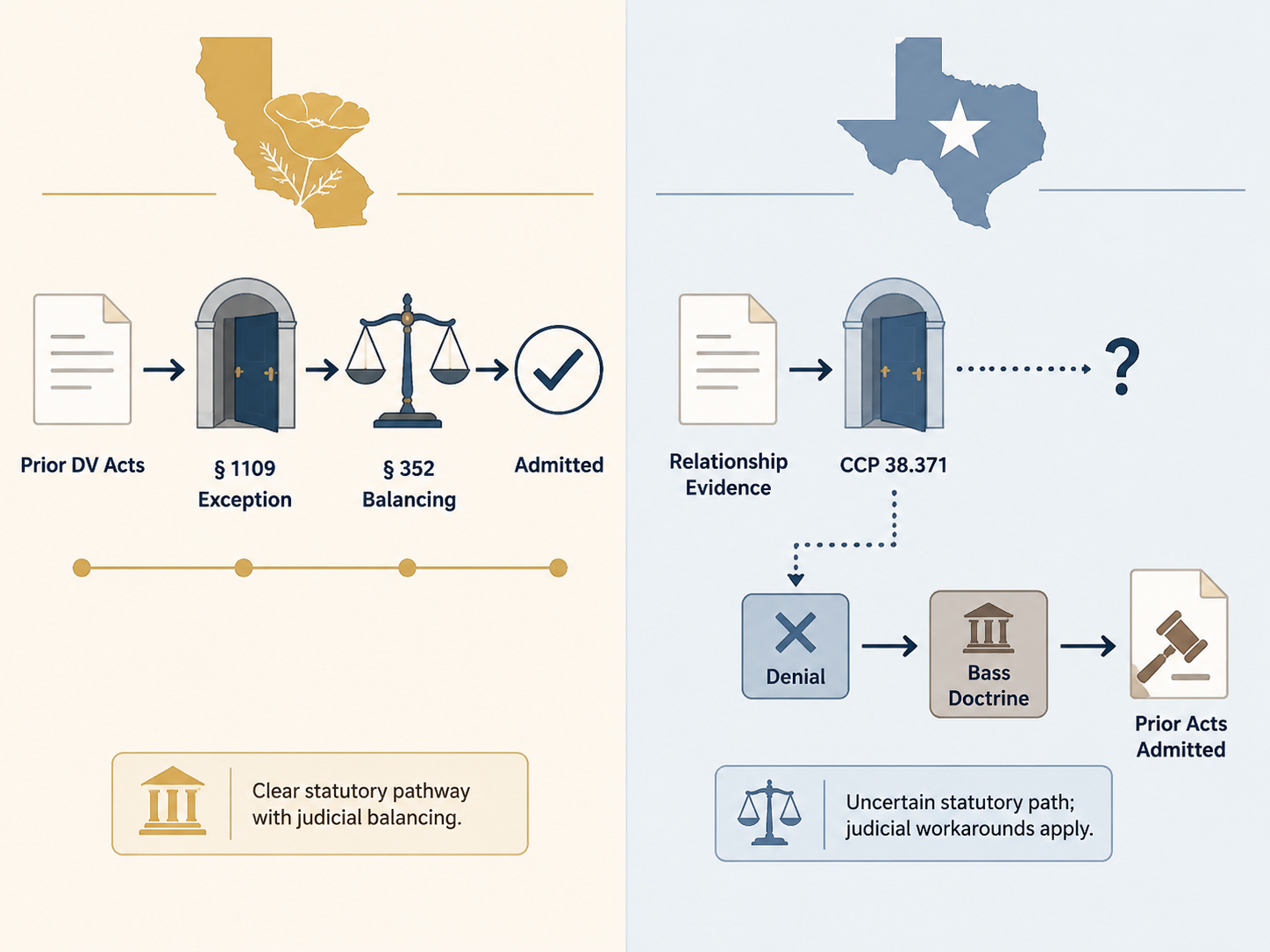
California and Texas are useful examples because they do not merely apply the same rule with different accents. California uses an express domestic-violence propensity exception. Texas has a relationship-evidence statute that says, in the same breath, that it does not authorize inadmissible character evidence. The difference matters at the motion-in-limine stage, at objection, in limiting-instruction practice, and on appeal.
The Baseline Rule Blocks More Than Bad Trial Theater
A prosecutor cannot ordinarily call a string of former partners to say, in substance, that the accused has always been violent and should be convicted because the charged complainant is only the latest example. That is the classic character-evidence problem. The objection is not a technicality; it protects the jury from using past allegations as a shortcut around the charged proof.
But domestic violence cases also expose the limits of classroom 404(b) language. A complainant’s continued contact with the accused, delayed report, changing statement, or refusal to testify may look irrational unless the jury hears something about the relationship. Prior incidents may also bear on intent, fear, coercive control, motive, or absence of accident. The harder question is whether the jurisdiction admits that history because it is relevant context, because it proves a permitted non-character issue, or because the legislature has decided that propensity reasoning is allowed in this category of prosecution.
Those are different mechanisms. Blurring them helps nobody. It deprives the defense of a clean objection, gives the prosecution unstable appellate footing, and lets the trial judge avoid saying which evidentiary door has actually opened.
California’s § 1109 Makes the Propensity Choice Explicit
California Evidence Code § 1109 is unusually direct. In a criminal action in which the defendant is accused of domestic violence, evidence that the defendant committed other domestic violence is not made inadmissible by the usual character-evidence bar in Evidence Code § 1101, subject to Evidence Code § 352 balancing and statutory limits.[2] That is not merely “relationship context” by another name. It is a legislative exception that permits the jury to consider prior domestic violence in a way ordinary character rules would normally forbid.
The candor has practical value. A California lawyer arguing § 1109 knows the fight is not over whether the court can pretend the evidence is non-propensity. The fight is over the scope of the statute, the fit between the prior act and the charged offense, and whether § 352 requires exclusion because the probative value is substantially outweighed by risks such as undue prejudice, confusion, or consumption of time.
| California issue | Trial consequence |
|---|---|
| Similarity between prior and charged conduct | Greater similarity tends to strengthen probative value; weak similarity gives the defense a concrete balancing argument. |
| Remoteness | Older incidents may carry less probative force, though remoteness is not automatically dispositive. |
| Certainty that the prior act occurred | A conviction, corroboration, or stronger proof may reduce the risk that the trial becomes a mini-trial over an uncertain allegation. |
| Conviction history | A prior conviction can matter to the reliability and prejudice analysis, but it does not eliminate § 352 balancing. |
People v. Gustavo Mendina Flores illustrates the working shape of that analysis. The California Court of Appeal upheld admission of prior domestic violence acts under § 1109 where the prior acts were substantially similar to the charged conduct and were not unduly remote.[3] The point is not that prior domestic violence always comes in. The point is that California supplies a statutory path, then forces the parties into a balancing argument about probative value and prejudice.
That architecture is cleaner than many common courtroom formulations. A prosecutor does not have to dress propensity evidence in the language of “background” if § 1109 applies. A defense lawyer does not have to pretend the statute does not exist; the better objection usually targets the § 352 factors, the factual certainty of the prior act, excessive detail, cumulative proof, or a limiting instruction that fails to tell the jury how the evidence may and may not be used.
Texas Admits Relationship Evidence While Preserving the Character Rule
Texas Code of Criminal Procedure article 38.371 takes a more unstable route. It permits evidence of the nature of the relationship between the accused and the alleged victim in certain family-violence and related prosecutions, including evidence that may help explain the complainant’s conduct or the relationship context. But the statute also states that it does not permit the presentation of character evidence that would otherwise be inadmissible under the Texas Rules of Evidence.[4]
That final caveat does real work, or at least it is supposed to. Article 38.371 is not written like California § 1109. It does not simply say that other domestic violence is admissible despite the usual character bar. It invites relationship evidence while preserving the Texas Rules of Evidence, which means the proponent still has to identify a permissible theory and survive ordinary objections.
The statute is understandable. Domestic violence prosecutions often involve conduct that looks different to jurors when severed from the relationship. A complainant may remain in contact, minimize the incident, delay disclosure, or give statements that appear inconsistent. Relationship evidence can help explain those facts without necessarily asking the jury to convict because of disposition.
The problem is the border. If the State offers a prior assault to show why the complainant feared the defendant, why she recanted, or why she did not immediately leave, the evidence may sound contextual. If the same proof is then argued as showing that the defendant has a pattern of assaulting intimate partners, the character problem has not disappeared. It has just been moved into the closing argument.
The Fabrication-Rebuttal Problem in Texas
The sharpest Texas uncertainty is not article 38.371 by itself. It is the interaction between relationship evidence and the fabrication-rebuttal doctrine associated with Bass v. State. As described in the Texas Law Review discussion of the doctrine, Texas courts have treated a defendant’s denial or fabrication theory as opening the door to prior-act evidence offered to rebut the suggestion that the complainant invented the allegation.[5]
There is an intuitive version of that rule. If the defense claims the complainant fabricated the charge for a particular reason, earlier similar accusations or incidents not subject to that same motive may have rebuttal value. The jury is not being asked only to reason from bad character; it is being asked to evaluate whether the present allegation is part of a newly invented story.
The troubling version is broader: every denial becomes a fabrication theory, and every fabrication theory becomes a door through which prior acts enter. That is where 404(b)-type protections begin to thin out. A defendant has to be able to say “I did not do this” without automatically placing every prior domestic incident before the jury. If the mere act of contesting guilt supplies the evidentiary trigger, the exception can swallow the rule in precisely the cases where the evidence is most inflammatory.
Gonzalez v. State shows how broad the rebuttal route can become. In that Texas appellate case, a prior charging document was admitted to rebut a fabrication defense, an application discussed as part of the wider concern that fabrication rebuttal can bring prior allegations before the jury even when the statutory relationship-evidence route is not supposed to authorize otherwise inadmissible character proof.[5]
Wheeler supplies a possible limiting principle. The Texas Law Review Note describes the Wheeler similarity requirement as a way to require prior acts to be similar to the charged conduct and not subject to the same alleged fabrication motive.[5] That kind of limit gives trial lawyers something to argue and trial judges something to decide. It narrows the rebuttal theory to evidence that actually responds to the defense claim instead of merely darkening the defendant’s character.
The difficulty is that this is not a fully settled cure. If one court treats denial as a broad opening and another insists on similarity plus a distinct fabrication motive, the pretrial admissibility forecast changes dramatically. The State may see rebuttal evidence as essential to explain why a complainant’s account should not be dismissed as invented. The defense may see the same evidence as propensity proof smuggled through a rebuttal label. Both positions can be plausible until the judge states the operative rule.
What the Trial Fight Should Actually Be About
The phrase “domestic violence history” is too blunt to decide admissibility. A useful motion or objection should identify the evidence and the mechanism separately: prior conviction, prior allegation, prior police call, protective-order history, statements to friends, medical records, photographs, messages, or testimony about the relationship. Each item may raise a different hearsay, confrontation, authentication, relevance, prejudice, or character issue.
- In California, ask whether § 1109 applies, whether the prior act qualifies as domestic violence, and how § 352 balancing should treat similarity, remoteness, certainty, and cumulative proof.
- In Texas, ask whether article 38.371 is being used for true relationship context or whether the State is effectively offering character evidence that the statute says it does not authorize.
- When rebuttal is claimed, identify the exact defense theory: general denial, specific fabrication motive, accident, self-defense, mistaken identity, or attack on the complainant’s credibility.
- If prior acts are offered to rebut fabrication, demand a limiting principle such as similarity and a showing that the prior act is not subject to the same alleged fabrication motive.
- Preserve the balancing issue. Even admissible domestic violence history can be limited in detail, sequence, number of witnesses, or permissible argument.
The judge’s stated reason matters. “It explains the relationship” is not the same as “it shows propensity under a statutory exception.” “It rebuts fabrication” is not the same as “the defendant has denied the charge.” The more precise the ruling, the easier it is for the parties to shape examination, request a limiting instruction, and preserve the appellate issue.
This is also where survivor-context arguments and evidentiary protections can be held in the same frame. Relationship history may be necessary to make fear, delay, or recantation legible to a jury. That does not mean every prior allegation should enter in full, or that every denial should be treated as a character waiver. The law does better when it names the route: express propensity exception, non-propensity purpose, relationship context, impeachment, rebuttal, or some combination that must still pass the jurisdiction’s balancing test.
A Jurisdiction-Specific Answer
Domestic violence history evidence enters the courtroom only through the mechanism the jurisdiction supplies. California’s § 1109 is an express exception to the ordinary character bar, constrained by § 352. Texas article 38.371 invites evidence about the nature of the relationship while insisting that otherwise inadmissible character evidence remains inadmissible. Texas rebuttal doctrine, especially after Bass and in applications such as Gonzalez, creates additional uncertainty when a fabrication theory is said to open the door to prior acts.
For trial practitioners, the admissibility question is therefore not whether the evidence can be described as domestic violence history. It is what the evidence is, why it is being offered, whether the jurisdiction recognizes that route, what limiting doctrine applies, and how the trial judge performs the balancing analysis. This article maps the doctrine and cited authorities for legal news and analysis purposes; it does not provide advice for any particular case, charge, party, or jurisdiction beyond the authorities discussed.
References
- Rule 404. Character Evidence; Crimes or Other Acts, Legal Information Institute, Cornell Law School.
- California Code, Evidence Code - EVID § 1109, Justia.
- People v. Flores: Prior DV Acts Admissible Under EC 1109, Greg Hill & Associates.
- Texas Code of Criminal Procedure Article 38.371, Texas Constitution and Statutes.
- Texas Law Review Note on Bass v. State, Article 38.371, Wheeler, and Gonzalez v. State, Texas Law Review.
Comments
Join the discussion with an anonymous comment.