
By mid-2026, the legal question around Russian drone attacks on cargo ships in the Black Sea had moved beyond one disputed strike or one damaged hull. Ukraine told the International Maritime Organization that Russian attacks had struck 59 commercial vessels in 2026, including 24 in April alone; that figure is a Ukrainian government claim reported through outside outlets, not a neutral audited count, but it is still the clearest public allegation of a repeated pattern rather than an isolated navigational accident.[1]
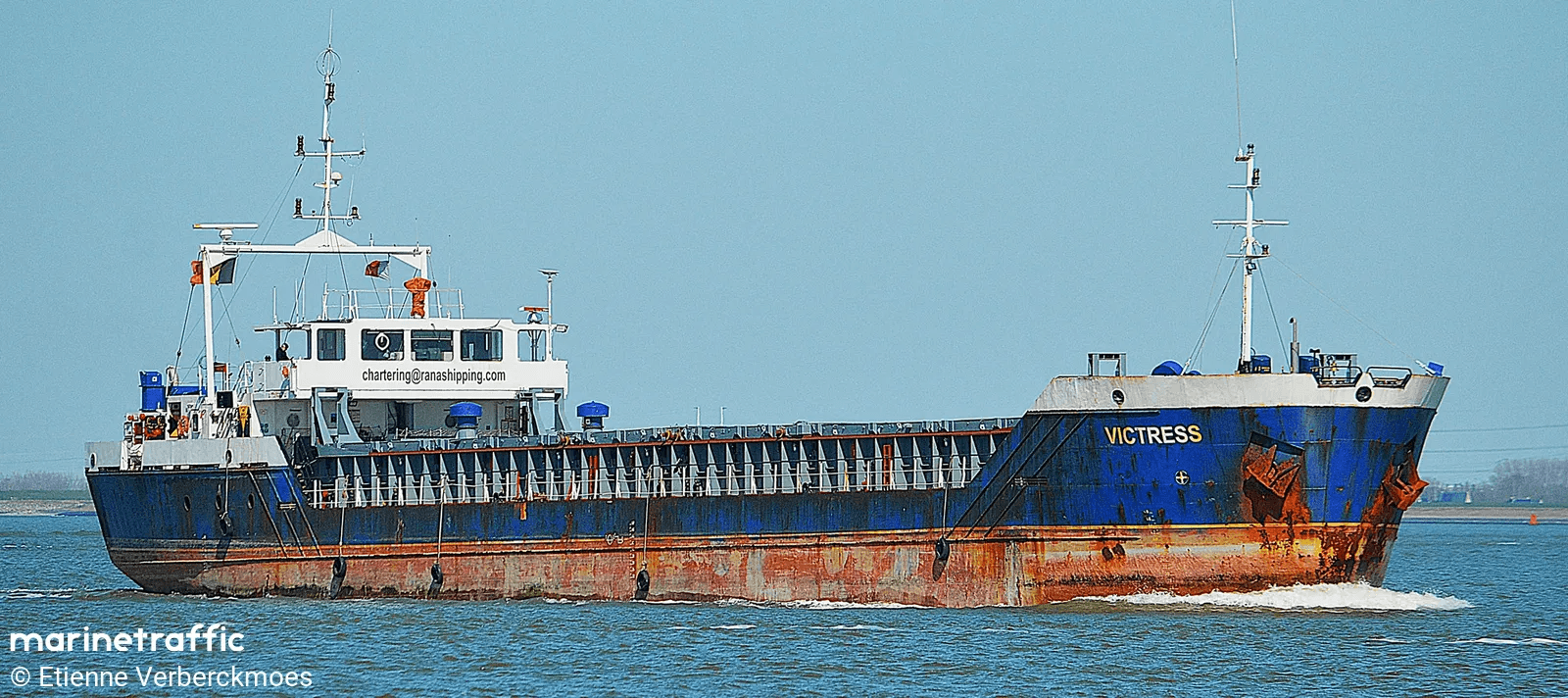
The named incidents matter because they identify the legal objects at issue: foreign-flagged merchant vessels, civilian crews, port-linked commercial routes, and belligerent accusations about cargo. The reported June 22, 2026 attack on the Panama-flagged MV Victress, in which an Egyptian crew member was killed, gives the issue its human weight without doing all the legal work by itself.[1] A death at sea does not automatically prove an unlawful attack. But it does sharpen the question that international humanitarian law and the law of naval warfare are built to answer: what must a belligerent establish before it uses force against a civilian merchant ship?
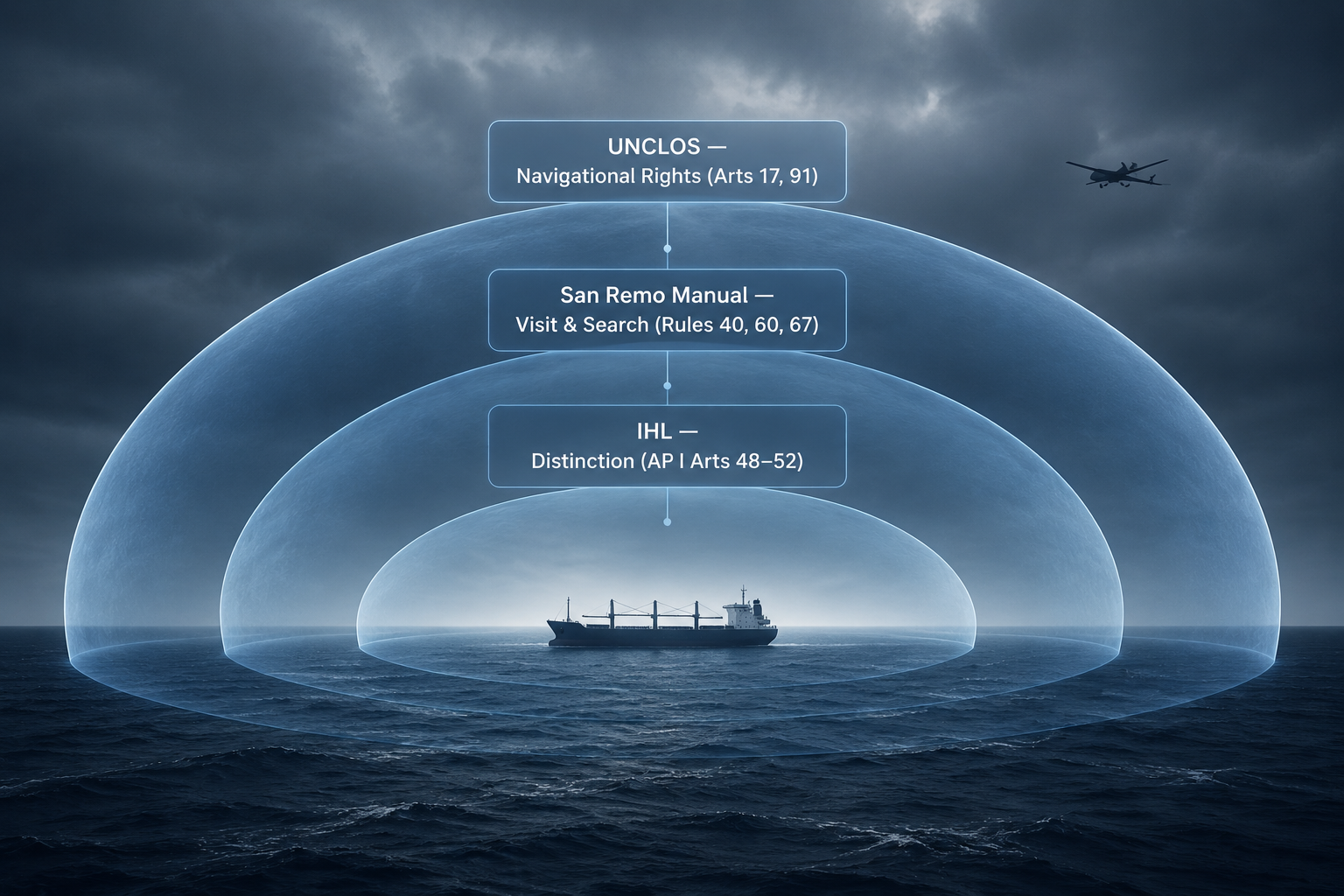
The short answer is that Russia’s reported drone attacks on foreign-flagged civilian cargo ships carry serious international law implications and, on the available public record, violate three overlapping bodies of law: the principle of distinction under international humanitarian law, the maritime visit-and-search discipline reflected in the San Remo Manual, and navigational rights protected by the law of the sea. That conclusion does not require pretending that merchant ships are untouchable in war. It requires the opposite: taking seriously the rules that describe when civilian shipping can lose protection, and noticing when those rules have not been followed.
The Flag Comes Before the Explosion Footage
A merchant ship is not just a moving object in a battlespace. It has a flag, a registry, a crew, an owner or operator, a cargo history, an intended port, and legal relations with states that may not be parties to the conflict. Those details are not paperwork trivia. They determine which state has nationality links to the vessel, which commercial actors bear the risk, and which wartime rules control the use of force.
Russia’s public posture since July 2023 has been that vessels bound for Ukrainian ports may be treated as potential carriers of military cargo. That is a legal claim, not a legal conclusion. A belligerent may suspect that a neutral merchant vessel is carrying contraband, contributing to military logistics, or otherwise being used in a way that affects the conflict. Suspicion can justify maritime enforcement steps. It does not, by itself, convert every vessel bound for a Ukrainian port into a lawful target.
That distinction is where much public commentary goes wrong. Calling the attacks “piracy” is vivid but generally imprecise when the alleged attacker is a state acting in an armed conflict. Accepting “military cargo” as a complete answer is just as careless. The law asks a narrower set of questions: what was the vessel doing, what was known about its cargo or use, whether less violent maritime procedures were feasible, and whether the attack was directed at a military objective rather than a civilian object.
Distinction: Civilian Ships Stay Protected Unless They Become Military Objectives
Additional Protocol I states the baseline rule in terms that are not maritime-specific but are directly relevant at sea. Article 48 requires parties to distinguish between civilian objects and military objectives. Article 51 protects civilians from attack. Article 52 protects civilian objects and limits attacks to military objectives, defined as objects that by their nature, location, purpose, or use make an effective contribution to military action and whose destruction, capture, or neutralization offers a definite military advantage in the circumstances ruling at the time.[2]
A foreign-flagged cargo ship starts on the civilian-object side of that line. It may cross the line if, for example, it is carrying military materiel in circumstances that make its destruction or capture a definite military advantage, directly participating in hostilities, acting as an auxiliary to enemy armed forces, refusing lawful orders after interception, or otherwise being used for military action. The important point is the individualized determination. A category label such as “vessels bound for Ukraine” is not the same as identifying a particular vessel as a military objective.
The public record described in the 2026 incident reporting does not show that Russia made that vessel-by-vessel determination before attacking. Nor does it show confirmed cargo findings, warning, boarding records, diversion orders, or other evidence that the ships had become military objectives. Russia’s press-reported assertions that vessels carried military cargo may be relevant if supported by facts, but assertions do not substitute for the legal analysis required before attack.
This is why the MV Victress death is legally significant but not legally sufficient on its own. The killing of a civilian crew member is a grave consequence. The primary violation, however, turns on whether the vessel was a lawful target and whether the attack complied with distinction and proportionality. If the ship remained a civilian object, a direct drone strike against it would violate distinction regardless of whether the attack killed one crew member, injured several, or damaged the ship without casualties.
San Remo Supplies the Maritime Discipline That General IHL Leaves Open
The San Remo Manual is not a treaty, but it is the central modern restatement of the law applicable to armed conflicts at sea. Its value here is procedural. It recognizes that neutral merchant shipping may be intercepted, searched, diverted, captured, or, in narrower circumstances, attacked. It does not treat destination alone as a trigger for direct lethal force.
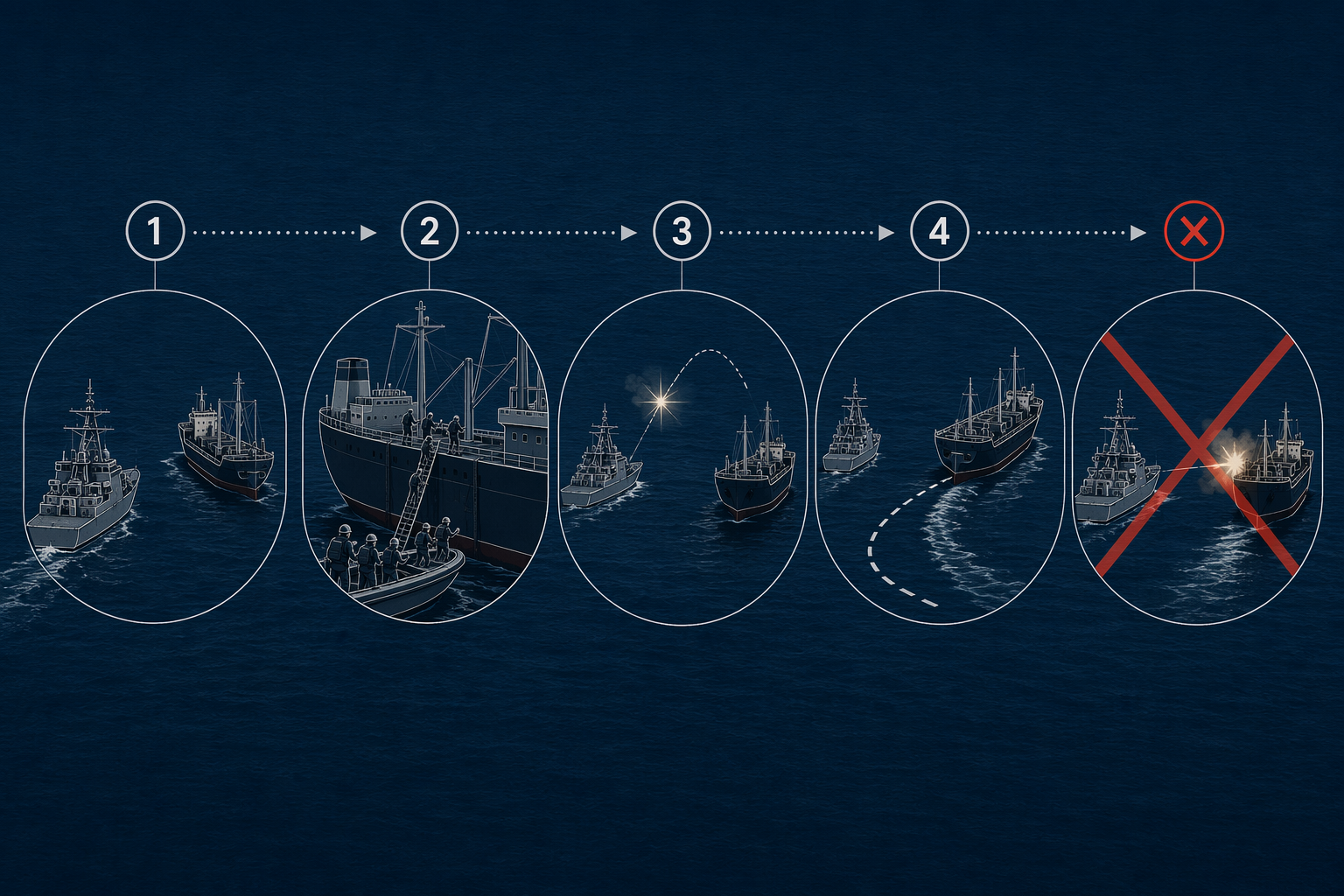
Rules 40, 60, and 67 of the San Remo framework are the relevant sequence. Neutral merchant vessels may be subject to visit and search outside neutral waters when there are grounds for suspicion; they may be captured if they are carrying contraband or breaching a blockade; and they may become liable to attack only in limited circumstances, including where they make an effective contribution to the enemy’s military action or resist lawful interception.[3]
| Question | Why it matters |
|---|---|
| Was the vessel neutral or enemy-flagged? | The flag affects rights, duties, and the procedures a belligerent must use before coercive measures. |
| Was there vessel-specific evidence of military use or contraband? | A port destination or route may justify suspicion, but it is not the same as confirmed military-objective status. |
| Was visit and search, diversion, or capture feasible? | San Remo procedure normally requires maritime enforcement before attack when the vessel is not itself fighting or resisting. |
| Was warning given? | Warning affects both the legality of escalation and the protection of civilian crews. |
| Would the expected military advantage outweigh civilian harm? | Even a military objective remains subject to proportionality. |
Those questions are not ceremonial. They are the difference between maritime interdiction and an unlawful strike. A belligerent that believes a cargo ship is carrying ammunition is not required to ignore the ship. It may have powerful military reasons to stop it. But the usual legal path is interception, visit and search, diversion, and capture, unless the ship resists, cannot be captured, or the circumstances otherwise make those measures impossible and the ship has actually become a military objective.
The available incident descriptions do not show that sequence. They describe drone attacks on commercial vessels, including foreign-flagged ships, in or around routes connected to Ukrainian ports. They do not describe Russian boarding parties discovering contraband, recorded warnings to crews, lawful diversion orders, or capture procedures. On that record, the San Remo analysis is more damaging to Russia’s position than a general statement about civilian protection, because it addresses precisely the wartime maritime problem Russia invokes.
Scholarly analysis of neutral merchant shipping in the Russia-Ukraine conflict has made the same basic point: economic pressure at sea and interdiction of neutral vessels are not prohibited in every form, but they remain bounded by the law of naval warfare, including the requirement to identify military objectives and respect visit-and-search limits.[4][5]
Russia’s July 2023 Declaration Does Not Rewrite the Targeting Rules
After the Black Sea grain arrangements broke down, Russia’s July 2023 declaration treated ships bound for Ukrainian ports as potential carriers of military cargo. The strongest version of Russia’s argument is not absurd. Belligerents may fear that civilian shipping is being used to move weapons, components, fuel, or dual-use goods. Merchant vessels have been used for war-supporting purposes in many conflicts. Cargo status can matter.
But a presumption about a class of ships is not enough. The law of targeting requires the attacking party to determine that the object attacked is a military objective in the circumstances ruling at the time. A general warning that all ships headed to a port may be treated as suspicious can support later interdiction; it cannot abolish distinction, proportionality, or the maritime procedures that protect neutral commerce.
The “war-sustaining” theory sometimes used to justify attacks on economic objects does not solve the problem either. Even where a merchant voyage may indirectly benefit a wartime economy, that is not the same as making the vessel an object that by its nature, location, purpose, or use makes an effective contribution to military action under the Additional Protocol I formulation.[6] The further the argument moves from concrete military use to generalized economic pressure, the weaker it becomes as a basis for direct attack.
UNCLOS Matters, But It Is Not the Whole Case
The United Nations Convention on the Law of the Sea adds a second layer. Article 17 recognizes the right of innocent passage through the territorial sea. Article 91 connects ships to the nationality of their flag state. These provisions matter because foreign-flagged cargo vessels do not lose their legal identity when they enter a war-adjacent sea lane.[7]
UNCLOS is especially useful for resisting the idea that a coastal or belligerent state may simply collapse commercial navigation into military targeting. A ship’s flag is a legal relationship, not a decorative marking. Interference with a foreign-flagged vessel can implicate the flag state and, depending on location and circumstances, navigational rights protected under the law of the sea.
At the same time, UNCLOS should not be made to do work that belongs to the law of armed conflict. The decisive question in a drone strike is not only whether a vessel enjoyed innocent passage or nationality protections. It is whether, in an international armed conflict, the vessel was a military objective and whether the attacking party complied with the rules governing attack at sea. That is why the IHL and San Remo analysis carries more of the weight.
Accountability Pathways Are Real, Though Not Automatic
If the reported strikes are investigated as unlawful attacks on civilian objects, several jurisdictional paths may be relevant. The International Criminal Court has already framed attacks on civilian objects in the Russia-Ukraine war as a basis for individual criminal responsibility: in March 2024, the Court issued arrest warrants for Sergei Kobylash and Viktor Sokolov in connection with alleged attacks against civilian objects and excessive incidental civilian harm.[8]
That does not predetermine liability for maritime drone strikes. Each attack would require evidence about the vessel, cargo, location, orders, intelligence basis, warnings, feasibility of capture or diversion, and expected civilian harm. But the ICC warrants show that civilian-object targeting is not an abstract category in the Russia-Ukraine context. It is already part of the accountability architecture.
Flag states may also have jurisdictional interests. The reported vessels include ships registered under states such as Panama, Vanuatu, Comoros, and St. Kitts and Nevis. A flag state could pursue diplomatic claims, domestic proceedings where available, or cooperation with international investigations. Those are possible pathways, not predictions. The political will, evidence access, and forum choices would vary sharply by state and incident.
What Would Change the Analysis
The strongest unresolved factual questions are evidentiary, not theoretical. First, the 59-vessel figure needs independent verification. Ukraine’s IMO communication is important, but incident totals in an active war should be treated carefully until vessel records, damage reports, insurance documentation, port logs, and neutral reporting can be compared.
Second, cargo claims need evidence at the level of the specific ship. If Russia had proof that a named vessel was carrying weapons, ammunition, or other material making an effective contribution to Ukrainian military action, that evidence would matter. It would not automatically license attack, because warning, capture feasibility, proportionality, and crew protection would still have to be assessed. But it would move the analysis from civilian-object protection toward military-objective status.
Third, Russia would need to show why visit and search, diversion, or capture were not feasible. Drones make attack easier at distance; they do not erase the legal preference for maritime enforcement measures when neutral merchant vessels are suspected of carrying contraband. The procedural burden is not a technicality. It is the restraint that keeps neutral commerce from becoming target practice whenever a belligerent announces a broad security zone.
The Legal Implications
On the available record, Russia’s drone attacks on foreign-flagged civilian cargo ships in the Black Sea violate the principle of distinction because the vessels have not been publicly shown to be military objectives. They violate the San Remo framework because the reported attacks do not show the individualized suspicion, visit-and-search process, warning, diversion, capture, or exceptional circumstances that would justify moving directly to force. They also interfere with navigational rights and flag-state interests protected by the law of the sea.
That judgment is bounded. Merchant shipping can lose protection in war. Contraband can be intercepted. A neutral flag does not immunize a vessel that is actually being used for military action. But Russia has not publicly supplied the evidence and procedure that international law requires before a belligerent may turn a merchant vessel into a target.
This article is editorial legal analysis for news-and-analysis purposes. It is not legal advice and is not a formal legal opinion.
References
- Ukraine Says Russian Drones Have Struck 59 Merchant Ships This Year, The Maritime Executive.
- Protocol Additional to the Geneva Conventions of 12 August 1949, and relating to the Protection of Victims of International Armed Conflicts, International Committee of the Red Cross, 1977.
- Russia’s Interdiction of Neutral Merchant Vessels and the Law of the Sea, Lieber Institute West Point.
- Merchant Shipping as Military Objectives and Naval Economic Warfare, Lieber Institute West Point.
- Russia In The Black Sea. The Law Of Armed Conflict At Sea Needs Due Consideration Alongside UNCLOS, Human Rights at Sea.
- Targeting Third-State Merchant Vessels: Military Objectives and War-Sustaining Objects, EJIL: Talk!
- United Nations Convention on the Law of the Sea, United Nations, 1982.
- Conceptualizing IHL: Legality of the Targeting of Merchant Ships, Public International Law & Policy Group, October 8, 2024.
Comments
Join the discussion with an anonymous comment.