
The legal problem begins before doctrine. It begins with the count.
The Bureau of Investigative Journalism has estimated that 910 to 2,200 civilians were killed across 14,040 US strikes, while the US Office of the Director of National Intelligence reported 64 to 116 non-combatant deaths for strikes outside areas of active hostilities from 2009 through 2015.[1][2] The two figures do not measure identical theaters: the ODNI count excludes Afghanistan, Iraq, and Syria, while the broader public datasets include theaters the US government did not treat the same way. That caveat matters. It does not make the divergence disappear.
Part of the gap is methodological. A former Obama administration official described the government’s approach to counting military-age males in a strike zone as “guilt by association,” a phrase that captures how civilian status can be lost inside the evidentiary frame before any court sees a complaint.[3] For families trying to litigate a death, that is not an abstract statistics dispute. It is a preview of the entire accountability structure: the state that chose the target usually controls the intelligence, the strike record, the post-strike assessment, and the public vocabulary for who died.

This article provides information about legal frameworks and reported litigation outcomes. It is not legal advice.
The US Court Door Closed Before the Merits
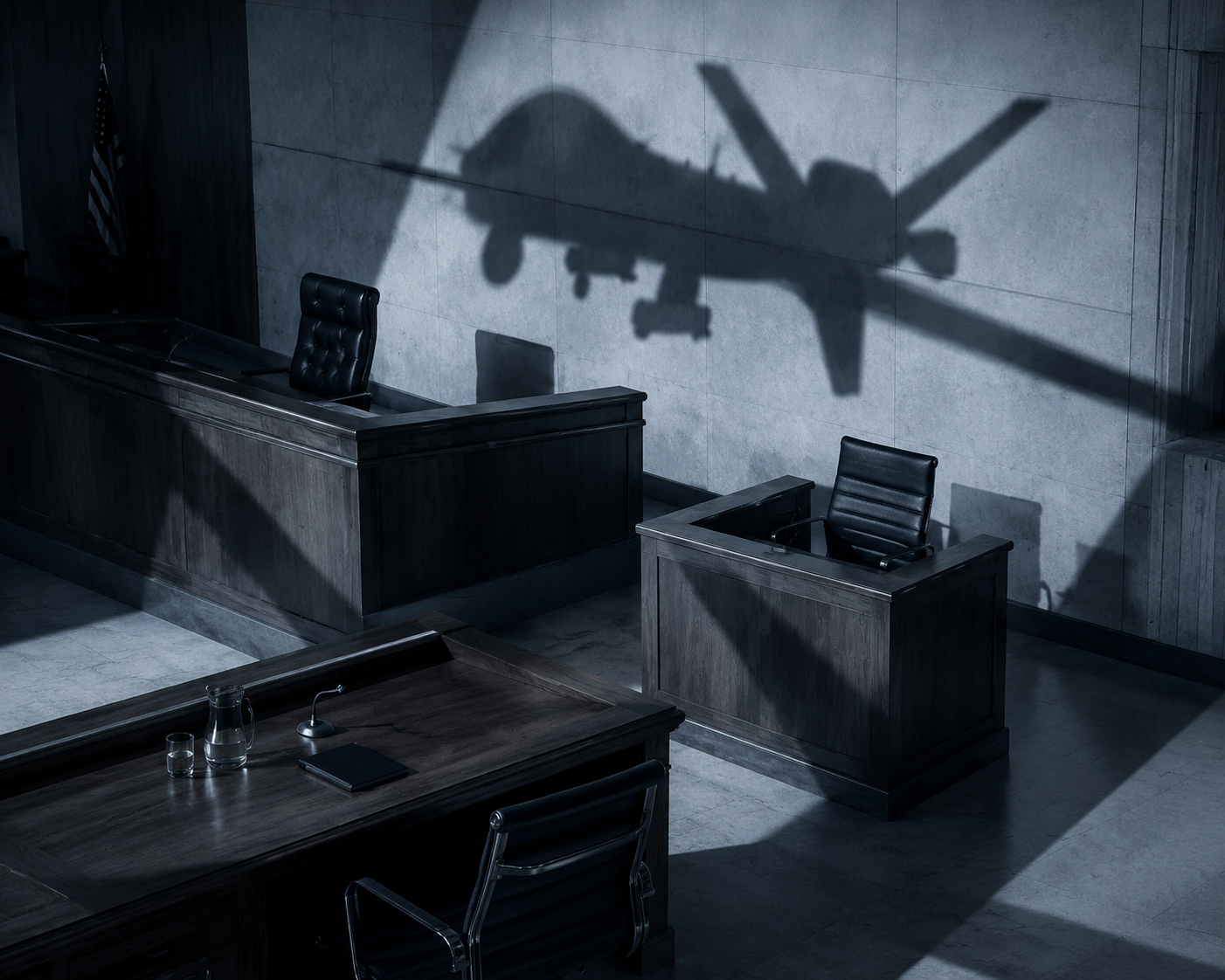
In US federal court, legal accountability for drone strike casualties has run into a barrier that is procedural in form but decisive in effect: the political question doctrine. The result is not a judicial ruling that the challenged strikes were lawful. It is a refusal to adjudicate whether they were lawful at all.
Al-Aulaqi v. Panetta is the clearest example. The case challenged the killings of three US citizens in Yemen, including 16-year-old Abdulrahman Al-Aulaqi. The district court dismissed the suit, concluding that the claims raised political questions and that special factors barred a damages remedy against officials involved in national security and military decision-making.[4] The constitutional claims never received a merits ruling.
Bin Ali Jaber v. United States reached the same structural endpoint. The plaintiffs alleged that a 2012 US drone strike in Yemen killed Salem bin Ali Jaber, an imam, and Waleed bin Ali Jaber, a police officer. The D.C. Circuit affirmed dismissal in 2017, treating the case as nonjusticiable under the political question doctrine.[5] Again, the court did not decide whether the strike violated domestic or international law.
That distinction is central. A merits loss creates law about the conduct. A political-question dismissal creates law about the forum. It tells future plaintiffs that the courthouse may be open for filing but closed for adjudication when the injury is tied to targeting, intelligence, and military operations overseas.
Ramstein Made Germany Plausible, Then Sovereignty Made It Small
The German litigation mattered because it did not ask a US court to review a US targeting decision. It asked whether Germany had legal obligations arising from the use of Ramstein Air Base, a US facility on German territory that plaintiffs alleged was integral to US drone operations in Yemen. That made the forum plausible in a way many third-state cases are not: the claim was tied to territorial control, not universal oversight of all US counterterrorism operations.
The bin Ali Jaber family pursued Germany on that basis. In 2019, the Higher Administrative Court in Münster issued what appeared to be a meaningful, if limited, opening. The court found that Germany had a duty to do more than accept US assurances; it had to take steps to ensure that US drone operations using Ramstein complied with international law.[6][7]
The 2019 ruling did not order Germany to shut down Ramstein or halt US drone operations. Its force lay elsewhere. It recognized that a state hosting infrastructure for lethal operations could not always avoid scrutiny by pointing to the acting state. For victims who could not obtain merits review in Washington, that was the closest thing in the record to a judicial acknowledgment that the support state had duties of its own.
The opening narrowed on appeal. Germany’s Federal Administrative Court later held that the government had met its obligations through diplomatic assurances and related measures, reducing the 2019 duty into a deferential review of executive handling. The difference was not semantic. A duty to investigate can force a government to confront factual claims; a duty satisfied by assurances lets the government treat another sovereign’s account as enough.
In July 2025, the Federal Constitutional Court closed the remaining door. According to ECCHR’s account of the ruling, the court held that Germany was not legally required under domestic or international law to prevent US drone missions conducted through Ramstein.[8] The full ruling text was not available for review in the materials used here, so the account of the decision necessarily relies on ECCHR’s press release and secondary analysis rather than a full independent reading of the judgment.[6][8]
The importance of that closure extends beyond Germany. Ramstein was a comparatively strong third-state case because the plaintiffs could identify infrastructure, territory, and a host-state relationship. If even that combination ends in deference to the political branches and to another state’s military representations, foreign domestic litigation becomes less an alternative forum than a narrower version of the same problem.
The ICC Track Has a Jurisdiction Problem Before It Has a Proof Problem
The International Criminal Court can look more attractive when domestic courts decline to act. For US drone strikes in Pakistan or Yemen, however, the jurisdictional map is narrow from the start. The United States is not a party to the Rome Statute, and Pakistan and Yemen are not parties either.[9] Unless another jurisdictional hook exists, the ICC cannot simply open a case because the alleged conduct is grave.
Even where jurisdiction can be argued, the evidentiary threshold is demanding. Article 8 war crimes theories would require proof, for example, of intentional attacks on civilians or attacks expected to cause excessive civilian harm in relation to the anticipated military advantage.[9] Those are not just moral conclusions. They require evidence about target selection, intelligence assessments, expected collateral damage, command knowledge, and after-action review.
The same fact-control problem returns here in international form. If the targeting state holds the classified intelligence and publishes only aggregate conclusions, outside investigators may be able to document death, location, family testimony, and visible damage, but still lack the material needed to prove the mental and proportionality elements of an Article 8 case. The ICC track therefore fails first on jurisdiction and then, in many cases, on the practical ability to compel the evidence that would make jurisdiction meaningful.
A Non-Judicial Route That Barely Operates
Congress has appropriated $3 million annually for ex gratia condolence payments to civilians harmed by US military operations, a non-judicial mechanism that might at least acknowledge loss without requiring a lawsuit.[10] The record described by Amnesty International is stark: zero such payments in 2020 and one payment in 2021.[10]
Condolence payments are not adjudication. They do not establish liability, disclose targeting evidence, or produce precedent. But when even that limited mechanism produces almost no payments, it cannot plausibly be treated as the humanitarian substitute for courts that never reach the merits.
Visibility Changes the Record, Not the Legal Architecture
The contrast with Sudan in 2026 is useful only if kept narrow. Sudan’s civil war is not the US targeted-killing program, and the legal dynamics are different. But independent monitoring changes what can be seen. UN reporting in May 2026 stated that armed drones had become the leading cause of civilian death in Sudan’s war, accounting for more than 80% of civilian deaths.[11] AP reporting, drawing on monitored incidents, described more than 1,000 civilians killed by drone strikes over five months.[12]
Those figures do not prove a general rule about all drone warfare. They show the narrower point that casualty visibility depends heavily on access, independent monitoring, and the ability to verify incidents outside the targeting state’s own classification system. Where those conditions exist, the record can look radically different from official understatement or silence.
Autonomous Weapons Will Inherit the Same File
The autonomous weapons question should not be treated as a separate futuristic debate grafted onto drone litigation. Its relevance is more concrete: the same procedural barriers are likely to meet a harder causation problem. A March 2026 Lieber Institute analysis argues that victims of AI-driven autonomous weapons will face familiar obstacles, including political question barriers, immunity doctrines, jurisdictional limits, and the difficulty of attributing legally relevant decisions across human and machine systems.[13]
Traditional drone-strike cases already show how accountability can fail when plaintiffs cannot obtain targeting evidence. Autonomous systems add another layer. A claimant may need to show not only who approved an operation, but how a model classified a target, what data it relied on, whether a human operator meaningfully reviewed the output, and whether the harmful result came from design, deployment, training data, command judgment, or battlefield use.
That does not mean every autonomous-weapons harm will be legally unknowable. It means the existing architecture is poorly suited to make it knowable. US courts have declined merits review. Foreign courts have stopped at sovereignty and executive discretion. The ICC has jurisdictional and evidentiary gaps. Condolence payments barely function. If autonomous weapons are deployed into that structure without stronger evidence-preservation, disclosure, review, and compensation mechanisms, the next accountability failure will not begin with a new legal theory. It will begin, again, with a disputed count and a file no adjudicator is required to open.
References
- Civilian casualties from the United States drone strikes, Wikipedia.
- Summary of Information Regarding U.S. Counterterrorism Strikes Outside Areas of Active Hostilities, Office of the Director of National Intelligence, July 1, 2016.
- Secret ‘Kill List’ Proves a Test of Obama’s Principles and Will, The New York Times, May 29, 2012.
- Al-Aulaqi v. Panetta, ACLU.
- US Lethal Strikes Program Continues to Violate Int’l Human Rights Law, Just Security, March 29, 2017.
- German Courts Weigh Legal Responsibility for U.S. Drone Strikes, Lawfare.
- Groundbreaking judgement on Germany's role in US drone program, ECCHR, March 19, 2019.
- No responsibility, no consequences: Germany is not required to prevent US drone missions, ECCHR, July 2025.
- Rome Statute of the International Criminal Court, International Criminal Court.
- Statement for the Record on Targeted Killing and the Rule of Law, Amnesty International USA.
- Armed drones leading cause of civilian death in Sudan war: UN rights chief, UN News, May 2026.
- Drone strikes have killed over 1,000 civilians in Sudan in 5 months, AP News.
- Legal Accountability for AI-Driven Autonomous Weapons, Lieber Institute, March 2026.
Comments
Join the discussion with an anonymous comment.