
The legal consequences of a DWI crash court case do not move through one courtroom on one timetable. If the crash injures or kills someone, the file usually splits almost immediately: the state decides whether to prosecute the driver, while the injured person, family, or estate considers a civil claim for compensation. Those two tracks may use the same crash report, blood-alcohol evidence, witness statements, and reconstruction work, but they do not ask the same legal question.
That distinction matters because alcohol-impaired crashes are not rare edge cases. NHTSA reported 12,429 deaths in alcohol-impaired-driving crashes in 2023, a public-safety figure that explains why prosecutors, insurers, and civil lawyers treat these cases as more than routine negligence files. [1]
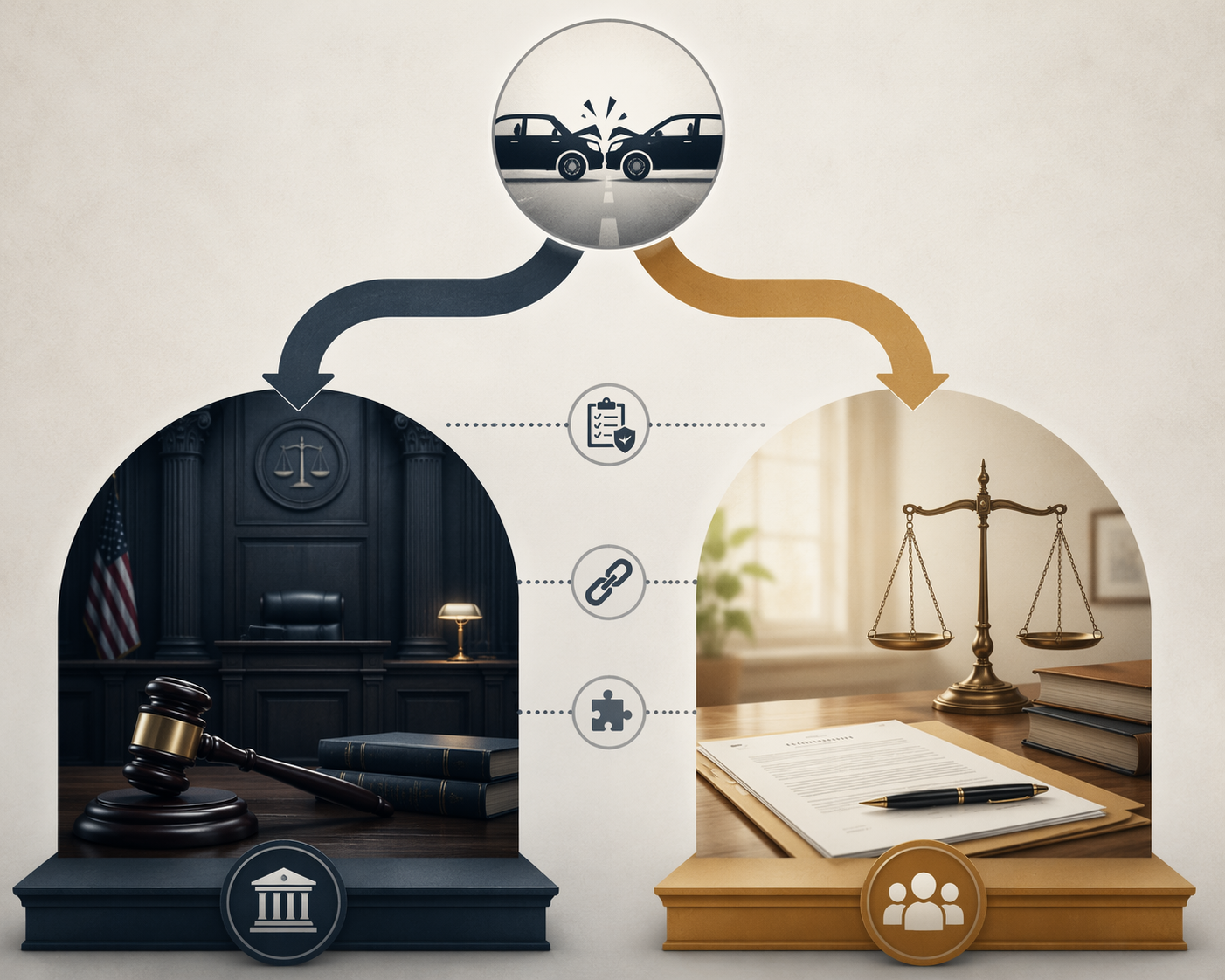
| Question | Criminal prosecution | Civil liability claim |
|---|---|---|
| Who brings the case? | The state or local prosecuting authority | The injured person, surviving family, estate, or other civil plaintiff |
| Who is the primary defendant? | The accused driver | The driver and, in some cases, other civil defendants depending on state law and facts |
| What must be proven? | A criminal offense beyond a reasonable doubt | Civil fault and damages, generally by a preponderance of the evidence |
| What is the main consequence? | Punishment, supervision, fines, license consequences, incarceration, or other criminal sanctions | Compensation for losses, and in some jurisdictions and circumstances, punitive damages |
| What is the victim’s role? | Witness, complainant, restitution participant, or affected party depending on the case | Party controlling the civil claim, subject to counsel, court rules, and settlement dynamics |
One Crash, Two Burdens Of Proof
The criminal case is not filed to make the victim financially whole. It is brought by the government to prove that the defendant committed a criminal offense. The prosecutor must satisfy the criminal burden of proof, and the available outcomes are criminal ones: conviction, acquittal, plea, dismissal, sentencing, probation, incarceration, fines, license restrictions, or other sanctions recognized by the jurisdiction.
The civil case has a different center. A plaintiff must prove liability and damages, usually by showing that it is more likely than not that the defendant’s conduct caused compensable harm. Legal guides from Jacobs & Dow and Zinda Law Group describe this basic split in DWI-related crash litigation: criminal proceedings punish the offense, while civil claims seek monetary recovery for the injured party or estate. [2][3]
Because the burdens are different, the two outcomes do not line up as neatly as nonlawyers sometimes expect. A guilty plea can make the civil defense harder. An acquittal does not automatically make the civil claim disappear. A prosecutor’s charging decision may be important evidence of how the government sees the case, but it is not a private plaintiff’s pleading. The civil lawyer still has to prove causation, damages, and the legally relevant duty breach; the criminal lawyer still has to protect against the state’s punishment power.
Criminal Consequences Escalate When Injury Or Death Enters The File
An ordinary DWI prosecution and a fatal crash prosecution are not the same kind of file simply because both involve alleged impaired driving. Once serious injury or death appears, prosecutors may evaluate enhanced charges, vehicular assault-type offenses, intoxication assault, DUI manslaughter, vehicular homicide, or comparable state-law crimes. The labels vary sharply by jurisdiction, and the facts that matter can include impairment evidence, driving conduct, prior convictions, warnings, causation, and the degree of risk the defendant is alleged to have consciously disregarded.
FindLaw’s discussion of DUI manslaughter and murder reflects a distinction that is useful but easy to overstate: DUI manslaughter generally addresses a death caused by impaired driving, while DUI murder is a narrower category that depends on state doctrine and a higher culpability showing. California’s Watson-rule framework is the usual example, where a prior DUI-related warning or conviction can help prosecutors argue implied malice in a later fatal impaired-driving crash. That example should not be read as a national default rule. [4]
This is where broad penalty summaries can mislead. A “DWI crash” may mean a misdemeanor impaired-driving count, a felony injury offense, a manslaughter prosecution, or, in unusual jurisdictions and circumstances, a murder theory. The charging decision is not just a reaction to the severity of the harm; it is also a judgment about whether the evidence can prove the required mental state and causal connection under the governing statute.
The existence of a charge also does not guarantee a conviction. MADD reported in 2019 that its court-monitoring data showed a 59% national conviction rate for drunk driving charges. [5] That figure is useful as a warning against assuming automatic criminal outcomes, but it is dated. It predates the full effect of pandemic-era court disruption and should not be treated as a current courthouse prediction for any particular county or state.
State-level sentencing data can be more concrete, but still local. The UNC School of Government’s 2024 DWI Sentencing Statistical Report is a North Carolina sentencing resource, not a national model. [6] Its value in this context is institutional rather than predictive: it shows that DWI outcomes are processed through state-specific sentencing structures, records, and offense classifications, not through a single national penalty grid.
The Civil Case Is Not Waiting For A Criminal Conviction To Exist
A civil plaintiff does not need the prosecutor to win before filing a negligence claim. The plaintiff needs admissible proof that the defendant owed a duty, breached it, caused the crash or injury, and created damages recognized by civil law. Impairment evidence may be central, but it is not the only issue. A plaintiff still may need medical proof, wage-loss documentation, expert causation opinions, vehicle data, toxicology evidence, photographs, video, or reconstruction testimony.
The civil defendant list may also be broader than the criminal caption. The criminal case usually names the accused driver. The civil case may examine whether other parties can be sued under state law and the available facts. That might include an employer if the driver was acting within the scope of employment, an owner under an entrustment theory, or a commercial alcohol provider where dram-shop law permits such claims. Those theories are highly jurisdiction-dependent and should not be assumed from the mere existence of a DWI arrest.
The remedy is also different. Civil damages may address medical expenses, lost income, diminished earning capacity, pain and suffering, property loss, funeral expenses, loss of support, or wrongful-death damages, depending on the claim and state law. Punitive damages may be available in some jurisdictions for intoxicated driving conduct, but caps, pleading rules, evidence thresholds, and insurability questions vary enough that a clean national statement would be careless.
How A Criminal Plea Can Move The Civil Case
The tracks remain legally separate, but they are not sealed off from each other. A guilty plea, conviction, sentencing finding, or admitted factual basis may become important civil material. The plaintiff’s lawyer will look for ways to use the criminal record to establish breach, narrow disputes, support punitive-damages arguments where permitted, or push an insurer toward earlier exposure analysis.
Negligence per se is one common bridge, though not a universal one. In jurisdictions that recognize it for the relevant statute and facts, violation of a safety law may establish the duty-and-breach component of negligence, leaving causation and damages for further proof. If the impaired-driving statute was designed to protect the class of people harmed and to prevent the kind of harm that occurred, a conviction or admitted violation may be powerful civil evidence. But states differ on whether the doctrine creates conclusive negligence, a rebuttable presumption, or only evidence of negligence.
Collateral estoppel can be more exacting. The basic idea is that an issue actually litigated and necessarily decided in one proceeding may, in some circumstances, prevent relitigation of that issue later. A criminal conviction after trial may give a civil plaintiff a stronger argument than a negotiated plea with limited factual admissions. Even then, the court must examine the identity of issues, finality, party relationship, and the fairness rules of the jurisdiction. The phrase “the driver was convicted” starts the analysis; it does not finish it.
Defense counsel usually sees the danger before anyone else. A plea that appears efficient in the criminal file can create a record that civil counsel will quote in a demand letter, motion, mediation statement, or punitive-damages briefing. The strategic question is not only the sentence exposure in criminal court. It is also what the plea admits, what the transcript preserves, and whether the wording leaves room to contest causation, damages, or comparative fault later.
Why An Acquittal Or Dismissal Does Not End The Civil Claim
The reverse point is just as important. If the criminal case fails, the civil case may still be viable. The prosecutor may have been unable to prove impairment beyond a reasonable doubt, unable to admit a key test result, unwilling to rely on a compromised witness, or forced to dismiss for reasons that do not answer the civil negligence question. A jury’s not-guilty verdict means the criminal burden was not met; it does not mean the crash caused no compensable injury.
Civil lawyers can still build a case from noncriminal proof: speed, lane departure, unsafe turning, phone records if obtainable, admissions at the scene, medical toxicology, bartender or passenger testimony, event-data recorder information, surveillance video, or the physical sequence of the collision. None of that automatically proves liability. It does explain why civil exposure may survive even after a prosecutor loses confidence in a charge.
Insurers understand this distinction. A carrier evaluating a bodily-injury or wrongful-death claim is not limited to asking whether the defendant was convicted. It must assess liability evidence, damages, venue, comparative fault, policy limits, punitive-damages risk where applicable, and the likelihood that a civil jury will view the crash record differently from a criminal jury or prosecutor.
The Evidence Moves Differently In Each Room
The same police report can have different value in different proceedings. In the criminal case, the defense may challenge the stop, arrest, field sobriety process, chemical test, chain of custody, confrontation issues, or statutory compliance. In the civil case, the report may lead to witnesses and admissions but still face hearsay objections if offered for the truth of its contents. A fact that helps one side investigate is not always a fact the jury will be allowed to hear in that form.
Timing creates another practical split. Criminal discovery, suppression motions, plea negotiations, and sentencing may occur while the civil statute of limitations continues to run. A civil plaintiff may need to file before the criminal case resolves. A defendant may invoke Fifth Amendment concerns in civil discovery while the criminal case is pending, forcing courts and counsel to manage stays, adverse-inference risks, and discovery sequencing. The two-track system is not just a legal abstraction; it changes who can ask questions, when they can ask them, and what happens if the defendant refuses to answer.
The victim or estate may experience the distinction as delay, but the institutions are doing different jobs. Prosecutors are weighing punishment under a high burden. Civil counsel is preserving compensation claims under a lower burden. Defense counsel is preventing admissions in one file from becoming uncontested facts in another. The insurer is estimating money exposure before the public criminal docket may reveal the final result.
State Variation Is Not A Footnote
National explanations of DWI crash litigation are useful only up to a point. FindLaw’s state DUI law comparisons reflect the obvious but often ignored point that DUI and DWI terminology, penalties, enhancement rules, and related consequences differ by state. [7] The same is true on the civil side for negligence per se, dram-shop liability, wrongful-death beneficiaries, punitive damages, comparative fault, and insurance coverage disputes.
That variation is why representative examples should stay representative. California’s Watson murder doctrine is important because it shows how a fatal impaired-driving crash may, in a narrow setting, become more than manslaughter. It does not mean every fatal DWI crash can or should be charged as murder. A state that treats statutory violations as negligence per se in one setting may treat them differently in another. A jurisdiction that permits punitive damages for intoxicated driving may still impose procedural limits or caps that alter settlement value.
For lawyers and claims professionals, the safer first move is to identify the state-law consequences on each track before predicting how the tracks will influence each other. The criminal code answers one set of questions. Civil negligence, wrongful-death, evidence, and insurance law answer another.
The Practical Consequence
A DWI crash court case is best understood as a pair of connected proceedings rather than a single legal event. The criminal case asks whether the government can prove an offense and justify punishment. The civil case asks whether the injured person, family, or estate can prove liability and damages. The proof standards differ, the parties differ, and the remedies differ.
The connection between them is where many consequential decisions are made. A plea may become civil ammunition. A conviction may support negligence per se or issue preclusion where the jurisdiction allows it. A failed prosecution may leave a plaintiff with a lower-burden civil path. The legally important question is not simply whether the driver was convicted. It is what each proceeding proves, what it leaves open, and how the record in one room changes the terrain in the other.
References
- Drunk Driving, National Highway Traffic Safety Administration.
- DUI Causing Injury or Death: Civil vs. Criminal Cases, Jacobs & Dow.
- Civil vs. Criminal DUI Cases, Zinda Law Group.
- DUI Manslaughter vs. Murder, FindLaw.
- New MADD Report Shows Only 59% of Drunk Drivers Are Convicted, Mothers Against Drunk Driving, 2019.
- DWI Sentencing Statistical Report, UNC School of Government, 2024.
- State DUI Laws, FindLaw.
Comments
Join the discussion with an anonymous comment.