
The Emily Willis disability lawsuit settlement is easy to flatten into a headline: a young woman leaves a Malibu rehabilitation facility with permanent catastrophic injury, and the case resolves for $3 million. The harder fact is that plaintiff counsel still described the case as "no slam dunk," and the reported attorney fee was reduced from $1.2 million to $1 million to secure approval of the deal.[1][2] That combination is the legal story. The settlement is large enough to recognize serious exposure, but not large enough to treat the Elder Abuse and Dependent Adult Civil Protection Act claim as if it automatically converted a bad medical outcome into punitive-value liability.
The public record, as presently reported, does not permit a complete reconstruction of the pleadings, motion history, settlement allocation, insurer position, or judicial reasoning. The complaint, settlement order, and licensing file were not independently available from the public sources cited here. That matters because this kind of case turns on distinctions that often disappear in media summaries: neglect versus professional negligence, delay versus causation, and custodial duty versus a competent adult's refusal of transport.

The Timeline Is More Important Than the Number
The most damaging factual sequence is the reported 26-hour gap between the first emergency call on February 3 and Willis being found unconscious on February 4.[2] A settlement figure can be discounted, allocated, insured, or shaped by confidentiality. A timeline is harder to soften. In a custodial-care case, the question is not simply whether a facility made a wrong medical judgment. It is whether the facility saw a patient in escalating danger, assumed responsibility for her safety, and then failed to respond with the urgency the situation required.
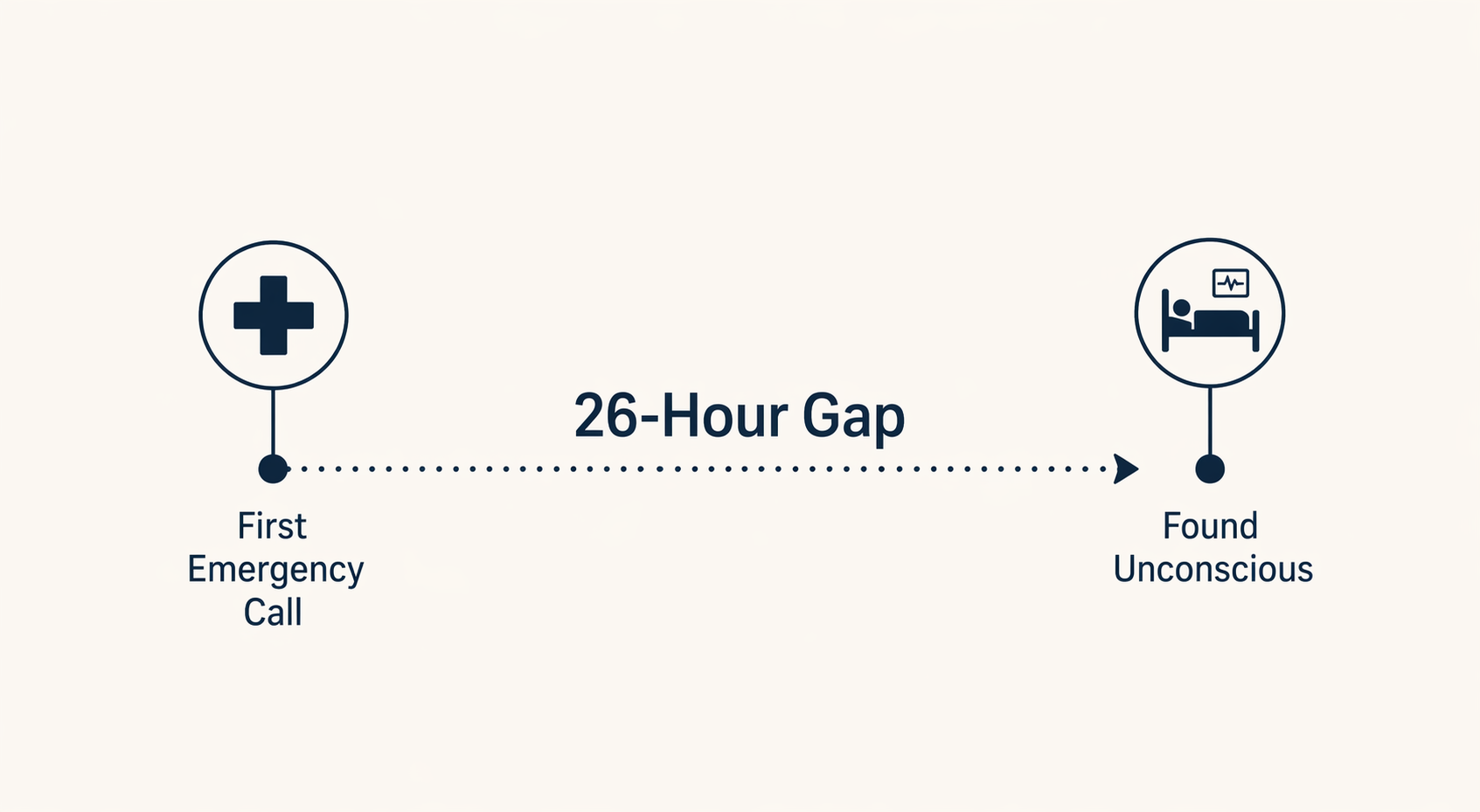
That is why the Willis facts have more force in sequence than in isolation. A rehab facility can argue that relapse, malnutrition, psychiatric instability, or drug-related medical fragility are part of the population it treats. It becomes harder to argue that prolonged deterioration was outside the facility's operational responsibility if staff had already recognized enough danger to involve emergency responders. The first emergency call gives the later delay its legal shape.
But the same timeline also contains the defense fact that prevents the case from becoming a simple abandonment narrative: paramedics were reportedly called, and Willis reportedly refused transport.[2] If true and legally effective, that refusal complicates both breach and causation. It allows the defense to say the facility did not ignore the emergency; it escalated to outside medical responders, and an adult patient declined removal.
That does not end the case. It changes the case. Once a refusal appears in the record, the plaintiff's burden shifts toward what the facility knew after the refusal, whether Willis had the capacity to refuse in that condition, what policies governed post-refusal monitoring, and whether staff treated the refusal as a reason to keep watching closely or as a reason to stand down.
Why EADACPA Could Reach a 25-Year-Old in Rehab
The legal architecture of the case depends on California's definition of a dependent adult. Under Welfare and Institutions Code section 15610.23, dependent-adult status is not limited to elderly residents; it can include an adult whose physical or mental limitations restrict the ability to carry out normal activities or protect rights.[3] The reported theory was that Willis, then 25, was unable to provide for basic needs because of severe ketamine addiction and anorexia, bringing her within EADACPA's dependent-adult framework.[2][3]
That threshold matters because a residential rehab facility is not merely a hotel with therapy rooms. When a facility accepts a patient who allegedly cannot safely meet basic needs, it may assume custodial obligations that look different from ordinary outpatient treatment. Carter v. Prime Healthcare is important here because the dependent-adult neglect theory focuses on a custodial relationship and the failure to provide goods or services necessary to avoid harm, not merely on a negligent act by a licensed professional.[3]
For plaintiff counsel, that framing opens the door to enhanced remedies under section 15657 if the neglect is proven by clear and convincing evidence and accompanied by recklessness, oppression, fraud, or malice.[3] For the defense, it creates an obvious line to police: a patient may be medically fragile and still not every clinical mistake becomes statutory elder or dependent-adult abuse. California law does not make EADACPA a damages multiplier for ordinary malpractice.
| Issue | Why It Mattered In Willis |
|---|---|
| Dependent-adult status | The reported allegation that Willis could not meet basic needs gave the EADACPA claim a statutory route despite her age. |
| Custodial relationship | Residential rehab care made the facility's monitoring and response duties central to the case. |
| Recklessness standard | Enhanced remedies required more than a showing that staff made a negligent medical decision. |
| Patient refusal | The reported refusal of transport gave the defense a direct answer to the claim that the facility simply failed to seek emergency help. |
The Four Claims Did Not Carry Equal Weight
Public reporting identifies four causes of action: dependent adult abuse under EADACPA, professional negligence, violation of California law, and fraudulent business practices.[4] They should not be treated as four equally strong engines of settlement value. The EADACPA claim was the claim with leverage because it threatened enhanced remedies if the plaintiff could prove statutory neglect at the required level. The professional-negligence and regulatory-duty theories supplied the standard-of-care backdrop. The marketing theory added atmosphere and potential unfairness, but it was not the center of gravity.
Dependent Adult Abuse
The dependent-adult abuse claim had the clearest path to higher exposure and the steepest proof problem. The plaintiff needed more than a showing that Summit Malibu made a poor clinical decision. EADACPA enhanced remedies require proof by clear and convincing evidence of recklessness, oppression, fraud, or malice.[3] In practical terms, that means the plaintiff would need evidence that the facility consciously disregarded a high probability of harm, not merely that another provider would have acted faster.
The 26-hour gap is the fact most likely to support that theory. If staff knew Willis was medically unstable, had already involved emergency responders, and then failed to implement adequate monitoring or escalation before she was found unconscious, a jury could view the conduct as something worse than ordinary negligence. That is the danger the case posed for Summit Malibu.
Still, the reported refusal of transport would have been a serious defense exhibit. A facility facing an EADACPA claim would likely argue that calling paramedics is inconsistent with conscious disregard. The plaintiff response would have to be narrower and more fact-intensive: the refusal did not discharge the facility's custodial obligations if Willis lacked meaningful capacity to refuse, if her condition worsened afterward, or if staff failed to follow appropriate post-refusal safeguards.
Professional Negligence and Regulatory Duties
The professional-negligence claim is more conventional: did the facility meet the standard of care expected of a licensed residential rehabilitation provider? The reported regulatory-duty theory points toward California Department of Health Care Services Title 9 licensing requirements.[4] Those allegations matter because they help define what competent monitoring, escalation, documentation, staffing, and emergency response should have looked like in a licensed rehab setting.
The limitation is equally important. Public reporting indicates that Summit Malibu had a clean licensing record.[2] A clean record does not prove that staff acted properly in Willis's case. It does remove a common plaintiff-side advantage: the ability to show regulators had previously identified the same kind of safety problem. Without that history, the plaintiff would need to build the regulatory case from the incident itself, facility policies, expert testimony, and witness accounts rather than from a pattern of prior licensing violations.
Fraudulent Business Practices
The fraudulent-business-practices theory appears tied to Summit Malibu's public-facing promises of "world-class clinicians" and "24/7" care.[5] Those representations can matter if the complaint alleged that the facility sold a level of oversight it did not provide. They help explain why the facts feel especially jarring: a patient entered a premium residential environment that marketed intensive support and allegedly was not protected during a medical crisis.
But marketing language is not liability by itself. Words like "world-class" may invite skepticism, but they do not prove causation, recklessness, or statutory neglect. The legally useful question is whether the facility made concrete representations about continuous clinical availability, medical monitoring, or emergency response and whether those representations shaped the admission decision or the standard of care the facility undertook to provide.
Patient Refusal Is the Fact That Depressed the Case
The autonomy problem sits at the center of the settlement. California law generally recognizes that a competent adult may refuse medical treatment. A residential rehab facility also may have custodial obligations when it accepts a dependent adult who cannot safely care for herself. Those principles can coexist peacefully in textbooks. In a crisis timeline, they collide.
If Willis had capacity when she refused transport, the defense could argue that Summit Malibu respected patient autonomy after taking the appropriate emergency step. If she lacked capacity because of addiction, malnutrition, altered mental status, or medical instability, the plaintiff could argue that the facility could not simply accept the refusal at face value. The legal significance of the refusal would depend on facts not available in the public materials: what paramedics observed, what staff documented, whether any capacity assessment occurred, what symptoms were present, and what monitoring was ordered after responders left.
This is also where causation becomes difficult. Plaintiff counsel reportedly acknowledged that "no one knows exactly what caused" the cardiac arrest.[2] That concession would matter at mediation and at trial. A plaintiff can prove a troubling delay and still face a defense argument that the ultimate arrest resulted from a medical process the facility did not cause and could not have prevented after a refused transport. The plaintiff answer would likely focus on lost chance, delayed escalation, and the foreseeability of deterioration, but those theories require expert support. They are not supplied by outrage alone.
What the $3 Million Settlement Signals
A $3 million settlement for permanent disability is substantial, but it is not a verdict. It does not establish that Summit Malibu committed dependent-adult abuse, that punitive damages were warranted, or that similar rehab cases now have a reliable market value. Public reporting does not identify a punitive-damages component, and the allocation among claims remains confidential.[1][4] That silence is not proof that punitive exposure was absent. It does suggest the case resolved inside a risk-managed range rather than as a public punitive-damages defeat.
The fee reduction is more revealing than it may look. A move from a reported $1.2 million fee to $1 million reduced counsel's share from 40% to roughly one-third of the settlement.[1] That is not a merits finding. It is a settlement signal. Plaintiff counsel had a catastrophically injured client, a powerful delay timeline, and an EADACPA theory with enhanced-remedy potential. Counsel also had patient refusal, uncertain causation, no publicly reported punitive allocation, and no reported adverse licensing history. Reducing fees to close the deal is consistent with a case that was dangerous for the defense but not clean enough for the plaintiff to price as a likely runaway verdict.
That distinction matters for anyone reading the settlement as precedent. The Willis result supports the proposition that rehab facilities can face heightened California exposure when they accept patients who qualify as dependent adults and then allegedly fail to respond to signs of medical crisis. It does not support the broader claim that luxury branding, severe injury, or a bad outcome automatically transforms rehab negligence into EADACPA recklessness.
The settlement's real legal signal is narrower and more useful: dependent-adult status can change the liability conversation in residential rehab, especially when the timeline suggests prolonged non-escalation after known danger. But the strongest emotional facts still have to pass through causation, capacity, refusal, and the clear-and-convincing burden. On the public facts available, that is why the case was worth millions, and also why it settled like a contested risk rather than a statutory rout.
References
- Emily Willis wins $3 million payout after being left permanently disabled, LADbible, 2026-07-17
- Legal Implications of Negligence in Rehab Centers: The Case of Emily Willis, Florida Justice
- Elder Abuse and Dependent Adult Civil Protection Act – Litigation 101, Plaintiff Magazine, 2026
- Emily Willis' Family Settles With Malibu Rehab Clinic, AVN
- Summit Malibu official website, Summit Malibu
Comments
Join the discussion with an anonymous comment.