
As of July 20, 2026, the Empire Pizza Tucson shooting is still an early-stage record, not a completed charging story. The public facts are serious but incomplete: 10 people were struck outside Empire Pizza & Pub at 240 E. Congress Street in downtown Tucson, including nine bystanders and the suspect; the confrontation reportedly began between two groups who knew each other; and the shooting drew a police response that ended with a Tucson officer shooting the fleeing armed suspect.[1] The suspect remained in life-threatening condition, had not been publicly identified, and no charges had been filed as of the same date.[2]
That posture matters because the case split almost immediately into two tracks. One track is the outside criminal investigation associated with the officer-involved shooting. The other is Tucson Police Department's internal review of whether the officer's use of force complied with department policy. Those tracks may eventually meet at the Pima County Attorney's Office, but they are not the same inquiry, and they should not be described as if they are.
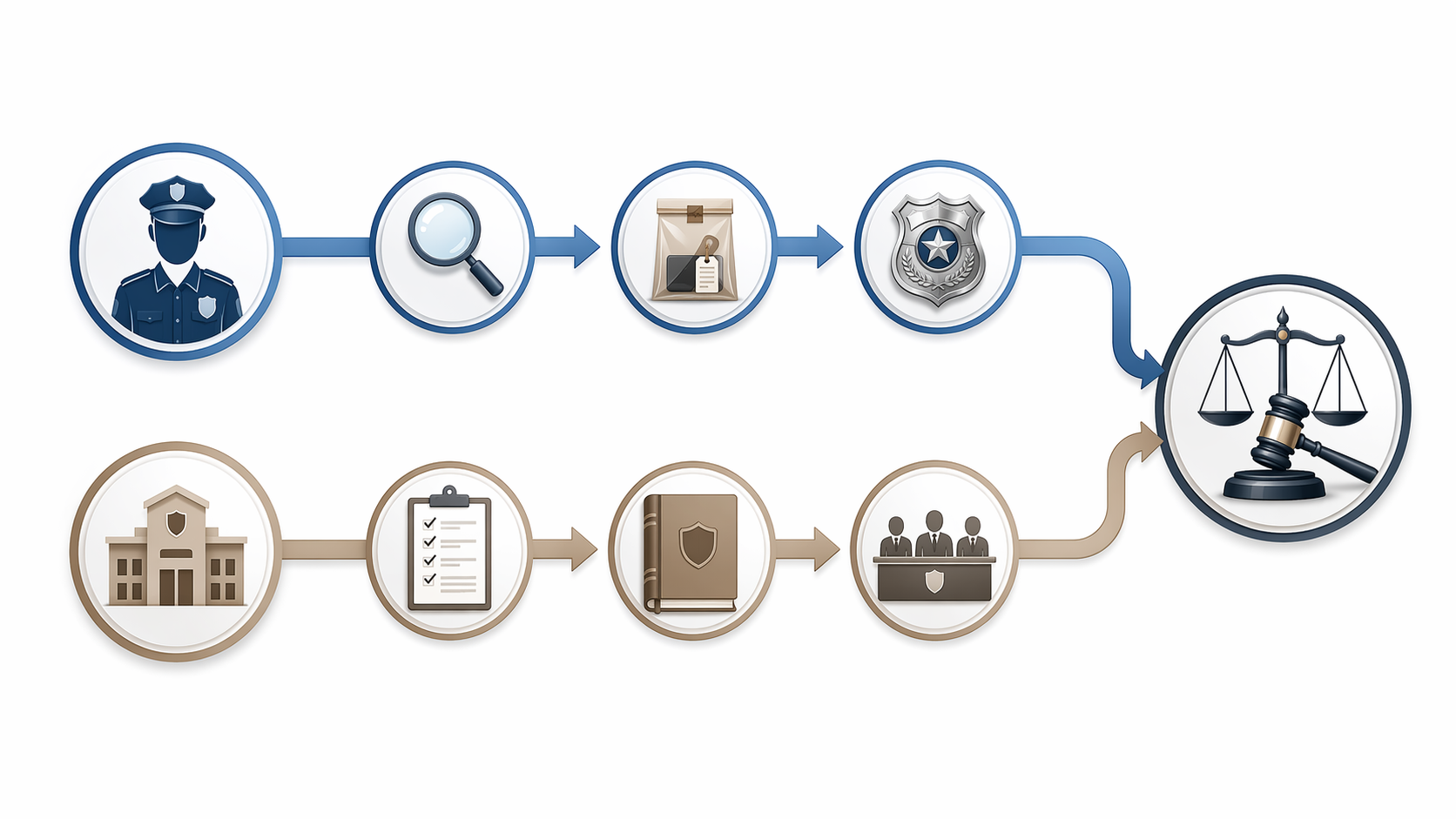
The first procedural fact is the split in responsibility
The Pima Regional Critical Incident Team, or PRCIT, is the mechanism built for cases like this: critical incidents involving law enforcement where a separate agency is expected to investigate the potential criminal dimensions of the officer's conduct. PRCIT was formed in March 2022 by nine southern Arizona law enforcement agencies: the Pima County Sheriff's Department, Tucson Police Department, Oro Valley Police Department, Marana Police Department, Pascua Yaqui Police Department, Sahuarita Police Department, University of Arizona Police Department, Pima Community College Police Department, and South Tucson Police Department.[3]
Because the officer who fired was a Tucson police officer, the Pima County Sheriff's Department is leading the outside criminal investigation through PRCIT. That is not a cosmetic distinction. It is the structural answer to an obvious conflict problem: the involved department does not lead the criminal review of its own officer's shooting.
The outside criminal investigation is not limited to the officer. In a mass-casualty incident, investigators also have to reconstruct the suspect's alleged conduct, the sequence of gunfire, witness accounts, physical evidence, medical evidence, and any video or body-worn camera material that can place events in order. The public may experience this as one police investigation. Procedurally, it is more exacting than that.
PRCIT is not TPD's Force Review
The central distinction is this: PRCIT examines whether conduct connected to the officer-involved shooting violated state criminal law, while TPD's internal Force Review process examines whether the officer's actions complied with department policy. Tucson's Critical Incident Review materials describe an internal process that includes a Force Review Board for department-level assessment after critical incidents.[4]
| Track | Lead entity | Main question | Near-term output |
|---|---|---|---|
| Outside criminal investigation | PCSD through PRCIT | Whether conduct in the officer-involved shooting violated state criminal law | Findings that may be forwarded for prosecutorial review |
| Internal force review | TPD Force Review Board / Critical Incident Review process | Whether the officer's force complied with department policy | Administrative findings and possible policy, training, or discipline consequences |
| Prosecutorial review | Pima County Attorney's Office | Whether the evidence supports criminal charges | Charging decision, declination, or request for further investigation |
A criminally justified shooting can still raise policy questions. A policy-compliant shooting can still be examined by prosecutors. An internal finding does not itself file a criminal charge. A prosecutor's decision does not answer every administrative question inside a police department. Those separations are not technicalities; they are what determine which records, standards, and decision-makers matter next.
The phrasing also matters for the public record. Saying that “police are investigating” obscures the fact that the Sheriff's Department is handling the outside criminal review because TPD is the involved agency. Saying that “the department cleared the officer,” if and when an internal result appears, would not necessarily say what prosecutors concluded. Saying that “prosecutors are reviewing the shooting” would not mean prosecutors made the arrest or controlled the initial evidence collection.
Where the County Attorney fits
The Pima County Attorney's Office is the legal gatekeeper for criminal charging decisions, but it is not the arresting agency. According to reporting on County Attorney Laura Conover's statement, the office said it reviews all forwarded findings, does not make arrests, and had sent victim advocates to the hospital and senior prosecutors to the scene after the shooting.[5]
Those details are not window dressing. Victim advocates at the hospital signal immediate contact with injured people and families at a point when medical information, safety planning, and basic notification duties are still active. Senior prosecutors at the scene do not transform the scene into a courtroom, but their presence can help preserve the line between investigative collection and later charging review.
For legal readers, the handoff point is the item to watch. PRCIT and PCSD can investigate, interview, collect, and reconstruct. TPD can conduct its internal use-of-force review. The County Attorney's Office then assesses whether the forwarded record supports criminal charges. As of July 20, that step had not produced publicly filed charges.[2][5]
Potential charges remain only potential
Given the number of people struck, it is reasonable for lawyers to think ahead to assaultive offenses, attempted-homicide theories, weapons allegations, and sentencing enhancements that can appear in Arizona shooting cases. But that is a legal possibility analysis, not a report of charges in this case. The suspect's medical condition alone may slow the ordinary sequence of charging, initial appearance, appointment of counsel, and arraignment.
The suspect's identity has also not been publicly released. Until that changes, there is no public charging document to read against a named defendant, no stated count structure, no filed probable-cause narrative, and no defense posture to evaluate. The case may feel procedurally urgent because of the number of injured people. It is still at the stage where the public record is mostly agency statements and media-confirmed status updates.
The downtown facts orient the case, but they do not answer the legal questions
The shooting happened outside Empire Pizza & Pub in downtown Tucson, a location that quickly made the incident legible to anyone familiar with Congress Street nightlife. Reports describe a confrontation between two groups who knew each other before shots were fired.[1] That fact narrows the public understanding somewhat: this was not reported as a wholly random attack on strangers. It does not, by itself, establish motive, legal culpability, or the sequence that investigators will have to prove.
The case reference number reported for TPD is 260719048.[2] In a developing case, a number like that is mundane but useful. It gives attorneys, journalists, and affected community members a stable reference point when later records requests, supplemental statements, or court filings begin to circulate.
The incident has also been described as Tucson's worst mass shooting since the 2011 attempted assassination of then-Rep. Gabby Giffords.[6] That comparison explains why national gun-violence organizations and local officials are likely to remain attentive. It does not reduce the current investigation to a historical analogy. This case has its own evidentiary record, its own injured victims, and its own officer-involved shooting review.
Why the officer-involved shooting count will draw separate scrutiny
The officer-involved component will not be evaluated in a vacuum. This was reported as the 10th officer-involved shooting in the Tucson area in 2026 and the 52nd statewide. Pima County Supervisor Matt Heinz said in April 2026 that Tucson typically sees eight to 10 police shootings per year, making the pace unusual by that point in the year.[7]
That context justifies closer attention to process. It does not, without more, prove anything about this officer's conduct or the suspect's actions. The legal question in the PRCIT track remains tied to this event: what the officer knew, saw, and did; what threat was present at the moment force was used; what evidence corroborates or contradicts witness accounts; and how state criminal law applies to that reconstructed sequence.
The administrative question is different. TPD's review can look at policy, tactics, supervision, equipment, training, and post-incident procedures. Those issues may matter even if prosecutors never file charges against an officer. They may also matter to civil litigants later. But at this point, there is no completed public Force Review outcome to analyze.
Civil exposure is a later-stage issue
Civil liability will be on the horizon for lawyers watching a shooting with multiple injured bystanders, but it should stay in the background for now. No lawsuits have been reported in the materials available as of July 20. The near-term timeline belongs to medical status, investigative findings, and charging review.
If civil claims are filed later, plaintiffs and defendants may have to deal with a complicated mix of Arizona tort law, public-entity defenses, causation issues, premises questions, and federal protections for firearms-industry defendants under the Protection of Lawful Commerce in Arms Act. That is a downstream litigation map, not the present case posture. The criminal record will likely shape what later civil pleadings can responsibly allege.
What to watch next
The next meaningful developments are procedural, not atmospheric. The public record should be watched for five items: identification of the suspect, an updated medical status, any PRCIT or PCSD findings forwarded for review, any charging decision by the Pima County Attorney's Office, and any TPD Force Review outcome.
- Suspect identification: necessary before the public can connect the incident to a named defendant or filed charging document.
- Medical status: directly relevant to timing for charging, custody, appearance, and defense proceedings.
- PRCIT or PCSD findings: the outside criminal review is the path most likely to feed prosecutorial analysis of the officer-involved shooting.
- PCAO charging decisions: the point at which hypothetical offenses become filed allegations, if prosecutors determine the evidence supports them.
- TPD Force Review results: the administrative answer to policy compliance, separate from criminal liability.
For now, the Empire Pizza Tucson shooting investigation remains a dual-track investigation in its opening phase. It is not yet a charging story, not yet a civil-liability story, and not yet a completed officer-use-of-force finding. The public record is still being built.
References
- 10 people struck in downtown Tucson mass shooting; Officer shoots armed suspect — KGUN 9
- 10 hospitalized, including suspect, in downtown Tucson mass shooting — AZFamily/KOLD
- Law enforcement agencies create team to investigate officer-involved incidents — KOLD News 13
- Critical Incident Review — City of Tucson Police Department
- Suspect in custody after shooting involving Tucson police; 10 people critically hurt — ABC15
- Gabby Giffords statement on mass shooting in Tucson, Arizona — GIFFORDS
- Police shooting spike is 'unusual,' county supervisor says — AZPM
Comments
Join the discussion with an anonymous comment.