
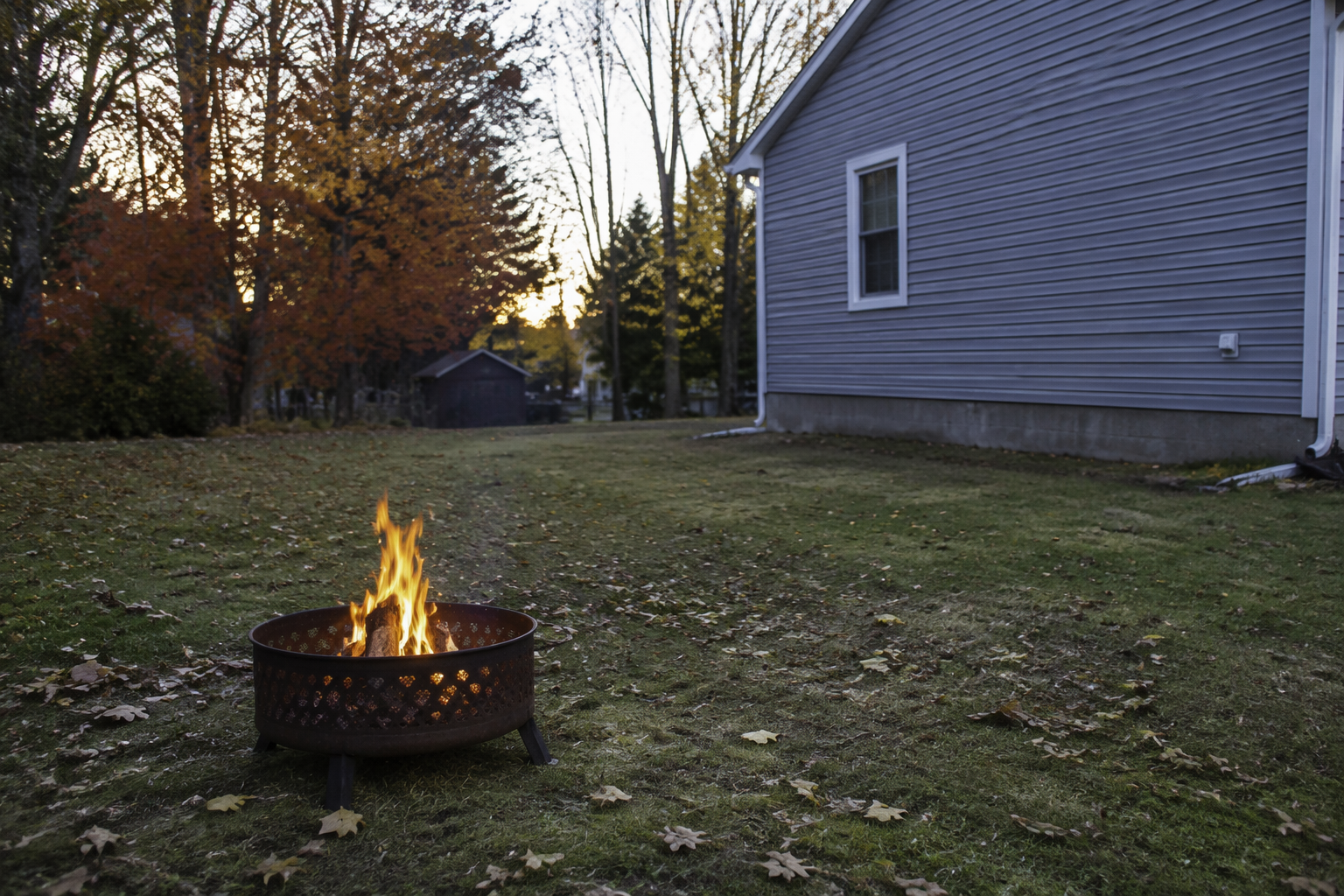
Erie does not treat a backyard recreational fire pit as automatically illegal. The controlling city rule is housed in Article 1503.2 of the Quality of Life ordinance, in the illegal-burning provisions, rather than in a standalone fire-pit chapter. Under the post-2025 framework reported in current Erie coverage, a recreational fire is allowed only if it uses dry seasoned firewood, sits in an approved container, keeps a 15-foot clearance from structures, property lines, and combustible materials, operates between 5 p.m. and midnight, and is not burned when sustained or gusting winds reach 10 mph.[1][2]
That is the practical answer for anyone checking what the City of Erie municipal code allows. The harder part is that the official code reference is authoritative, but the accessible public trail for the 2025 changes currently runs through local reporting that cites the ordinance and quotes Erie fire officials. For a citation, lease rule, or enforcement file, the safest practice is to verify the current Article 1503.2 text directly against the city’s official code source before relying on a secondhand summary.[1][2]
The Current Compliance Test
For ordinary residential use inside Erie city limits, the rule can be reduced to a short checklist. Each item matters because failure on any one of them can move the fire out of the protected recreational-fire category and into illegal-burning enforcement.
| Requirement | Reported Erie rule | Practical meaning |
|---|---|---|
| Container | Approved metal or masonry fire rings, portable outdoor fireplaces, and chimineas are allowed; hand-dug pits and burn barrels are prohibited. | The city is looking at the device, not just the size or purpose of the fire. |
| Fuel | Dry seasoned firewood only. | Trash, construction debris, yard waste, and similar material should not be treated as recreational-fire fuel. |
| Setback | 15 feet from structures, property lines, and combustible materials. | The measurement is not only from the house; fences, neighboring lines, and combustibles also matter. |
| Time | 5 p.m. to midnight daily. | The 2025 amendment standardized the schedule, replacing the older split weekday/weekend approach. |
| Wind | No burning at sustained or gusting winds of 10 mph or more. | A compliant container and distance do not save the fire if the wind threshold is crossed. |
| Penalty path | Warning, then $25, $50, and $100 for later violations, with fines subject to the district justice’s discretion. | The first encounter may be a warning, but repeat violations create a paper trail. |
The July 2026 Erie Times-News account identifies the 2025 amendment as the change that put the daily 5 p.m.-to-midnight window in place, specified approved containers, and tied enforcement to wind and setback limits.[2] The official code entry for Article 1503.2 remains the higher-authority source, but direct access to the raw text was not available for this review; the operative details here are therefore reconstructed from current reporting and official-code references rather than reproduced from the municipal code database itself.[1][2]
Allowed, Prohibited, Conditional, Escalated
A fire pit that clears all five ordinary conditions is the easy case: approved container, proper fuel, 15-foot clearance, permitted hours, and wind below the threshold. Erie’s code framework does not appear to require the resident to prove a special occasion or obtain a one-night permit for that ordinary recreational use, based on the reported post-2025 rule set.[2]
The prohibited category is also fairly concrete. Burn barrels and hand-dug pits are not treated as approved recreational-fire containers, and the fuel rule is limited to dry seasoned firewood.[2] A resident who says the fire is “just small” has not answered the code question if the container itself is forbidden or the material being burned is not approved.
The conditional category is where many disputes start. A portable outdoor fireplace may be an approved container, but it still has to be placed far enough from the house, the property line, a fence, stacked wood, dry leaves, or other combustible material. A chiminea can satisfy the container requirement and still fail the time or wind requirement. The ordinance structure makes compliance cumulative, not interchangeable.
The escalated category begins when the problem is no longer only a Quality of Life ticket. Erie fire officials have warned that a fire escaping control can lead to reckless-burning exposure under Pennsylvania criminal law, and property damage can lead to criminal-mischief consequences, including felony treatment depending on the damage and statutory elements.[2]
What the 15-Foot Setback Actually Does
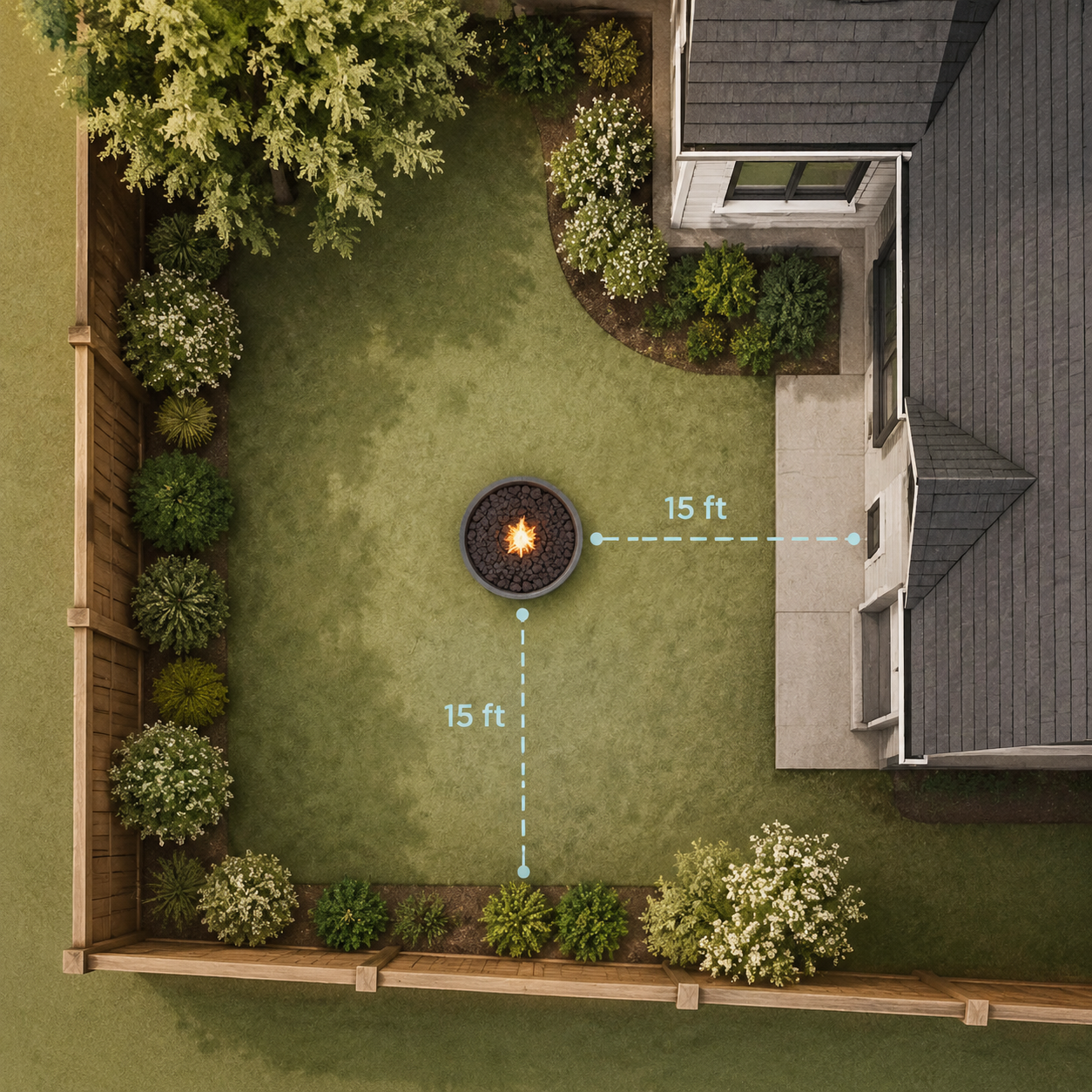
The 15-foot rule is a placement rule, not a suggestion about comfort. The reported Erie provision requires the recreational fire to be at least 15 feet from structures, property lines, and combustible materials.[2] That wording matters in narrow city lots, where a fire pit can be far enough from the rear wall of the house but too close to the lot line or a wood fence.
For enforcement purposes, “from structures” is only one measurement. “From property lines” brings the neighbor’s boundary into the analysis even if nothing on the neighboring property has caught fire. “From combustible materials” is broader still, because it can include movable conditions created after the fire pit was placed: patio furniture, firewood stacks, leaves, cardboard, or other burnable items.
This is also where Erie’s recreational-fire rule should not be confused with other fire-code distances. The Erie Fire Department’s International Fire Code materials distinguish larger or different categories, including bonfires with a 50-foot distance and uncontained recreational fires with a 25-foot distance.[5] Those figures are useful for comparison, but they are not the same as the reported 15-foot municipal setback for Erie’s approved-container recreational fires.
Containers Are the Gatekeeping Requirement
The approved-container language does much of the work in Erie’s rule. Metal fire rings, masonry fire rings, portable outdoor fireplaces, and chimineas are the reported examples of acceptable containers under the amended ordinance.[2] The common feature is containment: the city is drawing a line between a recreational fire built in a controlled device and an open or improvised burn.
A hand-dug pit fails that test even if it is neat, shallow, and used only for firewood. A burn barrel fails it even if the resident calls the use recreational. The label attached by the property owner does not control if the container falls outside the ordinance’s approved forms.
For property managers, this is the easiest provision to translate into lease language because it does not require a weather judgment or a measurement dispute. A rule can prohibit burn barrels and hand-dug pits outright while allowing only commercially made or masonry recreational-fire containers that can also be placed at the required distance.
The Time Rule Changed
Some Erie residents may remember a different schedule because the older ordinance discussion used one. In 2021, Erie Times-News coverage described a split schedule: 5 p.m. to 11 p.m. on weekdays and 5 p.m. to midnight on Fridays and Saturdays.[3] WJET’s 2021 reporting also covered the Quality of Life ticketing framework that accompanied the city’s illegal-burning enforcement approach.[4]
The reported post-2025 rule is simpler: 5 p.m. to midnight daily.[2] That change matters because neighborhood summaries often survive longer than the ordinance language they were based on. A resident relying on the older weekday cutoff may be more restrictive than the current reported rule; a resident relying on a vague “evening fires are fine” understanding may still violate the midnight endpoint.
Wind Is a Separate Stop Sign
The 10 mph wind limit is not a best-practices footnote. The reported ordinance language covers sustained winds and gusts, which prevents a narrow reading that looks only at average conditions.[2] If the gusts reach the threshold, the recreational fire should not be treated as code-compliant even if the sustained wind is lower.
This is one of the harder provisions to prove after the fact, but it is not meaningless. Code enforcement and fire officials can look to weather conditions, observed flame behavior, complaint timing, and the surrounding circumstances. For a resident, the more defensible decision is made before lighting the fire: if the forecast or current conditions show winds at or above the threshold, the fire waits.
Ticketing and Repeat Violations
Erie’s Quality of Life enforcement model is built for graduated ticketing. The reported schedule begins with a warning, then moves to a $25 fine for a second violation, $50 for a third, and $100 for a fourth or later violation, with the district justice retaining discretion.[2][4] That structure is important because a first contact and a fourth contact are not the same event in the city’s enforcement file.
The fine schedule should be read with some caution. The 2021 reporting confirms the warning, $25, $50, and $100 sequence in the Quality of Life ticketing program.[4] The 2026 Erie Times-News account describes fines as being at the district justice’s discretion in the post-amendment setting.[2] Without direct access to the current code text for this review, the best source-aware reading is that the graduated sequence remains the reported framework, but the exact current application should be checked against Article 1503.2 and the Quality of Life ticketing provisions before it is quoted in a formal filing or enforcement notice.[1][2][4]
When a Ticket Becomes Something More
Most fire-pit disputes will live in the warning-and-fine lane: wrong container, wrong time, too close to a fence, or burning during prohibited wind. The legal risk changes when the fire escapes control or causes damage. Erie fire officials have linked out-of-control fires to reckless-burning charges and property-damage fires to criminal mischief under Pennsylvania law.[2]
That distinction is not just theoretical. A contained fire at 12:15 a.m. presents a different enforcement problem than a fire that spreads to a garage, fence, or neighboring property. The first looks like a municipal-code violation. The second gives officials a public-safety event, possible damage valuation, and potential criminal elements to evaluate.
For a code officer or property manager, this is the point where documentation changes. Photos of placement and container type may be enough for an ordinary Quality of Life ticket. An escaped fire may require incident reports, fire department findings, witness accounts, damage records, and referral decisions. The municipal fire-pit rule is still relevant, but it is no longer the whole file.
Burn Bans Override the Ordinary Permission
The city rule should also be separated from temporary burn bans. Erie County announced a 14-day countywide burn ban in November 2024 during dry conditions.[6] During a valid county burn ban, the ordinary city allowance for a compliant recreational fire may not be available, even if the fire pit otherwise satisfies Article 1503.2.
The Pennsylvania Department of Conservation and Natural Resources adds another source of confusion. DCNR’s seasonal burn-ban rule from March 1 through May 25 applies to state forest lands, not automatically to residential backyard fire pits inside Erie city limits.[7] It may be relevant for camping or state-forest use, but it should not be blended into Erie’s municipal residential rule without checking the land and jurisdiction involved.
What to Verify Before Relying on the Rule
The current public account is strong enough for a practical compliance guide, but not strong enough to replace the official code in a legal file. The exact ordinance number and effective date of the 2025 Quality of Life amendment could not be confirmed from the materials reviewed here beyond the fact that the amendment was reported as passed in 2025.[2]
- Check the current Article 1503.2 text in the official Erie municipal code source before quoting ordinance language.
- Confirm whether the Quality of Life ticketing schedule has been modified since the 2021 and 2026 reports.
- Check for any active Erie County burn ban before advising that a particular fire is allowed.
- Separate residential city fires from state-forest, bonfire, and uncontained-fire rules.
Under the post-2025 framework, an Erie recreational fire pit is lawful only when it fits the city’s container, fuel, distance, time, and wind limits. Once the fire escapes those limits, the issue can move from a warning or Quality of Life fine to criminal exposure if the fire creates actual danger or property damage.
References
- Article 1503.2, Quality of Life Ordinance, eCode360
- Erie fire pit regulations and 2025 Quality of Life amendment, Erie Times-News, July 17, 2026
- Erie City Council considers ordinance regulating backyard fire pits, Erie Times-News, February 18, 2021
- Quality of Life ticketing program coverage, WJET, April 7, 2021
- International Fire Code reference materials, Erie Fire Department
- Erie County burn ban announcement, Erie County, November 4, 2024
- State Forest Rules and Regulations, Pennsylvania Department of Conservation and Natural Resources
Comments
Join the discussion with an anonymous comment.