
By Q3 2026, the legal calendar and the processing calendar no longer line up neatly for US citizens seeking permission to travel, live, or work in Europe. The EU AI Act treats AI systems used in migration, asylum, and border management as high-risk, including systems used to examine visa and residence permit applications and assess security or irregular-migration risks.[1][2] Yet the Digital Omnibus package agreed on 7 May 2026 defers the relevant high-risk obligations for this category until 2 December 2027.[3]
That gap matters because the systems are not waiting politely for the compliance date. ETIAS is not a work visa system, and it should not be described as one. It is a short-stay travel authorization for visa-exempt travelers, including US citizens, for stays of up to 90 days in the Schengen area. But it is also likely to be the first highly visible automated EU border-screening system many US travelers encounter. The official EU travel portal says ETIAS is not yet operational and that no launch date has been confirmed; many secondary sources continue to point to Q4 2026.[4][5]
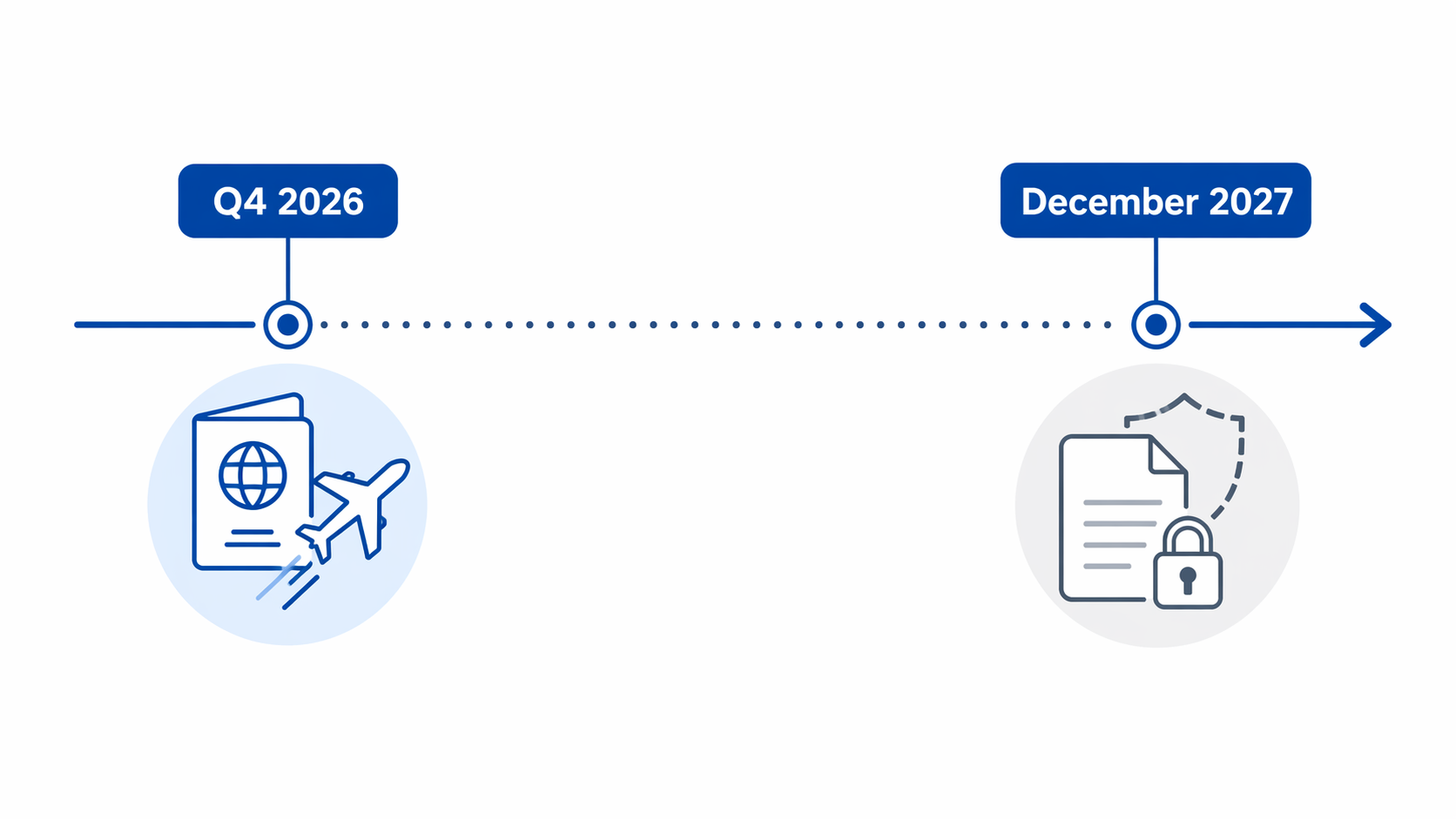
For counsel advising US employees, the practical question is not whether Europe has an AI law. It is whether a file screened, scored, routed, or delayed before December 2027 is protected by the AI Act obligations that lawyers would normally associate with a high-risk label: risk management, data governance, technical documentation, logging, transparency to deployers, human oversight, accuracy, robustness, and cybersecurity.[1][3] For migration and border systems, the label arrives before the enforceable guardrails.
What the AI Act classifies as high-risk
Annex III, point 7 is the provision that brings immigration administration into the AI Act’s high-risk architecture. It covers AI systems intended to be used by competent public authorities, or on their behalf, in migration, asylum, and border control management. The covered uses include examining applications for asylum, visas, and residence permits, assessing eligibility, and assessing risks such as security, irregular immigration, or health risks.[2]
That language reaches beyond airport e-gates. A US citizen applying for a European work visa or residence permit is usually dealing with a national immigration system, a consulate, a labor-market or residence authority, and sometimes an outsourced appointment or document channel. If an AI tool is used to evaluate the application, verify documents, triage risk, or support the authority’s decision-making, the Act’s high-risk category is implicated. The hard part is finding out what actually touched the file.
| Lane | What it generally covers | Why AI Act timing matters |
|---|---|---|
| ETIAS | Short-stay travel authorization for visa-exempt travelers, including US citizens, for stays up to 90 days | Visible automated screening may begin before migration high-risk safeguards are enforceable |
| Schengen visa and VIS processing | Short-stay visa processing and shared visa information systems | Risk profiling and database checks can affect routing, scrutiny, or refusal explanations |
| National work and residence permits | Long-stay employment, residence, and work authorization handled by Member State systems | National automation may already support eligibility review, document checks, or positive decisions |
The distinction is not academic. A US applicant may start with ETIAS because it is familiar and searchable, then later need a national work or residence permit because the planned activity exceeds short-stay permission or involves employment. The AI Act issue travels across those lanes, but the legal permissions do not. ETIAS approval is not authorization to work.
The deferred safeguards are the point
For high-risk AI systems generally, the AI Act’s compliance structure is supposed to force discipline before and during deployment. Providers must manage foreseeable risks, use appropriate data governance, keep technical documentation, design logging, provide instructions for use, enable human oversight, and meet accuracy, robustness, and cybersecurity requirements.[1] Those duties are not cosmetic in immigration processing. They are the materials a lawyer looks for when trying to understand whether a delay, escalation, or denial came from a legal ground, a database match, a document issue, or a machine-generated risk assessment.
The Digital Omnibus deferral means those high-risk obligations for migration and border-management AI do not apply until 2 December 2027.[3] A system can therefore sit in a category the EU itself recognizes as sensitive while the most useful procedural safeguards remain delayed. This is the uncomfortable middle ground: the law has named the risk, but applicants and advisers may still be working without the documentation, transparency, and oversight duties that would make the label operational.
Some transparency is also structurally narrowed in this domain. Vavoula’s analysis of the AI Act notes that providers may self-assess whether a system falls into the high-risk category under Article 6(3), migration and border-control systems are registered in a secure non-public section of the EU database under Article 49(4), and migration systems are not covered by the two-person human verification safeguard discussed for certain biometric identification systems in Recital 73.[2] Each of those choices may be defensible on security or administrative grounds. Together, they leave counsel with fewer public hooks to identify the tool, inspect its stated purpose, and challenge its role in a specific case.

ETIAS shows the scale, not the whole problem
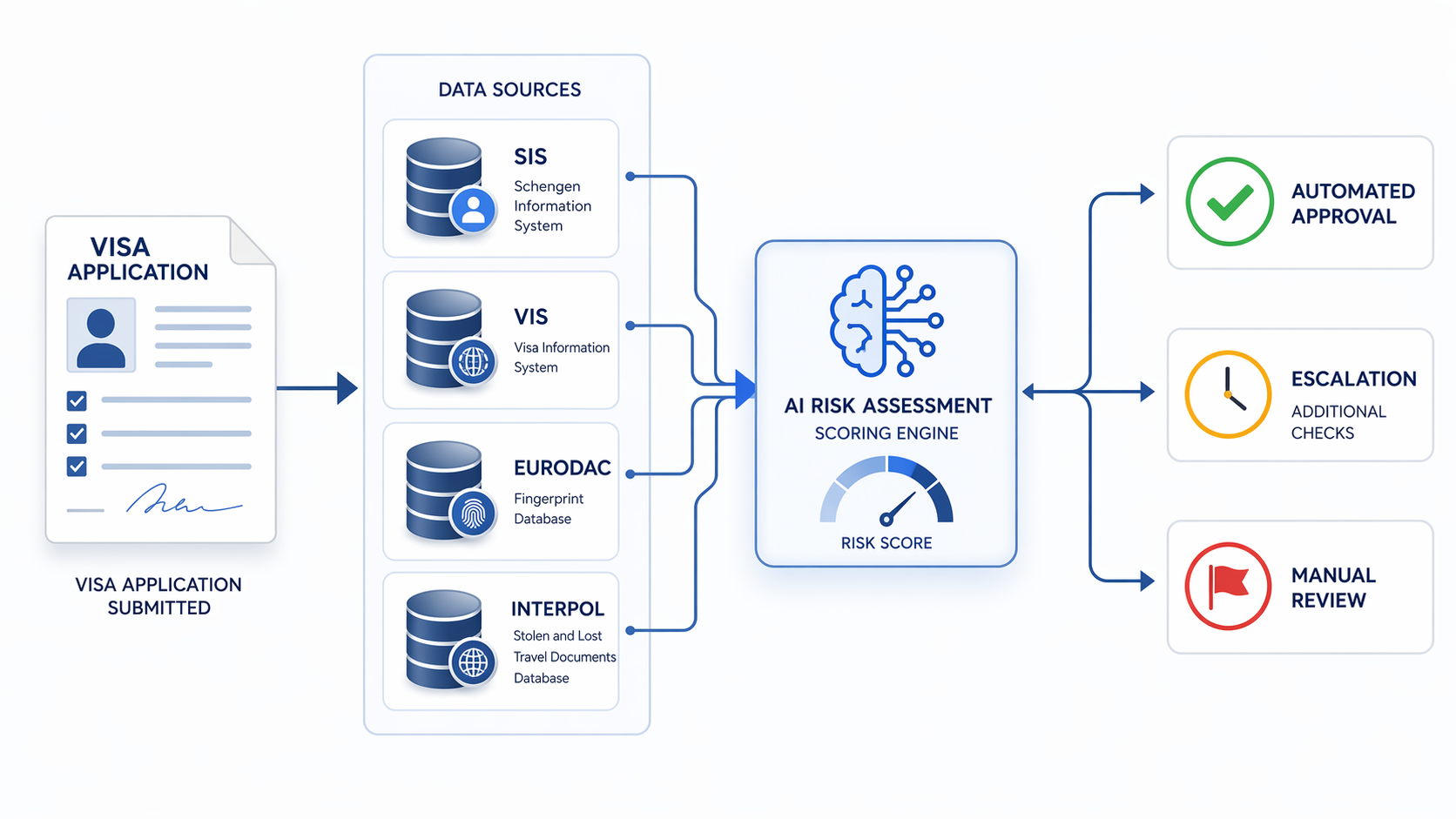
ETIAS is expected to screen travelers from 59 visa-exempt countries, a population commonly described at roughly 1.4 billion people, including US citizens.[5] The fee is listed at €20, and an authorization is expected to be valid for three years or until the travel document expires, whichever comes first.[4] For straightforward applications, automated processing may take minutes; where additional checks or information are needed, review can take longer, including up to four days for some escalations and up to 30 days where manual review is required.[5]
The mechanics matter more than the headline volume. ETIAS applications are checked against multiple systems, including SIS, VIS, EURODAC, ECRIS-TCN, and Interpol databases.[5] A clean automated clearance may feel like nothing happened. A non-clean result is different. The file may be routed for additional review, the traveler may be asked for more information, or the authorization may be refused. From the applicant’s side, the visible event may simply be waiting.
For business travel, that waiting can still be consequential. A US executive traveling for meetings may not need a work visa, but may need ETIAS once it becomes operational. A US engineer sent to perform productive work, take a long-term assignment, or reside in a Member State will usually need to move into national work or residence authorization. ETIAS may be the first automated gate, not the last.
Visa and residence systems are already using automation
The Visa Information System is the more direct bridge between travel screening and visa processing. Vavoula describes VIS as using algorithmic risk profiling in connection with visa applications.[2] That does not mean every visa decision is made by a machine, and it does not establish that a particular US citizen’s application will be refused because of a score. It does mean that visa administration is no longer just a queue, a consular interview, and a database search. Automated risk analysis can influence how a file is viewed and where it is routed.
National systems show the same direction of travel, though not a complete EU-wide pattern. Finland’s Immigration Service, Migri, has used automation to issue positive decisions for certain residence permit and work permit application types.[6] That use is materially different from an automated refusal. A faster approval for a clearly eligible applicant is the kind of automation mobility teams often want. It removes avoidable waiting and lets officers spend time on harder files.
But even positive-decision automation raises the same procedural question in reverse: what happens to the file that does not qualify for the automated path? If the system sorts some applications into fast approval and leaves others for manual processing, the rejected-from-automation group may experience delay without receiving a decision, a refusal ground, or an explanation of the criterion that moved the application out of the fast lane.
Germany’s Federal Office for Migration and Refugees, BAMF, has operated AI tools for dialect recognition and document verification in asylum and immigration procedures.[7][6] Those tools are not interchangeable with work permit adjudication. Dialect recognition in an asylum context presents different legal and factual issues than corporate assignment processing. Still, they show that immigration authorities are not merely planning AI pilots in the abstract. Automated support tools are already part of European migration administration.
A public map of national tools does not yet exist
The EU Fundamental Rights Agency’s 2026-2027 project is useful precisely because it does not overclaim. FRA is examining the use of AI in asylum, visa, residence permit, and return procedures across 12 Member States: Austria, Belgium, Bulgaria, Denmark, Estonia, Germany, Greece, Hungary, Ireland, Latvia, the Netherlands, and Sweden.[7] The agency expressly notes limited knowledge and awareness about what Member States are testing, piloting, or deploying.[7]
That sentence should slow down any confident inventory of “European immigration AI.” Deployment is real; the public picture is incomplete. For advisers, the resulting problem is practical rather than theoretical. If a US employee’s residence permit stalls, the legal team may know the consulate, the national authority, the employer sponsor, and the statutory category. It may not know whether a document-verification tool, risk model, database hit, automated eligibility screen, or routing rule affected the timeline.
That uncertainty affects how a case is managed. An attorney can request reasons, supplement documents, correct a record, escalate with the employer, or challenge a refusal. Those are familiar tools. They are harder to use when the problem is not a stated legal defect but an opaque administrative path: a file that keeps moving to secondary review, an unexplained request for documents already provided, or a refusal framed so generally that it is impossible to tell whether the issue came from the applicant, the database, the model, or the human officer.
The 2026 policy environment is pushing for speed
The EU’s broader migration and visa agenda is not only about control. In February 2026, the EU Visa Strategy was reported as including 30-day processing targets for long-stay work applications, Legal Gateway Offices, and longer multiple-entry visas for trusted business travelers.[8] Those goals sit naturally beside automation. Faster intake, duplicate-document detection, database checks, and automated routing can improve an overburdened system when they are properly bounded.
Speed, however, changes the pressure on review. If the system is designed around faster throughput, the exception file becomes more important. The person whose application does not clear automatically needs a way to understand what failed, who reviewed it, what evidence would matter, and whether the delay is administrative, factual, legal, or technical. The EU AI Act’s high-risk obligations are relevant because they are designed to make those questions answerable inside the system, not because they guarantee any applicant a particular outcome.
GDPR Article 22 is not a clean fallback
Applicants and counsel may look to GDPR Article 22, which gives individuals a right not to be subject to a decision based solely on automated processing where the decision produces legal effects or similarly significant effects.[9] In a visa, residence, or work permit context, that sounds powerful. A refusal of entry or residence permission is plainly consequential.
The difficulty is the word “solely.” Immigration systems often preserve formal human involvement. A human officer may review the file, confirm a recommendation, sign the decision, or handle the appeal channel. NYSBA’s discussion of automated immigration decisions notes the practical importance of disclaimers and system designs that say decisions are not solely automated.[9] Once a human is formally in the loop, Article 22 becomes harder to invoke, even if the automated component shaped the path the human reviewed.
That is the accountability gap counsel will recognize from other semi-automated decision systems: the machine does enough to structure the decision, while the institution points to the human as the decision-maker. The useful question is not only whether a human clicked approve or refuse. It is whether the human had enough information, authority, time, and contrary evidence to make review meaningful.
What US applicants and advisers should understand now
For US citizens, visa-exempt status should not be treated as a guarantee of low-friction travel once ETIAS becomes operational. ETIAS is short-stay authorization, not work permission. A traveler may clear ETIAS and still need a national work visa or residence permit for the planned activity. Conversely, a problem at the travel-authorization layer may arise before the person ever reaches the national work authorization question.
For employers and counsel, the better working assumption is that European immigration processing is becoming more automated at several points: pre-travel screening, visa information checks, document verification, application triage, and some positive-decision workflows. That does not justify telling every applicant that “AI will decide your case.” It does justify building time and process questions into mobility planning.
- Separate the travel lane from the work-authority lane: ETIAS, Schengen visas, long-stay visas, residence permits, and work permits answer different legal questions.
- Preserve clean document trails: if an automated document check or database match later becomes relevant, counsel needs exact copies, submission timestamps, and evidence of corrections.
- Ask targeted process questions after delays: whether the file is pending database verification, document review, security screening, employer validation, or officer assessment.
- Avoid overreliance on Article 22: it may matter, but formal human involvement can make a “solely automated” challenge difficult.
- Treat December 2027 as a safeguard date, not a deployment date: systems may already be operating before the AI Act’s migration high-risk obligations become enforceable.
The EU deserves some credit for naming migration and border-management AI as high-risk. Many legal systems still regulate automated immigration tools indirectly, if at all. But naming a system as high-risk is not the same as giving the affected person usable transparency, meaningful human oversight, or a review record that can be tested by counsel.
Until 2 December 2027, the EU AI Act’s own classification identifies these systems as sensitive while its central migration safeguards lag behind deployment. US citizens and the professionals advising them should treat European visa, travel authorization, and work permit processing as increasingly automated, unevenly transparent, and not yet protected by the Act’s promised guardrails.
References
- AI Act | Shaping Europe's digital future, Shaping Europe's digital future.
- Regulating AI at Europe's Borders, Verfassungsblog, Dec. 2024.
- Guide to the EU AI Act - Usercentrics, Usercentrics, Apr. 2026.
- ETIAS - EU Migration and Home Affairs, EU Migration and Home Affairs.
- ETIAS Assessment Explained - ETIAS.com, ETIAS.com.
- Will AI 'subtly' take over decision-making?, European Papers, 2024.
- Use of AI in asylum and immigration procedures, FRA, 2026.
- EU Issues Visa Strategy, Migration Strategy, Fragomen, Feb. 2026.
- Automation Nation, NYSBA, 2023.
Comments
Join the discussion with an anonymous comment.