
The FAA did not “recertify the MAX” on July 17, 2026. It restored a narrower, but still consequential, delegated function: Boeing may again issue airworthiness certificates for individual 737 MAX and 787 aircraft, effective July 20, 2026, after the FAA phased that authority back in over the preceding months.[1][2]
That distinction matters because “certification” is doing too much work in the public shorthand. The July action concerns airworthiness certificate issuance for completed aircraft. It is not a new type-certificate approval for the 737 MAX family, not an MCAS-specific legal finding, and not a global release from post-crisis oversight.

What the FAA Restored
An airworthiness certificate is the document that permits a particular aircraft to operate. In ordinary delegated certification practice, the FAA may authorize company personnel operating under an Organization Designation Authorization, or ODA, to perform specified certification functions. The legally important point is that the delegation is bounded. The FAA does not disappear from the process; it decides what may be delegated, monitors the designees, and can retain or withdraw functions.
For Boeing’s 737 MAX program, the FAA removed Boeing’s authority to issue airworthiness certificates in 2019 after the Ethiopian Airlines crash. For the 787, the FAA removed the same authority in 2022 after delivery quality issues. In September 2025, the agency began a partial restoration under which Boeing and the FAA alternated issuance weeks. The July 17, 2026 announcement completed that phased process for the 737 MAX and 787, with effectiveness on July 20.[1][2]
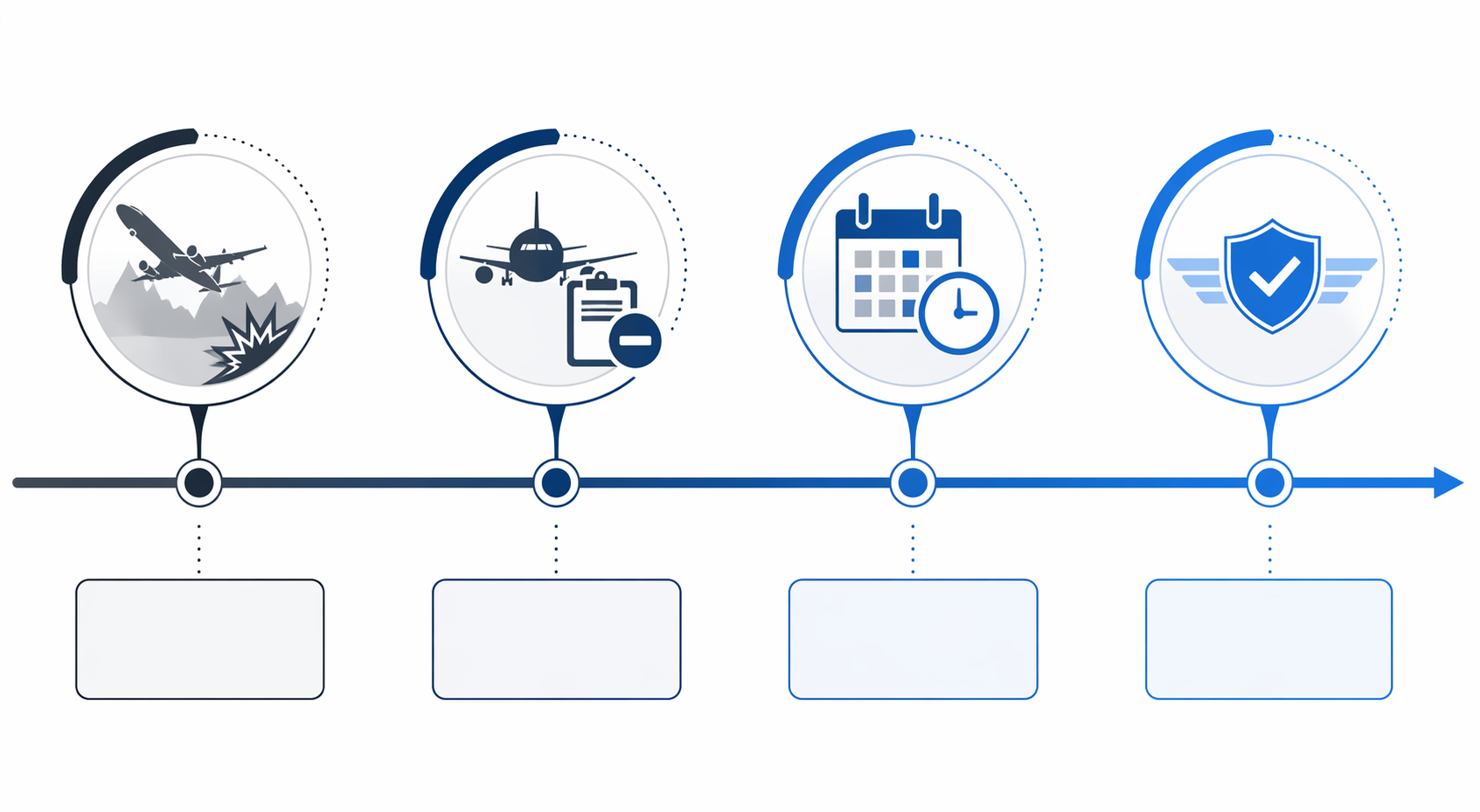
| Date or period | Regulatory event | Legal significance |
|---|---|---|
| 2019 | FAA removed Boeing’s authority to issue 737 MAX airworthiness certificates after the Ethiopian Airlines crash | FAA retained direct issuance for individual MAX aircraft |
| 2022 | FAA removed Boeing’s authority to issue 787 airworthiness certificates after delivery quality issues | The retained-issuance posture expanded beyond the MAX program |
| September 2025 | Partial restoration began through alternating FAA and Boeing issuance weeks | The FAA tested delegated issuance against direct FAA issuance in parallel |
| July 17–20, 2026 | FAA announced full restoration, effective July 20 | Boeing regained authority to issue airworthiness certificates for 737 MAX and 787 aircraft |
Calling that a “recertification” muddies the legal event. A model certification decision asks whether a design complies with applicable standards. An airworthiness certificate for an individual aircraft asks whether that aircraft conforms to its approved design and is in condition for safe operation. The July restoration returned a channel for issuing the latter; it did not reopen and resolve every legal controversy attached to the former.
Why the Eight-Month Comparison Carries the Weight
The strongest fact in the FAA’s stated basis is not a general assertion that Boeing has improved. It is the narrower operational comparison from the phased restoration period. Reuters and CNBC reported that the FAA relied on roughly eight months of comparative data showing comparable production quality findings between aircraft whose certificates were issued by Boeing and aircraft whose certificates were issued by the FAA.[1][2]
That comparison is useful because it tests the restored function against the regulator-retained function. During the alternating-week period that began in September 2025, the question was not whether Boeing had achieved some abstract condition of institutional redemption. The practical question was whether delegated certificate issuance produced a different quality signal from FAA-issued certificates during the same production environment.
“Comparable production quality findings” should still be read carefully. The phrase supports the FAA’s conclusion that, for this certificate-issuance function and during that review window, Boeing’s delegated process did not show worse production-quality findings than direct FAA issuance. It does not prove that no defects occurred. It does not establish that every supplier, inspection, or engineering issue has been resolved. It also does not convert an operational inspection comparison into a legal finding on criminal intent, civil damages, or the adequacy of earlier disclosures.
FAA Administrator Bryan Bedford’s reported framing points in the same direction. He said Boeing was “doing much better” and described the agency’s goal as “not to soften regulatory compliance requirements but to be more collaborative.”[3] That is a confidence signal, but it is not the language of absolution. It preserves the agency’s position that the compliance baseline remains in place while the issuance workflow changes.
The Delivery Pipeline Changes Before the Legal Exposure Does
The business effect is nevertheless real. When the FAA itself issues each certificate, regulator-side capacity can become a delivery constraint. Once Boeing can issue certificates through its restored delegated authority, one bottleneck moves back inside the company’s ODA and quality-control systems. For airlines waiting on aircraft, lessors managing financing dates, and suppliers watching production cadence, that is not symbolic.
The restoration also lands in the same period as reported FAA-approved increases in Boeing’s 737 production cap, from 38 aircraft per month to 42 and then to 47.[4] Those production-cap approvals and the certificate-issuance restoration are related in commercial consequence: both affect how quickly Boeing can move aircraft through production and toward customer delivery. They are not the same legal action.
- Certificate issuance concerns whether an individual completed aircraft receives its airworthiness certificate.
- Delivery release depends on the certificate, customer acceptance, contractual conditions, financing, and other closing mechanics.
- Production caps regulate how many aircraft Boeing may build in the approved cadence.
- Model certification concerns whether a specific aircraft model or variant satisfies applicable certification requirements.
That separation is not pedantry. A delivery team may reasonably treat July 20 as a material scheduling date. A lawyer reviewing counterparty risk should not translate the same date into a representation that the FAA has relaxed its view of Boeing’s design-certification obligations or closed post-MAX oversight issues.
MAX 7 and MAX 10 Are Adjacent, Not Included
The timing is easy to conflate because other 737 MAX milestones are moving in the same quarter. Reporting in July 2026 stated that the FAA expected MAX 7 certification by the end of July 2026 and MAX 10 certification by year-end 2026.[3] Those are model-certification milestones for variants that matter to Boeing’s order book and airline fleet plans.
They are not part of the July 17 airworthiness-certificate restoration. If the MAX 7 or MAX 10 reaches a certification milestone, that would rest on the applicable certification record for that variant. The July restoration addresses who may issue airworthiness certificates for aircraft within the restored programs once the relevant aircraft is otherwise eligible for issuance.
The Liability Firewall
The FAA’s action does not alter Boeing’s criminal or civil exposure. The DOJ resolution track, the more than $1.1 billion non-prosecution-agreement framework, Fifth Circuit finality issues, CVRA litigation, and pending civil claims sit on different legal rails from FAA airworthiness-certificate delegation. A delegated issuance restoration may become part of the broader factual atmosphere in which parties talk about Boeing’s compliance posture, but it is not a release, a settlement approval, or a damages ruling.

The LOT Polish Airlines verdict from May 2026, in which a jury cleared Boeing, is a useful reminder of the same compartmentalization. It is a civil-litigation datapoint, not a systemwide liability conclusion. A verdict in one civil case does not decide the FAA’s delegation posture, and an FAA delegation decision does not decide the merits of other civil claims.
The same firewall applies to MCAS. The July restoration does not announce a new MCAS certification standard, does not reopen the MAX return-to-service determinations, and does not declare that earlier certification controversies have lost legal relevance. It says that, after a monitored phased period, the FAA is prepared to allow Boeing to perform a particular certificate-issuance function again for 737 MAX and 787 aircraft.
Post-Crisis Reform Still Has Its Own Track
The FAA’s separate Part 25 Certification Modernization notice of proposed rulemaking, published June 26, 2026, belongs in the same post-MAX regulatory landscape but not in the same procedural box. The NPRM addresses broader transport-airplane and propulsion certification modernization; it is a rulemaking proceeding, not an aircraft-by-aircraft certificate-issuance decision.[5]
That distinction matters because ODA repair has never been only about whether Boeing may sign a particular document. Delegation policy asks how the FAA allocates technical review, how independence is protected inside delegated organizations, when the agency retains direct control, and what data justifies giving a function back. The July restoration answers one of those questions for one issuance function. It does not end the wider institutional debate.
How to Read the July 2026 Action
The clean reading is bounded. The FAA’s July 17 decision is a meaningful regulatory-confidence signal because the agency restored a function it had withheld for years and did so after a phased comparison of FAA-issued and Boeing-issued certificates. It is also a practical delivery-pipeline event because it can reduce regulator-side issuance friction for aircraft moving toward customer delivery.
It should not be used as shorthand for Boeing being “cleared.” The restored authority does not settle criminal-law questions, does not extinguish civil claims, does not certify the MAX 7 or MAX 10, does not revise MCAS history, and does not displace pending or future certification-reform proceedings.
For legal and compliance readers, the interpretive rule is simple enough to use in advice: treat the FAA decision as important for operational authority, delivery timing, and regulatory confidence in a specific delegated function. Do not let it collapse certification, enforcement, criminal, civil, and rulemaking tracks into a single Boeing-cleared narrative.
References
- FAA restores Boeing authority to certify 737 MAX, 787 planes, Reuters, July 17, 2026.
- FAA lets Boeing issue 737 Max, 787 airworthiness certificates again, CNBC, July 17, 2026.
- Boeing 737 MAX 7 Certified By Summer & MAX 10 By Year-End, Says FAA Chief, SimpleFlying, July 2026.
- Boeing 'off and rolling' as FAA backs 737 production boost, Aerotime.
- Transport Airplane and Propulsion Certification Modernization, Federal Register, June 26, 2026.
Comments
Join the discussion with an anonymous comment.