
Fairlife’s July 2026 ransomware incident is already more than a cybersecurity event. Coca-Cola has confirmed that unauthorized actors accessed certain information technology systems supporting fairlife operations, that production at three U.S. facilities was suspended, and that the suspension was indefinite as of the company’s July 16 disclosure. Coca-Cola also said Canadian operations were isolated from the affected systems and that it had not confirmed whether personal data was accessed or exfiltrated.[1]
For supply-chain counsel, those facts are enough to start the clock and not enough to answer the harder questions. Purchase orders still have delivery dates. Master supply agreements still have notice provisions. Retailers, distributors, foodservice customers, school districts, and co-manufacturing partners may already be triaging shortages while the most important technical point remains unresolved: whether the ransomware stayed within enterprise IT systems or reached operational technology tied to production.
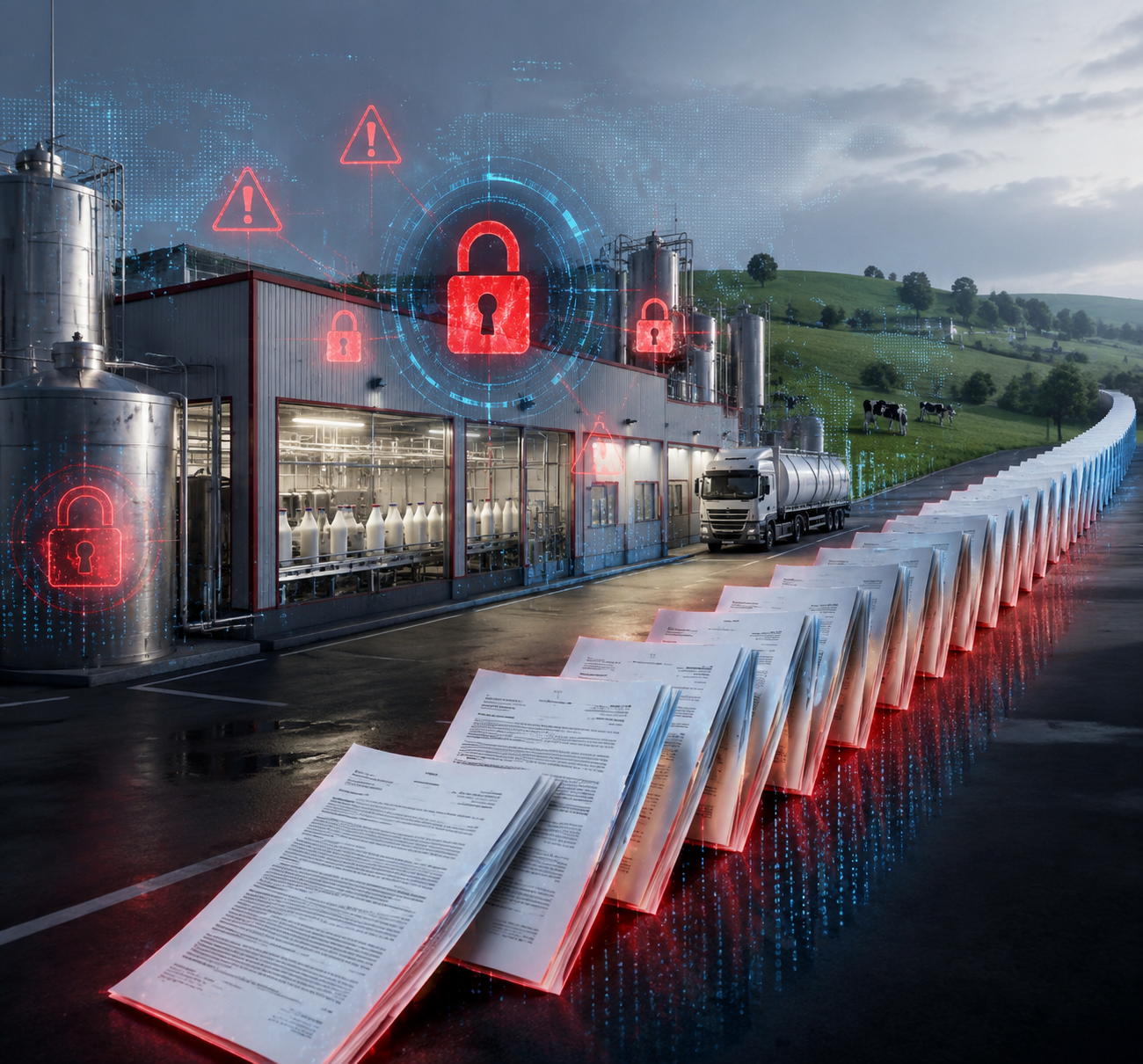
That uncertainty is not a technical footnote. It affects restoration timing, business interruption coverage, contract excuses, mitigation obligations, and the way counterparties describe the same event in reservation-of-rights letters. If the disruption is framed as an IT outage that made business systems unavailable, one set of policy and contract provisions comes forward. If it is framed as a compromise of production systems controlling pasteurization, bottling, or cold-chain logistics, the analysis moves closer to physical operations, equipment safety, and contamination-risk controls.
The liability cascade starts before the breach narrative is complete
The first legal consequence of an indefinite production halt is procedural. Parties do not get to wait for a clean forensic report before deciding whether to give notice, reserve rights, source substitute product, accept partial performance, or reject a proposed allocation. In a food supply chain, those decisions can arrive in the wrong order: procurement wants volume commitments, operations wants a realistic production date, insurance wants a cause-of-loss analysis, and outside counsel wants all communications preserved.
A halt at three U.S. facilities can therefore create legal movement in several directions at once. Fairlife may need to notify customers that contracted quantities will not ship as scheduled. Customers may need to notify their own buyers that a branded or ingredient product is unavailable. Distributors may need to decide whether to cover in the market or wait. If a school district, coffee chain, hospital system, or retailer has downstream commitments, it may be both a disappointed buyer and a potentially nonperforming seller in the same week.
That is where “supply chain” becomes too soft a phrase. The real chain is made of notice deadlines, cure periods, allocation clauses, substitute sourcing decisions, indemnity demands, cyber policy notices, and business interruption claims. Those documents rarely use the same trigger words. One agreement may ask whether performance was “prevented” by an event beyond reasonable control. Another may ask whether production systems suffered a covered “system failure.” A customer contract may ask whether the seller used commercially reasonable efforts to mitigate. Those are not interchangeable questions.
The scale of the interruption matters, but it does not decide liability by itself. Coca-Cola’s disclosure described an indefinite halt affecting three U.S. facilities and a fairlife business with a reported $4 billion annual revenue stream.[1] That size makes the dispute worth organizing immediately. It does not make force majeure automatic, establish an insured loss, or prove that downstream shortages were legally excused.
Force majeure turns on the clause, not the word ransomware
Ransomware can be a force majeure event in some contracts. It is not one as a general rule. The first question is embarrassingly basic and often decisive: does the clause name cyberattacks, ransomware, malicious code, information systems failures, telecommunications failures, criminal acts, sabotage, government action, or supplier failures? Legacy food and dairy supply agreements may rely on older baskets such as “acts of God,” labor disputes, fire, flood, war, embargo, or events beyond a party’s reasonable control. Those words leave more room to fight.
Even a clause broad enough to include a cyber event does not end the analysis. The affected party still has to show causation. Did the ransomware prevent production, or did the company voluntarily suspend operations to contain risk? Did it prevent all performance or only certain SKUs, pack sizes, regions, or delivery windows? Could the supplier allocate remaining inventory, use Canadian operations, qualify alternate production, or source substitute product? Each answer may change whether nonperformance is excused, partially excused, delayed, or simply more expensive.
Notice is where strong merits can still turn into a contract problem. Some clauses require notice within a fixed period after the force majeure event begins. Others require notice after performance is affected. Some require a description of the event, affected obligations, expected duration, mitigation steps, and continuing updates. In a ransomware incident, the party sending notice may not yet know whether the event reached operational technology, whether product safety was affected, or how long restoration will take. A carefully limited notice can preserve rights. An overconfident one can become an exhibit.
| Contract question | Why it matters in the Fairlife disruption |
|---|---|
| Is ransomware or cyberattack expressly listed? | Express language reduces the fight over whether the event is within the clause, though causation and mitigation still remain. |
| Does the clause excuse delay, non-delivery, or only complete impossibility? | A production halt may affect some obligations sooner than others, especially where inventory or alternate supply exists. |
| What notice content and timing are required? | Counterparties may need to preserve rights before forensic conclusions are complete. |
| Does the agreement require allocation or substitute sourcing? | Mitigation duties can decide whether shortage losses stay with the supplier or move downstream. |
| Are cyber events excluded from force majeure or assigned elsewhere? | Some newer agreements route cyber risk into security, indemnity, or insurance provisions instead of general excuse language. |
There is no settled U.S. food-sector ransomware precedent that lets counsel skip this clause-by-clause work. Analogies help, but only to a point. The 2021 JBS incident is useful because it involved a major food producer and an $11 million ransom payment, yet ransom payment tells only part of the legal story; it does not answer whether a particular buyer’s contract excused missed delivery or who absorbed substitute-purchase costs.[2]
Colonial Pipeline is useful for a different reason. The DarkSide incident highlighted the operational consequences of ransomware and the need to manage disruption risk where IT and operational environments intersect, but the comparison can mislead if it is used too loosely.[3] A voluntary shutdown for containment, an encrypted production-control environment, and an enterprise-system outage may all interrupt business. They may not trigger the same contract language.
The IT-OT distinction is the insurance hinge
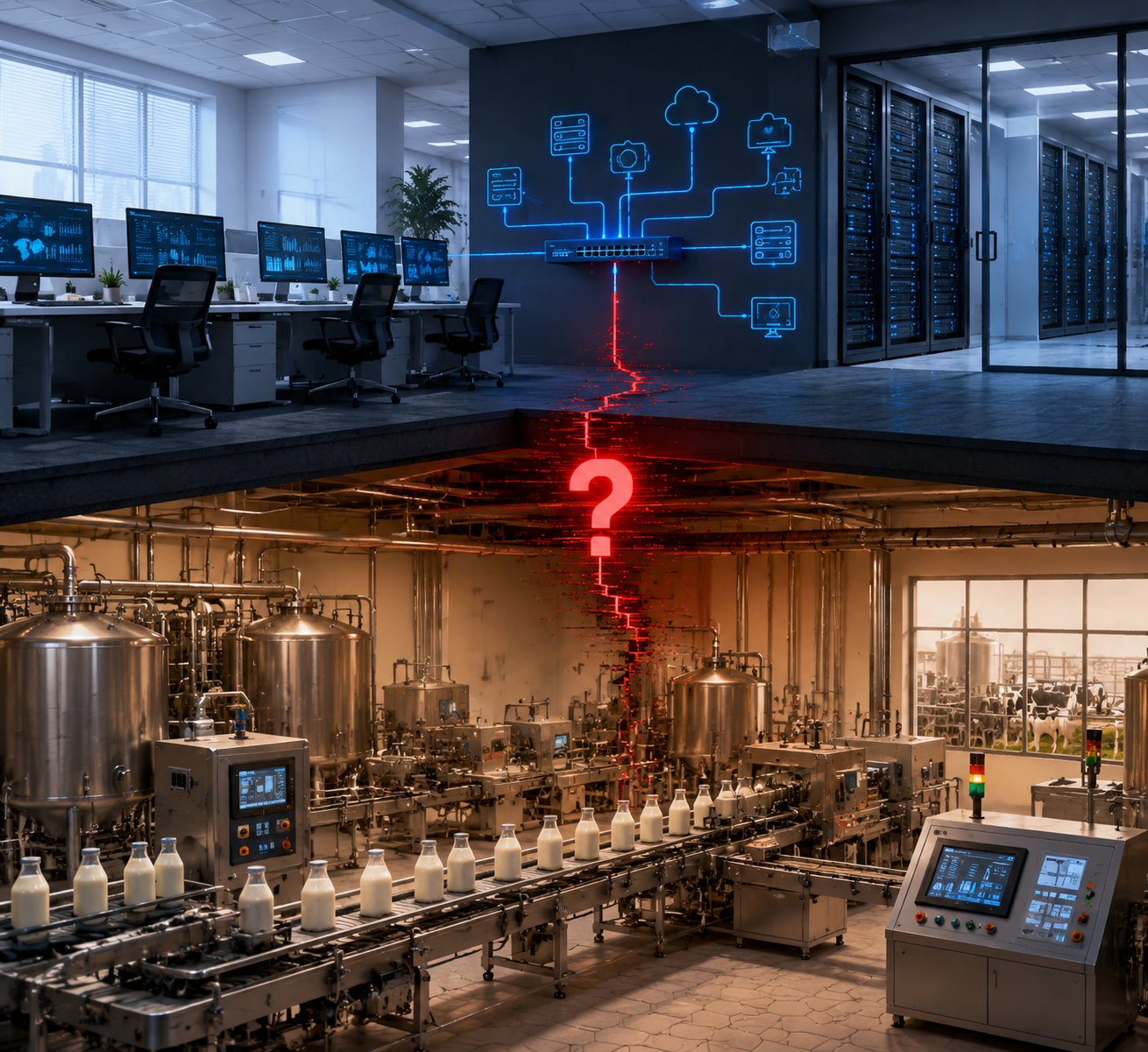
Business interruption coverage asks different questions from force majeure. A supply contract is usually concerned with whether a party’s nonperformance is excused and what mitigation is required. An insurance policy is concerned with the insuring agreement, waiting period, covered systems, excluded causes, restoration period, loss calculation, and proof that the claimed income loss resulted from a covered event.
That is why the unresolved system boundary matters so much. Coca-Cola has disclosed that IT systems supporting fairlife operations were accessed and that production was suspended; it has not confirmed data exfiltration, and the public record provided does not establish that ransomware encrypted or disrupted operational technology controlling dairy equipment.[1] If the affected systems are defined narrowly in a cyber policy, coverage may depend on whether the compromised environment fits the policy’s “computer system,” “insured system,” “production system,” or “operational technology” language.
The same fact pattern can also generate different restoration arguments. A company may restore corporate IT faster than it can safely restart pasteurization, bottling, quality testing, labeling, warehouse release, and cold-chain logistics. If a policy covers loss during the “period of restoration,” counsel will need evidence showing which systems were unavailable, why production could not resume, what validation was required, and whether any delay was caused by covered cyber damage, precautionary shutdown, product-safety review, lack of inventory, or customer allocation decisions.
Cyber business interruption claims are also vulnerable to vocabulary drift. An operations team may say “production systems” because orders, scheduling, warehousing, and plant communications were all affected. A policy may use the same phrase differently, or not at all. A counterparty may use it to suggest equipment-level disruption. An insurer may ask whether the loss was caused by a covered failure of insured systems or by a discretionary halt after an IT compromise. Those are predictable fights, and they become harder when early notices use broad phrases that later technical reports do not support.
Recent cyber business interruption coverage disputes have not produced a mechanical rule that every ransomware-related suspension is covered or uncovered. The safer operating assumption is narrower: coverage will turn on the policy’s system definitions, the evidence tying the halt to the covered system event, exclusions, waiting periods, sublimits, and the documented restoration path. The word “ransomware” does not do that work by itself.
Downstream parties may have to preserve inconsistent positions
The difficult position for downstream counsel is that they may need to preserve rights against Fairlife while invoking similar excuses to their own customers. A distributor that cannot obtain product may send a notice upstream reserving claims for non-delivery, then send a different notice downstream explaining that its own performance has been affected by a supplier disruption. A retailer may demand allocation information while deciding whether to substitute another brand. A foodservice customer may need to meet menu, nutrition, or procurement obligations that were written with little thought to a ransomware halt at a supplier’s plant.
Those parties should expect the documentary record to matter. When did they learn of the disruption? Did they request written confirmation of affected products and locations? Did they cover reasonably or wait for updates? Did they over-order substitute product and create avoidable losses? Did they promise downstream customers a replacement date that Fairlife had not confirmed? These facts may matter more than the headline fact that a cyberattack occurred.
Vendor liability theories may also appear before the facts are ready for them. ClassAction.org reported on July 17, 2026, that attorneys were investigating whether a lawsuit could be filed over the Fairlife incident.[4] That is not a filed complaint, and it is not proof that personal data was accessed. It is a signal that plaintiffs’ firms are watching for a litigation template if later facts support claims based on data exposure, delayed notice, inadequate security, or downstream loss.
The Kronos ransomware litigation template is relevant in that limited sense. After the Kronos incident, employees at companies including Tesla and PepsiCo pursued class claims against UKG, showing how an attacked vendor can become a direct defendant to people or entities outside the vendor’s immediate contract stack.[4] Fairlife is not the same case, and the available facts do not establish the same claims. The point is procedural: a cyber incident that begins as an operations problem can become private litigation once affected parties identify a theory of duty, loss, and causation.
Disclosure choices become contract signals
Coca-Cola’s securities disclosure posture also matters to supply-chain readers, though it should not be mistaken for a final materiality ruling. The company filed the Fairlife technology disruption disclosure under Item 8.01 rather than Item 1.05 on July 16, 2026.[5] In practical contract terms, that choice may influence how counterparties read the company’s current certainty about material impact, but it does not answer what a supply agreement requires Fairlife or Coca-Cola-related entities to disclose to customers, lenders, insurers, or strategic partners.
The SEC has cautioned that companies should make materiality determinations without unreasonable delay after discovering a cybersecurity incident, and its 2024 guidance distinguished the timing of materiality decisions from the broader process of incident investigation.[6] For contract purposes, the parallel is familiar: a party may still be investigating and still have notice obligations. The content of that notice can be limited to confirmed facts, but silence is rarely risk-free once performance is affected.
Regulatory disclosure history adds pressure without resolving supply-chain liability. In 2024, the SEC announced charges against four companies for allegedly misleading cyber disclosures, and separate commentary on the Flagstar enforcement action noted a $3.55 million penalty tied to cyber disclosure failures.[7][8] Those matters do not decide Fairlife’s contractual obligations. They explain why public-company parents and subsidiaries may be cautious, slow, and lawyered in the language they give counterparties during the early days of a cyber-driven production halt.
This is not a one-off food-sector problem
The Fairlife disruption should not be treated as an exotic fact pattern. Food and Ag-ISAC reported that food and agriculture ransomware attacks more than doubled from 2024 to 2025, reaching 265 incidents.[9] That figure supports a modest conclusion: food and beverage contracts that still treat cyber interruption as an unnamed, exceptional possibility are lagging the operating environment.
It does not support a broader conclusion that every food manufacturer faces the same loss profile. A dairy producer with refrigerated distribution, quality holds, perishable inputs, and equipment validation issues has a different recovery path from a shelf-stable packaged-goods supplier. Even within dairy, the legal analysis may vary by product, facility, customer class, and whether the interruption affected manufacturing, ordering, inventory release, logistics, or invoicing.
Where the losses are likely to be pushed
If deliveries fail, losses will not sit politely in one file. Fairlife may look to cyber and business interruption coverage. Customers may look to Fairlife for non-delivery, cover costs, lost margin, promotional disruption, or service-level failures. Downstream sellers may invoke supplier-delay provisions against their own customers. Insurers may ask whether claimed losses are tied to covered systems or to commercial decisions made after the attack. Each participant will try to describe the interruption in the language most favorable to its own document.
The claims most likely to survive early scrutiny will be the ones that do not depend on slogans. A buyer that claims damages will need records showing purchase commitments, missed shipments, substitute purchases, mitigation attempts, and downstream consequences. A supplier invoking force majeure will need records showing the event, affected obligations, notice, causation, and efforts to resume or allocate performance. An insured seeking business interruption recovery will need a disciplined loss model tied to policy language and restoration evidence.
The open IT-OT question remains the center of the file. If later disclosures show that operational technology was encrypted or otherwise disrupted, production-restoration evidence and equipment-level recovery costs may become more important. If later facts show that the halt was driven by enterprise IT containment and verification rather than compromised production controls, insurers and counterparties may press harder on voluntary shutdown, mitigation, and causation. If data exfiltration is later confirmed, breach-notification and privacy litigation issues will expand the case beyond the supply interruption record.
For now, the legal consequences are already spreading while key facts remain unresolved. The outcome will turn less on labeling the incident “ransomware” than on contract drafting, insurance trigger language, confirmed system impact, notice timing, and mitigation evidence. That is an uncomfortable answer, but it is the one the documents are likely to enforce.
References
- The Coca-Cola Company Announces Technology Disruption Involving fairlife Operations — The Coca-Cola Company, July 16, 2026.
- JBS USA Cyberattack Media Statement — JBS Foods, 2021.
- DarkSide Ransomware: Best Practices for Preventing Business Disruption — CISA/FBI, May 11, 2021.
- Fairlife Data Breach Prompts System Investigation; Lawsuit Possible — ClassAction.org, July 17, 2026.
- Coca-Cola Form 8-K — U.S. Securities and Exchange Commission, July 16, 2026.
- Statement on Cybersecurity Disclosure — U.S. Securities and Exchange Commission, May 21, 2024.
- SEC Charges Four Companies With Misleading Cyber Disclosures — U.S. Securities and Exchange Commission, 2024.
- SEC Caps 2024 with Another Cyber Enforcement Action (Flagstar $3.55M) — Morrison Foerster, 2024.
- Navigating the 2025 Food and Agriculture Sector Ransomware Landscape — Food and Ag-ISAC, 2026.
Comments
Join the discussion with an anonymous comment.