
The legally important sentence in Coca-Cola’s July 16, 2026 Form 8-K is not the production halt. It is the unresolved line that “the company has not confirmed whether personal data of employees, customers, or suppliers was accessed.”[1] For anyone mapping the legal consequences and notification obligations from the Fairlife ransomware attack, that sentence is the hinge: no confirmed personal-data access means the state breach-notification cascade may not yet be active; confirmed access or exfiltration would move the matter into a different legal posture.

That distinction sounds procedural until the investigation starts producing artifacts: file paths, server images, directory listings, mailbox exports, identity logs, vendor access records, ransom notes, and forensic conclusions about what was encrypted, viewed, staged, copied, or merely made unavailable. A ransomware attack can disrupt a plant without becoming a reportable personal-data breach under state law. It can also begin as a production incident and later become a multi-state notice event once forensic findings show that employee, customer, supplier, or other resident data was accessed.
The public operational facts are still limited. Reporting has described halted U.S. Fairlife dairy production, ongoing investigation work, and no public ransomware-group claim as of July 19, 2026.[2] Coverage also notes that whether ransomware reached operational technology on the plant floor remains unconfirmed.[2][3] Coca-Cola has said Canadian operations were isolated and unaffected, and reporting has separately described product safety as unaffected while the investigation continues with external forensic support.[2]
Those facts matter, but they do not answer the personal-data question. Product safety, plant-floor continuity, and privacy notice are different workstreams. A conclusion that milk products were not affected would not, by itself, resolve whether payroll files, supplier contacts, customer records, HR attachments, or other personal information was exposed.
The first legal fork is operational disruption versus personal information
If the investigation shows only production interruption or exposure of non-personal operational material — formulas, batch records, plant configuration data, production schedules, quality documentation, or similar business records — state breach-notification laws may not be triggered. That would not make the incident insignificant. It would still raise SEC disclosure, contractual, insurance, supply-chain, and possibly sector-reporting questions. But it would not automatically require resident breach notices merely because the word “ransomware” appears in the incident description.
If the investigation confirms access to or exfiltration of personal information, the legal character changes. The response team then has to identify whose data was involved, where those people reside, what statutory definition applies in each jurisdiction, whether notice to a state attorney general or consumer-reporting agencies is required, whether law enforcement has requested delay, and whether federal or cross-border reporting obligations are moving on a parallel clock.
| Investigation finding | Likely notification consequence |
|---|---|
| Production systems encrypted, no personal information accessed | State privacy breach notices may not activate; operational, SEC, contractual, insurance, and sector duties still require review |
| Employee, customer, or supplier personal information accessed or acquired | Resident notice analysis begins across applicable states, with attorney general notice and deadline tracking where required |
| Ransom payment made | Separate federal ransom-payment reporting may need review under CIRCIA if the organization is within scope |
| Canadian residents affected | PIPEDA breach-reporting analysis becomes a cross-border workstream despite operational isolation statements |
Illinois is the practical anchor, not the whole map
Fairlife is headquartered in Chicago, so Illinois is a natural starting point for the notification analysis. The Illinois Personal Information Protection Act requires notice to affected Illinois residents “in the most expedient time possible and without unreasonable delay,” subject to statutory considerations including measures needed to determine the scope of the breach and restore the reasonable integrity, security, and confidentiality of the data system.[4]
That language is harder to operationalize than a simple calendar deadline. A fixed-day statute lets a team build backward from day 30, 45, or 60. Illinois asks a more fact-sensitive question: once the organization has enough information to know that notice is required, is any remaining delay reasonable? The answer depends on what the team is still verifying, whether the affected population is stable enough to notify, whether notice content would be misleading if sent too early, and whether law enforcement has asked for delay.
Illinois also requires notice to the Attorney General when a single breach affects more than 250 Illinois residents.[4] That threshold is the sort of detail that becomes painful when resident counts are still moving. A privacy lead cannot wait for a perfect final population if the forensic record already supports a reportable event, but an underdeveloped population file can produce incomplete attorney general notice, inaccurate consumer notice, or later supplemental filings.
The useful Illinois lesson is not that Illinois controls every decision. It is that the first anchor state forces the response team to translate forensic uncertainty into legal workflow: what personal information was involved, which residents are implicated, what notice content can be stated accurately, and which regulator-facing notices must be prepared while facts are still being refined.
The state-law problem is variation, not just speed
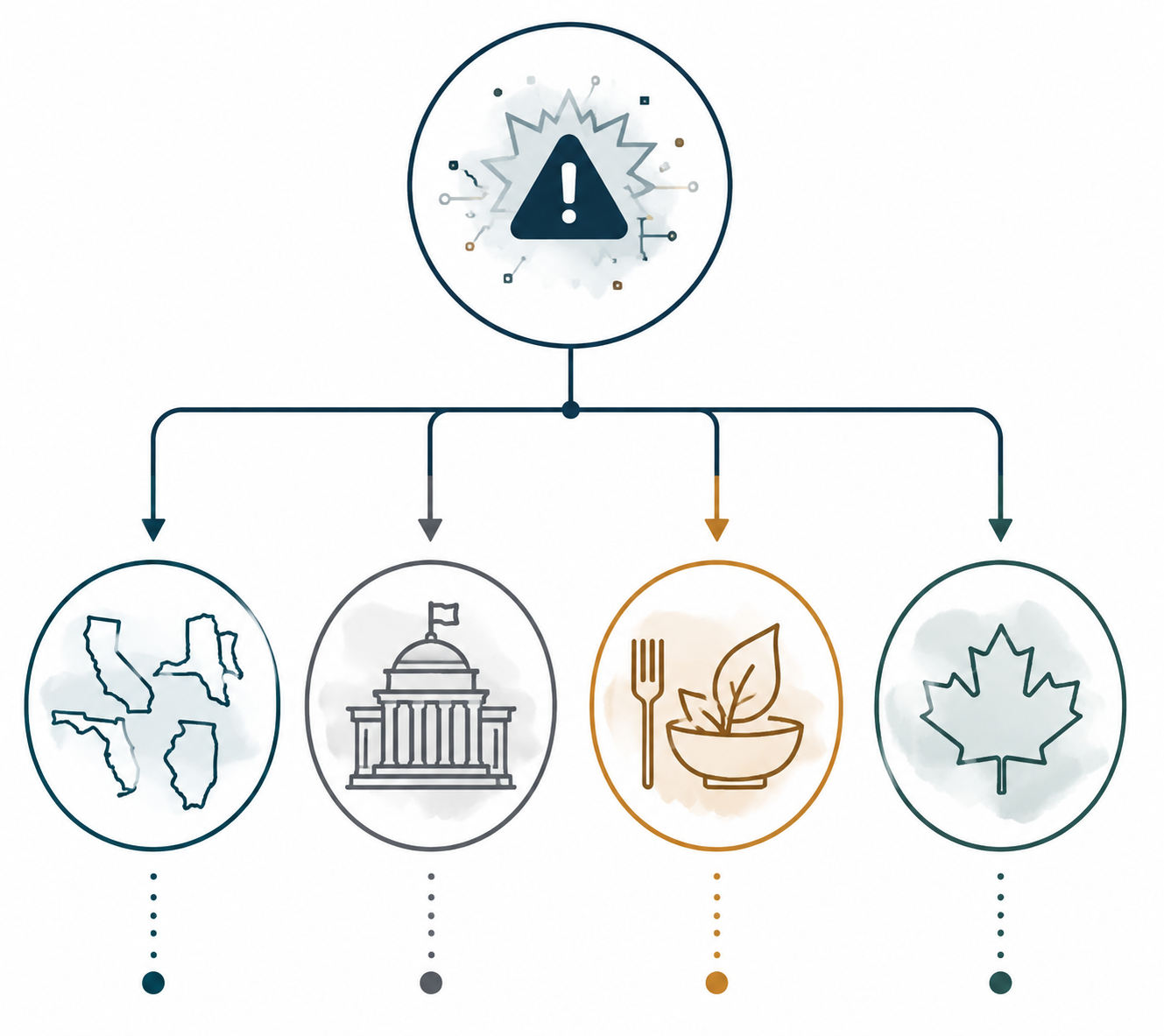
All 50 states have breach-notification laws, but they do not ask exactly the same question. The National Conference of State Legislatures’ framework tracks state-by-state differences in who is covered, what counts as personal information, what constitutes a breach, timing standards, attorney general notice, and law-enforcement delay provisions.[5] That variation is why a national manufacturer cannot solve notice with one headquarters-state memo.
The first split is definitional. Some statutes focus on traditional combinations such as name plus Social Security number, driver’s license number, financial account information, or health-related information. Others have expanded to credentials, biometric data, online account access, medical information, insurance identifiers, or other data elements. A file that is immaterial in one state’s breach analysis may be central in another.
The second split is the trigger. Some regimes turn on unauthorized acquisition; others may treat unauthorized access as enough, or require an assessment of whether misuse is reasonably likely. In ransomware matters, that distinction matters because encryption alone is not the same as exfiltration, and exfiltration is not always proved by the same evidence as access. The response team needs forensic language that lawyers can actually use: Was data viewed? Copied? Staged? Compressed? Transferred externally? Available to the threat actor through compromised credentials? Or only encrypted in place?
The third split is notice routing. Some states require attorney general notice only above a resident-count threshold. Others require regulator notice in broader circumstances. Some require notice to consumer-reporting agencies when a large population is involved. Some permit delay for law-enforcement purposes. These are not decorative differences; they decide who must receive what version of the facts, and when.
A usable notification matrix therefore has to be built before the personal-data finding is confirmed. It should already contain resident states, data-element categories, statutory triggers, consumer notice timing, attorney general timing, law-enforcement delay rules, regulator portals, required content elements, translation needs, call-center assumptions, mailing vendor timing, and an owner for supplemental notices if the population changes.
What the matrix has to answer quickly
- Which individuals are employees, customers, suppliers, contractors, or other contacts, because different systems and notice content may follow.
- Where affected individuals reside, because notice duties follow residents rather than the location of the plant or server.
- Which data elements are tied to each person, because state definitions of personal information do not align perfectly.
- Whether the evidence supports access, acquisition, exfiltration, or only encryption, because trigger language differs by jurisdiction.
- Whether regulator notice, consumer-reporting agency notice, substitute notice, or law-enforcement delay applies.
This is where breach response becomes less dramatic and more difficult. Someone has to reconcile HR exports against supplier master data, remove duplicates, match addresses to residents, separate corporate contacts from personal information, confirm whether former employees are in scope, and keep the legal analysis synchronized with a forensic report that may still be changing. That work is invisible in most public incident narratives. It is also where statutory deadlines are won or lost.
Federal and sector clocks may move at the same time
State breach notice is only one possible clock. Because food and agriculture are treated as critical-infrastructure sectors in U.S. policy, a ransomware incident affecting food manufacturing can raise Cyber Incident Reporting for Critical Infrastructure Act questions if the entity and incident fall within the covered framework. The commonly discussed CIRCIA structure includes a 72-hour covered-cyber-incident report to CISA and a separate 24-hour ransom-payment notice if a ransom payment is made, while implementation details and scope have remained subject to regulatory development following the proposed-rule process described in the research materials.
That federal overlay should not be overstated. CIRCIA is not a substitute for state resident notice, and state breach-notification duties are not a substitute for critical-infrastructure reporting. They answer different questions. One asks whether covered cyber activity affecting a covered entity must be reported to CISA. The other asks whether individuals and state regulators must be notified because personal information was compromised.
FDA and USDA coordination sits in a different lane again. For a dairy manufacturer, agencies concerned with food safety, product integrity, recalls, and supply-chain continuity may need to understand whether operations or product controls were affected. But a food-safety communication does not tell an employee whether their Social Security number was accessed, and a privacy notice does not tell a food regulator whether production controls remained reliable. The workstreams can share facts without collapsing into one another.
Cross-border review belongs on the same planning board. Coca-Cola’s reported position that Canadian operations were isolated and unaffected narrows one set of operational concerns, but it does not by itself dispose of Canadian privacy analysis if Canadian residents’ personal information appears in affected systems.[2] If affected Canadian residents are identified, PIPEDA breach-reporting duties would need separate review alongside U.S. state notices.
The investigation finding has to be converted into notice language
The hardest moment is often not the first day of encryption. It is the day counsel receives a forensic update that is strong enough to trigger legal analysis but not clean enough to write a perfect notice. The team may know that a server containing HR data was accessed, but not yet know every file. It may know that supplier-contact records were compressed, but not whether the archive left the environment. It may know that credentials were compromised, but not whether the attacker used them to reach systems containing customer information.
Notice language cannot outrun the facts. It also cannot wait indefinitely for certainty that the statutes do not require. A disciplined response team separates what is known, what is reasonably believed, what remains under investigation, and what protective steps are being offered. It avoids letting “not confirmed” drift into “not happening,” but it also avoids notifying a population on a theory the evidence does not support.
For Fairlife, the public record has not crossed that line as of the current materials. Coca-Cola’s 8-K says personal-data access has not been confirmed.[1] The practical consequence is not inaction. It is preparation: build the state matrix, identify likely affected systems, preserve evidence, draft contingent notices, stage regulator workflows, and decide who has authority to move once the forensic threshold is met.
Where the legal consequences actually begin
The Fairlife incident is a useful warning precisely because it has not publicly resolved the key privacy fact. Treating ransomware as automatically equivalent to a reportable data breach would overstate the law. Treating an unconfirmed personal-data finding as comfort would understate the risk. The legally relevant work sits between those errors.
If the investigation finds no access to personal information, the state notification cascade may never activate. If it finds access or exfiltration involving employees, customers, suppliers, or other individuals, the organization will not have the luxury of designing its notice program from scratch. Illinois timing, all-state variation, possible CIRCIA reporting, food-sector coordination, and Canadian privacy review may all need attention while executives are still asking whether the incident is “really” a breach.
That is the central legal consequence of the present limbo: once the personal-data fact is confirmed, the clocks may already be running.
References
- The Coca-Cola Company Form 8-K, The Coca-Cola Company, July 16, 2026, link
- Coca-Cola says Fairlife ransomware attack halts US dairy production, BleepingComputer, link
- Fairlife Ransomware Attack Stops All US Milk Production; IT/OT Breach Unconfirmed, TechTimes, July 17, 2026, link
- Personal Information Protection Act, Illinois General Assembly, link
- Security Breach Notification Laws, National Conference of State Legislatures
Comments
Join the discussion with an anonymous comment.