
The banner lasted longer than a goal celebration and shorter than a legal argument. After Argentina’s July 15, 2026 World Cup semifinal, players posed with a blue-and-white sign reading “Las Malvinas son Argentinas,” turning a sovereignty claim usually handled through diplomatic notes, UN committee language, and carefully repetitive communiqués into a stadium image built for circulation.[1]

The reaction followed the logic of a live controversy. British politicians called for FIFA to investigate, while FIFA said it was still assessing match reports and had not announced a deadline or disciplinary decision as of July 18–19 reporting.[2][3] Argentina’s president, Javier Milei, tried to keep the incident from becoming the whole diplomatic story, saying the Falklands would be recovered “through diplomacy, not football,” while also telling supporters that Argentina was “getting closer” to reclaiming the islands.[4][5]
That combination is what made the episode legally interesting. A World Cup semifinal is a venue of emotional certainty: flags, songs, victory, injury, grievance. The Falklands/Malvinas dispute is almost the opposite. It is a dispute in which the law has preserved rival vocabularies for decades without supplying a rule that can make one of them disappear.
FIFA procedure matters only up to a point. Political messaging by teams and players can trigger disciplinary scrutiny, and recent debates over FIFA’s handling of political symbols have made governing-body consistency a story of its own.[6][7] But even if FIFA eventually fines, warns, or declines to act, it will not decide the question the banner invoked. Sports discipline can regulate the stage. It cannot settle sovereignty.
The Dispute the Banner Did Not Create
Argentina’s claim is not simply patriotic insistence in sporting form. Its modern legal architecture rests heavily on decolonization language and on UN General Assembly Resolution 2065 (XX), adopted in 1965, which recognized the existence of a sovereignty dispute between Argentina and the United Kingdom over the Falkland Islands, or Malvinas, and invited the two governments to proceed without delay to a peaceful solution.[8]
The careful part of Resolution 2065 is also the consequential part. It did not endorse Argentina’s title. It did not award sovereignty. But it also did not treat the matter as an ordinary case of a non-self-governing people choosing its future by referendum. The resolution’s reference point was a dispute between two states, to be resolved through negotiation while taking account of the interests of the islanders.[8]
That distinction supports Argentina’s central move in law: the argument that the islanders are not a colonized indigenous people exercising external self-determination against an imperial power, but a population implanted after Britain displaced Argentine authority in the nineteenth century. On that view, allowing the current island population to veto Argentina’s territorial claim would let a colonial act generate its own legal immunity.
Argentina has kept that claim inside domestic law as well as diplomacy. In 2020, Argentine legislation unanimously reaffirmed sovereignty over the Malvinas, South Georgia, South Sandwich Islands, and surrounding maritime areas, embedding the claim again in national legal and political practice.[9]
The UK and the Falkland Islanders answer from a different legal register. The UK position emphasizes British administration since 1833, interrupted by the 1982 Argentine invasion, and frames the islanders as a people entitled to determine their own political status under the UN Charter and the common Article 1 language of the International Covenant on Civil and Political Rights and the International Covenant on Economic, Social and Cultural Rights.[9][10]
That position is not only diplomatic. The Falkland Islands constitution that came into force in 2009 affirms the right of the people of the Falkland Islands to self-determination.[9] In the 2013 referendum, 1,513 voters chose to remain a British Overseas Territory and 3 voted against, on turnout reported at about 92 percent.[9]
It is easy to overstate what that referendum can do. It is powerful evidence of the islanders’ political wishes. It is not accepted by Argentina as capable of extinguishing Argentina’s territorial claim. That is the legal knot: one side treats the vote as the clearest expression of self-determination; the other treats it as the preference of a population whose presence cannot decide a decolonization dispute over territory.
| Legal frame | What it emphasizes | What it cannot make disappear |
|---|---|---|
| Argentina’s territorial-integrity and decolonization claim | Resolution 2065, peaceful negotiation, the argument that the islanders are a transplanted settler population, and continued domestic reaffirmation of sovereignty | The islanders’ settled constitutional identity and their repeatedly expressed wish to remain British |
| UK and Falkland Islanders’ self-determination claim | Continuous British administration since 1833 except 1982, the UN Charter and human rights covenants, the 2009 constitution, and the 2013 referendum | The UN’s recognition of a sovereignty dispute and its long-running call for UK-Argentina negotiations |
International Law Recognizes Both Principles
Territorial integrity and self-determination are not fringe claims smuggled into the Falklands/Malvinas argument by partisan lawyers. Both are part of international law’s basic vocabulary. Territorial integrity protects states against the loss of territory through force or external interference. Self-determination protects peoples from being governed without regard to their political will. In many decolonization cases, the two principles can be made to work together. In this one, they have not.
The continuing UN status of the territory captures the tension. The Falkland Islands have been listed as a non-self-governing territory since 1946, yet UN practice has not converted that listing into a simple referendum-based route to final status.[9] The UN Special Committee on Decolonization, often called the C-24, continues to call annually for negotiations between the UK and Argentina.[9]
That practice matters because institutional repetition is sometimes mistaken for institutional decision. Annual calls for negotiation keep the dispute alive; they do not adjudicate title. They avoid recognizing Argentine sovereignty outright, but they also avoid treating the islanders’ wishes as legally conclusive against Argentina. The system manages the contradiction by restating it.
Nor has the International Court of Justice supplied the missing hierarchy. There has been no binding ICJ judgment deciding the competing sovereignty claims. Without consent to adjudication or another binding route, the legal order can identify applicable principles, generate pressure toward peaceful settlement, and record disagreement. It cannot, by mere discomfort, make the parties litigate to judgment.
The War Proved What Force Could Not Settle
The 1982 war is the point at which abstraction becomes inadequate. Argentina invaded the islands; Britain fought to retake them. The conflict lasted 74 days and left 649 Argentine and 255 British personnel dead.[9][10] The military result restored British control. It did not produce a legal settlement of sovereignty.
That is not a minor distinction. International law prohibits the acquisition of territory by force and favors peaceful settlement of disputes. Yet the Falklands/Malvinas war shows both the force and the weakness of that framework. Law could condemn the resort to force and shape the postwar diplomatic environment. It could not prevent the conflict, and it did not transform the ceasefire’s outcome into an agreed title.
The result has been a kind of frozen asymmetry. Britain administers. Argentina protests. Islanders vote and govern locally under a constitutional order tied to British sovereignty. UN organs continue to ask the two states to negotiate. Each fact is legally relevant. None is legally final.
Why the Stakes Keep Returning
A territorial dispute that has not been decided does not stay confined to land. It follows ships, fisheries, military patrols, investment decisions, and alliance calculations. Argentina’s July 13, 2026 formal protest over HMS Medway’s transit through waters it claims around the islands was therefore not a side episode. Argentina’s Foreign Ministry reportedly described the transit as “unilateral and illegal,” language that makes sense only because the maritime claim depends on the unresolved land claim.[1]
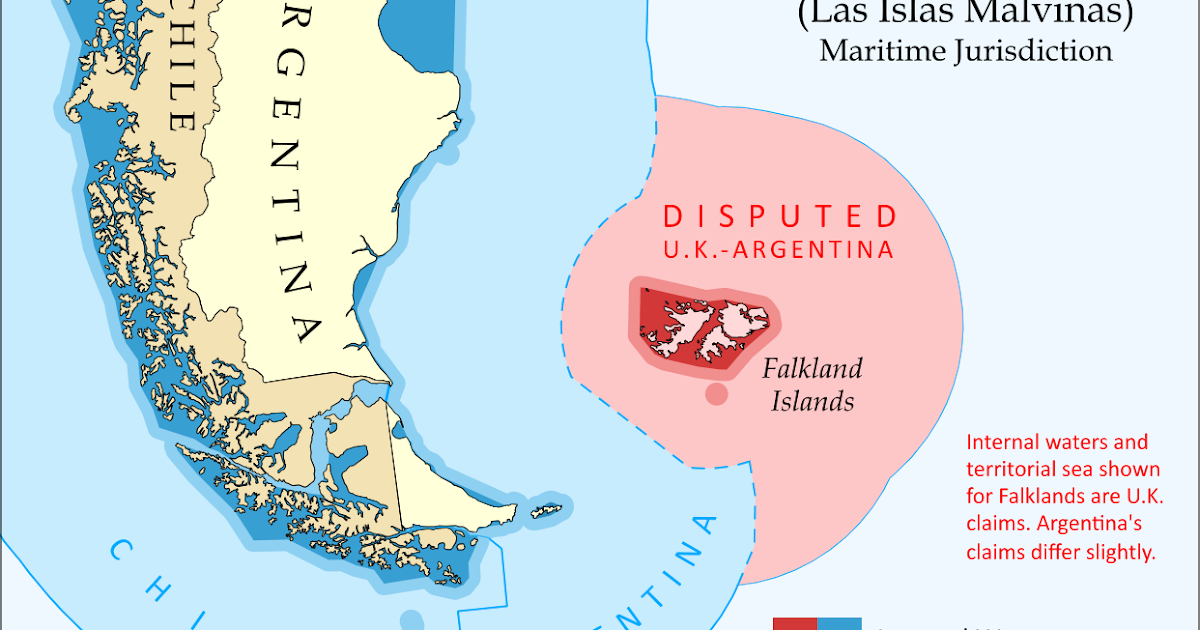
The same dependency appears in resource development. The Sea Lion oil field, located about 220 kilometers north of the Falkland Islands, has been described as having a first-phase potential of 55,000 barrels per day, with a final investment decision announced in December 2025 and drilling possibly as early as 2027.[10] Those figures remain projections, but the legal point does not require speculation: offshore entitlements are routed through sovereignty over land, and the land claim remains contested.
Alliance politics adds another pressure point. Reporting in April 2026 by The Guardian and Reuters said a Pentagon memo suggested the United States could review its Falklands position as leverage against the UK over the Iran war.[11] Because the original memo text has not been made public in the cited reporting, that claim should be treated with caution. Still, the reporting illustrates how much the post-1982 status quo has depended on diplomatic alignment as well as law.
The legal ambiguity is therefore not decorative. It affects who may license drilling, who may police waters, which military movements provoke protest, and how third states calibrate their language. A resolved sovereignty dispute can still produce policy conflict. An unresolved one turns ordinary governmental acts into evidence, provocation, or both.
The Institutional Middle: Channels Without a Deciding Rule
The Falklands/Malvinas dispute has not persisted because there are no institutions available to name it. The UN General Assembly named it in 1965. The decolonization machinery continues to revisit it. Bilateral contacts have occurred in different political periods. The parties have legal arguments sophisticated enough to be stated without embarrassment in formal documents.
What is missing is not vocabulary. It is a binding hierarchy. If territorial integrity controls, Argentina’s case gains force and the islanders’ wishes become interests to be considered rather than a veto. If self-determination controls, the islanders’ constitutional preference becomes central and Argentina’s historical claim cannot compel transfer. International law contains both propositions. It has not supplied, for this dispute, a superior rule for choosing between them.
That absence explains why commentary around the World Cup banner so quickly became too confident. Treating the banner as mere football theatrics misses the legal dispute it invoked. Treating it as proof that Argentina has somehow converted spectacle into title is no better. The same caution applies in reverse: the islanders’ referendum is a serious act of political self-identification, but it has not made Argentina’s UN-recognized sovereignty dispute vanish.
There is a particular discomfort in that conclusion for lawyers who prefer that institutions eventually discipline contradiction. Here, the record is untidy because the law is untidy. The UN has encouraged negotiation but not imposed outcome. The UK has maintained administration but not secured Argentine acquiescence. Argentina has maintained protest but not displaced British control. The islanders have expressed their wishes overwhelmingly, but the decolonization framework has not treated those wishes as the final word.
What the World Cup Row Reveals
The Milei Falklands World Cup controversy has international law implications precisely because it did not change the law. It exposed the degree to which the dispute depends on legal principles that are individually familiar and collectively unresolved. The banner was new as a global image. The contradiction beneath it was not.
International law can identify the Falklands/Malvinas dispute. It can preserve the claim from being dismissed as merely rhetorical. It can protect the islanders’ expressed wishes from being treated as administratively irrelevant. It can discourage force, invite negotiation, and register protest. What it has not done is provide a rule capable of deciding, in this case, whether territorial integrity or self-determination prevails.
References
- Banner incident coverage, Milei administration protest, HMS Medway, Al Jazeera, July 16, 2026.
- UK government cross-party calls for FIFA investigation, AP News, July 2026.
- FIFA assessing match reports, BBC Sport, July 16, 2026.
- Milei diplomacy not football statement, Morocco World News, July 2026.
- Milei getting closer remarks, Politico EU, July 2026.
- Political statements regulation by FIFA, UEFA, IOC, LawInSport.
- FIFA Disciplinary Code 2026 changes, FIFA SportsAgent Institute, effective May 1, 2026.
- UN General Assembly Resolution 2065 (XX) 1965, United Nations General Assembly, 1965.
- Sovereignty since the ceasefire, Lords Library, parliament.uk.
- Territorial integrity, self-determination, Sea Lion oil field data, The Conversation.
- Pentagon memo reporting, The Guardian and Reuters, April 2026.
Comments
Join the discussion with an anonymous comment.