
For two days in July 2026, Taylor Farms occupied the uncomfortable space between a public-health investigation and a corrected agency record. On July 18, FDA said testing had found Cyclospora in an iceberg lettuce sample tied to a five-state outbreak investigation. On July 20, the agency walked that statement back: the reported positive was a false positive. The voluntary recall did not simply disappear, because FDA said epidemiological and traceback evidence still pointed to the same product as the likely outbreak vehicle.[1][2]
That is the hard version of the problem. Taylor Farms is not a neat example of a company cleared by a bad test. The investigation remained active, and FDA did not say the recall was baseless. But the sequence is exactly why the legal implications of FDA false-positive food recalls now deserve a more precise vocabulary. A laboratory correction can arrive quickly. The recall notice, retailer communications, customer code spreadsheets, destroyed inventory, press coverage, and future complaint allegations do not unwind at the same speed.

The Legal Whiplash Starts Before Any Lawsuit
A voluntary recall is not mandatory in the technical sense, but that distinction narrows once FDA has published an outbreak update and customers are deciding whether to pull product from shelves. The company may recall to protect consumers, preserve regulator credibility, satisfy retailer expectations, and contain reputational damage. Later, if the triggering lab result is corrected, the record still shows the company participated in a recall.
Plaintiffs in post-recall litigation often try to make that recall do substantial pleading work. The argument is familiar: the product was recalled; therefore the product was defective, adulterated, worth less than represented, or not what consumers paid for. Defense counsel usually answers that a recall identifies a risk population, not contamination in every purchased unit. A false-positive retraction sharpens that answer. It gives defendants a public agency record saying that one piece of proof plaintiffs might have expected to rely on was wrong.
The complication is that Taylor Farms still had more than the corrected lab result in the record. FDA continued to cite epidemiological and traceback evidence, which prevents any fair reading of the July 20 update as a complete exoneration.[1][2] That mixed posture matters. A future complaint could point to the recall and outbreak investigation; a defendant could point to the retraction and insist the complaint still has to connect the plaintiff’s own purchase to actual contamination or legally cognizable economic injury.
False Positives Are Not a Litigation Fiction
Food testing is not a courtroom exhibit manufactured after the fact. It is an operating system for deciding whether product moves, gets held, gets recalled, or becomes evidence. That operating system has error modes.
A 2013-reported American Proficiency Institute study covering more than 700 laboratories in 43 countries over 14 years found false-positive rates of 3.9% for Salmonella and 2.5% for E. coli and L. monocytogenes.[3] Those figures are not Cyclospora-specific and they are not current-year recall statistics. They are still useful for one limited point: false positives are not exotic events that can be dismissed as impossible simply because the consequence is serious.
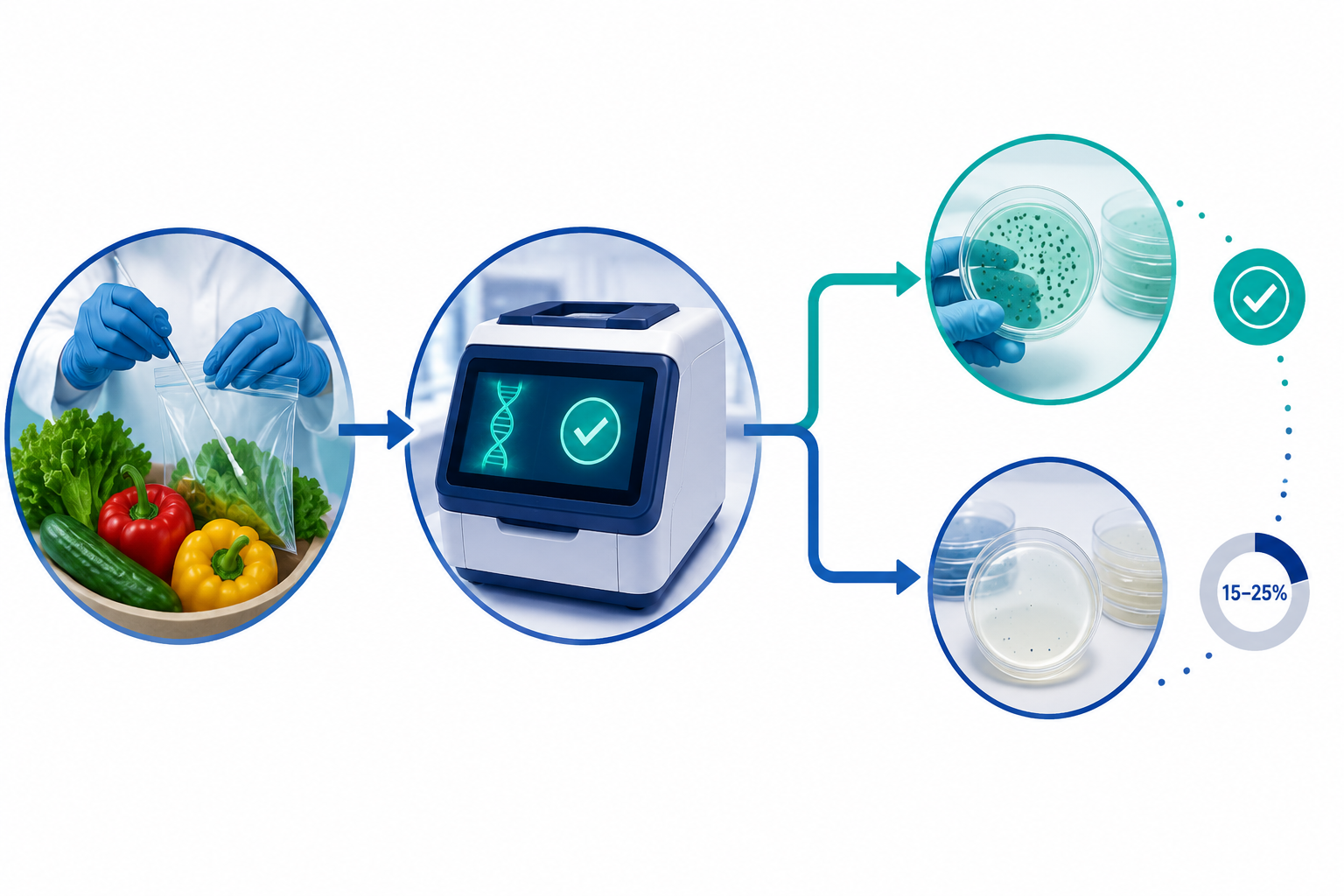
The technical reason also matters. FSNS explains that molecular PCR methods can detect genetic material from organisms that are dead or viable-but-non-culturable, producing presumptive positives that do not confirm through culture. Under USDA Microbiology Laboratory Guidebook procedures, FSNS states that only 75% to 85% of PCR-positive samples confirm culturally.[4] That is not a legal rule, and it is not a reason to ignore presumptive positives. It is a reason to avoid treating every initial positive as though it has the same evidentiary weight after confirmation fails or an agency retracts the result.
In the recall room, the distinction between presumptive, confirmed, corrected, and independently supported findings is not academic. Those words decide who calls customers, who signs destruction paperwork, who drafts public statements, who preserves samples, and who later explains why a recall happened after the lab record changed.
Why a Short-Lived Recall Can Still Become a Long-Lived Claim
The commercial reason companies care about recall language is that the recall itself can become the pleading hook. Cozen O’Connor, in a March 2026 defense-side client publication, described a continuing rise in post-recall consumer class actions and identified settlements involving Quaker Oats for $6.75 million, Mid American Pet Food for $5.5 million, TreeHouse Foods for $4.4 million, and Boar’s Head for $3.1 million.[5] Crowell & Moring’s recall litigation report likewise framed 2024 trends as continuing into 2025, again from a defense-side client-alert perspective rather than a neutral empirical study.[6]
Those alerts should not be read as proof that every recall now produces viable litigation. They do show why even a corrected agency statement does not end the business problem. Retailers may have already pulled product. Consumers may have already received notices. Competitors may have already seen customer hesitation. Complaint writers may already have the word “recall,” the outbreak headline, and the brand name in the same sentence.
The legal issue is narrower than the business loss. A company can suffer a real recall expense without consumers having Article III standing or a plausible state-law defect claim. That gap is where most of the motion practice lives.
The Standing Cases Ask for More Than a Recall Notice
The defense starting point is Ward v. J.M. Smucker. The Sixth Circuit’s formulation is blunt: “the mere fact that a product purchased by plaintiffs was recalled does not nudge a claim of alleged contamination from conceivable to plausible.”[7] That sentence does useful work in a false-positive case because it separates recall status from unit-level contamination. A recall may justify caution. It does not automatically establish that the plaintiff bought contaminated food.
The Seventh Circuit took a similar approach in In re Recalled Abbott Infant Formula. Plaintiffs lacked standing absent facts suggesting contamination was “sufficiently widespread to plausibly affect any given unit.”[8] That is a harder standard for a complaint built around brand-wide fear or recall participation alone. It asks whether the pleaded facts make the plaintiff’s own product plausibly affected, not merely whether the defendant had a serious food-safety event somewhere in the distribution chain.
Huertas v. Bayer leaves plaintiffs more room. The Third Circuit held that benefit-of-the-bargain damages can confer standing if the plaintiff’s lot numbers match the recall scope, though the matter was remanded.[9] For food defendants, Huertas is a reminder that standing arguments are not all-or-nothing. A plaintiff who can match purchase records, lot codes, and recall scope has a better economic-injury story than a plaintiff who only alleges purchase of the same brand during a broad time period.
Catalano v. Grimmway narrows the path further for consumers who ate the product and did not get sick. In March 2026, the Southern District of New York dismissed with prejudice, holding that consumption without illness meant the product was not contaminated.[10] McLean v. Walmart adds a different defense lever: in 2025, the Western District of Arkansas found that functioning refund programs can defeat standing.[11] Neither case is a false-positive decision, but both show courts testing whether plaintiffs actually lost money on the product they bought.
| Defense Question | What the Cases Contribute | What They Leave Open |
|---|---|---|
| Does a recall alone make contamination plausible? | Ward says no; the recalled status of the product does not itself move contamination from conceivable to plausible. | How that rule applies when FDA first announces a positive and then retracts it. |
| Must the plaintiff connect the purchased unit to actual contamination? | Abbott requires facts suggesting contamination was widespread enough to plausibly affect a given unit. | Whether traceback and epidemiology, without a confirmed positive, can satisfy that burden. |
| Can economic injury exist without illness? | Huertas allows a benefit-of-the-bargain theory when lot numbers match recall scope. | Whether a corrected false positive reduces the value-loss theory for matched-lot purchasers. |
| Does eating the product without illness defeat injury? | Catalano treated consumption without illness as fatal to a contamination theory. | Whether courts will apply that reasoning outside the specific facts of that case. |
| Can refunds eliminate standing? | McLean recognizes functioning refund programs as a standing defense. | Whether refund availability is enough when plaintiffs plead broader price-premium or brand-value theories. |
The Untested False-Positive Syllogism
As of July 2026, no reported federal decision has squarely addressed whether an FDA-retracted false-positive food test changes the standing or plausibility analysis. That absence is the doctrinal gap. The existing cases ask whether recall participation, lot matching, consumption, refund availability, and contamination breadth are enough. They do not answer what happens when the agency record itself removes the lab finding that helped explain the recall.
The likely defense syllogism is straightforward. First, a recall alone is not evidence that any particular unit was contaminated. Second, the only laboratory result plaintiffs can point to was retracted as a false positive. Third, unless the complaint pleads independent facts tying the plaintiff’s unit, lot, retailer, or exposure pathway to actual contamination, the claim rests on recall status rather than a plausible injury.
Taylor Farms would test that syllogism under less-than-perfect facts for a defendant, because FDA continued to cite epidemiological and traceback evidence after correcting the lab result.[1][2] A company facing a cleaner false-positive record would make the argument more aggressively. A plaintiff facing the Taylor Farms record would likely answer that the retraction removed one fact, not the entire outbreak investigation.
That is why the pleadings would matter. A complaint that says only “the product was recalled” should face Ward and Abbott. A complaint that matches lot numbers to the recall scope may invoke Huertas. A complaint by consumers who ate the product without illness may encounter Catalano. A complaint filed despite a working refund process may confront McLean. A complaint filed after an FDA false-positive retraction should have to explain what evidence remains that the plaintiff’s own purchase was contaminated or worth less when bought.
What the Agency Record Should Preserve
The practical lesson is not to resist recall cooperation until every lab question is resolved. In an outbreak investigation, delay can create the worse record. The lesson is to preserve distinctions that later decide whether the recall becomes a substitute for proof.
- Separate presumptive positives, confirmed positives, retractions, and non-lab evidence in internal timelines.
- Avoid public language that converts cautionary recall participation into an admission of unit-level contamination.
- Preserve lot-code, customer-code, shipment, hold, destruction, and refund records before retailer communications fragment the evidentiary chain.
- Track whether FDA’s public updates rely on laboratory confirmation, epidemiology, traceback, or a combination of those sources.
- Document refund availability and consumer notice mechanics, because standing may turn on whether purchasers had a real economic loss.
A false-positive retraction is helpful, but it is not self-executing. It must be tied to the complaint’s theory: no confirmed positive, no pleaded contamination of the plaintiff’s unit, no illness, no unmatched lot code, no unreimbursed purchase, or no plausible value loss. The more disciplined the recall record is, the easier it is to make those distinctions without appearing to rewrite history.
Taylor Farms Is a Warning, Not a Verdict
The July 2026 Taylor Farms matter remains a moving target. Case counts, recall scope, agency language, and any litigation posture may change after this writing. Public commentary has also included efforts to decode customer codes and distribution clues, but those exercises should be treated as inference unless confirmed by the company, FDA, or another primary source.
The durable point is narrower. Food companies can incur the full consequences of a recall even when an FDA-identified positive is later corrected. Existing standing doctrine gives defendants tools against recall-only complaints, but it has not yet been calibrated to the agency false-positive scenario. When that case arrives, the motion-stage fight should not be over whether recalls matter. They do. The fight should be over whether a corrected recall record plausibly shows contamination, causation, and injury for the plaintiff who sued.
References
- FDA Walks Back Positive Lab Test in Cyclospora Outbreak, Bloomberg Law.
- Investigation of 5-State Outbreak of Cyclospora Illnesses: Iceberg Lettuce, July 2026, U.S. Food and Drug Administration, July 2026.
- Labs Fail to Detect Cases of Bacterial Food Contamination, TIME.
- Non-confirming Food Samples: How to Handle False Positives, FSNS.
- The Continuing Rise of Post Recall Consumer Class Actions, Cozen O’Connor, March 2026.
- Recall Litigation Report: Trends in 2024 Continue into 2025, Crowell & Moring.
- Ward v. J.M. Smucker, Sixth Circuit.
- In re Recalled Abbott Infant Formula, Seventh Circuit, 2024.
- Huertas v. Bayer, Third Circuit, 2024.
- Catalano v. Grimmway, Southern District of New York, March 2026.
- McLean v. Walmart, Western District of Arkansas, 2025.
Comments
Join the discussion with an anonymous comment.