
By the time the counter-drone rule changed on July 1, the World Cup was already operating inside the problem the rule was meant to solve. The FBI’s drone takedown legal authority at the 2026 World Cup was real, but it was not yet broadly portable. Federal teams were detecting and seizing drones around venues, while state and local officers who knew the streets, parking lots, rooftops, and stadium perimeters still could not simply interdict an unlawful aircraft on their own authority.
The enforcement numbers were large enough to draw headlines, but their more useful function is diagnostic. The FBI said more than 700 illegal drones were seized during the tournament, after earlier reporting described roughly 1,600 drone detections across 11 host cities and city-level seizure counts including 99 in Miami and 77 in Atlanta.[1][2] Nearly 5,000 FBI personnel were assigned to World Cup security, including ground-intercept teams at every venue.[3] Separately, 60 state and local officers were trained and sworn as temporary federal deputies for the opening period because independent state-and-local counter-UAS authority had not yet taken effect.[4]
That is the part worth slowing down over. The question is not whether the FBI had any authority to seize drones. It did. The question is why an event planned for years still required a temporary federal-deputy patch while matches were already being played.
The 2018 authority solved one legal problem and created another
Before Congress acted in 2018, counter-drone operations sat in an uncomfortable legal space. The same federal statutes that protect aircraft, communications, and computer systems could make it legally risky for government personnel to interfere with a drone, even when the drone itself was the security problem. That restraint was not imaginary. A drone is an aircraft for some legal purposes; many detection and mitigation tools can implicate communications interception, signal interference, or access to onboard systems.
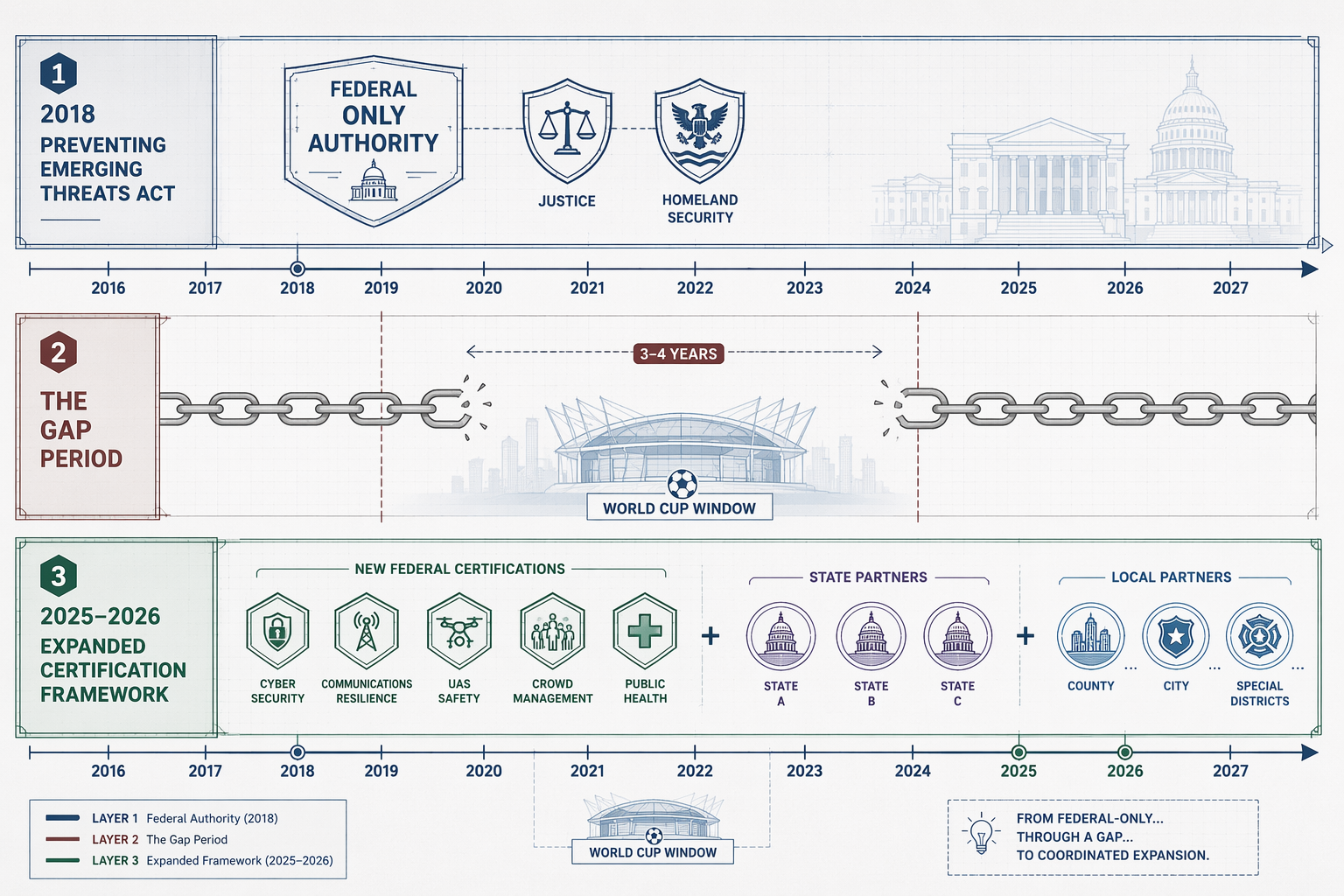
The Preventing Emerging Threats Act of 2018 addressed that problem by creating a specific counter-UAS exception now codified at 6 U.S.C. § 124n. The statute authorizes the Departments of Homeland Security and Justice, notwithstanding certain otherwise applicable provisions of federal law, to take specified actions against unmanned aircraft systems that pose a credible threat to covered facilities or assets.[5]
The verbs matter. Under § 124n, covered federal departments may detect, identify, monitor, and track drones; warn operators; disrupt control; seize or exercise control of the aircraft; confiscate it; and use reasonable force if necessary, within the limits of the statute and implementing policies.[5] For a federal agency assigned to a protected mass event, that is substantial authority.
It was also a federal-only answer. The 2018 law did not let a city police department, sheriff’s office, stadium authority, or state emergency agency independently bring down a drone because it crossed into a temporary flight restriction or hovered over a crowded entrance. Those officers could call, coordinate, evacuate, observe, or help with ordinary policing. They could not become counter-drone operators merely because the risk was in their jurisdiction.
The capacity gap was not theoretical
A tightly held federal exception can be defensible at the beginning of a new and legally sensitive mission. It is easier to supervise a small set of federal operators, standardize equipment approvals, and keep mitigation decisions away from improvised local experiments. The difficulty is that mass-event airspace did not stay small.
CSIS reported that, since 2018, stadiums, venues, and other entities requested federal counter-drone assistance about 121,000 times, while assistance was provided in only 77 instances.[4] That ratio is not a measurement of drone takedown effectiveness. It is a measurement of access to lawful counter-drone support. It shows a system that recognized demand while preserving a pool of authorized operators far too small for the number of events asking for coverage.
The sports-security trend line was already pointing in the wrong direction before the World Cup. CSIS cited NFL drone incursions rising from roughly 12 in 2017 to 2,845 in 2023.[4] That figure does not prove that every drone was malicious or that every incursion required mitigation. It does show why a legal model built around scarce federal response teams would strain under simultaneous events, recurring league schedules, and international tournaments.
| Layer | What it did | Operational consequence at the World Cup |
|---|---|---|
| 2018 Preventing Emerging Threats Act | Created DHS and DOJ counter-UAS authority under 6 U.S.C. § 124n | The FBI had legal tools, but authority remained federally concentrated |
| Federal-only operating period | State and local officers could support but not independently mitigate drones | The opening weeks required temporary deputization for selected officers |
| 2025 SAFER SKIES Act and July 1, 2026 Interim Final Rule | Opened a certification path for state, local, tribal, and territorial personnel | A permanent framework began mid-tournament, replacing the emergency workaround prospectively |
Deputization made local officers usable under federal command
The temporary-deputy solution was legally elegant in the narrow sense and revealing in every other sense. Sixty state and local officers completed a two-week National Counter-UAS Training Center course at Redstone Arsenal, Alabama, and were sworn as temporary federal deputies for the World Cup’s opening weeks.[4] FedScoop had reported before the tournament that World Cup counter-drone plans included deputizing state and local law enforcement because they otherwise lacked the relevant mitigation authority.[6]
Once deputized, those officers were not acting as ordinary local police officers who had suddenly acquired a new home-agency power. They were operating under federal authority and FBI command. That distinction is not paperwork. It controls who may give the order, what legal shield applies, what training standard matters, how the incident is documented, and which institution owns the consequence if an interception affects communications, property, or aviation safety.
For an event-security planner, the workaround also changes the staffing math. A sworn local officer posted at a stadium gate may be close to the drone, close to the crowd, and close to the operator. Without the right legal status, that proximity does not equal authority. The World Cup opening period therefore depended on transforming a limited number of local personnel into temporary federal actors rather than giving certified local agencies their own standing role from the first match.
SAFER SKIES expanded the eligible operators, but not immediately enough for kickoff
Congress changed the architecture with the SAFER SKIES Act, enacted on December 18, 2025. The Act expanded counter-UAS authority beyond DHS and DOJ by creating a path for trained state, local, tribal, and territorial law enforcement personnel to conduct certain counter-drone activities for large public gatherings and critical infrastructure, subject to federal certification and conditions.[7]
The statute did not, by itself, put every police department into the mitigation business. That would have created the opposite problem: too many actors with too little standardization around aircraft, spectrum, privacy, and use-of-force consequences. The expansion depended on implementing rules that would define who could be certified, what training they needed, which activities they could perform, what equipment could be used, and what reporting and retention limits would attach.
Those rules arrived in the form of an Interim Final Rule effective July 1, 2026 and published in the Federal Register on July 6, 2026.[8] The timing is the uncomfortable fact. The new framework came into force three weeks into the tournament, after the FBI had already been operating with temporary deputies to cover the gap between congressional authorization and usable state-and-local certification.
The two-tier system separates seeing a drone from taking action against it
The Interim Final Rule’s central design choice is a two-tier certification system. The first tier, Detection and Warning Certification, permits qualifying personnel to perform detection-and-warning functions after completing an online course of about one hour. The second tier, Mitigation Certification, requires more intensive in-person resident training through the National Counter-UAS Training Center.[8]
That split is sensible because detection and mitigation are different legal events. Detecting, identifying, monitoring, or warning about a drone can still raise privacy and operational concerns, but mitigation is the point at which the government may disrupt control, seize the aircraft, or otherwise interfere with property and aviation operations. A certification regime that treated both acts alike would either overtrain basic observers or undercontrol the personnel allowed to take the consequential step.
The rule’s preamble reported that, by mid-2026, approximately 46 agencies and 61 officers had been certified.[8] That number is small beside the scale of World Cup operations, but it marks the legal transition from ad hoc federalization toward a standing SLTT pathway. It also confirms that certification is a bottleneck by design. The federal government did not simply delegate drone takedown power to every jurisdiction hosting a crowd.
The new framework carries legal conditions, not just new permissions
The July rule also matters because it attaches operating discipline to the expanded authority. It includes civil penalties that may reach $75,000 to $100,000 depending on the violation, criminal penalties in specified circumstances, equipment forfeiture provisions, a 48-hour reporting mandate, and data-retention limits including a 180-day retention rule.[8] These details are not secondary for counsel advising an agency or venue. They are the difference between a lawful counter-UAS program and a well-intentioned aviation incident with a badge attached.
The reporting requirement is especially important because counter-drone action often happens under time pressure. A venue may see only the visible result: a drone recovered, a match protected, an operator located or not located. The legal system needs a record of who detected the aircraft, who authorized mitigation, what method was used, what data was collected, what property was seized, and whether collateral effects occurred. Without that record, oversight becomes anecdotal and after-action narratives become too tidy.
The penalty and forfeiture provisions also cut both ways. They give enforcement agencies leverage against unlawful operators, but they also underscore that counter-UAS work is not ordinary crowd control. The aircraft, controller, signal path, software, and stored data can all become legally relevant. The operational team that treats drone mitigation as merely another field tactic will eventually hand its lawyers a problem they cannot fix after the fact.
The rule is still procedurally alive
Because the rule was issued as an Interim Final Rule, it took effect before ordinary notice-and-comment was complete. The agencies invoked the Administrative Procedure Act’s good-cause exception, and public comments are due September 4, 2026.[8] That does not mean the rule is invalid. It does mean the framework that governed the back half of the World Cup remains open to challenge, refinement, and amendment after the tournament’s security story has already been told.
There is also a statutory clock. SAFER SKIES authority sunsets on December 31, 2031.[7] Between now and then, the United States has the 2028 Olympics, recurring Super Bowls, other major sports events, and National Special Security Events that will test whether the certification pipeline can grow without losing legal control.
The World Cup did not show that the FBI lacked drone takedown authority. It showed that authority concentrated at the federal level was too thin for the scale of modern mass-event airspace enforcement. The 2018 statute made lawful federal action possible; the years that followed exposed the access gap; SAFER SKIES and the July 1 rule began to distribute capacity under certification. That is a governance problem with a six-year deadline, not a completed success story.
References
- More than 700 illegal drones seized during the World Cup, says FBI, The Athletic / NYT, July 19, 2026
- FBI seizes 600 drones at World Cup games, The Guardian, July 5, 2026
- FBI boss Kash Patel details how agency partners secured record-shattering FIFA World Cup, Fox News
- Playbook or Rental? U.S. Counter-Drone Defense and the 2026 World Cup, CSIS
- 6 U.S. Code § 124n - Protection of certain facilities and assets from unmanned aircraft, Cornell LII
- Counter-drone World Cup plans include deputization of state, local law enforcement, FedScoop
- S.3481 - SAFER SKIES Act, Congress.gov
- Counter-UAS Authority for State, Local, Tribal, and Territorial Law Enforcement and Correctional Agencies, Federal Register, July 6, 2026
Comments
Join the discussion with an anonymous comment.