
The most legally interesting fact about the FBI’s World Cup drone operation is not that it was large. It is that, after the largest reported federal drone enforcement operation of its kind, the constitutional docket stayed quiet.
Public reporting put the operation at more than 1,600 unauthorized drones detected across 11 host cities, more than 700 drones seized, and none destroyed during the tournament security effort.[1][2] Those figures are operationally impressive. They are also legally incomplete. “Detected,” “seized,” “disabled,” “commandeered,” and “destroyed” do not describe the same government act, and they do not trigger the same constitutional questions.
Yet no reported constitutional challenge appears to have followed from the seizures. That absence is already being treated, in some quarters, as a kind of practical validation: the system worked, the games ended, no court intervened. That is too much weight to put on silence. The better explanation is procedural. Most affected operators appear to have been civil FAA violators rather than criminal defendants, which meant they lacked the familiar path for forcing a Fourth Amendment issue into court through a suppression motion.
That distinction matters for anyone evaluating the legal implications of the FBI’s World Cup drone operation. The World Cup did not resolve the constitutional questions around federal counter-UAS authority. It mostly avoided producing the kind of plaintiff, posture, and remedy that would let a court answer them.
Why 700-plus seizures produced no constitutional ruling
In ordinary criminal procedure, an unlawful search or seizure can become a constitutional issue because the government wants to use evidence against a defendant. The defendant moves to suppress. The court must decide whether the government’s conduct violated the Fourth Amendment and, if so, what follows. That mechanism is imperfect, but it is familiar, repeatable, and adversarial.
The World Cup drone seizures seem to have lived mostly outside that channel. Reporting and legal commentary describe the affected operators largely as recreational drone users cited for civil FAA violations, including flying in restricted areas, operating unregistered aircraft, or lacking required authorization.[3][4] A person who receives a civil citation and loses a consumer drone may have suffered a real deprivation, but that person is not automatically positioned like a criminal defendant with evidence to suppress.
That is the standing gap. The constitutional injury may be colorable, but the procedural vehicle is unattractive. A hobbyist whose drone was seized could try to pursue return of property, challenge a civil penalty, or test a forfeiture-style process if one was used. Those paths require the owner to initiate or sustain litigation, bear filing and attorney costs, and do so over property that may be worth less than the lawsuit. In practical terms, the smaller the seized aircraft, the less likely it is to generate the constitutional case that clarifies the government’s authority.
That does not mean no one had a claim. It means the claims most likely belonged to people least likely to litigate them. The absence of a ruling therefore tells lawyers more about enforcement posture than constitutional strength.
Detection, seizure, and mitigation are not interchangeable
The public numbers require sorting before the amendments can do any useful work. Detection is not confiscation. Confiscation is not destruction. A radio-frequency sensor that identifies a drone in restricted airspace raises different questions from an agent taking possession of the aircraft, and both differ from a government system that forces a drone to land or takes control away from the operator.
| Government act | What the public figure appears to measure | Why the constitutional category changes |
|---|---|---|
| Detection | Sensors or personnel identified an unauthorized drone | The key question is whether monitoring the drone or its signals constituted a search or merely observation of activity in regulated public airspace. |
| Seizure | The government physically confiscated or otherwise took possession or control of the drone | The owner’s possessory interest is directly affected, raising Fourth Amendment seizure and Fifth Amendment property-deprivation questions. |
| Mitigation | The drone was disabled, redirected, grounded, or otherwise neutralized | The analysis depends on the method; RF takeover, forced landing, physical interception, and destruction do not present identical legal problems. |
| Destruction | The drone was destroyed | Public reporting says no drones were destroyed during the operation, so destruction should not be treated as the fact pattern the World Cup actually tested. |
This is not semantic housekeeping. The Fourth Amendment protects against unreasonable searches and seizures. The Fifth Amendment asks a different set of questions when property is taken or deprived without adequate process. A journalist deciding whether to fly near a protest sees still another problem if aggressive counter-drone enforcement makes aerial documentation too risky. A state officer working through a federal task force faces yet another constitutional map. Folding all of that into “takedown” obscures the dispute rather than explaining it.
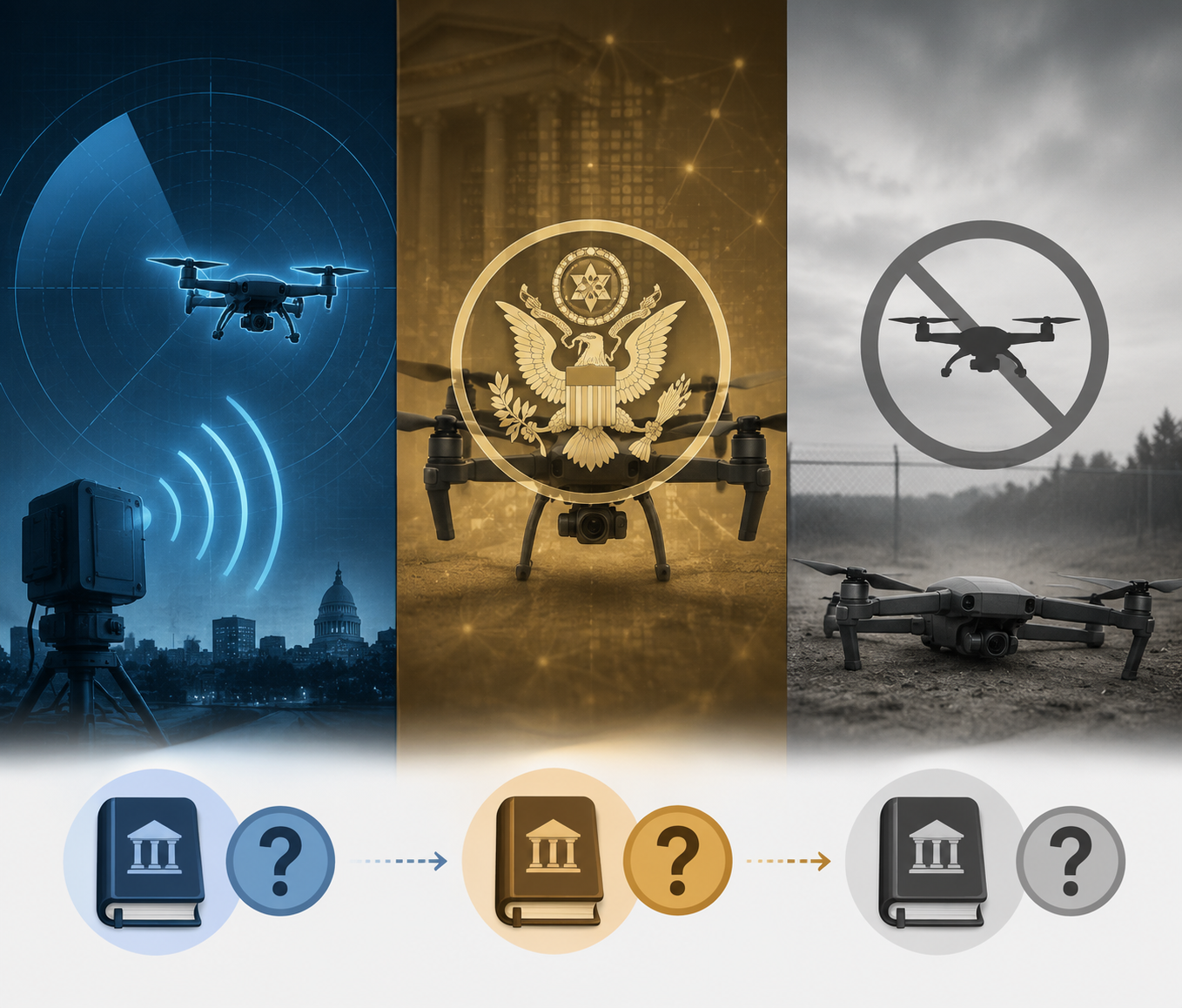
The Fourth Amendment issue was not settled by Remote ID
The government’s strongest starting point is not frivolous. Drones operate in heavily regulated airspace. Operators accept legal conditions that do not apply to a person writing in a notebook at home. Courts have often been less protective of activity exposed to public view or conducted inside regulated channels than of private papers, homes, phones, or intimate digital records.
That is why the D.C. Circuit’s treatment of the FAA’s Remote ID rule matters, but only up to a point. Commentary on the decision emphasizes that the court rejected a Fourth Amendment challenge to a rule requiring drones to broadcast identifying and location information, reasoning that operators lacked a reasonable expectation of privacy in public airspace drone flights.[5][6] That ruling is relevant to privacy expectations around drone identification. It is not a blanket approval of every federal counter-drone tactic used at a mass event.
Remote ID is a regulatory broadcast requirement. A counter-UAS operation at a stadium is a government enforcement system that may include active hunting, RF monitoring, operator location, seizure, and mitigation. The difference is not academic. A rule telling aircraft to identify themselves creates one kind of constitutional question. A federal team using sensors to locate an operator and then confiscating or commandeering the aircraft creates others.
Passive RF monitoring has been analogized by critics to warrantless surveillance, but the legal materials do not support the broader claim that courts have resolved whether such monitoring, when deployed at scale for counter-UAS enforcement, is always outside the Fourth Amendment.[5] The World Cup would have been a useful test because the facts were concrete: temporary flight restrictions, high-density venues, visible security needs, identifiable owners, and hundreds of seized aircraft. But without a litigant who could press the claim, none of that became doctrine.
The government would also have arguments rooted in exigency and special security needs. A drone approaching a packed stadium during an international event is not a slow-moving records dispute. Venue security officials do not have the luxury of waiting for a warrant process while an aircraft crosses into a restricted area. But exigency is usually a justification applied to particular facts, not a solvent poured over an entire surveillance-and-seizure architecture.
The unresolved Fourth Amendment questions therefore sit at several levels: whether detection of RF signals is a search; whether locating the operator changes the privacy analysis; whether taking command of the aircraft is a seizure separate from later physical confiscation; whether temporary flight restrictions and Remote ID obligations reduce the operator’s reasonable expectation of privacy; and whether mass-event exigency justifies warrantless action across categories of cases rather than in discrete emergencies. The World Cup generated facts that could have framed those questions. It did not generate a ruling.
Property deprivation after the press conference
The Fifth Amendment problem begins where much public-safety coverage ends: the drone is gone. If the government physically seizes or commandeers a drone, the owner has lost control over property. The constitutional question is then not only whether the initial seizure was reasonable, but what process the owner received before or after the deprivation.
Legal commentary identifies the likely government response: urgent security circumstances justified immediate action, and post-deprivation remedies, including federal tort or property-return mechanisms, could supply process afterward.[5][7] That may be the argument. It has not been tested in court in the setting that matters here: mass-event counter-UAS operations producing hundreds of seizures from mostly noncriminal operators.
The hard part is not imagining a dangerous drone. The hard part is designing constitutional process for the many less dramatic cases: the operator who flew too close to a venue without malicious intent, the visitor who misunderstood a temporary restriction, the hobbyist whose drone was seized but who never faced charges serious enough to justify hiring counsel. A post-deprivation remedy can exist on paper and still be functionally unavailable to the ordinary owner.
That practical burden affects constitutional development. If the only realistic challengers are well-funded manufacturers, commercial operators, journalists, or repeat players, the first case may not look like the ordinary World Cup seizure. It may involve higher-value equipment, clearer economic damages, or a claimant with institutional reasons to litigate. Doctrine formed on that record could still govern the hobbyist, but it will not necessarily have been built around the hobbyist’s facts.
There is also a difference between temporary control and permanent loss. If agents force a drone to land and return it promptly, the deprivation is different from a seizure that leads to prolonged retention, forfeiture, or destruction. Public reporting for the World Cup gives aggregate seizure figures, but not a consistent incident-by-incident account of the mitigation method, retention period, owner notice, or return process.[1][2] Those missing details are exactly the details that would matter in a due process case.
The civil-liberties question the event did not answer
The First Amendment issue is narrower than some rhetoric suggests and broader than venue-security officials may prefer. There is no general First Amendment right to fly an aircraft wherever one wants. Temporary flight restrictions, aviation safety rules, and venue security perimeters do real work. But drones are also used for newsgathering, protest documentation, and public oversight. A counter-drone regime that is vague, aggressive, or discretionary can chill those uses even when no journalist is ultimately prosecuted.
EFF, ACLU, CDT, and EPIC jointly urged explicit First Amendment safeguards in expanded counter-UAS legislation, warning that drone-based journalism and protest documentation could be chilled by aggressive enforcement.[8] The SAFER SKIES Act did not include the safeguards those groups requested.[8]
That does not prove the World Cup operation violated the First Amendment. It does mean the event did not answer how counter-UAS authority should be cabined when the drone is being used to record police activity, document crowd-control tactics, or cover a protest near a secured event. A person who simply decides not to fly because the enforcement environment is opaque will rarely become the plaintiff who clarifies the law. Chilling-effect claims are possible, but they are not easy vehicles when the plaintiff cannot point to a specific enforcement action against protected activity.
Federal task forces and the state-officer problem
The federalism issue is less developed in the public record, but it should not be waved away. The SAFER SKIES framework contemplates state, local, tribal, and territorial participation through FBI task force deputization, allowing nonfederal officers to operate under federal authority during the implementation period.[9][10] That model may be administratively sensible during a major event. It also blurs responsibility.
If a state officer, deputized into a federal task force, participates in detecting or seizing a drone, whose constitutional policy choices are being applied? Who trained the officer? Who approved the mitigation? Which sovereign answers for the deprivation? These questions may sound like litigation housekeeping until an owner sues the wrong defendant, or a state agency claims it was acting under federal direction, or a federal defendant argues the challenged conduct belonged to local implementation.
The posture may change again once implementing regulations are finalized and state or local entities exercise more independent counter-UAS authority. The research record supports caution here, not a confident Tenth Amendment conclusion. Cooperative federalism and commandeering arguments turn on structure, voluntariness, control, and accountability. The World Cup took place while implementation details were still being built, so it is a poor vehicle for declaring the federalism question settled.
What lawyers can and cannot take from the World Cup
There are a few safe conclusions. Federal agencies can point to the World Cup as evidence that large-scale counter-drone operations can be run without reported destruction of aircraft and without immediate constitutional litigation. Public-safety officials can point to the same event as a proof of operational coordination across cities. For statutory background, the separate question of what legal authority supported the FBI’s World Cup drone seizures is distinct from whether those authorities have survived adversarial constitutional testing.
The unsafe conclusion is that no lawsuit means no constitutional problem. The missing lawsuit may reflect the enforcement population: recreational operators, civil citations, relatively low-value property, and no criminal case in which suppression would matter. It may also reflect the difficulty of litigating against an operation that ended quickly, across temporary restrictions, with technical details that remain unclear to outsiders.
Counsel advising drone manufacturers, commercial operators, media organizations, or public agencies should therefore separate operational risk from litigation risk. The government may be willing and able to seize drones at mass events. That is operational reality. Whether particular detection, mitigation, retention, and remedy practices survive Fourth or Fifth Amendment review remains unresolved. Those are different statements.
The same separation matters for agencies. A record of successful event security does not substitute for clear notice, retention procedures, return mechanisms, auditable mitigation decisions, and limits on use of collected data. Those measures are not just civil-liberties window dressing. They are the difference between an emergency response that a court can understand and a black box that asks for deference after the fact.
The next case may not look like a stadium case
The SAFER SKIES Act’s sunset date, December 31, 2031, creates a defined period before Congress must revisit the framework.[3][7] That window includes the lead-up to the 2028 Olympics and the continued buildout of more permanent counter-drone infrastructure. The first plaintiff with standing may arrive before Congress returns to the issue. If so, that case may do what the World Cup did not: force a court to distinguish detection from search, mitigation from seizure, and post-deprivation remedy from meaningful process.
It may not be a hobbyist. It may be a journalist, a commercial operator, a manufacturer, or a state entity caught between federal direction and local accountability. It may arise from a protest, a critical infrastructure site, an airport-adjacent operation, or an Olympic venue. The constitutional doctrine will depend on those facts, which is why the World Cup’s clean litigation record should be read modestly.
The World Cup showed that the federal government could execute counter-drone enforcement at scale. It did not show that the Fourth, Fifth, First, or Tenth Amendment questions had been answered. More likely, it showed how easily those questions can pass through a major operation untouched when the people most affected lack the procedural leverage to get them before a judge.
References
- FBI seizes 600 drones at World Cup games, The Guardian, 2026-07-05.
- More than 700 illegal drones seized during the World Cup, says FBI, The Athletic, 2026-07-19.
- SAFER SKIES Act Counter Drone Law Enforcement, airsight.
- FBI boss Kash Patel details how agency, partners secured record-shattering FIFA World Cup, Fox News.
- Dawn Zoldi on Counter-Drone Laws Under Fire: The Real Danger Is Constitutional Confusion, Not C-UAS Technology, Duke Law/Lawfire, 2025-06-08.
- Faculty Articles, Law Commons.
- Will Trump EO on Counter-UAS Unleash Constitutional Wrath, Autonomy Global.
- Please Drone Responsibly: C-UAS Legislation Needs Civil Liberties Safeguards, Electronic Frontier Foundation.
- Defense law includes expanded counter-drone authority, Route Fifty.
- SAFER SKIES Act Counter UAS Authority FBI DRONERESPONDERS, Dronelife, 2026-03-11.
Comments
Join the discussion with an anonymous comment.