
By the final stretch of the 2026 World Cup, federal agents were no longer dealing with the occasional hobbyist drifting too close to a stadium. The FBI had detected roughly 1,600 drones across 11 host cities and seized more than 700 of them, making the tournament the largest federal drone enforcement operation reported in the United States to date. Earlier counts had already passed 600 seizures, which helps explain why this was treated inside security operations as an active airspace-control problem rather than routine FAA housekeeping. [1][2]
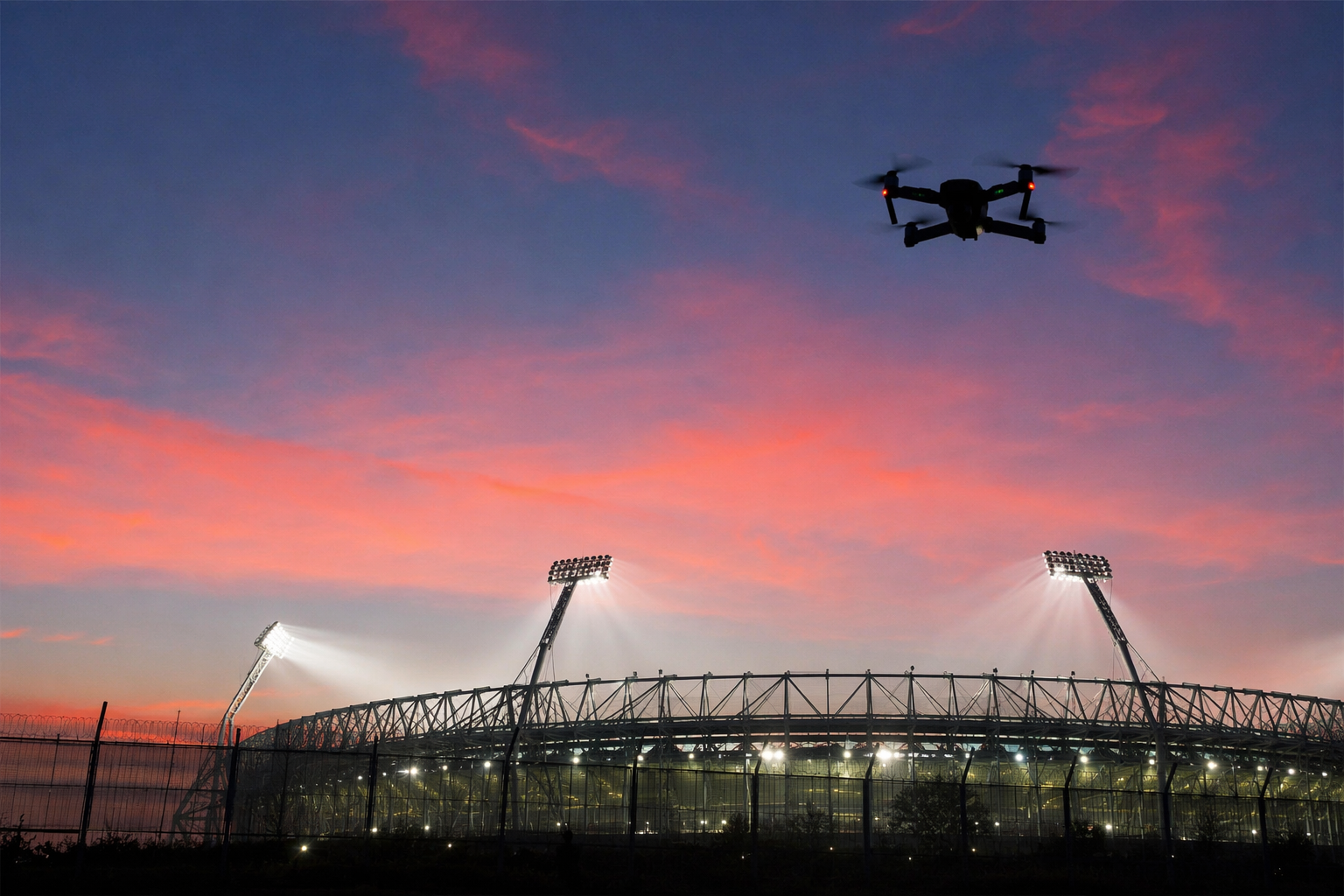
That scale matters to the legal question. A drone over a packed venue is not merely an unauthorized camera angle. It can force security officials to decide, in real time, whether the aircraft is a nuisance, a negligent commercial flight, a media-gathering attempt, or a threat that needs to be interrupted before anyone has time to draft a warrant affidavit.
The authority behind the FBI World Cup drone seizures was not invented at the stadium gate. It came from several overlapping legal sources: the SAfer SKIES Act, FAA temporary flight restrictions, and federal penalty provisions that can turn a prohibited flight into a seizure, forfeiture, or prosecution matter. The harder question is not whether the government had any legal basis. It did. The harder question is how far that basis reaches after the immediate airspace danger has passed.
The working legal stack behind the seizures
The first layer was the SAfer SKIES Act, enacted on Dec. 18, 2025 and codified at 6 U.S.C. § 124n. The statute expanded federal counter-unmanned aircraft system authority and gave designated officials power to take actions against unmanned aircraft systems in protected settings, including authority described in federal materials as the ability to “seize, confiscate, or destroy” drones. The interim final rule implementing parts of that system was not published until July 6, 2026, after World Cup enforcement had already begun, so the operation rested on pre-existing federal authority rather than a mature, fully implemented regulatory program. [6]
The second layer was FAA temporary flight restriction authority. For major sporting events and high-security operations, the FAA can impose temporary flight restrictions that define where aircraft may not operate, when the restriction applies, and what exceptions exist. In the World Cup setting, those restrictions supplied the airspace rule that made many flights unlawful in the first place. A drone that would be legal over a construction site on a normal afternoon could become unlawful when the same location falls inside a stadium-related restriction.
The third layer was the penalty framework. Reported enforcement materials described potential civil penalties of up to $75,000 per violation, criminal fines of up to $100,000, up to one year in prison in some charged scenarios, and drone confiscation. Some cases carried different maximums depending on the charge; one Dallas defendant was reported as facing a three-year maximum in connection with an unregistered drone allegation. [3][4]
| Legal component | What it did in the World Cup operation | Why it matters legally |
|---|---|---|
| SAfer SKIES Act / 6 U.S.C. § 124n | Supplied federal counter-UAS authority, including authority to act against drones in protected security settings. | Supports mitigation and seizure authority, but does not by itself settle every Fourth or Fifth Amendment question. |
| FAA temporary flight restrictions | Defined restricted airspace around protected venues and related operations. | Made otherwise ordinary drone flights unlawful when they entered the restricted area without authorization. |
| Federal penalty and enforcement provisions | Allowed civil penalties, criminal charges in some cases, and confiscation. | Moved the issue from airspace management into property seizure, prosecution, and forfeiture process. |
Those layers should not be collapsed into one phrase like “counter-UAS authority.” The FAA restriction answers one question: was the flight prohibited? The SAfer SKIES framework answers another: may federal officials interfere with or take control of a drone in a protected security environment? The penalty provisions answer still another: what consequences can attach after the operator has been identified and the aircraft has been recovered?
Why the facts do not look like a single kind of case
The public cases already show a spectrum. Reported defendants included John Alexander Meza in Houston, described in coverage as flying a DJI Mavic 3 without a license; Patrick Heer in Katy, Texas, connected to real estate photography and reported as being aware of temporary flight restrictions but not checking them; Luis Mauricio Flores Ordonez in Dallas, tied to an unregistered drone allegation; and Lorenzo Rojas-Martinez in Atlanta, who was reported as a prior deportee later in ICE custody. [3][4]
The FBI also confirmed that seized-drone operators included real estate photographers and roofing inspectors. That fact does not make the seizures unlawful, and it does not make the flights authorized. It does, however, sharpen the constitutional problem. A roofing inspector who failed to check a restriction presents a different enforcement profile from someone trying to probe a stadium perimeter, even if both drones enter the same prohibited airspace. [5]
For agents working a match day, that distinction may not be knowable at the moment of detection. A small aircraft near a venue does not announce whether it is filming shingles, selling aerial footage, or testing security response. The statute and the TFR let officials act before intent is clear. The unresolved issue is what the legal system owes the operator once intent becomes clearer and the aircraft is no longer in the air.
In-flight mitigation is not the same legal event as keeping the drone
A useful way to separate the problem is to ask what the government is doing at each stage. During flight, the government may be trying to stop an aircraft from entering or remaining in restricted airspace. After landing or recovery, the government may be keeping physical property as evidence, contraband, or forfeitable property. Those are related events, but they are not identical constitutional events.
The in-flight stage is where the government’s strongest practical argument sits. A drone inside a World Cup restriction can create immediate risk and operational confusion. If the aircraft is approaching a protected venue, officials may not have the luxury of determining ownership, commercial purpose, registration status, or whether the pilot misunderstood an app notification. In that setting, counter-UAS action looks closer to emergency mitigation than ordinary evidence gathering.
The post-landing stage is less tidy. Once the drone is grounded, disabled, or physically in government hands, the emergency rationale weakens. The legal justification may shift toward evidence preservation, administrative enforcement, civil forfeiture, or criminal process. That is where the Fourth Amendment question becomes more exposed: when is warrantless seizure of the aircraft reasonable, and how long may the government keep it without judicial review?
Available sources do not identify controlling litigation that has fully settled the relationship between FBI counter-UAS seizure authority under 6 U.S.C. § 124n and FAA enforcement authority under 49 U.S.C. § 46307. That absence matters. A statute can authorize agents to act, but statutory authorization is not the same as a court holding that every application is reasonable under the Fourth Amendment.
Forfeiture turns the seizure into a process problem
The Fifth Amendment question begins after the spectacular part of the operation is over. A seized drone is not just a risk object; it is also someone’s property, and sometimes a work tool. For a commercial operator, losing the aircraft may interrupt paid assignments even if the eventual penalty is modest or no criminal case follows.
Under 6 U.S.C. § 124n(c)(2), forfeiture of seized drones follows state law. That is an unusually important detail because it can produce a procedural patchwork. In some jurisdictions, forfeiture may require a judicial proceeding. In others, administrative forfeiture procedures may allow property to be kept unless the owner acts quickly enough to contest it. The same federal security operation can therefore lead to different post-seizure paths depending on the host city and state.
That patchwork is not a minor administrative inconvenience. If an operator flew negligently but without malicious intent, the central fairness question may be whether there is a prompt, understandable way to contest continued retention of the drone. A delayed forfeiture notice, a short contest deadline, or a process that requires counsel to recover equipment can become the real penalty long before a court decides anything about culpability.
This is where broad seizure counts can mislead. “More than 700 drones seized” describes operational activity. It does not tell us how many operators were charged, how many drones were returned, how many forfeiture proceedings were opened, or how many owners had meaningful review. The reported number proves scale. It does not prove the adequacy of process. [1]
The enforcement system was still being assembled during enforcement
The July 6, 2026 interim final rule underscores how new this legal architecture remains. The rule created a two-tier certification structure distinguishing Detection/Warning authority from Mitigation authority, imposed a 180-day data retention limit, required audit trails, and prohibited use of counter-UAS authority solely for evidence collection or First Amendment monitoring. The comment period runs through Sept. 4, 2026, so the rule is still subject to revision. [6]
Those guardrails are not decorative. Detection technology can collect information about aircraft, controllers, locations, and operator behavior. Mitigation authority can interfere with or take possession of an aircraft. Audit trails and retention limits are the mechanisms that let later reviewers ask whether an agency used the tool for the stated security purpose or drifted into general surveillance.
Capacity is another sign of a system still catching up to its mission. By July 2026, the FBI’s National Counter-UAS Training Center had certified only about 61 officers across roughly 46 state, local, tribal, and territorial agencies, out of more than 18,500 eligible agencies. [7]
That bottleneck does not invalidate the World Cup seizures. It does show why federal agencies remained central to the operation and why local expansion of this authority is likely to be uneven. A stadium security plan can be funded, staffed, and drilled for a tournament; a nationwide certification and oversight system takes longer.
The funding picture points in the same direction. Public reporting identifies $625 million in FEMA security funding for counter-UAS infrastructure during the World Cup, with capability expected to transition into a more permanent DHS Program Executive Office for UAS and Counter-UAS structure. That suggests the World Cup was not only an event-security operation. It was also a proving ground for a larger domestic counter-drone apparatus.
The First Amendment issue is adjacent, not identical
The First Amendment question should be handled carefully. The Electronic Frontier Foundation’s 2026 challenge concerned a separate nationwide FAA temporary flight restriction, FDC 6/4375, involving ICE and CBP mobile assets. It was not a challenge to the World Cup venue restrictions themselves. [8]
Still, the challenge is relevant to the broader legal environment. Drones are used for aerial recording, journalism, documentation of government activity, and commercial imaging. A temporary flight restriction can be a safety tool, but it can also restrict the places from which lawful recording may occur. The World Cup restrictions were easier for the government to defend because they involved mass gatherings, international teams, fixed venues, and known security perimeters. That does not answer how broad or mobile TFRs should be treated when they affect recording of public officials away from a stadium setting.
The interim final rule’s express prohibition on using counter-UAS authority solely for First Amendment monitoring is therefore significant, but not conclusive. It states a boundary for authorized use. It does not tell a court what remedy applies if data are retained too long, if a restriction is drafted too broadly, or if a drone used for newsgathering is seized in circumstances that later look less urgent. [6]
What can be said now, and what cannot
The FBI’s World Cup drone seizures were not legally baseless. The government had a statutory counter-UAS framework, FAA restrictions defining prohibited airspace, and penalty provisions that made seizure and prosecution available in at least some circumstances. For a drone detected near a protected stadium during a World Cup match, the government’s authority to act quickly is stronger than many after-the-fact objections acknowledge.
But the operation also exposed questions that the statute and early enforcement reports do not resolve. The Fourth Amendment question is whether warrantless seizure remains reasonable once the drone is no longer an immediate airspace threat. The Fifth Amendment question is whether state-law forfeiture procedures provide prompt and meaningful review when the operator is negligent, mistaken, or commercially careless rather than malicious. The First Amendment question, while not squarely presented by the World Cup TFRs, remains nearby whenever broad drone restrictions affect aerial recording.
The cleanest legal description is also the least dramatic one: the seizures sat on real statutory ground, but the constitutional perimeter around that authority is not yet settled. Courts and regulators still have to answer what happens after the drone is down, the match is over, and the government is no longer managing an immediate threat but holding someone’s property.
References
- Most current seizure count (700+), The Athletic, July 19, 2026.
- FBI seizes 600 drones at World Cup games, The Guardian, July 5, 2026.
- Drones at the World Cup, CNN, July 1, 2026.
- Feds charge four as World Cup drone crackdown tops 400 seizures, Fox News.
- FBI World Cup drone seizures included real estate photographers, roofing inspectors, NBC DFW.
- Interim Final Rule, Counter-UAS SLTT Rule, Federal Register, July 6, 2026.
- The Counter-UAS Certification Bottleneck, Lawfare.
- FAA’s Temporary Flight Restriction on Drone Flights Raises First Amendment Concerns, Electronic Frontier Foundation.
Comments
Join the discussion with an anonymous comment.