
By late July 2026, the legal scaffolding for FBI World Cup security is already entering its afterlife. The White House task force created for the tournament is scheduled to terminate on December 31, 2026, while the counter-drone authority expanded for the same security environment runs until December 31, 2031. Between those two sunset dates sits the harder question: which parts of the operation were temporary legal permissions, and which parts have become reusable government capacity?
That distinction matters because “FBI World Cup security” was not simply a larger version of ordinary event policing. It was built from an executive coordination order, statutory counter-UAS authority, formal and quasi-formal event-security protocols, and federal grant instruments that moved money into local and technical capability. Some of those instruments expire on paper. Training centers, vetted personnel, interagency routines, and local drone-response capabilities do not disappear so neatly.

The first layer: a White House task force with a fixed expiration date
Executive Order 14234, published in March 2025, established the White House Task Force on the FIFA World Cup 2026. The order placed the task force administratively within the Department of Homeland Security and made the FBI Director one of 13 listed member-agency heads. It also included an unusually important piece of temporal drafting for anyone trying to understand what was meant to be temporary: the task force “shall terminate on December 31, 2026,” unless extended by the President.[1]
The order did not make the FBI the sole owner of World Cup security. Its function was to create a federal coordination frame around a multi-jurisdiction tournament spread across U.S. host cities and involving international movement, dignitary protection concerns, cyber and physical security planning, aviation restrictions, and local law enforcement execution. In that sense, the order was less a dramatic grant of new police power than an organizing instrument: it identified who belonged at the federal table, where the task force would be housed, and when the structure was supposed to end.
That administrative placement is not a footnote. Housing the task force within DHS while including the FBI Director in the membership helped align two different institutional logics: DHS’s event-security, infrastructure, transportation, and grant functions, and the FBI’s intelligence, counterterrorism, investigative, and intergovernmental coordination role. The legal architecture did not require one agency to absorb the other’s mission. It created a temporary forum in which those missions could be synchronized.
The longer clock: SAFER SKIES and the counter-UAS expansion
The more consequential statutory change came through the SAFER SKIES Act, included in the FY2026 National Defense Authorization Act and signed on December 18, 2025. The Act was described in the available legal analysis as the first federal statute to extend counter-UAS detection and mitigation authority to qualifying state, local, tribal, and territorial law enforcement entities; before that expansion, counter-UAS authority of this kind rested with DHS, DOJ, DOD, and DOE.[2][3]
The difference is operationally large. Drone security at a distributed mega-event cannot be handled only by federal personnel standing at a handful of federal perimeters. Local officers are often the first people positioned near stadium approaches, training facilities, fan zones, hotels, transportation corridors, and temporary restricted areas. SAFER SKIES made it possible, under defined conditions, for qualifying SLTT law enforcement to participate in detection, tracking, seizure, disablement, or destruction of unmanned aircraft systems when a credible threat standard was met.[2][3]
This is where the legal analysis has to stay disciplined. SAFER SKIES did not make every police department a free-standing drone interdiction authority. The sources describe a conditional extension to qualifying entities, not an across-the-board deputization of every local officer. Nor did it permanently rewrite the counter-UAS field. The authority expires on December 31, 2031, which is five years beyond the World Cup task force’s scheduled termination.[2]
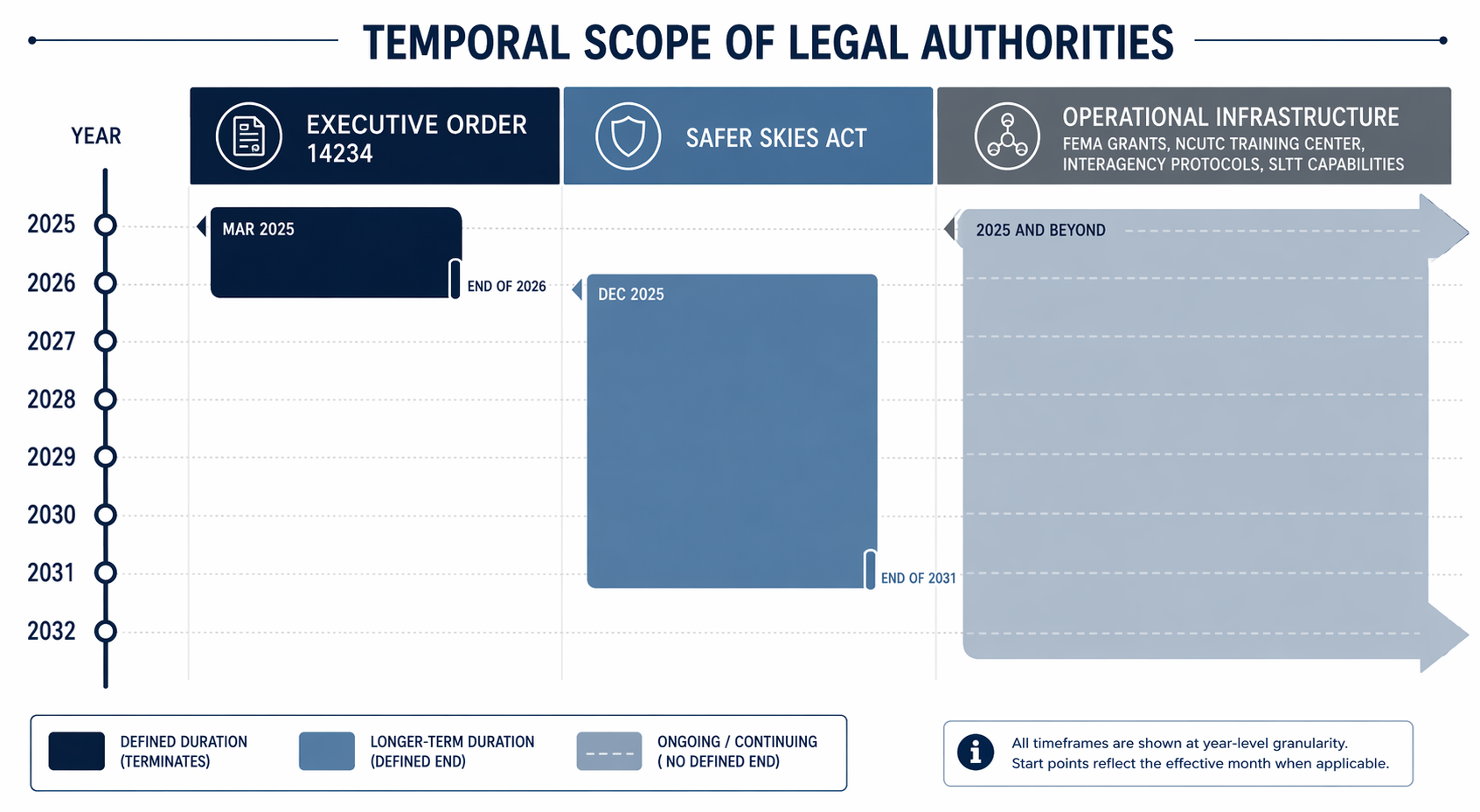
That staggered timing is the central legal tension. Executive Order 14234 created an event-specific federal task force scheduled to vanish at the end of 2026. SAFER SKIES created a longer but still temporary counter-UAS regime. The operational habits built under both authorities—who trains whom, which local agencies qualify, what information is shared, and how drone incidents are triaged—can outlast either sunset date even if the formal instruments expire on schedule.
NSSE designation and the problem of “equivalent” security
The cleanest example of legal form diverging from operational practice is the National Special Security Event issue. Kroll’s security analysis stated that all 78 U.S. matches operated under NSSE-equivalent protocols.[4] The Guardian, by contrast, reported that only the final match at MetLife Stadium received official NSSE designation.[5]
Those statements are not necessarily irreconcilable, but they are not interchangeable. An official NSSE designation carries a formal federal status and triggers an established security-planning architecture. “NSSE-equivalent protocols” describes a practical security posture: comparable screening, intelligence coordination, access control, airspace protection, incident management, and multi-agency planning. One is a legal designation. The other is an operational standard.
For the FBI’s role, that distinction is more than semantic. If every U.S. match is described publicly as an NSSE, the legal basis appears broader and more settled than the record supports. If only the final is treated as legally significant, the operational reality is understated. The available materials support a narrower and more useful conclusion: the final match had the official NSSE designation, while the wider U.S. match schedule appears to have been secured through protocols designed to approximate that level of coordination.
How authority became capacity
The FBI’s Senate testimony is useful because it shows the machinery after the legal frame had been assembled. Special Agent in Charge Douglas Olson testified that the FBI conducted approximately 300,000 background checks on accredited personnel, established the National Counter-UAS Training Center at Redstone Arsenal, Alabama, certified roughly 60 officers, operated Intelligence Coordination Centers processing about 26 incidents per day, produced approximately 100 intelligence reports, and coordinated with 46 countries through the International Police Cooperation Center.[6]
Those figures are not just operational trivia. Background checks convert credentialing into a federal screening function. A national counter-UAS training center converts statutory authority into personnel who know when and how to use it. Intelligence Coordination Centers convert scattered event incidents into reviewed and disseminated information. International police cooperation converts a domestic sporting event into a cross-border intelligence and law enforcement exercise.
The drone numbers show the same pattern. The Guardian reported that the FBI seized 600 drones at World Cup games.[5] That fact is best read against the SAFER SKIES backdrop, not as a stand-alone anecdote about unruly hobbyists or careless fans. A seizure program at that scale requires a chain of authority, trained personnel, incident intake, evidence handling, deconfliction with aviation rules, and an understanding of when local and federal actors may intervene.
The legal framework therefore did not merely authorize the FBI to appear at venues. It gave federal and qualifying non-federal actors a repeatable process for identifying who could be cleared, who could fly, who could intervene, who would receive intelligence, and who would escalate an incident. That is the part of event security that tends to survive: not the visible perimeter, but the operating process.
Grants were part of the governance structure
The funding channel deserves the same treatment as the statutes. FEMA identified $625 million through the FIFA World Cup Grant Program, and FBI Senate testimony referenced more than $221 million through the Counter-UAS Grant Program, for a combined total of approximately $846 million in grant funding associated with World Cup security preparation.[7][6]
A grant program is not just a budget line. It determines which governments can acquire equipment, which capabilities are worth subsidizing, which procurement conditions attach to the money, and which local agencies can build capacity before the federal task force disappears. For a tournament spread across multiple jurisdictions, grants are one of the legal instruments that turn federal policy into local implementation.
The record flagged in the available materials also contains a verification point that should not be smoothed over: references to a partial government shutdown affecting FEMA grant disbursement require primary-source confirmation as to timing, duration, and actual disbursement effects. The existence and scale of the FEMA-linked grant programs are supported; the precise consequences of any funding lapse should be treated more cautiously unless supported by agency documentation.
The civil liberties question is not separate from the legal architecture
The civil liberties concerns raised around the World Cup are sometimes presented as a late-stage objection to an otherwise technical security story. That framing misses the point. If the legal issue is what survives the event, then surveillance, travel screening, border scrutiny, and information-sharing practices belong inside the main analysis, not after it.
The ACLU’s 2026 World Cup travel advisory, joined by more than 120 civil society groups, raised legal concerns for travelers coming to the United States during the tournament.[8] The advisory does not prove that any specific FBI security action was unlawful. It does, however, identify the human point of contact with the architecture described above: people seeking admission, accreditation, movement, or participation encounter the system through screening decisions, data checks, and law enforcement discretion.
Fast Company’s warning that surveillance systems built for the World Cup “rarely go away” is not a statutory conclusion, but it is a useful permanence test.[9] The legal instruments may contain sunset clauses. The purchased equipment, trained local officers, shared procedures, and expectations of federal-local coordination may remain available for the next event, protest, emergency, or security campaign.
That is not an argument that every World Cup security measure was illegitimate. It is an argument that temporary authority should be evaluated at the level where it actually changes government behavior. If an expiring order funds enduring tools, if a temporary statutory authority trains a local cadre, or if an event-specific intelligence process becomes familiar across agencies, the legal sunset date is only part of the answer.
What remains after the final match
As of July 2026, the World Cup security framework is not yet a settled precedent. Executive Order 14234 still points to a December 31, 2026 termination date for the task force.[1] SAFER SKIES still points to a December 31, 2031 expiration date for the expanded counter-UAS authority described in the available legal analyses.[2] The official NSSE designation record, as reported, still appears narrower than the operational protocols applied across U.S. matches.[4][5]
But the enduring infrastructure is already visible. The FBI and its partners processed accreditation at large scale, trained counter-UAS personnel, operated intelligence coordination centers, built international police channels, and helped move federal security money into local capability.[6][7] Those are not merely memories of a tournament. They are components of a legal-operational template.
The careful conclusion is not that the World Cup created a permanent emergency regime. The sources do not prove that. The better-supported conclusion is narrower and more important for lawyers and public-sector operators: the formal authorities may sunset, but the capacities assembled under them are positioned to be inherited by future mega-events.
References
- Establishing the White House Task Force on the FIFA World Cup 2026, Federal Register, March 12, 2025.
- SAFER SKIES Act: Counter Drone Law Enforcement, Airsight.
- Government Moves to Provide Safer Skies Above World Cup Events, Woods Rogers.
- World Cup 2026: A Security-Focused Breakdown, Kroll.
- FBI seizes 600 drones at World Cup games, The Guardian, July 5, 2026.
- Statement of Special Agent in Charge Douglas Olson to Senate Appropriations, Federal Bureau of Investigation.
- FIFA World Cup 2026, FEMA.
- 2026 World Cup Travel Advisory, ACLU.
- World Cup US surveillance security systems, Fast Company.
Comments
Join the discussion with an anonymous comment.