
The first legal correction matters: the 2026 FIFA World Cup was not, in its entirety, a National Special Security Event. The NSSE designation applied to the July 19 final at MetLife Stadium, where the Secret Service had the statutory lead role for security planning and coordination.[1][2] The rest of the U.S. tournament footprint was handled through a different federal classification system: all 78 U.S. matches received Special Event Assessment Rating Level 1 or Level 2 treatment, a DHS risk-rating framework that CISA described as a 240% increase over an average year.[3]
That distinction is not a lawyer’s quibble. NSSE status changes the lead federal agency and the formal planning architecture around the event. SEAR status identifies nationally significant events that require federal support, but it does not turn every match into a Secret Service-led NSSE. In practical terms, the FBI World Cup security risk legal response in 2026 was a layered structure: Secret Service lead authority for the final, FBI-led operational coordination across the broader threat environment, DHS infrastructure and cyber support, FEMA grant conditions, state and local police powers, and new counter-drone authority distributed far beyond the usual federal circle.

Once the designations are separated, the scale becomes easier to understand. The tournament required security planning across 11 U.S. host cities, with Canadian and Mexican legal systems operating alongside the U.S. framework. Federal officials also described a joint operations environment involving police from 46 countries and more than 300,000 background checks on players, coaches, and personnel.[4] Those numbers convey size. They do not, by themselves, explain authority. The harder question is who could act, under what instrument, when a threat crossed the border between stadium security, aviation law, cybercrime, immigration discretion, and intelligence sharing.
The authority map was built from designations, not one master statute
Mega-event security is often described as though the federal government simply “takes over.” That is not how the legal machinery works. A host city still owns local policing. A stadium operator still carries private security and access-control duties. State law still governs ordinary arrests. Federal agencies enter through specific gateways: criminal jurisdiction, protective responsibility, immigration authority, aviation safety, critical infrastructure support, grant conditions, intelligence authorities, or an event designation that assigns coordinating roles.
For the final, NSSE status brought the familiar model: Secret Service lead for security planning, with the FBI, DHS components, and state and local authorities organized through a unified coordination structure.[1][2] The FBI’s role did not disappear at the final; it remained central to threat investigation, intelligence, and federal criminal response. But the lead-agency label matters when lawyers are drafting memoranda of understanding, reviewing command-post protocols, or deciding whose approval is required before a protective measure becomes operational.
For the other matches, SEAR Level 1 and Level 2 status signaled high national significance and a need for federal coordination, but it did not replicate NSSE authority. CISA’s May 2026 materials treated the 78 U.S. matches as SEAR-rated events and emphasized preparation for cyber, physical security, and infrastructure coordination across the host-city footprint.[3] The legal consequence is narrower than the press shorthand often suggests: SEAR can mobilize support and planning attention, but it is not a universal command statute.
This is also where source discipline matters. At least one public account characterized all 78 U.S. matches as NSSE-designated, while CSIS and later event reporting identified only the MetLife final as the NSSE and CISA identified the full match set as SEAR Level 1 or 2.[1][2][3] For operational counsel, that is not an academic discrepancy. A mislabeled designation can produce the wrong assumptions about lead authority, reimbursement, protective protocols, and escalation channels.
| Layer | Instrument or authority | What it did in practice | Dependency |
|---|---|---|---|
| MetLife final | NSSE designation | Placed the final inside a Secret Service-led national special security framework | Federal, state, local, and venue coordination had to follow the NSSE planning structure |
| All U.S. matches | SEAR Level 1 or 2 designations | Triggered high-level DHS risk assessment and federal support across 78 matches | Host-city and federal agencies still needed local implementation capacity |
| Drone response | SAFER SKIES Act | Expanded counter-UAS authority to state, local, tribal, and territorial law enforcement agencies | Training, equipment, grant funding, and aviation-law compliance had to be in place |
| Cyber fraud | FBI IC3, CFAA, wire fraud, identity theft statutes | Supported public warnings, victim reporting, and potential federal prosecution | Detection and referral depended on public reporting, vendors, and agency cyber capacity |
| Funding | FEMA grant structure | Moved security money to U.S. host cities with conditions attached | Disbursement timing depended on DHS funding continuity |
| Intelligence sharing | ODNI, NCTC, JCAT products and law enforcement channels | Provided unclassified products and symposium-based coordination | Useful only if local agencies could ingest and operationalize the material |
Counter-drone authority moved from a federal specialty to a local operating problem
The most consequential legal change for future events may not be the NSSE designation at all. It may be the SAFER SKIES Act, enacted on December 18, 2025 through the FY2026 National Defense Authorization Act, which expanded counter-UAS authority beyond a small set of federal agencies and made it available, for the first time, to roughly 18,000 state, local, tribal, and territorial law enforcement agencies.[5][6]
Before that expansion, counter-drone operations sat inside a narrow federal authority model. That made legal sense in one respect: detecting, tracking, disrupting, or seizing aircraft implicates communications law, aviation law, property rights, and criminal procedure. It also created an operational bottleneck for a tournament spread across 11 U.S. cities. A drone over a stadium perimeter does not wait for a clean jurisdictional memo.
SAFER SKIES changed the allocation of authority, but not the need for legal precision. A local agency newly empowered to act against an unauthorized drone still needed training, approved technology, evidence-handling protocols, coordination with federal aviation authorities, and an understanding of when mitigation crossed from detection into interdiction. The FBI trained about 60 officers at the National Counter-UAS Training Center before the tournament, and reporting around the event described more than 1,000 unauthorized drones detected, more than 300 neutralized, and more than 600 seized across the 11 U.S. host cities.[2][4]
Those figures show why Congress acted. They also show why the statute created a compliance burden. Once authority is extended to thousands of agencies, the legal risk no longer sits mainly with federal specialists. It moves to the sergeant at the perimeter, the city attorney approving a concept of operations, the prosecutor reviewing a seizure, and the agency counsel who must know whether a detection platform, jamming measure, or evidence transfer is covered by the specific authority being invoked.
The temporary character of the authority matters as well. The SAFER SKIES authority is scheduled to expire on December 31, 2031.[5] That date falls after the Los Angeles 2028 Olympics but before the Salt Lake City 2034 Winter Games. Unless Congress revisits the statute, the drone lessons from 2026 will sit on an authority that may not exist in the same form for the next U.S. winter mega-event.
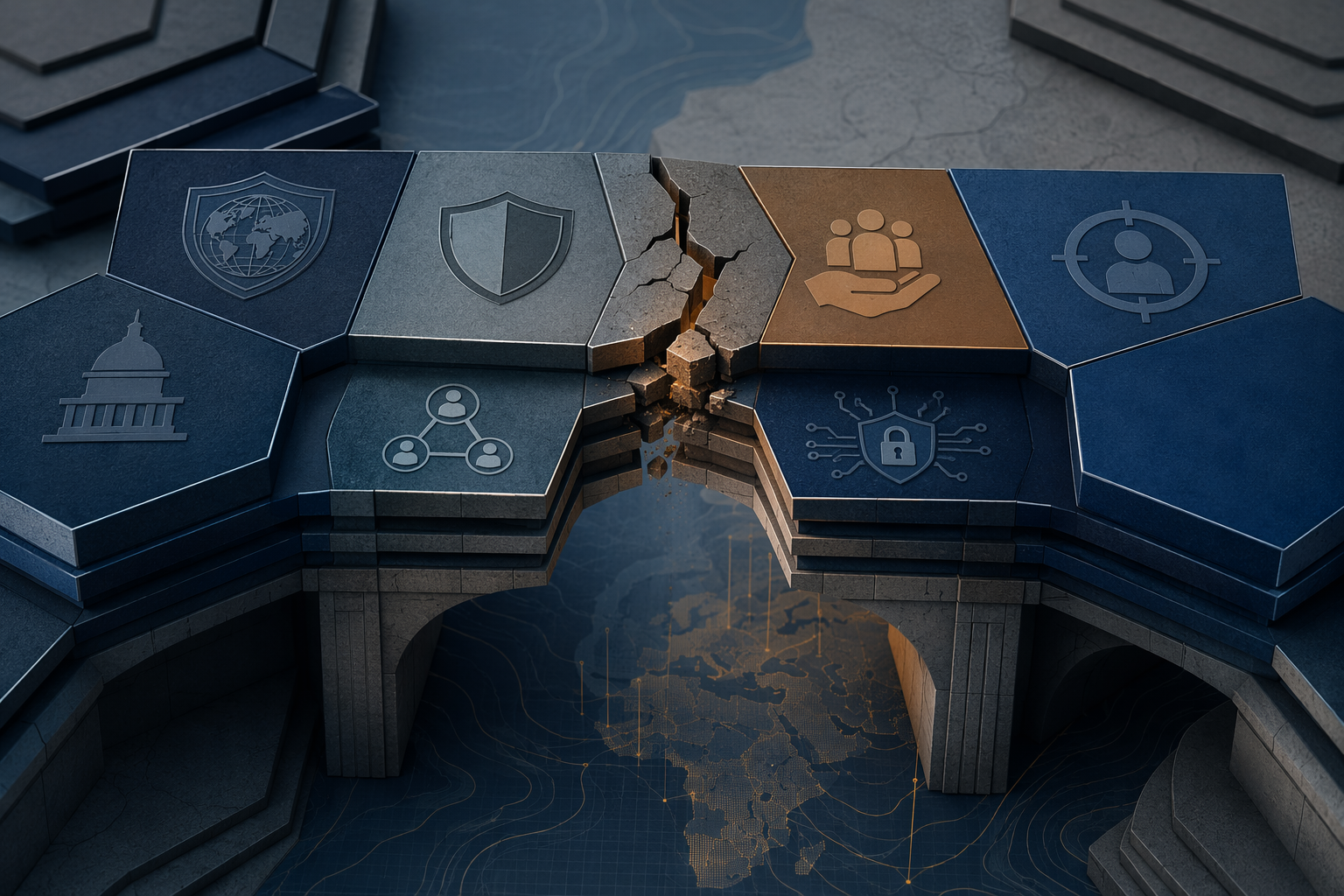
The FBI’s coordinating role sat across criminal, intelligence, and operational lines
The FBI’s World Cup role is easiest to misunderstand if it is treated as ordinary event security. The Bureau was not merely supplying agents to stadiums. It sat across several legal functions: threat investigation, background screening support, federal criminal enforcement, cybercrime intake, international law enforcement liaison, and joint operations center coordination. Director Kash Patel described more than 300,000 background checks tied to players, coaches, and personnel, and a joint operations environment with police representatives from 46 countries.[4]
That kind of coordination requires more than goodwill. It requires information-sharing channels that permit foreign liaison officers, federal agents, state police, local command staff, and private venue operators to work from a common threat picture without treating every piece of intelligence as if it can be freely redistributed. A criminal lead, an intelligence product, a visa-related concern, and a suspicious activity report each travel through different legal and policy channels.
The same point applies to the background checks. The number is impressive, but the legal importance lies in the consequence attached to a result. A match worker, vendor, credentialed contractor, player-support employee, or team official could fall under different vetting rules and appeal pathways. A match-day denial based on a database hit is not the same legal event as a federal prosecution, immigration denial, or private credentialing decision. A functioning security architecture must keep those categories separate even when the operations center sees only one red flag.
Cyber enforcement was public, statutory, and dependent on outside detection
The cyber layer had a more conventional legal backbone. On May 27, 2026, the FBI’s Internet Crime Complaint Center warned that threat actors were spoofing FIFA-related websites and publicly identified more than 30 domains, including fifa.city, fifa.beer, fifa.pink, jobs-fifa.com, fifa-ticket.live, and fifaworldcup26.sale.[7] The warning tied the fraud environment to familiar federal charging tools: the Computer Fraud and Abuse Act, wire fraud, and aggravated identity theft.[7]
Flashpoint separately reported thousands of fraudulent domains and AI-enhanced phishing campaigns targeting the tournament’s commercial and fan ecosystem.[8] That is an important distinction: IC3 provided the official public warning and federal reporting pathway; Flashpoint supplied independent threat-intelligence visibility into the broader fraud market. The two are complementary, but they are not the same kind of source and should not be treated as one government finding.
For counsel, the practical issue is referral discipline. A spoofed ticketing page might support a consumer-protection complaint, a platform takedown request, a registrar notice, a payment-fraud investigation, or a federal criminal referral. The charging statutes exist, but the case still depends on evidence preservation, victim reporting, attribution, interstate or international elements, and prosecutorial judgment. The public warning was therefore not a declaration that every fraudulent domain would become a federal case. It was a signal that the tournament’s cyber fraud environment had moved squarely into federal enforcement visibility.
Intelligence sharing widened the aperture without erasing classification boundaries
ODNI’s National Counterterrorism Center convened a symposium with more than 100 intelligence and law enforcement officers, and the Joint Counterterrorism Assessment Team issued four unclassified products covering fan-zone security, transit protection, nightlife venue threats, and high-profile figure safeguarding.[9] That is the correct kind of intelligence product for a dispersed event: specific enough to guide planning, broad enough to share, and unclassified enough to reach the local officials who actually manage sidewalks, transit nodes, entertainment districts, and hotel corridors.
But unclassified does not mean frictionless. A city police department, transit authority, stadium security office, and private nightlife venue do not all have the same legal status, security clearance posture, data systems, or retention rules. The value of a JCAT product depends on whether it reaches the right person in time and whether that person can translate it into staffing, access control, camera placement, vehicle barriers, or a suspicious-activity reporting protocol without over-collecting on lawful spectators.
The international layer adds another constraint. A joint operations center with foreign police representation can improve speed and context, especially when teams, supporters, and known risk groups move across borders. It also requires discipline about what information is shared, under what authority, and for what purpose. Cross-border policing cannot be reduced to a contact list.
Grant money carried conditions, and the timing exposed the weak hinge
The funding layer is where the legal architecture stopped looking elegant. FEMA distributed $625 million to the 11 U.S. host cities, but a 76-day DHS funding shutdown in spring 2026 delayed disbursements.[1][10] Separately, the counter-UAS funding structure included $500 million in FEMA grant funding, with $250 million directed to World Cup needs.[6] Grant money is not just money. It is authority with conditions attached: allowable costs, procurement rules, reporting duties, timelines, audit exposure, and sometimes civil-rights or nondiscrimination obligations.
A delay in that stream does not merely inconvenience a finance office. It can slow hiring, equipment purchases, exercises, communications upgrades, perimeter hardening, drone-detection deployment, and reimbursement planning. The legal instrument may authorize the expense, but if the cash arrives late, the host city still has to decide whether to front the money, scale back, defer procurement, or accept contract risk before federal reimbursement is secure.
The shutdown also collided with staffing losses at the agencies expected to make the federal coordination model work. CSIS and AP reporting identified CISA losses of roughly one-third of its staff and TSA losses of nearly 8% of its workforce.[1][10] Those figures matter because the same security model that asks CISA to help coordinate cyber and infrastructure resilience also assumes CISA has the people to do it. A statutory role does not answer emails, review a venue’s cyber plan, convene a regional tabletop, or push a time-sensitive infrastructure advisory to a local operator.

This is the structural gap the tournament exposed. Congress and agencies can widen legal authority, raise event ratings, assign lead roles, and fund equipment. Those measures still depend on an administrative layer that is less visible: grant managers, regional protective security advisors, cyber coordinators, TSA field personnel, agency counsel, contracting officers, and analysts who convert federal posture into usable local action. If that layer is underfunded or understaffed, the legal framework remains formally intact while its operating capacity thins out.
The Iran visa dispute showed where security law met diplomatic and rights commitments
The Iran visa dispute deserves separate treatment because it was not simply another security-screening issue. Reporting in June 2026 described visa denials affecting Iran’s team and officials under INA § 212(f) and presidential proclamation authority, creating a flashpoint between U.S. immigration discretion, FIFA’s human-rights commitments, and protest-management obligations in the host country.[1][10]
The source record was fast-moving, and later developments may have refined the practical outcome. The legal tension is still clear enough. INA § 212(f) gives the president broad authority to suspend entry of classes of noncitizens when their entry is deemed detrimental to U.S. interests. FIFA’s tournament obligations and public commitments pull in a different direction, especially when a host country’s immigration rules affect participation, official travel, or access for delegations. Add First Amendment protest rights around matches and fan zones, and the security plan has to distinguish between exclusion authority, event-access control, lawful protest, and threat-based intervention.
That distinction matters operationally. A protest near a team hotel is not, by itself, a security threat. A visa denial is not, by itself, proof of a criminal predicate. A FIFA accreditation problem is not the same as an immigration decision. When these categories collapse inside public debate, the lawyers and command staff still have to separate them before someone makes an arrest, denies access, restricts movement, or shares information with a foreign counterpart.
What this leaves for LA 2028 and Salt Lake City 2034
The 2026 framework was not a failure. It was large, legally inventive, and in several places well matched to the threat environment. It corrected an obvious counter-drone capacity problem. It used IC3 to make cyber fraud visible to the public. It pushed unclassified intelligence products toward the local agencies and venue operators that needed them. It put the final into an NSSE structure while rating the broader match schedule through SEAR. It also forced the FBI, DHS components, host cities, foreign police, venue operators, and grant recipients to work inside one of the most complex peacetime security arrangements the United States has had to operate.
The legacy question is whether the authority map can survive ordinary political and administrative stress. LA 2028 will arrive while SAFER SKIES authority is still scheduled to be in force. Salt Lake City 2034 will not, unless Congress extends or replaces it.[5] Both events will require cyber and infrastructure support from agencies whose staffing levels and funding continuity cannot be treated as background details. A grant program delayed by a shutdown is not just a budget story; it is a security-law implementation problem.
The broader lesson from the full tournament is harder: federal mega-event security law is now expanding faster than the administrative capacity beneath it. The designations, statutes, grants, intelligence products, and joint operations centers can be real and still rest on fragile hinges.
References
- The Terrorist Threat to the 2026 World Cup — CSIS
- Two days out: the World Cup final locks down as a National Special Security Event — OpsCon Intelligence, July 17, 2026
- Preparing for the World Stage — CISA, May 2026
- Director Patel on Securing the 2026 FIFA World Cup — FBI, June 11, 2026
- S.3481, SAFER SKIES Act, 119th Congress — Congress.gov
- SAFER SKIES Act Explained — Airsight
- Threat Actors Spoofing FIFA Websites — FBI IC3, May 27, 2026
- Navigating the Threat Landscape of the 2026 FIFA World Cup — Flashpoint
- ODNI Hosts Symposium... — ODNI, PR-09-26
- The World Cup poses an unprecedented security challenge — AP News
Comments
Join the discussion with an anonymous comment.