
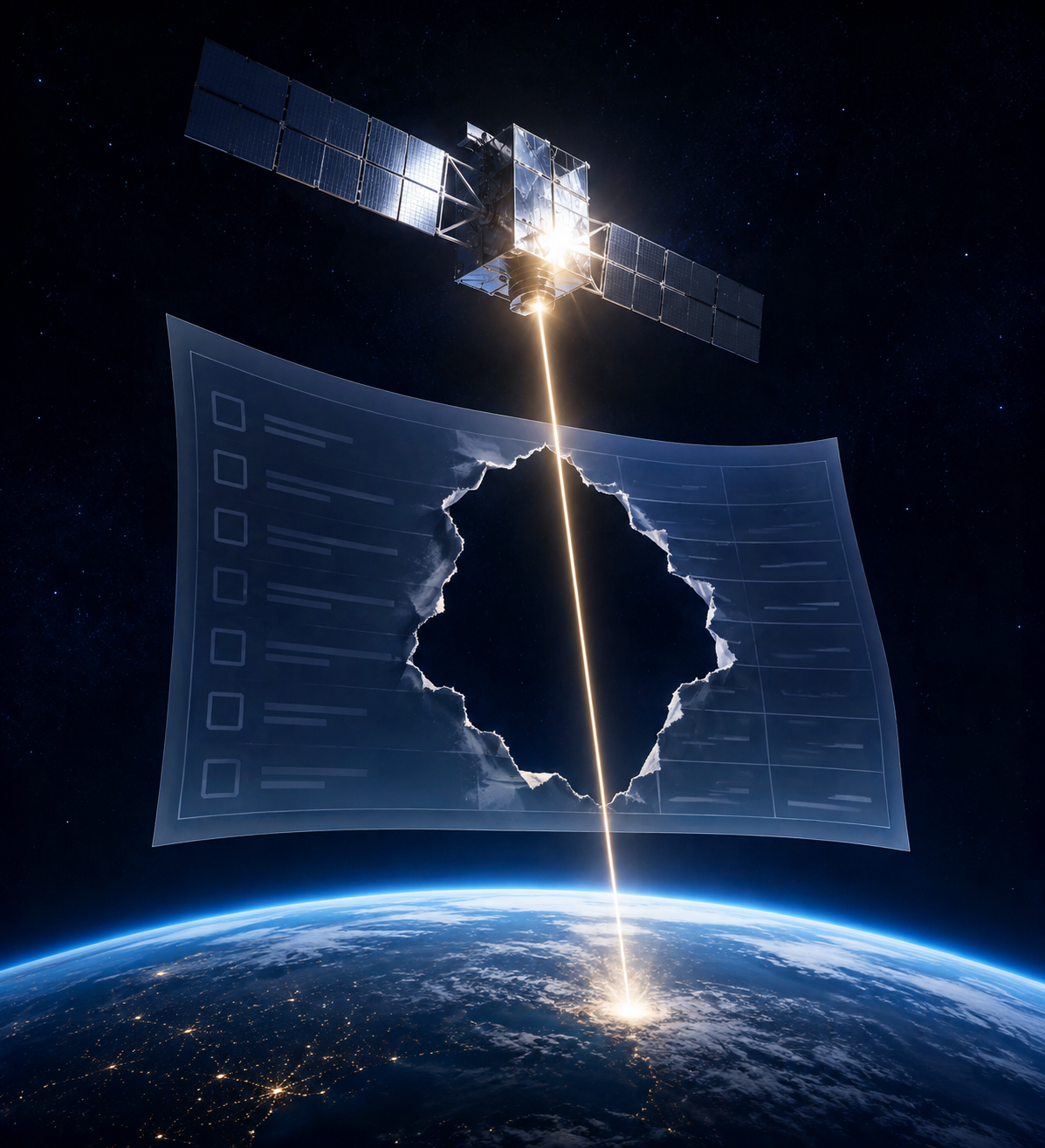
The FCC’s July 9, 2026 approval of Reflect Orbital’s Eärendil-1 did not turn on whether a “space mirror” is clever, alarming, or premature. The more consequential sentence was the jurisdictional one. The commission granted authority to launch and operate the experimental satellite, while saying that objections about optical brightness and environmental effects “fall outside our review.” That is the operative move: the license issued, and the agency placed the central alleged harms outside the licensing analysis.[1]
DarkSky International, which opposed the approval, described the same boundary in plainer terms: the FCC concluded that it lacked authority to evaluate the environmental impacts of an orbital solar reflector and confined its review to radiofrequency spectrum.[2] That is not a small procedural footnote. It means the agency with the application in front of it treated the light-reflection feature—the feature that makes the satellite legally interesting—as someone else’s problem, without identifying the someone else.
As of July 19, 2026, that posture has not yet produced a filed lawsuit. DarkSky has said it is evaluating legal and policy options with Earthjustice and coalition partners; Earthjustice has signaled that litigation is available if the FCC will not comply with environmental review obligations. Those are threats and evaluations, not a docketed complaint. The difference matters, because the legal story is still about the record the FCC has made and the paths opponents may try to open from it—not about claims already tested in court.[2]
The approval rests on a narrow license theory
Satellite licensing at the FCC has a familiar core: radiofrequency use, interference, orbital debris disclosures, and conditions tied to communications authority. Eärendil-1 pushes against that administrative template because its public controversy is not principally about communications. It is about a satellite designed to reflect sunlight from orbit. The asserted effects are optical, environmental, and astronomical.
The commission’s answer, as reported from the order, was not that those concerns are imaginary. It was that they are outside the scope of the review the FCC believed it was conducting.[1] That distinction will likely shape any challenge. A reviewing court would not simply ask whether the agency liked space mirrors. It would ask whether the agency reasonably defined the bounds of its statutory and environmental-review obligations, and whether its explanation was adequate under the Administrative Procedure Act.
The FCC may have a real jurisdictional argument. Agencies do not acquire power merely because a novel technology lands on their desk. If Congress gives the commission authority over spectrum, the commission cannot transform itself into a general orbital-environment regulator by administrative enthusiasm. But a jurisdictional limit is not the same thing as a complete answer. When an agency action enables the activity that creates the alleged effects, administrative law still asks how the agency identified its lane, how it dealt with environmental statutes, and whether it explained why the usual review process does or does not apply.
The 1986 NEPA exclusion is doing more work than it was built to do
The immediate legal pressure point is the FCC’s categorical exclusion from National Environmental Policy Act review for satellite licensing. That exclusion dates to 1986. The Government Accountability Office found in 2022 that the FCC had not sufficiently documented its decision to apply the exclusion when licensing large constellations of satellites, and recommended that the commission review and document whether such constellations normally do not have significant effects, establish a periodic review process, and identify and publish extraordinary-circumstances factors. GAO’s July 2025 status update listed all three recommendations as still open.[3]
That GAO finding is unusually important because it is not a dark-sky advocacy brief. It is an institutional audit of agency paperwork, or more precisely, of the absence of paperwork. A categorical exclusion survives by being tied to an agency’s reasoned judgment that a category of actions normally does not have significant environmental effects. If the category changes in practical operation—larger constellations, different orbital uses, reflective systems whose alleged harms are not incidental to communications—the agency needs a record showing why the old exclusion still fits.
Eärendil-1 is not a large constellation, so the GAO report does not mechanically decide the issue. Its significance is broader and more procedural. GAO identified that the FCC had not documented and periodically reviewed the satellite-licensing exclusion in the face of changing satellite activity.[3] An orbital reflector gives opponents a sharper example of the same defect: the licensed object may be a satellite, but the alleged effect is not the ordinary environmental profile that the 1986 exclusion was designed around.
| Administrative question | Why Eärendil-1 makes it harder |
|---|---|
| Is the action within a category that normally lacks significant environmental effects? | The central feature of the project is intentional reflection of sunlight, not merely operation of communications equipment. |
| Has the FCC documented why the exclusion still applies? | GAO found the commission had not sufficiently documented the exclusion’s use for changed satellite activity and had not completed recommended updates. |
| Are there extraordinary circumstances? | Opponents can argue that optical, astronomical, and environmental objections are exactly the sort of unusual effects that require a closer look. |
| Can the FCC avoid the issue by saying the effects are outside its review? | That may be a jurisdictional defense, but it also spotlights the absence of another front-end federal review. |
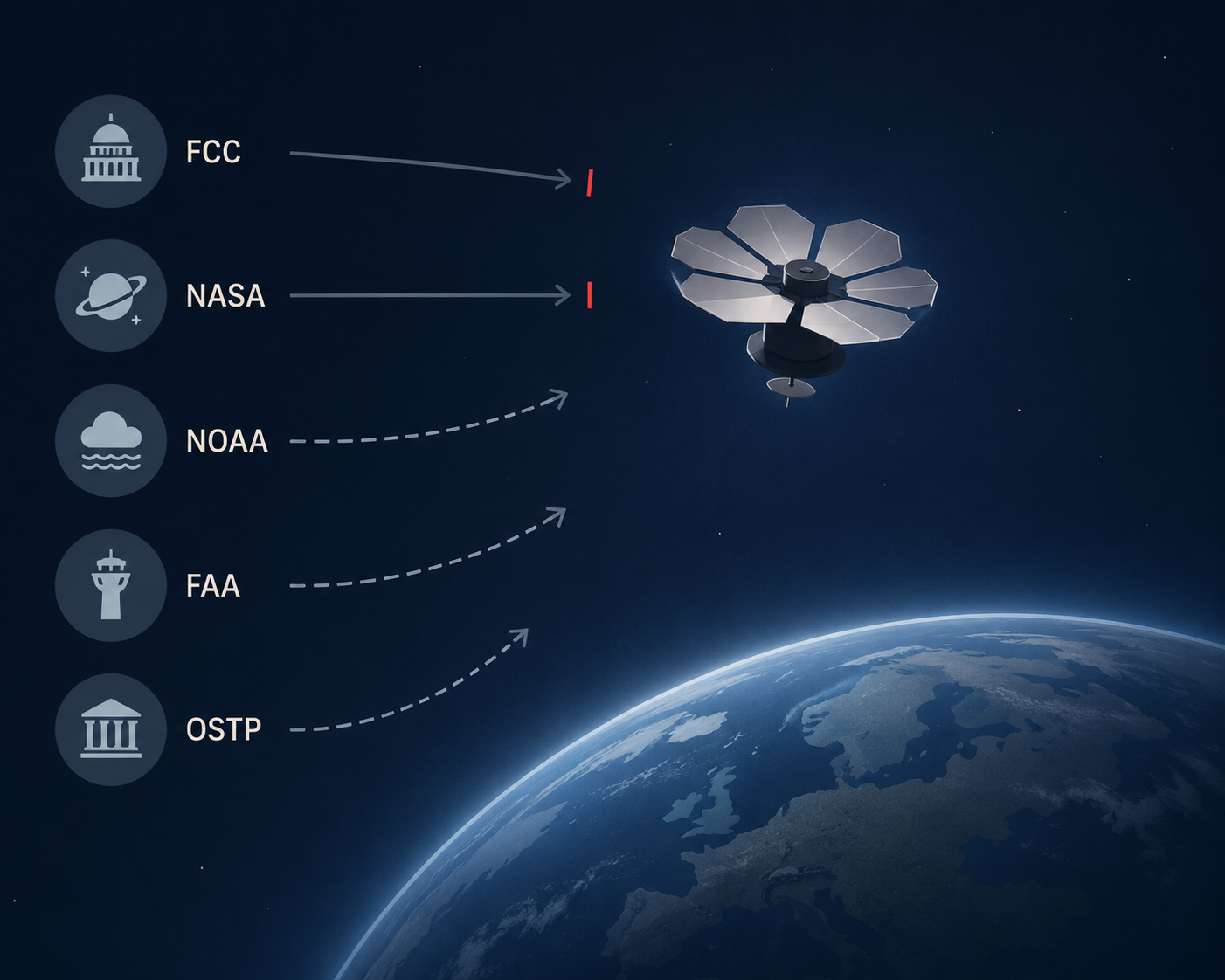
This is where the regulatory vacuum becomes concrete. It is not enough to say “no one regulates this” as a slogan. NASA is not the licensing agency for private commercial satellites merely because the activity occurs in space. NOAA’s remote-sensing authority does not naturally map onto a reflector whose disputed impact is illumination rather than imaging. The FAA’s launch role concerns launch and reentry safety, not a continuing optical-effects review of an orbital payload. OSTP can coordinate policy but does not issue the license. The FCC has the application, but says the challenged effects are outside its review. Put agency by agency, the gap becomes less dramatic and more legally useful.
The 2025 rulemaking gives challengers a record to work with
The FCC’s 2025 proposed rulemaking matters because it shows the commission was already trying to stabilize its NEPA position before the Eärendil-1 approval. The proposal would exclude satellite operations from NEPA review on the theory that they are extraterritorial activities with effects located entirely outside U.S. jurisdiction.[4] That formulation is tidy. The record against it is not.
A coalition of 17 state attorneys general filed comments in September 2025 arguing that the notice lacked draft rule text, violated the APA, and required a supplemental notice before any final rule.[4] Those comments do two things at once. They preserve procedural objections to the rulemaking itself, and they put the commission on notice that states view satellite environmental review as an administrative-law problem, not only a policy disagreement.
The American Astronomical Society’s comments pressed on the substance of the extraterritorial theory. AAS pointed to satellite reentry depositing metal vapor over U.S. territory, undermining the premise that satellite effects are located entirely outside domestic jurisdiction. Its deputy director, Roohi Dalal, put the institutional concern this way: “That innovation … can’t come at the cost of imperiling scientific research.”[5]
That evidence does not prove that Eärendil-1 will produce the same effects as a large satellite constellation or that every orbital reflector requires a full environmental impact statement. It does make a narrower point that could matter in litigation: the FCC cannot assume away domestic effects simply by placing the satellite above the atmosphere. The legal adequacy of a categorical exclusion depends on the category and the record supporting it, not on a verbal label attached to outer space.
What a challenge would likely argue
If opponents sue, the most plausible path is not a free-floating claim that space mirrors are bad. It is a challenge to the FCC’s application of its categorical exclusion and to the reasoned decision-making behind the approval. The argument would likely start with the age and thin documentation of the exclusion, then move to the unusual character of an orbital reflector, then to the FCC’s express refusal to examine the very effects raised in the record.
- NEPA theory: the FCC could not rely on a 1986 categorical exclusion without documenting why that category still normally lacks significant environmental effects for current satellite activities.
- Extraordinary-circumstances theory: even if satellite licenses are usually excluded, an intentional orbital reflector presents unusual optical and scientific concerns that required at least a more focused environmental assessment.
- APA theory: the commission acted arbitrarily if it acknowledged central objections and disposed of them only by saying they were outside review, without explaining the consequences of that jurisdictional line.
- Rulemaking-record theory: the 2025 NPRM, state comments, and scientific comments show the FCC had notice that its NEPA approach was contested and possibly underdeveloped.
The FCC’s defense would be equally recognizable. It would say that Congress gave the commission authority over communications and spectrum, that NEPA does not expand an agency’s substantive jurisdiction, and that the commission cannot regulate environmental or astronomical impacts that fall outside its statutory charge. It would also likely rely on the D.C. Circuit’s 2024 decision in International Dark-Sky Ass’n v. FCC, which upheld the FCC’s use of the categorical exclusion for 7,500 Gen2 Starlink satellites and found the agency’s reliance on European Space Agency atmospheric studies reasonable.[6]
That precedent helps the FCC, but it does not end the Eärendil-1 question. Starlink involved communications satellites, not an orbital solar reflector. The court also emphasized SpaceX’s voluntary mitigation commitments.[6] A reflector case would arrive with a different payload purpose, a different alleged harm, and a cleaner version of the jurisdictional problem: the object is licensed because it uses spectrum, but the disputed effect is the light it reflects.
Opponents should also be careful not to overread NEPA. NEPA is a procedural statute. It can require an agency to take a hard look when the statute applies; it does not itself hand the FCC a roving mandate to prohibit all orbital activities with undesirable effects. That limitation is not a technicality. It is why a successful challenge might produce more analysis, a remand, or a revised explanation rather than a broad judicial rule that no reflector may fly.
The problem will not stay confined to one reflector
Eärendil-1 is useful as a test case because it makes the mismatch visible, not because it is the only application pressing on the FCC’s framework. Earthjustice filed a formal petition on July 8, 2026 seeking programmatic environmental review for a wave of orbital data center applications totaling more than 1.1 million proposed satellites from SpaceX, Orbital, and StarCloud.[7] Those proposals are not the same as an artificial illumination system. They do show that the commission’s satellite-licensing process is being asked to absorb activities whose environmental profile is not captured by the older communications-satellite baseline.
The phrase “weird space stuff” is tempting because the applications really are beginning to sound like hypotheticals from a law school exam. But novelty is not a substitute for jurisdictional analysis. If the FCC is the only federal agency issuing the practical permission needed for launch and operation, and if the FCC says the non-spectrum effects are outside its review, the public is left with post-approval litigation as the mechanism for discovering whether anyone had to look at those effects before the license issued.
That is an expensive substitute for a front-end process. It also disadvantages the challengers most likely to care about the record: observatories, scientific organizations, environmental groups, states, and communities affected by cumulative satellite activity. They must spend time and money converting a missing review into an APA case, while the license holder proceeds under an authorization already granted unless a court intervenes.
International efforts are context, not a domestic answer
International bodies are not ignoring the issue. In May 2026, G7 national science academies recommended a new governing body and treaty for satellite constellation regulation, and the U.N. Committee on the Peaceful Uses of Outer Space has been engaged on related questions. Betty Kioko of the European Southern Observatory has said that “we’re going to see a more concerted effort at an international level.”[8]
Those efforts matter, especially for astronomy and orbital environmental impacts that do not respect national borders. They do not answer what a U.S. licensing agency must do today when an applicant seeks domestic authorization. International coordination may eventually supply standards, but it does not cure a deficient administrative record in an FCC order, and it does not identify which U.S. agency presently evaluates the optical effects of an orbital reflector before approval.
The FCC’s Eärendil-1 approval therefore did more than authorize one experimental satellite. It exposed a mismatch among spectrum licensing, NEPA practice, and new orbital technologies. The commission may be right that it lacks authority to regulate some of the harms opponents fear. But once it says so in an approval order, the missing review no longer looks theoretical. As of July 19, 2026, no lawsuit has been filed; challengers are evaluating their options; and future approvals will be harder to characterize as routine satellite licensing once the agency record itself says the central effects are outside the agency’s review.
References
- DA 26-706 — Federal Communications Commission, July 9, 2026.
- FCC Approves Reflect Orbital Space Mirror Despite Environmental Concerns — DarkSky International, July 2026.
- Satellite Licensing: FCC Should Reexamine Its Environmental Review Process for Large Constellations of Satellites — U.S. Government Accountability Office, November 2022.
- State AGs Say FCC Satellite Environmental Review Plan Violates APA — Broadband Breakfast, September 2025.
- A Space Mirror Startup Wants to Sell Sunlight After Dark — Scientific American, 2026.
- International Dark-Sky Ass’n v. FCC — U.S. Court of Appeals for the D.C. Circuit, July 12, 2024.
- Earthjustice Petitions FCC for Programmatic Environmental Review of Orbital Data Centers — Earthjustice, July 8, 2026.
- G7 Science Academies Statement on Satellite Constellations — G7 National Science Academies, May 2026.
Comments
Join the discussion with an anonymous comment.