
The important moment in FDA’s April 2, 2026 warning letter to Purolea Cosmetics Lab is not that the firm used artificial intelligence. It is that the firm tried to explain a cGMP failure by saying its AI agent had not alerted it to process validation requirements, and FDA treated that explanation as another compliance problem rather than a softer version of the original one.[1]
For regulatory liability after a pharmaceutical plant incident, that distinction matters. A missed validation requirement can already support a conventional cGMP citation. Purolea adds a more pointed theory: when a manufacturer puts an AI agent into a regulated manufacturing workflow, the agent’s silence does not dilute the manufacturer’s duty to know and apply cGMP. It may instead show that the firm has failed to control the system it chose to use.[1]
The warning letter also gave the issue a name. FDA placed the discussion under the standalone heading “Inappropriate Use of Artificial Intelligence in Pharmaceutical Manufacturing,” a formulation that outside analysis identified as the first standalone AI misuse enforcement category in FDA history.[2] That does not make one small cosmetics-lab warning letter a settled enforcement pattern across the drug industry. It does mean FDA has now put language on the page that inspectors, counsel, and quality leaders can quote back to firms.
The liability theory starts with the quality unit
The legal center of gravity is the quality-unit framework. FDA tied the AI issue to the manufacturer’s cGMP obligations, including the requirement that the quality control unit have responsibility and authority to approve or reject drug products, components, in-process materials, packaging materials, labeling, and production records under 21 CFR 211.22(c).[1]
That matters because AI tools do not sit neatly outside the quality system once they begin shaping regulated outputs. If an AI agent drafts, screens, recommends, routes, summarizes, or fails to surface information that affects validation, batch disposition, deviation handling, laboratory controls, supplier oversight, or production documentation, the manufacturer still has to account for the output as part of its own cGMP system. The tool is not the responsible legal actor. The firm is.
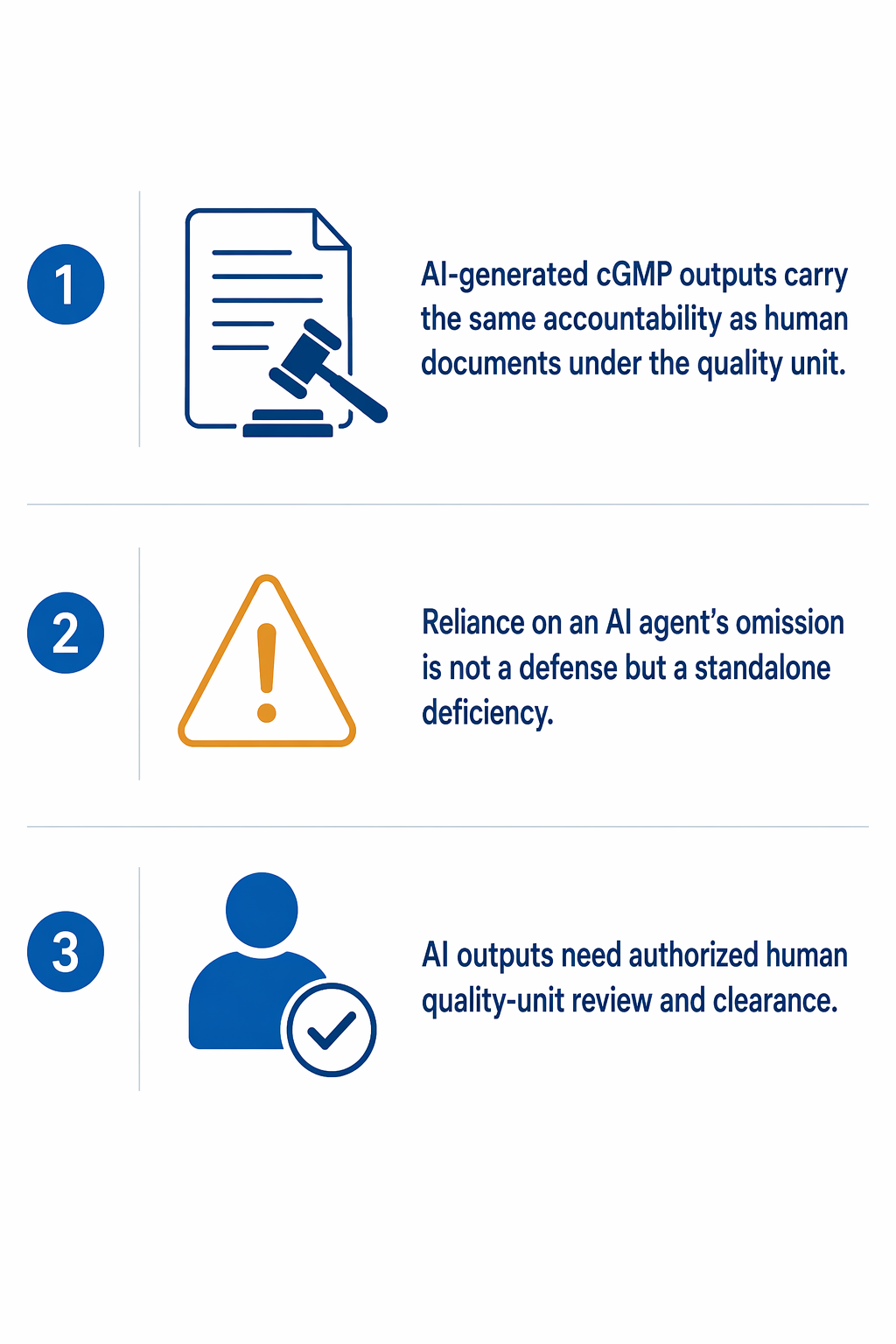
That is the first liability principle Purolea supplies: AI-generated cGMP work remains the manufacturer’s responsibility. The point is not limited to documents formally labeled “AI-generated.” A system that recommends whether a validation issue is material, summarizes procedure gaps, or classifies an observation as low risk can affect the record before the quality unit ever sees the final version.
In a post-483 conference room, that difference quickly becomes practical. Operations may say the tool followed its configuration. Quality may say the procedure did not require a particular manual check. Legal may try to isolate a software performance issue from a governance failure. FDA’s Purolea language makes that separation harder. If the firm used the tool in a cGMP workflow, FDA can ask who approved that use, what the quality unit understood about the tool, what evidence supported reliance on it, and why the firm believed the tool could safely affect regulated decisions.
An AI omission can become evidence, not excuse
The second principle is the one that should get counsel’s attention: an AI agent’s failure to flag a requirement can itself become evidence of deficient control. Purolea’s explanation was not accepted as mitigation. FDA rejected the premise that the firm’s unawareness was meaningfully excused by the agent’s omission.[1]
That is a familiar delegation problem in unfamiliar clothing. Manufacturers have long been unable to delegate cGMP responsibility away to consultants, contractors, templates, or enterprise systems. AI does not change that baseline. What it changes is the evidentiary trail. The firm may now have to defend not only the missed requirement, but also the design, qualification, governance, access controls, prompts, data sources, review rules, escalation criteria, and change controls around the system that missed it.
For legal teams, the dangerous fact pattern is not simply “AI made an error.” It is “the firm built a workflow in which a human relied on the absence of an AI alert as evidence that no regulatory action was required.” That workflow converts silence into a decision. Once silence has operational consequence, FDA can reasonably ask why the quality unit allowed it to operate that way.
A hypothetical example shows the distinction. If a tool summarizes a validation protocol and an engineer separately verifies the applicable requirements against approved procedures and regulations, the tool may have reduced clerical work. If the tool is treated as the reason nobody checks whether process validation is required, the firm has created a control point without proving it is controlled.
Human review has to mean authorized quality review
The third principle is narrower than many AI governance policies, and more demanding where it applies: AI outputs or recommendations used in cGMP manufacturing need review and clearance by an authorized human representative of the firm’s quality unit.[1]
Generic “human in the loop” language is not enough. A production supervisor, validation contractor, legal reviewer, or business process owner may be important to the workflow, but cGMP assigns particular authority to the quality unit. If the AI output affects a regulated manufacturing decision, the review question is not only whether a person looked at it. It is whether the right person had authority, enough information, and documented basis to accept or reject what the system produced.
| AI use in the workflow | Regulatory liability question |
|---|---|
| Drafting or summarizing validation documentation | Who verifies that the output reflects applicable cGMP requirements before it enters the approved record? |
| Screening deviations or complaints for significance | Who confirms that the classification criteria are approved, current, and not substituting for quality-unit judgment? |
| Recommending whether an issue requires escalation | Who has authority to clear the recommendation, and what evidence shows the decision was independently reviewed? |
| Searching procedures or regulations for applicable duties | Who is responsible when the system does not surface a requirement? |
The practical burden lands on the person who signs. If a quality-unit representative is expected to approve a record shaped by an AI tool, that reviewer needs more than a clean final document. The reviewer needs to know what the tool did, what sources it used, what it was not designed to do, what checks were performed, and what exceptions or limitations were identified. Otherwise, the signature risks becoming a ceremonial endpoint for a decision already made elsewhere.
Purolea did not appear from nowhere
The warning letter fits into a regulatory trajectory, though it should not be overstated as if FDA has already issued a complete manufacturing AI liability code. CDER began publicly framing AI issues in a March 2023 discussion paper. FDA then issued draft guidance on AI credibility in January 2025, followed by guiding principles in January 2026, before the Purolea enforcement action in April 2026.[3]
That sequence shows movement from policy development toward enforcement language. The earlier materials helped establish concepts around credibility, governance, and lifecycle management. Purolea is different because it is not abstract governance architecture. It is FDA applying cGMP responsibility to a manufacturer’s attempted reliance on an AI agent in the context of a specific compliance failure.[1][3]
The broader enforcement climate makes the signal harder to ignore
Purolea also arrives during a more active enforcement period. A mid-2026 enforcement roundup reported a 50% surge in CDER warning letters in FY2025, with 35% citing GMP violations.[4] Separate trend analysis identified more than 120 import alerts in 2025.[5] Those figures do not prove an AI-specific enforcement campaign. They do help explain why a new cGMP theory, once named, deserves attention.
The severe end of FDA-related liability remains familiar: consent decrees, injunctions, import restrictions, product seizures, criminal referrals, and business interruption. Consent decrees involving Pharmasol, Johnson & Johnson/McNeil, and Abbott Sturgis illustrate how quality-system failures can become court-supervised operating constraints rather than ordinary remediation projects.[6]
Criminal enforcement is still a separate and more severe category. FDA criminal case activity has included the Peanut Corporation of America prosecution, where a 28-year sentence was imposed; the New England Compounding Center case, involving a 9-year sentence and 64 deaths; and Endo Pharma penalties exceeding $1.5 billion.[7] Those cases should not be casually mapped onto AI tool use. They do mark the outer boundary of what happens when regulated-product failures are treated as more than technical noncompliance.
The business consequence can be severe even without criminal exposure. A cost-of-non-compliance report citing McKinsey data states that manufacturing halts typically erase 25% of company EBITA over 10 years.[8] For counsel advising on AI in manufacturing, that figure is useful less as a prediction than as a reminder that validation, documentation, and quality authority are enterprise-risk issues, not back-office formalities.
Contract manufacturing makes the accountability problem harder
The Purolea principles become especially awkward in CDMO and contract testing arrangements. Oversight materials describe the familiar dual-accountability structure: the brand manufacturer retains ultimate responsibility for the product, while the contract site bears GMP compliance obligations at the point of execution.[9]
AI can blur that structure quickly. A sponsor may provide a platform for deviation triage. A CDMO may use its own system to draft batch-record investigations. A contract laboratory may use an AI-enabled tool to review analytical documentation. The brand owner may never see the prompt, training set, configuration, or exception log, but it may still receive and rely on the output. The contract site may control the execution environment, but not the product’s full regulatory strategy.
That division is manageable only if it is made explicit before the tool is used. Quality agreements and service contracts should not merely say that each party will comply with applicable law. They should identify which party approves AI use in cGMP workflows, which party validates or qualifies the tool for the intended use, which records are retained, which changes require notice, who reviews exceptions, and who has authority to reject AI-shaped outputs.
Legal teams should also be careful with indemnity language that treats AI failure as an ordinary vendor technology issue. Purolea points in the other direction. If the output affects cGMP execution, the liability question will turn on quality-system control, not only software performance.
What compliance programs should change now
The immediate response should not be an AI moratorium. Automation can make compliance evidence easier to find, reduce clerical load, and improve consistency when it is properly bounded. The response should be to stop treating AI tools as peripheral once they affect regulated manufacturing outputs.
- Map where AI touches cGMP workflows, including drafting, searching, classifying, routing, recommending, and exception handling.
- Separate administrative uses from uses that affect validation, production, laboratory controls, deviation management, supplier oversight, complaint handling, or batch disposition.
- Assign quality-unit ownership for approving intended use, reviewing outputs, clearing recommendations, and rejecting unsupported results.
- Document what the tool is allowed to do, what it is not allowed to do, and when human verification is mandatory.
- Retain records showing configuration, source limitations, change control, review activity, exceptions, and quality-unit decisions.
The most important control is not a policy statement that humans remain responsible. The most important control is evidence that an authorized quality representative had a real chance to understand and challenge the AI-shaped output before it became part of the regulated decision.
That is also where legal review should become more precise. Counsel should ask whether the firm can show who approved the AI use case, who evaluated its fit for cGMP purpose, who reviewed its outputs, who investigated failures, and who had authority to stop use when the tool’s limitations became material. Those are governance questions, but after Purolea they are also enforcement questions.
The disciplined reading of Purolea
Purolea is not enough to declare a mature FDA enforcement pattern against AI use by major pharmaceutical manufacturers. It is one warning letter, involving one firm, in one factual posture. It should not be stretched further than the record supports.
It is enough, however, to retire one defense before it spreads: the manufacturer cannot say it did not know a cGMP requirement applied because its AI agent failed to surface it. FDA has now treated that explanation as part of the problem.
Before AI touches regulated manufacturing outputs, the question is therefore concrete: who in the quality unit has the authority, evidence, and responsibility to clear what the system produces?
References
- FDA Warning Letter 722591, FDA, April 2, 2026.
- Outsourced Pharma analysis by Dr. Hotha, Outsourced Pharma, April 22, 2026.
- Xevalics AI governance framework, Xevalics, February 2026.
- Mid-2026 enforcement roundup, Epstein Becker Green, July 2026.
- RegulatoryIQ trend analysis, RegulatoryIQ.
- Consent decree analysis including Pharmasol, J&J/McNeil, and Abbott Sturgis, FDA press releases and EMMA International analysis.
- FDA OCI criminal case activity, FDA Office of Criminal Investigations.
- Cost-of-non-compliance report, SystechOne.
- Contract manufacturing oversight report, IntuitionLabs, February 2026.
Comments
Join the discussion with an anonymous comment.