
The immediate legal problem for 2026 midterm campaigns is not that federal campaign finance law has been suspended. It has not. Reports still come due, contribution limits still apply, disclaimers still matter, coordinated-spending questions still have consequences, and treasurers still sign filings under a statute that remains on the books. The problem is narrower and more operationally dangerous: the Federal Election Commission has lacked the quorum needed to take central enforcement and regulatory actions since April 30, 2025, a period that now exceeds 440 days as of July 18, 2026.[1]
That distinction is the practical core of what legal teams now have to manage as continuing resolutions and shutdowns affect midterm campaigns. A committee can still file. A vendor can still ask counsel whether a proposed communication creates a coordination problem. A PAC can still discover an excess contribution. But the ordinary administrative machinery that turns those questions into guidance, deterrence, correction, or closure has been hollowed out.
The vacuum is legal before it is political
The FEC’s disability turns on a simple institutional fact: without a quorum, the Commission cannot act as the Commission. The agency may continue to receive electronic filings and preserve some staff functions when funded, but it cannot vote to enforce the Federal Election Campaign Act, issue advisory opinions, conduct audits, or process administrative fines in the way regulated actors rely on during an election cycle.[1][2]
For compliance professionals, that is not a theoretical separation-of-powers problem. It changes the risk calculation inside ordinary campaign work. A pending matter cannot be resolved by Commission vote. A fact pattern that would normally be routed into an advisory opinion process remains unanswered. A late or defective filing may still be unlawful, but the administrative fine process cannot function normally. An audit trigger may exist without an agency able to move the matter through the usual channel.
| Obligation or process | Status in the current environment |
|---|---|
| Federal filing deadlines | Still legally operative; electronic filing remains the expected channel where available. |
| FECA enforcement votes | Disabled while the Commission lacks a quorum. |
| Advisory opinions | Unavailable as a Commission action while quorum is absent. |
| Audits and administrative fines | Unable to proceed through normal Commission action. |
| Legal exposure | Not erased; unresolved questions may be deferred, litigated, or revisited if capacity returns. |
That last line is the one campaigns most often want to blur. Agency paralysis is not legal permission. It may reduce the likelihood of immediate administrative consequences, but it does not convert a statutory violation into a safe harbor. The difference matters when counsel is advising a client who wants a yes-or-no answer before spending money, accepting funds, changing vendors, or airing a communication.
How the quorum loss became a midterm-cycle condition
The sequence matters because each event removed a different layer of institutional capacity. President Trump fired Democratic Commissioner Ellen Weintraub in February 2025, an unprecedented removal of an opposition-party commissioner without an immediate replacement, according to the Brennan Center.[2] By April 30, 2025, the FEC lacked a quorum; NOTUS described it as the fourth quorum loss in the agency’s 50-year history and the longest continuous period without enforcement capacity.[1]
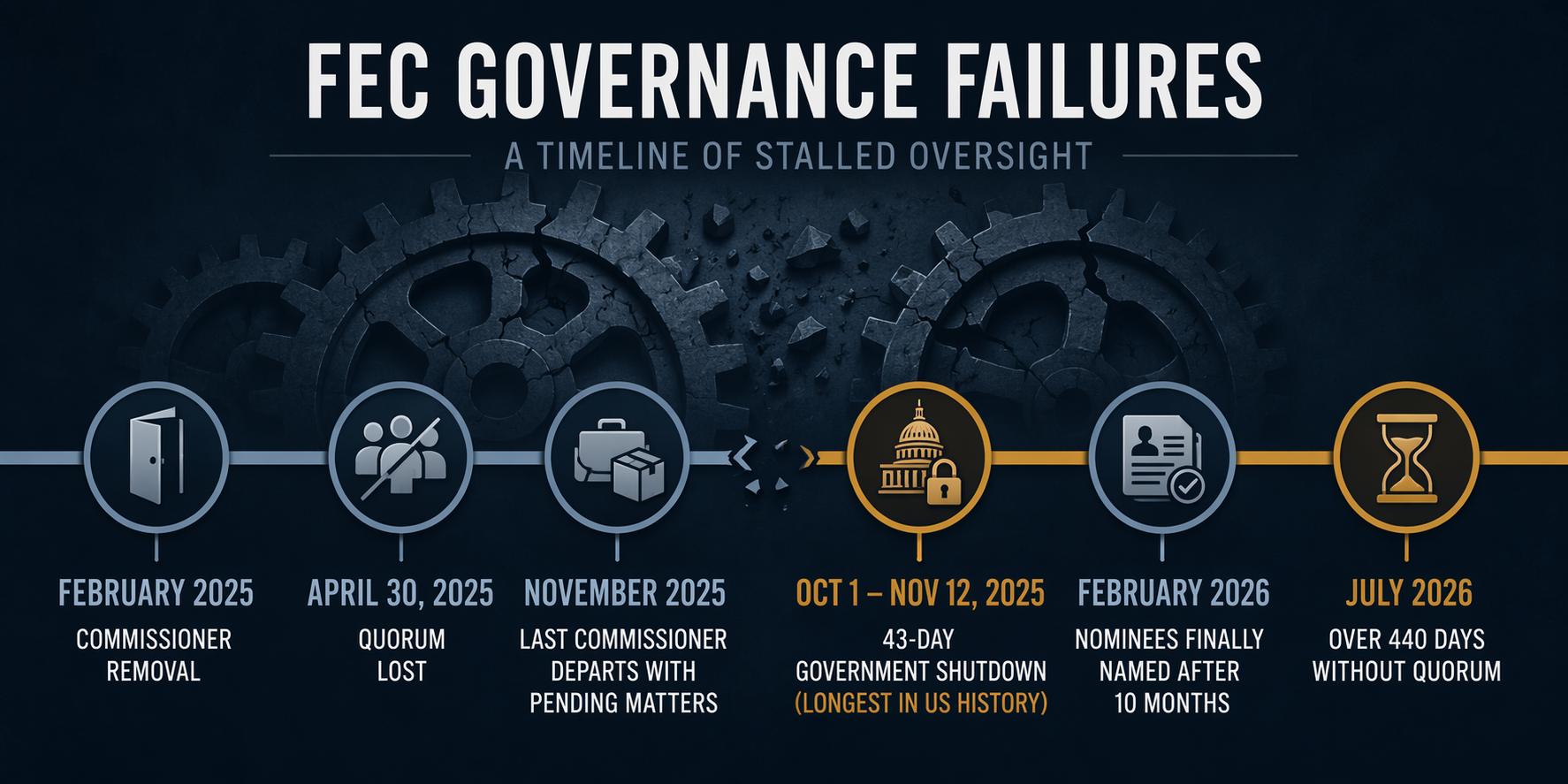
The nominations came late for the cycle. Andrew Woodson and Ashley Stow, both Republicans, were not formally nominated until February 2026, after what IVN characterized as 10 months of zero federal oversight.[4] A nomination, however, is not the same thing as a restored quorum. Until commissioners are confirmed and seated in sufficient number, the legal disability remains.
The November 2025 departure of the last Republican commissioner added a backlog marker. Former Commissioner Trey Trainor told NOTUS that roughly 100 enforcement cases were pending when he left.[1] That figure should not be overstated. It is a November 2025 estimate, not a verified July 2026 inventory. The present backlog is likely larger after additional months of campaign activity, but the exact number is unconfirmed.
Continuing resolutions and shutdowns did not create the quorum problem. They made it harder to live with.
A continuing resolution is often discussed in Washington as budget choreography. For a quorumless enforcement agency, repeated stopgap funding and shutdown risk have a more concrete effect: they thin the staff-side support that remains after the commissioners can no longer act. The FY2026 shutdown lasted 43 days, from October 1 through November 12, 2025, the longest in U.S. history.[1][3]
During shutdown conditions, the FEC’s electronic filing system remained operational but unmonitored, paper filings were not accepted, and no technical support was available, according to Skadden’s description of the agency’s FY2026 shutdown plan.[3] That is a peculiar kind of compliance environment: the portal can receive the filing, but the institutional feedback loop around filing support, monitoring, and problem correction is absent.
That distinction is easy to miss from outside the building. A live filing system can create the appearance of continuity. For treasurers and counsel, continuity also requires someone to answer technical questions, process exceptions, receive paper filings where required, and move defects into an administrable cure process. When those functions disappear during a shutdown, the regulated party still carries the deadline risk, but loses the ordinary means of reducing operational error.
The result is a layered failure. The quorum loss prevents Commission action. Shutdowns and CR-driven uncertainty interfere with the staff and support functions that remain. One disables final agency decisions; the other degrades the daily compliance infrastructure around those decisions. In a midterm cycle, those layers interact rather than sit in separate boxes.
What campaigns can safely infer, and what they cannot
The safest inference is procedural: the FEC cannot presently provide the normal set of Commission-level enforcement and guidance outputs. The unsafe inference is substantive: that federal campaign finance law can be ignored until the agency is repaired. Those are different propositions, and only the first is supported by the present record.
A committee deciding whether to accept a contribution, classify an expenditure, report debt, allocate costs, or approve a communication still has to make a legal judgment. The absence of an advisory opinion process does not create an advisory opinion. It leaves the committee with counsel’s risk assessment, prior law to the extent it applies, and a record that may later be reviewed by a restored agency, a court, an opponent, or the public.
The same is true for enforcement exposure. A dormant administrative pathway may delay consequences, and delay can matter. It affects settlement leverage, document preservation decisions, budgeting, and whether a questionable practice becomes normalized across a campaign operation. But delay is not closure. A matter that cannot be voted today may still be part of a future backlog if quorum and staffing capacity return.
This is where overconfident advice becomes costly. A client may hear “the FEC cannot enforce” as “there is no enforcement risk.” Counsel should hear something more limited: there is no effective Commission enforcement capacity now, while statutory duties and future exposure remain. The practical recommendation is not to pretend the agency is healthy. It is to document decisions as though someone may later ask why the committee treated paralysis as permission.
The advisory opinion gap is not just an inconvenience
Campaign finance law relies heavily on pre-action guidance. Advisory opinions are not merely academic products for lawyers to collect. They let committees test proposed conduct before money is spent, vendors are retained, ads are placed, or organizational structures are built. In an election cycle, the timing of that guidance can be as important as the answer.
When the Commission cannot issue advisory opinions, the cost falls unevenly. A risk-tolerant actor may proceed without guidance. A cautious committee may abandon a lawful strategy because it cannot obtain timely comfort. A vendor may demand indemnity. A candidate committee may ask for outside counsel memos that are useful but do not bind the agency. The vacuum therefore does not simply produce more violations; it also produces more hesitation, inconsistent behavior, and private ordering by lawyers, insurers, consultants, and counterparties.
The missing guidance is especially consequential where old precedents do not map cleanly onto current campaign practices. Counsel can analogize, but analogy is not administrative resolution. The farther a proposed tactic sits from settled precedent, the more the quorum loss transfers decision-making pressure from the agency to private lawyers and, eventually, to courts.
Unresolved questions migrate to litigation
Former commissioners have warned that the vacuum will push disputes out of the FEC and into less predictable forums. Trainor and former Republican Commissioner Lee Goodman both described the quorum loss as creating a “Wild West” environment and warned that compliance questions would be forced into litigation rather than administrative resolution.[1][4]
The phrase is vivid, but the important point is procedural. When the expert agency cannot answer, complainants and regulated parties have stronger incentives to look elsewhere. Opponents may frame campaign finance disputes as private litigation strategy. Committees may seek declaratory relief or defend against suits without the benefit of current Commission reasoning. Courts may be asked to address questions that, in a functioning system, would first receive an administrative answer.
That migration changes the character of risk. FEC practice is slow, technical, and often unsatisfying, but it is also specialized. Litigation is more expensive, more public, more variable by forum, and less likely to produce cycle-sensitive guidance for similarly situated committees. A court ruling may answer the dispute before it, while leaving other actors to decide whether the reasoning applies to a different structure, communication, or funding stream.
For compliance officers, the consequence is that recordkeeping becomes more important, not less. If a committee proceeds in an uncertain area, the file should show the question presented, the facts assumed, the law considered, the alternatives rejected, and the reason the chosen course was treated as permissible. That file may never be reviewed. But if the issue later leaves the administrative lane and enters litigation, contemporaneous judgment will matter more than a later explanation.
The backlog will not be a clean restart
A restored quorum would not instantly restore normalcy. The agency would inherit pending enforcement matters, delayed advisory opinion requests or substitutes for them, audit work, administrative fine processing, and the ordinary flow of midterm-cycle filings. The FEC’s FY2027 budget request of $87.8 million, including a $6.9 million increase, reflects anticipated workload associated with processing the enforcement and advisory opinion backlog once quorum is restored.[1]
Backlogs also create triage. Some matters age badly. Witnesses move, vendors dissolve, staff leave campaigns, and memories degrade. Other matters become more urgent because the same practice is still being used. The agency’s eventual return would therefore raise its own governance questions: which cases move first, how stale matters are treated, whether advisory opinion demand can be processed in time to matter, and how much deterrence can be recovered after a long period without credible administrative response.
None of that makes present compliance futile. It makes disciplined compliance more valuable. A committee that keeps clean records, follows existing law where it is clear, documents uncertainty where it is not, and preserves evidence of good-faith decision-making will be in a different position from one that treated the missing referee as a temporary exemption.
The operating posture for July 2026
As of July 18, 2026, the professional answer is uncomfortable because it is conditional. Campaigns and committees should assume their legal obligations remain in force. They should also assume the FEC cannot presently provide the normal administrative enforcement, guidance, audit, and fine-processing functions that make those obligations administrable at scale.
That means compliance advice should separate three questions that clients tend to merge: what the law requires, what the FEC can do today, and who else might challenge the conduct later. The first question is still governed by FECA and existing authority. The second is constrained by quorum and funding realities. The third increasingly points toward private litigation, public complaints, counterparties, and a future agency facing a backlog.
The filing portal may still accept reports. Lawyers may still advise. Treasurers may still certify. But the normal administrative system for guidance, deterrence, and resolution has been hollowed out until quorum and staffing capacity return.
References
- The FEC Has Effectively Been Shut Down for More Than 200 Days, NOTUS
- As of Thursday, the FEC Can't Enforce Campaign Finance Laws, Brennan Center
- Federal Shutdown: Complying With Political Law Filings and Gift Rules, Skadden
- No Referee in the Midterms? Trump's FEC Nominations Come After 10 Months of Zero Federal Oversight, IVN
Comments
Join the discussion with an anonymous comment.