
The fireworks federal plaza arrest is not, at least on the public record as of July 21, 2026, an indictment. That matters. The facts now being reported point toward a serious federal case: a July 20 attack at 26 Federal Plaza in Manhattan, a building that houses ICE, the FBI, and immigration court functions; commercial-grade fireworks; a gasoline fire; an anti-ICE manifesto posted before the attack; four reported injuries, including smoke inhalation and burns; and an arrest in which Andrew Arrabaca was allegedly carrying an airsoft gun. But the legal consequences still have to be discussed as potential charges, not as counts already returned by a grand jury.
On those reported facts, the charging map is already visible. Federal prosecutors would not need to choose between an arson theory, a federal-facility theory, an assault theory, and a terrorism-guideline theory. In a case like this, the exposure comes from the way those provisions can sit on top of one another.
| Potential federal theory | What the government would have to tie it to | Sentencing consequence |
|---|---|---|
| 18 U.S.C. § 844(f) | Malicious damage or destruction, by fire or explosive, of federal property | At least 5 years; at least 7 years if personal injury results; up to 20 years, or up to 40 years if injury results |
| 18 U.S.C. § 844(i) | Malicious damage or destruction, by fire or explosive, of property used in interstate or foreign commerce or in an activity affecting commerce | Same basic penalty structure as § 844(f), depending on injury |
| 18 U.S.C. § 844(h) | Use of fire or an explosive to commit another federal felony | 10 years, and the statute requires that term to run consecutively |
| 18 U.S.C. § 111 | Assault, resistance, opposition, impediment, intimidation, or interference involving federal officers or employees | Up to 20 years if a deadly or dangerous weapon is used or bodily injury is inflicted |
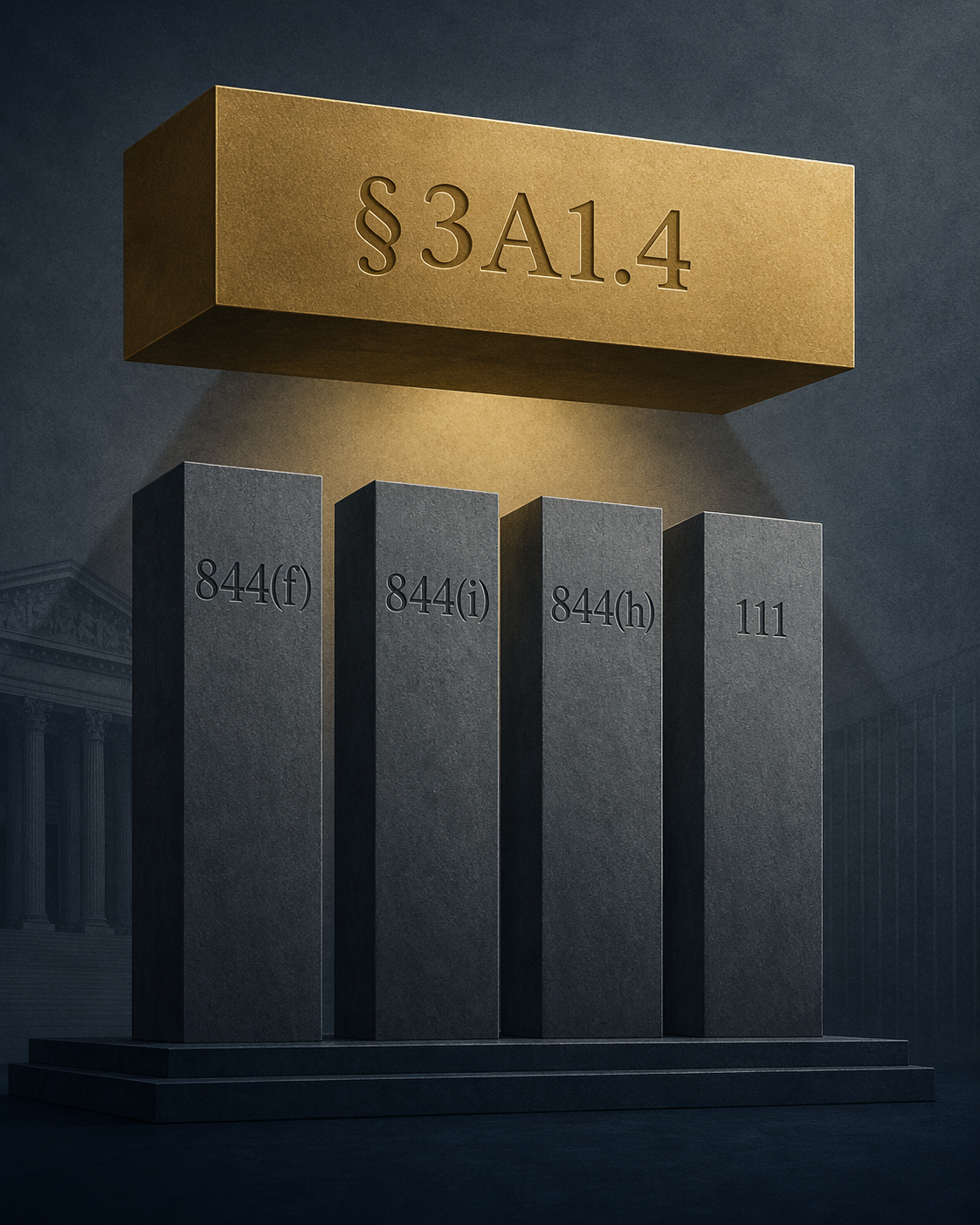
| USSG § 3A1.4 | A felony that involved, or was intended to promote, a federal crime of terrorism | Adds 12 offense levels and sets criminal history at Category VI |
The anchor count: damage to federal property under § 844(f)
The cleanest federal arson count on these facts is 18 U.S.C. § 844(f), because 26 Federal Plaza is not merely a building where federal employees happen to work. The statute reaches anyone who maliciously damages or destroys, or attempts to damage or destroy, by fire or explosive, property owned or possessed by the United States or an institution or organization receiving federal financial assistance. For federal property, the basic punishment is imprisonment for not less than 5 years and not more than 20 years. If personal injury results, the range changes to not less than 7 years and not more than 40 years. If death results, the statute authorizes any term of years, life, or death, depending on the case posture and applicable law. [1]
The injury clause is doing real work here. If prosecutors can prove that the fireworks-and-fire episode caused the four reported injuries, § 844(f) would not just be a five-to-20-year count. It would start at a 7-year mandatory minimum and reach a 40-year statutory maximum. That does not mean a 40-year sentence follows automatically. It means the count itself gives the sentencing court room to impose a sentence far above the ordinary five-year floor.
That is also why the exact cause of the injuries will matter. Smoke inhalation, burns, evacuation-related injuries, and officer-contact injuries can raise different proof questions. For § 844(f), the government would want a tight chain: the fire or explosive conduct, damage or attempted damage to covered property, and personal injury resulting from that conduct. The statute supplies the penalty increase, but the facts have to carry it.
The alternative arson route: § 844(i)
Section 844(i) is the broader arson statute. It covers malicious damage or destruction, by fire or explosive, of property used in interstate or foreign commerce or in any activity affecting interstate or foreign commerce. Its penalty structure tracks the same basic numbers: 5 to 20 years in the ordinary case, 7 to 40 years if personal injury results, and heightened punishment if death results. [1]
For 26 Federal Plaza, § 844(f) is the more direct fit because the federal-property hook is obvious. Section 844(i) still matters because it gives prosecutors a second way to frame the arson conduct if they want to plead in the alternative or preserve a commerce-based theory. It is not the count that changes the arithmetic most dramatically. It is the count that gives the government flexibility.
The multiplier: § 844(h) and the mandatory consecutive 10 years
The provision that can be missed in quick punishment summaries is 18 U.S.C. § 844(h). It punishes a person who uses fire or an explosive to commit any felony prosecutable in a United States court. The term is 10 years for a first conviction under that subsection. More important, Congress wrote the stacking rule into the statute: the sentence imposed under § 844(h) may not run concurrently with any other term of imprisonment, including the term imposed for the underlying felony. [1]
That makes § 844(h) different from a second label attached to the same incident. If the government proves that Arrabaca used fire or an explosive to commit another federal felony — for example, a federal-property arson offense or an assault-related federal offense — the 10-year term is not simply absorbed into the guideline range. It is imposed after, not alongside, the sentence for the predicate felony.
A simplified hypothetical shows the point without pretending to forecast the actual sentence. If a court imposed 12 years on an injury-based § 844(f) count and § 844(h) also applied, the § 844(h) sentence would add 10 more years consecutively. The total would be 22 years before considering any other counts, grouping rules, or guideline enhancements. The statute turns one fire-based event into sequential punishment.
Assault on federal officers or employees under § 111
Section 111 is a separate federal theory if officers or federal employees were assaulted, resisted, opposed, impeded, intimidated, or interfered with while engaged in official duties. The base version carries lower exposure, but the statute reaches up to 20 years if the offense involves a deadly or dangerous weapon or inflicts bodily injury. [2]
On the present facts, § 111 would likely matter less than § 844(f) and § 844(h) for sentence math, but it still matters. It can supply an additional felony predicate, capture injury or force directed at personnel rather than property, and increase plea leverage. The reported airsoft gun should not be casually treated as a firearm for purposes of federal firearms law, but § 111 asks a different question when it comes to dangerous weapons and bodily injury. The charging document, if one is unsealed, will show whether prosecutors treat that object as legally significant or merely as part of the arrest narrative.
Where the terrorism enhancement enters the calculation
The word “terrorism” can obscure more than it clarifies unless it is tied to the mechanism that changes the sentencing range. In federal court, the key guideline provision is USSG § 3A1.4. If the offense is a felony that involved, or was intended to promote, a federal crime of terrorism, the guideline adds 12 levels. If the resulting offense level is less than 32, it becomes 32. The provision also sets the defendant’s criminal history category at Category VI. [3]
That last move is severe. Criminal History Category VI is normally reserved for defendants with substantial prior criminal history points. Section 3A1.4 assigns it by operation of the terrorism enhancement. So the enhancement does two things at once: it raises the offense level and places the defendant in the highest criminal-history column. In practical terms, a case that might otherwise sit in a rough five-to-20-year statutory conversation can move into a guideline range measured well above 30 years, depending on the final offense level, grouping, counts of conviction, and consecutive terms.
The reported manifesto is the fact prosecutors would be expected to scrutinize most closely for this purpose. A political statement alone is not the enhancement. The question is whether the felony involved, or was intended to promote, a federal crime of terrorism as the guideline and related statutory definitions use that phrase. That inquiry turns on intent, target, statutory predicate, and proof — not on whether commentators have already attached a label to the event.
Recent anti-ICE protest-violence sentences, including the June 23, 2026 Prairieland Nine sentences reported in the 30-to-100-year range, are useful as a warning against treating these cases as ordinary protest-adjacent prosecutions. They are not a sentencing template for Arrabaca. Different charges, jury findings, plea posture, injury proof, criminal history, and guideline calculations can all change the result. The comparison is limited: when federal violence charges are coupled with terrorism findings or enhancements, the exposure can become extraordinarily high.

Stacking, grouping, and the difference between exposure and sentence
The statutory maximums should not be added together as if the judge must impose every available year. Nor should the mandatory minimums be ignored. Federal sentencing works between those two errors.
Some counts may group for guideline purposes because they arise from the same act or transaction. Others may alter the calculation through specific offense characteristics, injury findings, official-victim issues, or terrorism findings. Section 844(h) is the hard edge because Congress made its 10-year term consecutive. A judge has discretion in many parts of a federal sentence; that consecutive command is not one of them. [1]
The clean floor on the present reported facts, if the government proves injury-based § 844(f) and a first § 844(h) count, is therefore not five years. It is at least 7 years on § 844(f), plus 10 consecutive years under § 844(h), before any separate punishment under § 111, any alternative arson count, and any guideline movement from § 3A1.4. That is a 17-year mandatory-minimum structure on just those two pieces. The actual indictment could be narrower or broader.
At the ceiling end, an injury-based § 844(f) count reaches 40 years, an injury-based § 844(i) count reaches 40 years, § 111 can reach 20 years when the weapon-or-injury provision applies, and § 844(h) adds a mandatory consecutive 10 years for a first conviction under that subsection. [1][2] That arithmetic describes exposure, not prediction. Prosecutors may charge fewer counts. Counts may merge in practical sentencing effect. A plea may cap the range. A jury may reject a predicate fact. A judge may vary from the guideline range where the law permits.
Time served is not parole-era time
Any discussion of a federal sentence also has to account for the absence of federal parole for modern federal offenses. The practical shorthand is that a federal defendant generally must serve at least 85% of the imposed sentence, assuming available good-time credit. A 20-year federal sentence is therefore not a parole-board sentence that can collapse after a few years; it is a sentence with a much narrower release valve. [4]
That matters when the statutes already contain mandatory minimums and consecutive time. If § 844(h) adds 10 years consecutive, the time is not only added on paper. It becomes part of the sentence on which Bureau of Prisons time calculations are made, subject to the limited credits available under federal law.
The present legal consequence
On the facts now public, Arrabaca faces potential federal exposure under at least four overlapping statutes: § 844(f) for fire or explosive damage to federal property, § 844(i) as an interstate-commerce arson theory, § 844(h) for using fire or an explosive to commit another federal felony, and § 111 for assault or interference involving federal officers or employees. The sentencing pressure comes from the injury-triggered minimum under § 844(f), the mandatory consecutive 10 years under § 844(h), and the possibility that USSG § 3A1.4 moves the guideline calculation into terrorism-enhancement territory.
The severe legal consequence is not that one label has been placed on the incident. It is that several federal provisions can compound from the same alleged conduct. The real outcome still depends on what charges are actually brought, what prosecutors can prove, how the guideline facts are found, and whether the case is resolved by plea or trial.
References
- 18 U.S. Code § 844 - Penalties, Cornell Legal Information Institute.
- 18 U.S. Code § 111 - Assaulting, resisting, or impeding certain officers or employees, Cornell Legal Information Institute.
- §3A1.4. Terrorism, United States Sentencing Commission Guidelines Manual.
- Federal Arson Charges Federal Property Arson, Spodek Law Group.
Comments
Join the discussion with an anonymous comment.