
For lawyers handling FEMA disaster-aid delay issues after Tropical Storm Arthur, the case is already inside a filing calendar. Arthur struck Louisiana on June 17-18; Louisiana asked the White House for a major disaster declaration for six parishes on June 27; the federal declaration followed on July 2 and was announced by FEMA on July 3 for Ascension, East Baton Rouge, Iberville, and Livingston only; FEMA opened Individual Assistance application channels on July 6.[1][2][3]
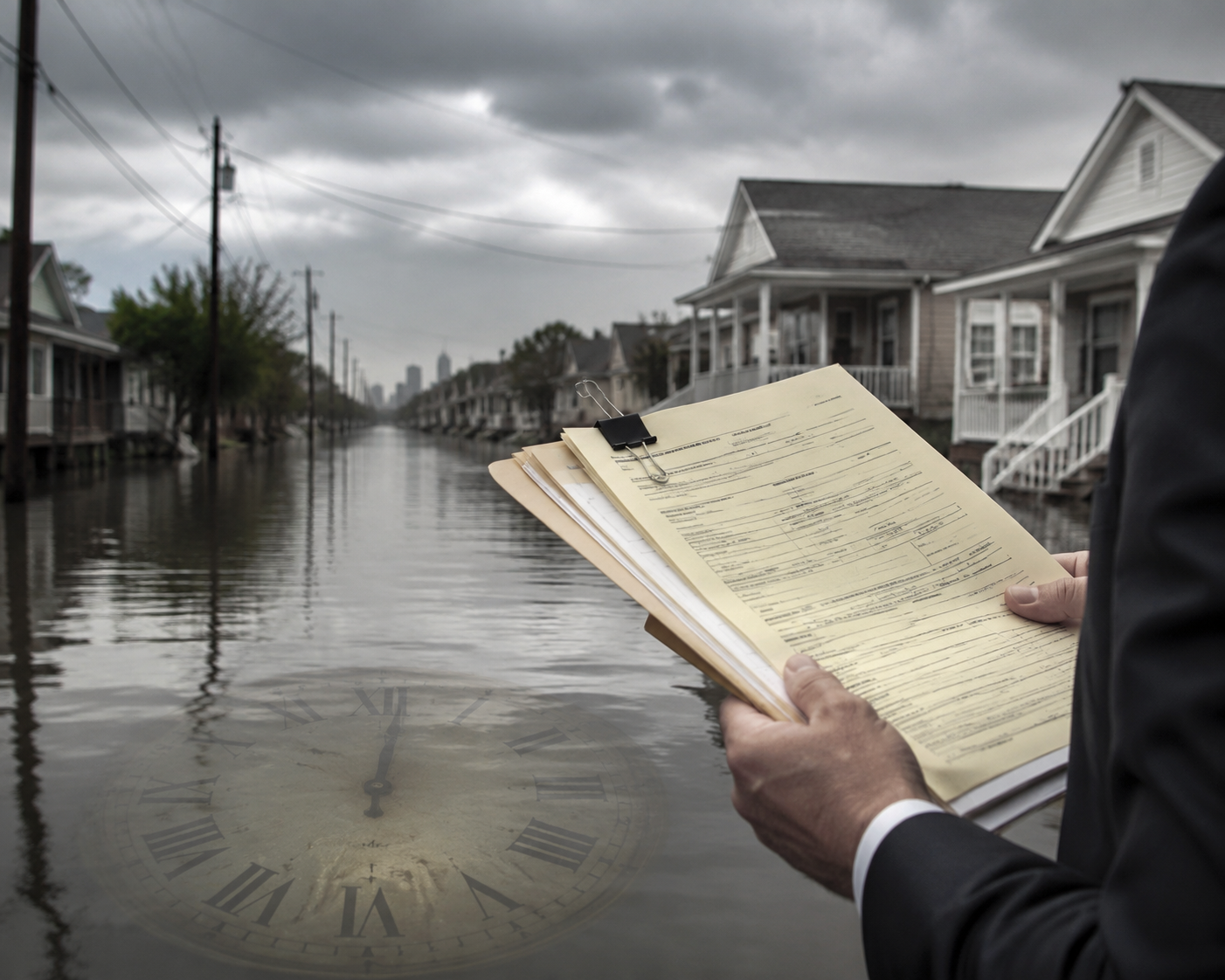
That sequence leaves two different legal problems. In the four approved parishes, survivors who receive FEMA decision letters have a 60-day appeal deadline measured from the date of the decision letter, not from the day they finally find stable housing, replace a phone, or understand what FEMA says is missing.[4] In Pointe Coupee and Lafourche, the problem is sharper and easier to misstate: residents may have storm damage, but they are not currently in parishes designated for Individual Assistance under the Arthur declaration.[2]
| Date | Procedural event | Legal consequence |
|---|---|---|
| June 17-18, 2026 | Tropical Storm Arthur affects Louisiana | Damage, displacement, insurance notice, and proof problems begin before any federal Individual Assistance file exists. |
| June 27, 2026 | Louisiana requests a major disaster declaration for six parishes | The state request includes Ascension, East Baton Rouge, Iberville, Livingston, Pointe Coupee, and Lafourche. |
| July 2-3, 2026 | Federal declaration is approved and FEMA announces Individual Assistance for four parishes | Only residents in the approved parishes can enter the FEMA IA application and appeal process. |
| July 6, 2026 | FEMA announces application channels for eligible Louisianans | Applications begin moving toward decision letters, and appeal deadlines will run from those letters. |
The 60-day FEMA appeal clock is the first legal emergency
FEMA’s appeal rule is simple on paper and unforgiving in practice: an applicant who disagrees with an Individual Assistance decision must appeal within 60 days of the date on the FEMA decision letter.[4] That matters because the date on the letter may not match the date a displaced survivor actually reads it. Mail may be going to a damaged home, a relative’s address, a temporary rental, or an email account the applicant checks only when service is available.
For counsel in Ascension, East Baton Rouge, Iberville, and Livingston, the first intake task is not to argue the whole disaster. It is to locate every FEMA communication, identify the letter date, and separate three things that survivors often collapse into one: a denial, a partial award, and a request for more information. Each one can require a different response.
FEMA’s appeal guidance identifies common issues that can be contested, including eligibility determinations, the type or amount of assistance, late applications, requests to return money, and continued temporary housing assistance.[4] In a storm file, those categories often turn on documents that may be wet, missing, or split among several people: insurance letters, repair estimates, receipts, leases, proof of occupancy, proof of ownership, contractor communications, and photographs of the damage.
- Screen the decision letter first: record the letter date, FEMA application number, disaster number, stated reason for denial or reduction, and any document FEMA says is missing.
- Preserve proof in duplicate: scan damaged documents, photograph originals before they deteriorate further, and keep envelopes or screenshots showing when notices were received.
- Match the response to the reason: an insurance-related denial is different from an occupancy problem, an identity issue, or a repair-cost dispute.
- Watch the submission method: FEMA permits appeals and supporting documents through the applicant’s online account, by mail, by fax, or at a Disaster Recovery Center.[4]
- Prepare the client for time after filing: FEMA says it may take 30 to 90 days to review an appeal, and that review period is not a promise of approval.[4]
The practical danger is that a survivor hears “apply for FEMA” and thinks the process has just begun, while the legal file has already moved into a deadline phase. A lawyer who waits for the full insurance picture, the final contractor estimate, or a permanent address may lose the cleaner opportunity to keep the FEMA appeal alive.
Partial approval changes the case before any appeal is filed
Louisiana’s June 27 request covered six parishes, but the federal Individual Assistance designation announced by FEMA covered four: Ascension, East Baton Rouge, Iberville, and Livingston.[1][2] Pointe Coupee and Lafourche were not included in the Arthur IA designation announced on July 3.[2]

That distinction should not be softened into a paperwork problem. A resident of an excluded parish does not have an individual FEMA appeal route to prove that the parish should have been designated for IA. The ordinary appeal process belongs to applicants who have an Individual Assistance determination to contest. If the parish is outside the IA designation, there may be no individual IA decision letter to appeal.
For Pointe Coupee and Lafourche residents, the immediate legal screening therefore starts somewhere else. Counsel may still need to evaluate insurance coverage, landlord-tenant obligations, habitability, title and succession issues, consumer debt, contractor disputes, public benefits, school displacement, medical debt, and employment interruptions. Those are not substitutes for FEMA IA, but they are the legal problems that surface when a household is damaged and the federal aid channel is closed.
The governmental path is different from the individual path. A parish-level designation can change only through governmental channels, not through a survivor’s personal FEMA appeal. Attorneys should be careful with language at intake: “You may need legal help after the storm” is accurate; “You can appeal FEMA’s exclusion of your parish” is not supported by the ordinary IA appeal guidance.
Why the 14-day gap still matters
Arthur’s declaration timeline should be described precisely. The storm hit June 17-18, the state request was reported June 27, and the federal declaration was approved July 2.[1][2] That is not slower than every recent disaster approval. It is also faster than the average described in a July 16 Associated Press analysis of the current administration’s disaster declaration pace.[5]
The AP analysis reported that President Trump’s average time to approve disaster aid was about 1.5 months, the longest average on record; that 70% of approvals took at least one month, compared with less than 10% under prior administrations; that approval rates differed by state political control, with about 80% approval for Republican-led states and about 60% for Democratic-led states; and that there had been more than 25 denials since January 2025.[5]
Those national figures explain why lawyers and public officials are watching disaster timing closely, but they do not carry the Arthur file by themselves. The Arthur-specific legal problem is more concrete: two weeks passed before the declaration, then only four of six requested parishes entered the IA system, and the first applicants’ individual FEMA deadlines began attaching to decision letters soon after applications opened.
Two weeks is enough time for temporary repairs to be made without receipts, for a tenant to move out before photographing conditions, for an insurance adjuster to inspect before FEMA documents are assembled, and for a survivor to give inconsistent damage descriptions across agencies. None of those facts automatically defeats a FEMA appeal. They do make the record harder to rebuild.
What attorneys should look for in declared parishes
In approved parishes, the best early legal work is often unglamorous. It is a document chase, a deadline audit, and a client interview that tests whether FEMA’s stated reason matches the household’s actual situation.
Decision letters and missing-document denials
A denial based on missing documentation may be fixable, but only if counsel can identify the exact missing proof. FEMA’s appeals page tells applicants to submit documentation supporting the reason for appeal and allows a written explanation if the applicant chooses to provide one.[4] The letter should be read against the client’s insurance file, lease or ownership documents, repair receipts, photographs, and proof that the damaged dwelling was the primary residence.
The appeal packet should not become a general statement that the storm was severe. FEMA is deciding the applicant’s file. A useful packet ties each document to the problem FEMA identified: occupancy, ownership, identity, insurance duplication, repair amount, personal property, rental assistance, or continued housing need.
Insurance and duplication issues
Delayed declarations can leave survivors interacting with insurers before they understand how FEMA will treat insurance proceeds. If FEMA denies or limits assistance because insurance is expected to cover the loss, the attorney needs the insurer’s actual written position, not only the client’s recollection of a phone call. A pending claim, a partial payment, an exclusion, a deductible, and a denial can have different effects on what FEMA still needs to evaluate.
This is also where secondary legal work begins. An underpaid insurance claim may require a different deadline calendar. A contractor who begins work before coverage is clear may create a consumer dispute. A landlord who keeps rent running on an uninhabitable unit may create a housing case. The FEMA file is one door, not the whole courthouse.
Ownership, occupancy, and Louisiana property complications
Ownership and occupancy problems deserve early screening in Louisiana. A survivor may live in family property, inherited property, a home without a conventional recorded deed in the occupant’s name, or a rental arrangement documented more by payment history than by a formal lease. The research available here does not establish a special Arthur-specific FEMA rule for Louisiana title issues, so local counsel should treat this as a state-law proof problem rather than a place for generic national advice.
At intake, ask how the household got the property, who else claims an interest, whose name appears on utility bills, where tax notices go, and whether any succession, divorce, heirship, or servitude issue is already active. Those facts may matter to FEMA, to insurance, and to any later repair or buyout paperwork.
Excluded-parish residents still need a legal intake, just not a false FEMA promise
The harder conversation is with a resident in Pointe Coupee or Lafourche who has flood damage but is outside the IA declaration. There may be no FEMA application to perfect and no IA denial to appeal. That does not mean the legal file is empty.
- Insurance: preserve notice dates, claim numbers, adjuster reports, photographs, payment letters, and denial letters.
- Housing: document habitability conditions, rent demands, deposits, utility shutoffs, lockouts, and temporary relocation expenses.
- Property and title: identify ownership documents, family-property issues, mortgages, tax sale risks, and repair authorization problems.
- Debt and consumer issues: watch for high-cost emergency loans, contractor deposits, vehicle damage, repossession threats, and collection activity.
- Benefits and work: screen for interruptions in public benefits, child care, transportation, medical access, and employment caused by displacement.
That intake posture respects the legal boundary. It does not tell excluded residents that better paperwork will open a FEMA IA case the declaration has not opened. It also does not abandon them to a technical distinction that may be invisible from the front porch of a damaged home.
Where to route survivors and practitioners
Disaster Legal Services and Louisiana Legal Navigator list free legal help resources for low-income disaster survivors, including help with FEMA appeals and insurance claims. Louisiana Legal Navigator also listed “Know Your Rights After a Disaster” events at FEMA Disaster Recovery Centers in Washington, Louisiana, beginning July 15.[6] Because Disaster Legal Services is income-based, it will not cover every household, and complex matters may still require private counsel.
Advocates for Disaster Justice maintains a FEMA help resource for survivors navigating FEMA issues, including appeals.[7] Practitioner-oriented materials such as Baker Donelson’s Disaster Recovery Briefs can help lawyers orient themselves to disaster recovery law, although they should be paired with the FEMA notices and the specific Arthur declaration before advice is given on an individual file.[8]
The practical conclusion is narrow but important. Attorneys cannot undo the 14-day declaration gap through an individual FEMA appeal, and excluded residents cannot appeal their way into Individual Assistance while their parish remains outside the IA designation. What prompt legal intervention can do is protect 60-day appeal rights in declared parishes, rebuild proof before it disappears, and catch the insurance, housing, property, debt, and benefits problems that delayed disaster aid tends to leave behind.
References
- Louisiana asks White House for major disaster declaration after Tropical Storm Arthur flooding, WAFB, June 27, 2026.
- President Donald J. Trump Approves Major Disaster Declaration for Louisiana, FEMA, July 3, 2026.
- Louisianans Affected by Tropical Storm Arthur Can Apply for Possible FEMA Assistance, FEMA, July 6, 2026.
- How to Appeal a FEMA Decision, FEMA.
- Trump is taking longer to approve disaster aid and denying Democratic states more frequently, WTTW News, July 16, 2026.
- Know Your Rights After a Disaster, Louisiana Legal Navigator.
- FEMA Help, Advocates for Disaster Justice.
- Disaster Recovery Briefs, Baker Donelson.
Comments
Join the discussion with an anonymous comment.