
Judge Nachmanoff's July 17, 2026 bench ruling in Comans v. Executive Office of the President matters because it refused to turn Trump v. Slaughter into a master key. The administration argued that Article II gave the president plenary authority to remove Mary Comans, FEMA's former chief financial officer and a career Senior Executive Service employee. The court rejected that claim and held that her February 11, 2025 termination was unlawful, reportedly emphasizing that "for the last 140 years the Supreme Court has affirmed the president does not have plenary power to remove inferior officers."[1][2]
That is the central point for analyzing the FEMA CFO unlawful-termination ruling. The ruling is not a general judicial protest against presidential control of the executive branch. It is a classification ruling. Slaughter dealt with principal officers. Comans, as the court treated her, was an inferior officer with statutory removal protections. The administration's mistake was not invoking Article II; it was invoking Article II at too high a level of generality.

The Line Slaughter Did Not Erase
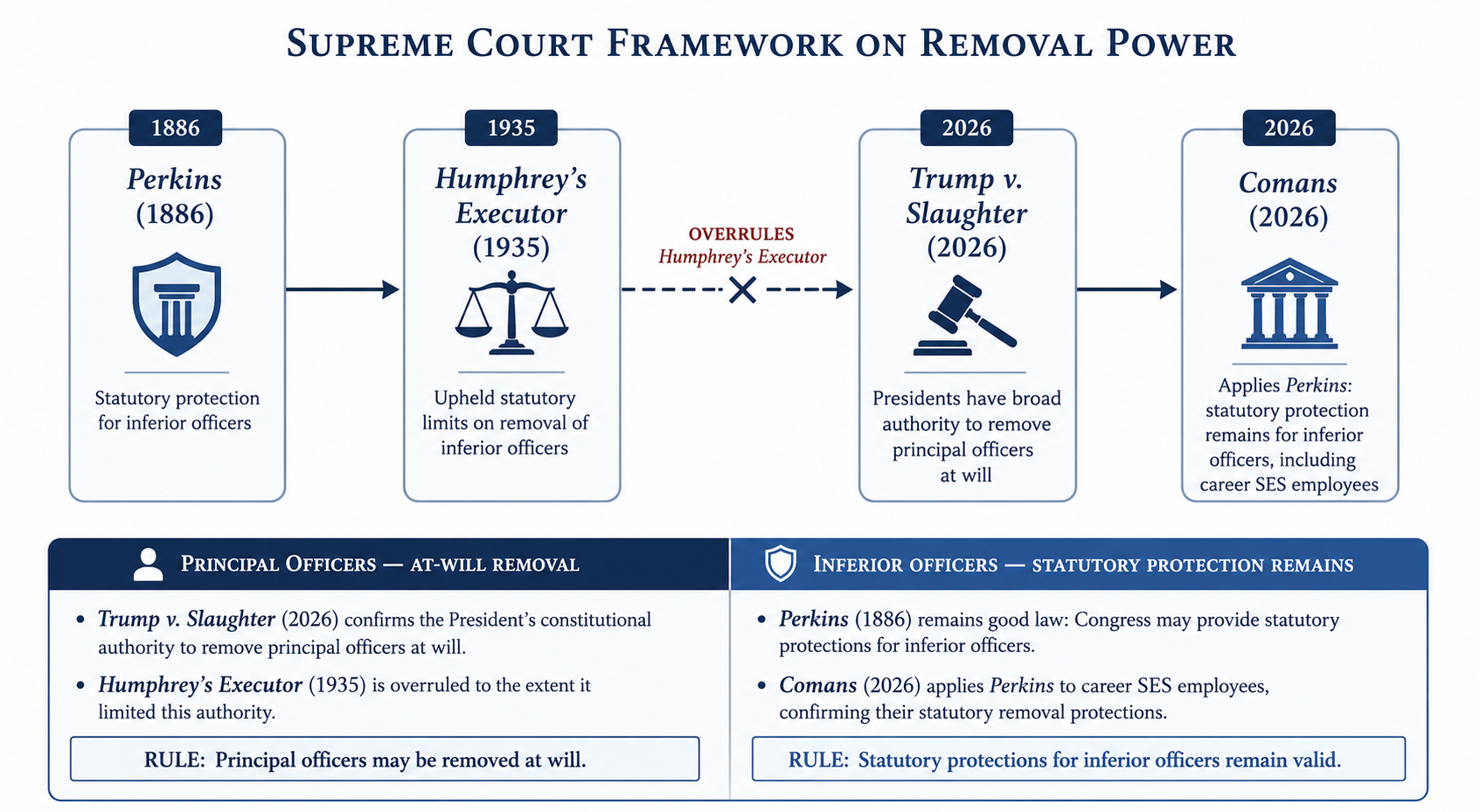
Trump v. Slaughter was a major removal-power decision. On June 29, 2026, the Supreme Court overruled Humphrey's Executor and held that Federal Trade Commission commissioners are principal officers subject to at-will presidential removal.[3] That holding is large enough on its own. It removed one of the canonical limits on presidential removal of independent-agency leadership.
But Slaughter did not say that every federal employee who exercises meaningful governmental authority can be fired at will by the president. The Court, as reported by SCOTUSblog, left United States v. Perkins intact.[3] Perkins is the old but still consequential case allowing Congress to restrict removal of inferior officers. Nachmanoff's ruling appears to have taken that survival seriously rather than treating it as decorative residue.
The distinction is not formalism for its own sake. A principal officer generally answers to the president in a way that makes presidential removal constitutionally central. An inferior officer operates under supervision and within statutory structures that Congress may regulate more closely. FTC commissioners after Slaughter sit on one side of that line. A career SES official such as Comans sits, at least under Nachmanoff's analysis, on the other.
| Category | Example in the current disputes | Removal consequence after Slaughter and Comans |
|---|---|---|
| Principal officer | FTC commissioner in Trump v. Slaughter | Subject to at-will presidential removal under Slaughter |
| Inferior officer | Career SES official such as Mary Comans, as treated in Comans | Statutory removal protections remain available under Perkins |
| Career employee with alleged due-process interests | Protected federal employee terminated with stigmatizing public accusations | May have property and liberty claims depending on statutory status and public allegations |
The administration's broader position depends on collapsing those categories. If Slaughter means only that principal officers lack Humphrey's Executor-style protection, then it does not resolve the legal status of career officials. If Slaughter means presidential removal authority extends downward to inferior officers and protected civil servants, then Perkins becomes the obstacle. Comans is important because it names that obstacle and refuses to step around it.
Why Comans Was Not Just Another Firing Case
The factual sequence is compressed but not incidental. On February 5, 2025, Comans attended a DOGE meeting and raised cost concerns about migrant housing grants. On February 10, Elon Musk posted on X characterizing her actions as "criminal." On February 11, DHS terminated her and issued a press release calling her a "deep state activist."[4][5]
Those facts do not decide the Article II question. A public official can be treated harshly and still lose a constitutional removal argument. But they matter to the due-process claim because Comans was not merely alleging that she lost a job. She was alleging that the government changed her employment status while publicly attaching accusations that could damage her professional standing.
That is the familiar territory of a stigma-plus claim. The "stigma" is the public accusation; the "plus" is the tangible alteration of legal status, here the termination. Board of Regents v. Roth and Paul v. Davis supply the doctrinal frame, and the reported remedy tracks that frame: Nachmanoff denied reinstatement and back pay but ordered a name-clearing hearing, with discovery and a full evidentiary hearing before a magistrate judge. The parties were ordered to submit a joint proposal within 14 days of July 17, 2026.[2]
That remedy is narrower than some headlines will make it sound. The court did not return Comans to her former position. It did not award back pay. It recognized procedural injuries and required a process capable of addressing the reputational component of the firing. The constitutional removal holding carries the broader institutional significance; the remedy reflects the more particular due-process injury.
Perkins Becomes the Bridge
The doctrinal bridge between Slaughter and Comans is Perkins. Without Perkins, the administration's argument would have a cleaner path: Slaughter says the president must be able to remove executive officers who wield executive power; Comans exercised executive authority; therefore the president may remove her. Perkins interrupts that syllogism.
Perkins stands for the proposition that Congress may limit removal of inferior officers. Slaughter overruled Humphrey's Executor, but it did not overrule Perkins.[3] That choice matters. Courts do not normally treat an untouched precedent as silently dead because a neighboring precedent has fallen. If the Supreme Court wants to extend at-will presidential removal from principal officers to inferior officers covered by statutory protections, it can say so. Nachmanoff's ruling appears to hold the lower court line until it does.
That is why the principal-officer label did so much work in Slaughter. FTC commissioners are Senate-confirmed heads of an independent agency exercising substantial authority without the kind of supervision that usually marks inferior-officer status. A career SES chief financial officer at FEMA is differently situated. She may exercise serious authority, but she does so inside a departmental chain, under statutes and personnel rules that are not automatically displaced by the president's removal power.
Christine Chabot of Marquette Law School has described the Comans reading as consistent with Slaughter, according to available reporting. That assessment is unsurprising if Slaughter is read as a principal-officer case rather than as a civil-service case. The harder move belongs to the administration: it must explain why a precedent expressly left standing should not govern the very category of officials it protects.
The Administration's Reclassification Strategy Now Has a Doctrinal Problem
The practical stakes extend beyond one FEMA official. OPM's proposed Schedule Policy/Career reclassification would make about 50,000 federal employees at-will. That proposal aims at a different lever than a one-off termination letter, but Comans complicates the same underlying claim: that constitutional removal authority can overpower statutory job protections without granular attention to officer status.
A reclassification program can change labels. It cannot, by label alone, answer whether an employee is a principal officer, an inferior officer, or a non-officer employee with statutory and procedural protections. If the administration wants Slaughter to carry that weight, it has to show why Slaughter's principal-officer reasoning applies outside the principal-officer context.
That does not make every protected federal employee immune from removal. Civil-service protections are not tenure for life. Agencies can remove employees for cause, through prescribed procedures, and subject to the review channels Congress created. What Comans rejects is the cleaner, more aggressive proposition that Article II alone supplies plenary removal power over a protected career official whom the court treated as an inferior officer.
The difference will matter in litigation. A government lawyer defending a termination after Comans cannot simply cite Slaughter and stop. The next questions are unavoidable: What office did the employee hold? Was the employee a principal officer, an inferior officer, or neither? What statute supplied removal protection? Did Congress validly attach that protection? Was the termination justified under the applicable personnel framework? Those are slower questions, but they are the questions the doctrine requires.
Parallel Cases Point in Different Directions
Comans is not developing in isolation. In April 2026, Judge Jesse Furman in the Southern District of New York held in litigation involving Maurene Comey that Article II-based terminations fall outside Merit Systems Protection Board jurisdiction, allowing affected federal employees to proceed directly in federal court.[6] That ruling matters procedurally. If an agency says it is acting under constitutional removal authority rather than ordinary civil-service rules, the forum question changes.
The MSPB has also moved in a different direction in immigration-judge cases. In March 2026, two Republican MSPB members ruled that immigration judges are inferior officers subject to at-will Article II removal; that decision was appealed to the Federal Circuit.[7] That position sits uneasily beside the Comans ruling because both disputes involve the status of officials below the principal-officer level. The tension is not necessarily irreconcilable; immigration judges may present distinct statutory and functional arguments. But the MSPB decision shows that the inferior-officer category is now the contested terrain, not an afterthought.
Those cases also show why procedural posture should not be mistaken for merits. Comey helps identify a path to court. The MSPB immigration-judge decision tests how far Article II removal can reach within a specific adjudicatory workforce. Comans supplies the first reported federal-court rejection of plenary Article II removal authority over a protected career civil servant. The cases are related because the administration's theory is related, but they do not all answer the same question.
What the Remedy Does and Does Not Prove
The denial of reinstatement and back pay may look, at first glance, like a partial win for the administration. It is more precise to say that the court separated the unlawfulness of the termination from the available immediate relief. In public-employment cases, identifying a due-process violation does not automatically dictate restoration to office, especially when the court focuses on reputational process rather than the full economic consequences of removal.
The ordered name-clearing hearing is therefore not a consolation prize. It is the remedy that matches the liberty-interest theory. If the government publicly charges a terminated employee with disloyalty, criminality, or comparable professional dishonor, due process may require a meaningful opportunity to contest the charge. Discovery and an evidentiary hearing before a magistrate judge give that process some adversarial structure.[2]
The property-interest holding is also important, but the available reporting does not yet provide the full reasoning. A protected career employee may have a property interest in continued employment if statutes or regulations restrict removal. The bench ruling reportedly found both property and liberty interests were deprived without due process.[2] Until the transcript is available, the safer analysis is to treat the property holding as reported but not overbuild on details not yet public.
The Appeal Path Is Obvious, the Supreme Court Question Less So
Any government appeal from the Eastern District of Virginia would go to the Fourth Circuit. If the administration wants to press the broader claim that Article II permits at-will removal of inferior officers despite statutory protections, Comans is a plausible vehicle. It presents the question cleanly because the district court reportedly framed the issue directly in Perkins terms.
The Supreme Court question is harder. Slaughter was decided in June 2026, and the Court chose to overrule Humphrey's Executor while leaving Perkins intact.[3] A rapid return to the Court asking for an extension into inferior-officer territory would require the administration to argue that the preserved line should now be narrowed, distinguished, or discarded. That is possible. It is not what Slaughter already did.
There is also a vehicle problem lurking beneath the merits. Comans includes due-process and reputational-remedy issues alongside the removal-power question. The cleaner the appellate presentation, the more likely the case becomes a direct test of Perkins after Slaughter. The more the case turns on remedy, factual stigma, or procedural posture, the less cleanly it serves as a constitutional extension vehicle.
The Bounded Meaning of Comans
Comans does not undo Slaughter. It does not restore Humphrey's Executor. It does not guarantee reinstatement for every fired federal employee, and it does not say the president lacks removal authority over the executive branch. Its point is narrower and, for that reason, more durable at the district-court level: Slaughter's at-will removal rule for principal officers does not automatically eliminate statutory protections for inferior officers.
That is enough to matter. The administration's theory works best when "officer" is treated as a single constitutional bucket. Nachmanoff's ruling makes the bucket smaller. Principal officers remain governed by Slaughter. Inferior officers remain, unless and until higher courts say otherwise, within the Perkins line that Slaughter left standing.
There is an important caveat. The full transcript of the July 17 bench ruling has not yet been published in the materials reviewed here. The analysis depends on accounts from Comans's legal team and press reporting, including Newsweek and other outlets. Those accounts may emphasize different parts of the oral ruling. The basic reported holding, however, is clear enough to identify the legal fault line.
As of Q3 2026, Comans is the first clear federal-court rejection of plenary Article II removal authority over protected career civil servants. Its importance lies less in the personalities around DOGE or the politics of FEMA than in the classification question it forces into the foreground. If the administration wants to fire protected career officials under Slaughter, it now has to confront the inferior-officer problem directly.
References
- Trump Administration Loses Key Court Fight Over Presidential Firing Power, Newsweek.
- Mary Comans Wins Landmark Verdict Against Trump Administration for Unlawful Firing, Democracy Defenders Fund.
- Court allows Trump to fire FTC commissioner and overturns major restraint on presidential power, SCOTUSblog, June 2026.
- Mary Comans fired FEMA CFO Musk DOGE migrants New York City, CBS News.
- Former FEMA CFO Mary Comans sues Trump administration for defamation, unlawful firing, CFO.com.
- Feds Trump fired without cause can take their appeals directly to federal court, judges say, Government Executive, April 2026.
- MSPB relinquishes jurisdiction over some federal worker appeals, Government Executive, March 2026.
Comments
Join the discussion with an anonymous comment.