
The federal antitrust review of Tilman Fertitta’s proposed private acquisition of Caesars Entertainment began in the ordinary but consequential place: a Hart-Scott-Rodino filing. The parties filed their HSR application on July 13, 2026, starting the 30-day initial waiting period in which the FTC may allow the period to expire, grant early termination, issue a second request, or move into consent-order discussions.[1] That timing matters more than the transaction’s casino-theater optics. The first live antitrust question is not whether a larger casino company is aesthetically troubling. It is whether the acquisition would substantially lessen competition in specific casino-service markets where Fertitta-controlled properties and Caesars properties already constrain each other.
That is why the deal’s antitrust implications are best understood as a market-definition problem before they are a deal-size problem. A large national casino footprint can be relevant background, but Section 7 analysis will turn on customers, properties, drive patterns, and local alternatives. If the FTC treats casino customers as choosing among properties within practical driving markets, then the review will be built market by market rather than around a generalized theory that casino consolidation is inherently unlawful.

The 2020 Consent Order Is the Better Starting Point
The closest public guide is not a financing presentation or a banker’s divestiture model. It is the FTC’s 2020 Eldorado-Caesars matter. In that case, the Commission accepted a consent order requiring divestitures tied to competitive overlaps in South Lake Tahoe and Bossier City-Shreveport, and it imposed contingent monitoring in Kansas City.[2] The order was not a general objection to casino scale. It was a property-level remedy for local competitive concerns.
The product-market treatment is the useful part. The FTC treated casino services as a distinct relevant product market, not as a vague leisure or hospitality category.[2] That framing matters because it keeps the agency from diluting the analysis with every possible entertainment substitute. A customer who might also spend money on restaurants, sports, concerts, or hotel stays is not automatically treated as a disciplining substitute for casino gaming services. The Commission’s prior approach instead asks which casino properties customers view as practical alternatives.
The geographic-market treatment is even more important. The Eldorado-Caesars order reflected narrow local markets defined by customer drive patterns.[2] For casino mergers, that is a stubbornly practical inquiry. It asks where customers actually go, how far they are willing to travel, and which nearby properties constrain pricing, promotions, amenities, and reinvestment. It also means that national property counts and corporate market capitalization do less work than deal commentary often assumes.

The remedy structure also tells a lawyer what to expect if the FTC finds a problem here. In 2020, MontBleu in South Lake Tahoe was sold to Bally’s, Eldorado Casino in the Bossier City-Shreveport area was sold to Bally’s, and Kansas City was handled through a contingent monitoring remedy rather than an immediate mandatory sale.[2] That mix is a reminder that casino overlap does not mechanically equal divestiture. The agency can distinguish between markets where a sale is necessary to preserve competition and markets where monitoring, changed facts, or a less severe concentration concern may be enough.
The Commission approved the 2020 order by a 3-1-1 vote, with Commissioner Rohit Chopra dissenting.[2] That dissent should not be ignored, especially after several years of more aggressive merger rhetoric and revised merger-guidelines practice. Still, the binding lesson for this transaction is not that every casino deal will be hard-fought. It is that the FTC has already translated casino overlap into an administrable remedy: identify the relevant local casino-service market, measure the competitive problem, then require assets to move to an acceptable buyer where necessary.
The Overlap Map Explains the Spread in Divestiture Estimates
The reported overlap list is not especially long, but it is consequential. JPMorgan analyst Daniel Politzer identified six overlapping markets: Las Vegas, Lake Tahoe, Laughlin, Atlantic City, Biloxi, and Lake Charles.[3] That list is the operative map for the antitrust review. It is also where divestiture estimates begin to diverge, because the answer changes materially depending on whether the FTC defines each market broadly, narrowly, or in submarkets around particular drive patterns.
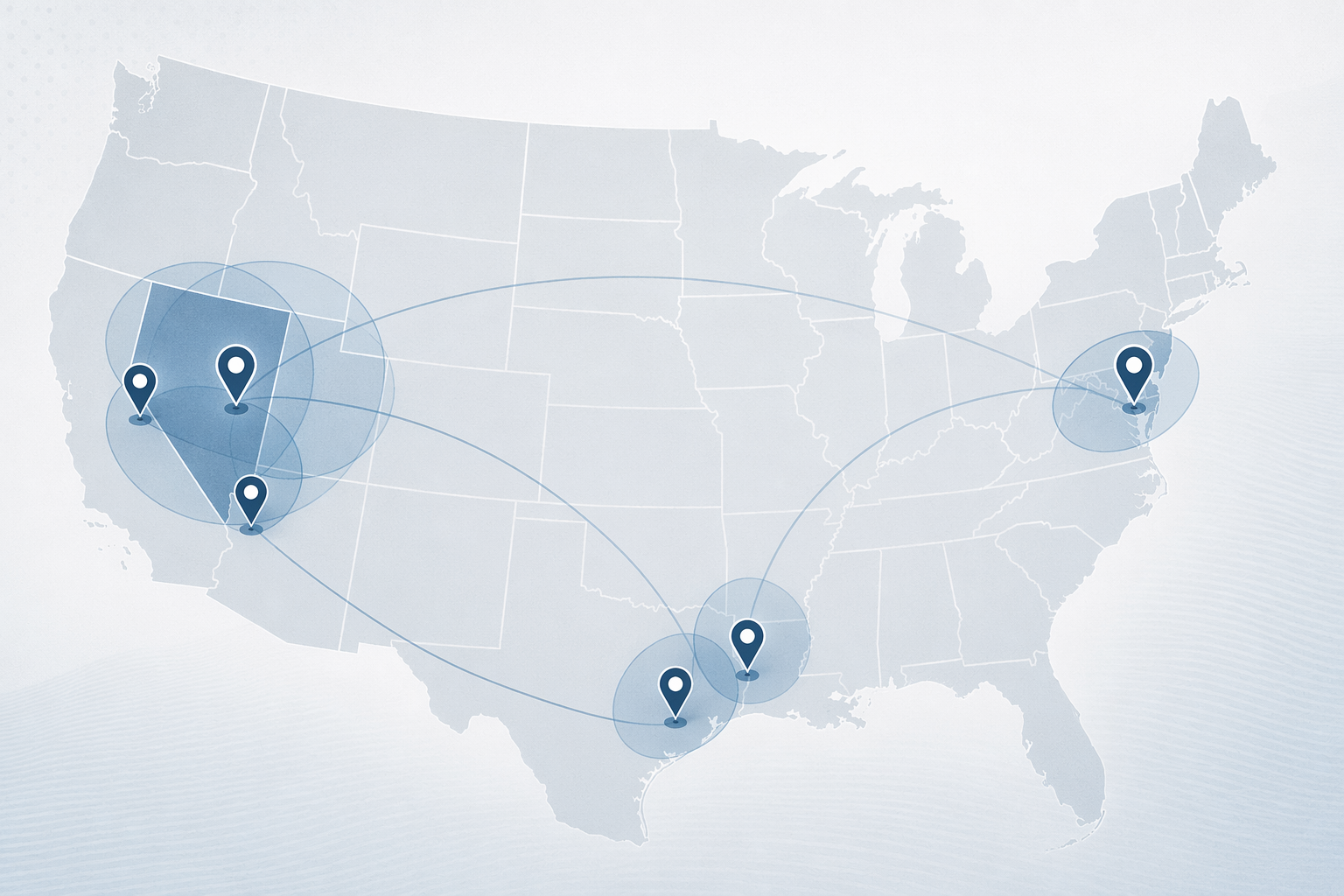
| Market | Why it matters to the review |
|---|---|
| Las Vegas | Large property base and visitor mix may complicate any simple local-overlap theory, but the market remains on the overlap list. |
| Lake Tahoe | Directly echoes the 2020 Eldorado-Caesars remedy area, making it one of the more obvious places for FTC scrutiny. |
| Laughlin | A drive-market analysis could matter more than national-brand presence because the competitive set is local. |
| Atlantic City | A distinct casino destination with flagged property-level divestiture possibilities. |
| Biloxi | Another local casino cluster where the market boundary will determine whether overlap becomes a remedy issue. |
| Lake Charles | One of the markets singled out by both broader and narrower analyst concerns. |
JPMorgan’s estimate put potential forced divestiture proceeds at $2.3 billion and identified Circus Circus Reno, Eldorado Reno, Horseshoe Lake Charles, and Golden Nugget Atlantic City as examples of properties that could be sold.[3] The estimate is useful because it attaches the antitrust issue to actual assets. But it should not be read as a divestiture order in advance. A proceeds number without a declared geographic market is a banking output, not an antitrust conclusion.
The Reno references illustrate the point. If the FTC treats Lake Tahoe and nearby Northern Nevada casino options in a way that captures particular customer drive behavior, a property package might look different than it would under a tighter South Lake Tahoe frame. If the Commission keeps the market narrower, the remedy may need to be narrower. If it treats a broader regional cluster as competitively meaningful, more assets could come into view. The legal work sits in that boundary drawing.
CBRE analyst John DeCree offered the counterweight, assessing “few if any anti-trust concerns” and identifying Lake Charles and Tahoe as the only two markets where an issue could arise.[4] That is not necessarily inconsistent with the existence of six overlaps. It is a narrower prediction about which overlaps become legally material after market definition, competitive-effects analysis, and likely remedy negotiation.
This is the right disagreement to have. The choice is not between “no antitrust issue” and “blocked merger.” The more realistic range is between a small remedy around the clearest local overlaps and a broader divestiture package that treats several of the six listed areas as concentrated casino-service markets. The FTC’s prior use of customer drive patterns makes Lake Tahoe and Lake Charles especially easy to understand as candidates for review. It does not automatically convert Las Vegas, Laughlin, Atlantic City, and Biloxi into required sales.
Why a Second Request Is Possible but Not the Endgame
A second request remains a real procedural possibility. The FTC may need ordinary-course documents, property-level data, customer-origin information, loyalty-program records, competitive analyses, and revenue information by market before deciding whether a negotiated remedy is sufficient. If the agency wants to test whether a Lake Charles or Tahoe customer sees the other party’s property as a close alternative, it will not get very far on investor-call adjectives.
Still, a second request is not the same thing as a litigation forecast. The buyer’s incentives point toward solving the problem. Fertitta Entertainment must pay Caesars a $450 million reverse termination fee if regulatory obstacles block closing.[5] That fee does not guarantee settlement, but it changes the bargaining posture. A buyer facing that exposure has a reason to identify salable assets early, test buyer interest, and offer a remedy that lets the transaction proceed without forcing the Commission into a full preliminary-injunction fight.
The outside date gives the parties room to do that work. The deal’s initial outside closing date is May 27, 2027, with an extension available to November 2027.[5] That schedule can absorb a more searching investigation more comfortably than a transaction built around a short drop-dead date. It also reduces the credibility of any claim that the only practical choices are unconditional clearance or litigation on an emergency timetable.
The Eldorado-Caesars order makes voluntary remedy design easier than it would be in a novel industry. The parties can see the agency’s prior remedy style: sell a property where the overlap is competitively acute, secure an acceptable buyer, and preserve the divested asset as an ongoing competitor.[2] That does not mean the FTC will rubber-stamp a replay. It means the conversation is likely to begin with recognizable remedy architecture rather than a blank page.
Gaming Approvals and Deal Noise Sit Around the Antitrust Review
The state gaming process is important to closing, but it is a different regulatory track. At a July 8, 2026 Nevada Gaming Control Board hearing, Fertitta general counsel Steven Scheinthal and CFO Richard Liem were unanimously recommended as suitable directors, with final Nevada Gaming Commission consideration scheduled for July 23, 2026.[4] Scheinthal also said gaming approvals across all Caesars jurisdictions were expected to take 9 to 10 months.[4] Those approvals can affect timing and regulatory atmosphere. They do not answer whether the acquisition lessens competition in Lake Charles, Tahoe, or any other local casino-service market.
Other facts belong in the same outer ring. Fertitta’s passive 12% stake in Wynn Resorts, described as the largest shareholder position, and his role as U.S. ambassador to Italy may draw attention from gaming regulators and transaction watchers.[4] They are not, on the available record, substitutes for the FTC’s market-by-market antitrust analysis. If those facts create licensure, governance, conflict, or political issues, they should be analyzed on those terms rather than folded into a loose antitrust objection.
The same caution applies to transaction uncertainty. The go-shop period ended July 11, 2026, and a reported Carl Icahn competing bid at $33 per share with $5 billion of Jefferies financing remained unconfirmed by SEC filing.[5] A live topping-bid process could affect which transaction the FTC ultimately reviews to completion. Unless and until the bidder or structure changes, the agency’s current problem remains the Fertitta-Caesars overlap map created by the pending deal.
The Likely Remedy Path
On the present facts, the most likely outcome is not an unconditional clearance and not a full block. It is a consent order with targeted divestitures in the overlapping markets the FTC finds competitively significant. The narrow version of that remedy would focus on Lake Charles and Tahoe, consistent with CBRE’s assessment of where issues are most likely to arise.[4] The broader version would draw from JPMorgan’s six-market overlap map and could include one or more of the properties identified in its divestiture discussion.[3]
The precise scope depends on geographic market definition. That is not a lawyerly hedge; it is the variable that explains why credible observers can land on different divestiture expectations. If the FTC sees customers as choosing within narrow drive-defined areas, it can isolate the most problematic property pairs and require limited sales. If it defines some markets more broadly or finds that the combined company would remove a close local constraint across several clusters, the remedy package grows.
The agency has enough precedent to demand a practical fix, and the buyer has enough economic reason to offer one. The $450 million reverse termination fee, the May 2027 outside date with a possible November 2027 extension, and the 2020 casino-consent precedent all point toward negotiation before courthouse drama.[2][5] A second request may be the route to that negotiation. It should not be mistaken for the destination.
References
- Fertitta executives share details on Caesars deal during licensure hearing, Las Vegas Review-Journal
- Eldorado Resorts, Inc. / Caesars Entertainment Corporation, Federal Trade Commission
- Fertitta’s pursuit of Caesars may spur wave of casino sales, JPMorgan says, CDC Gaming Reports
- Fertitta Entertainment outlines financing, regulatory and anti-trust review process for private takeover of Caesars, CDC Gaming Reports
- Potential Fertitta Acquisition of Caesars Entertainment Raises Change of Control Questions Across Caesars Capital Stack, Octus
Comments
Join the discussion with an anonymous comment.