
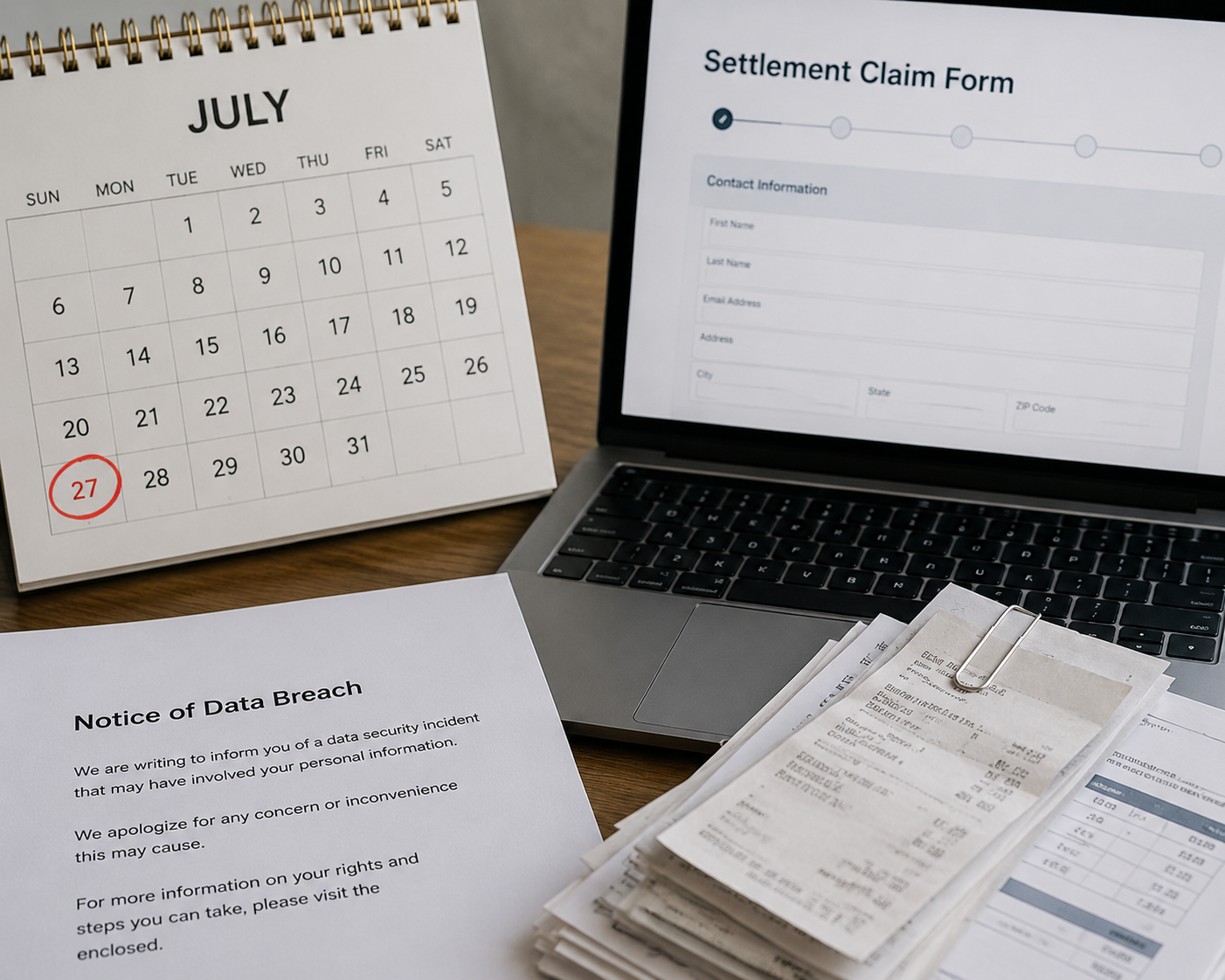
As of today, July 20, 2026, affected Fidelity customers have one week left to file a data breach settlement claim. The claim deadline is July 27, 2026; final approval was granted July 9, 2026; and the deadline to opt out or object was June 26, 2026, which means the remaining practical choice is whether to file a claim before the window closes. Claims are submitted through the official settlement site at fidelitydatasettlement.com. [1][2]
The short version is this: if you received a Fidelity breach notification letter connected to the August 2024 incident, you are likely in the settlement class. That does not mean you automatically receive $5,000, and it does not mean every estimated payment will be paid at the listed amount. It means you still have a claim route, and the deadline is now the most important fact.
This article is informational coverage of a legal settlement, not legal advice. If you have a case-specific legal question, especially about rights you may have lost by missing the opt-out or objection deadline, consult an attorney.
First, make sure this is the Fidelity data breach settlement
The relevant settlement is the Fidelity Investments data breach litigation tied to an August 2024 incident. The official claim site identifies the filing route, deadlines, eligibility language, and compensation categories. If you are checking search results, be careful not to confuse this matter with a separate $210 million Fidelity securities settlement; that is not the data breach settlement discussed here.
Eligibility is narrower than “anyone whose information appeared somewhere in the incident.” The practical gate is the breach notification letter. The settlement materials say class members are people in the United States who were sent notice that their private information may have been impacted in the August 2024 data security incident. Claimants can use the Class Member ID from the notice or submit identifying information through the official online claim form. [1]
That distinction matters because the incident has been described as involving both customer and non-customer data exposure. Vendor-related data exposure does not, by itself, expand the settlement class beyond the people who were sent Fidelity notification letters. If you never received a notice and cannot match yourself through the settlement administrator’s claim process, do not assume you qualify just because you saw the breach in the news.
What you can claim, and what “up to $5,000” really means
The settlement created a $2.5 million fund, but individual payments come out of that fund after settlement administration, attorneys’ fees, litigation costs, and any service awards approved by the court. Final amounts also depend on how many valid claims are submitted. That is why the headline number and the likely payment are not the same thing. [2]
| Claim category | What it covers | Documentation needed | Important limit |
|---|---|---|---|
| Documented ordinary losses | Out-of-pocket costs tied to the breach, such as bank fees, overdraft charges, identity theft-related costs, fraud charges, or credit monitoring costs | Yes | Up to $5,000 |
| Lost time | Time spent responding to issues related to the breach | Claim form details; supporting documentation may help if available | Up to 4 hours at $25 per hour, or $100 maximum |
| Pro rata cash payment | A cash payment for valid claimants from the remaining fund | No loss documentation beyond a valid claim | Estimated around $100, subject to change |
| California CCPA payment | Additional estimated payment for eligible California residents | California residency and valid claim information | Estimated $50, subject to available funds |
The $5,000 figure applies to documented ordinary losses. The official FAQ and consumer coverage identify examples such as bank fees, overdraft charges, identity theft-related costs, fraud charges, and credit monitoring costs. The settlement also allows lost time to be claimed at $25 per hour, capped at four hours, for a maximum of $100 for time. [1][3]
The estimated pro rata cash payment is different. It is listed at about $100, but that estimate is not a guarantee. If many people file valid claims, or if fund deductions leave less money than expected, the actual amount can change. The same caution applies to the estimated $50 California Consumer Privacy Act payment for eligible California residents; it is described as an estimated payment and remains subject to the settlement fund’s limits. [1]
For a claimant with receipts, statements, or invoices, the most important choice is whether to file only for the cash payment or also claim documented losses. A person who paid for credit monitoring after receiving the notice, incurred bank fees while dealing with a fraud issue, or spent money responding to identity theft concerns should not skip the documentation portion simply because the form also offers an estimated cash payment. The settlement administrator cannot credit losses that are not claimed and supported.
What to gather before opening the claim form
The fastest claim is the one prepared before the browser tab opens. The official claim form asks for identifying information, and the settlement FAQ says claimants may provide the Class Member ID from their notice or use their full name and address. Supporting documentation is required for losses beyond the basic pro rata payment. [1]
- Your Fidelity breach notification letter, especially the Class Member ID if one appears on it.
- Your current mailing address, email address, and any prior address that may match the notice records.
- Receipts, invoices, account statements, bank notices, credit monitoring bills, or other records showing claimed out-of-pocket losses.
- A short, plain explanation tying each expense to the August 2024 Fidelity data incident.
- A reasonable estimate of time spent responding to the incident if you are claiming lost time, remembering the four-hour cap.
Documentation does not need to be theatrical. A bank statement showing a fee, an invoice for credit monitoring, or a receipt for a related service is more useful than a long narrative with no record attached. If a document contains unrelated sensitive information, review whether the claim portal permits redaction before uploading. The point is to show what was paid, when it was paid, and why it belongs in this settlement claim.
How to file the Fidelity data breach settlement claim online
The claim form is available online through the official settlement website. CNBC Select also notes that claims are filed through fidelitydatasettlement.com, which is the site readers should use rather than a search ad, forwarded email link, or unofficial claims page. [1][2]
- Go to fidelitydatasettlement.com and choose the claim filing option.
- Enter your Class Member ID from the notification letter, or provide the requested name and address information if you do not have the ID available.
- Select the payment category or categories that apply: documented ordinary losses, lost time, pro rata cash payment, and, if applicable, the California CCPA payment.
- Upload documentation for any claimed out-of-pocket losses and review whether each document clearly supports the amount entered.
- Review the claim carefully before submitting, because missing documentation or inconsistent identifying information can slow administrator review.
- Submit before July 27, 2026, and save or print the confirmation page or email for your records.
Do not wait until the last evening to find the notice letter. Settlement portals are designed for volume, but the claimant still bears the ordinary risk of a missing document, a password issue, an upload problem, or a mismatch between the address on the notice and the address entered on the form. None of those problems is dramatic; all of them are easier to solve before the deadline day.
What happened in the breach, briefly
The underlying incident occurred in August 2024, when an unauthorized third party accessed Fidelity customer data. Massachusetts consent order reporting cited by WealthManagement.com described 23.7 million image calls and approximately 373,000 exposed documents. [4]
The class action settlement is separate from regulatory action. Massachusetts regulators fined Fidelity $1.25 million over the 2024 breach, and Fidelity agreed to engage an independent cybersecurity consultant under a consent order. That regulatory outcome does not replace the settlement claim process for affected customers; it is a separate consequence of the same broader incident. [4]
For claim-filing purposes, the breach history matters mostly because it anchors the claim to the August 2024 event. A receipt or fee is stronger when it can be tied to the period after the notification and to actions taken in response to the incident. A general worry about data security, without a qualifying notice and without a filed claim, is not enough to produce a settlement payment.
What you can no longer do
The opt-out and objection deadlines have passed. June 26, 2026 was the deadline for both, so readers arriving now should not spend the remaining week trying to decide whether to exclude themselves or object to the settlement. The remaining settlement action is filing a claim by July 27 if you are eligible and want payment consideration. [1]
That also means the decision is no longer strategic in the way it was before June 26. You are not choosing between staying in the class and preserving separate claims by opting out. If you have questions about what the missed opt-out deadline means for your personal situation, that is a legal-advice question, not something a settlement guide can resolve.
After you submit, expect review before payment
Submitting a claim is not the same as receiving an approved payment. The settlement administrator must review claims, documentation, fund deductions, and the number of valid claimants before final payment amounts can be calculated. Because the pro rata and California payments are estimates, the number on the claim materials should be treated as a planning figure, not a promised deposit. [1]
Payment timing remains uncertain. The court granted final approval on July 9, 2026, but distribution can depend on settlement administration and whether appeals are filed after approval. The available materials confirm the approval and the July 27 claim deadline; they do not provide a reliable payment date that claimants should treat as fixed. [1][2]
If the claim deadline passes without a filing, the ordinary consequence is straightforward: an eligible class member who did not submit a valid claim should not expect payment from this settlement. If the deadline is extended or the administrator posts a payment update, the official settlement website is the place to verify it first.
The deadline is the part you can still control
Affected Fidelity customers still have a viable claim path as of July 20, 2026. The useful move is not to chase the largest advertised number, but to match the claim form to the records you actually have: notice letter, identifying information, receipts, statements, and a clear loss explanation where required.
File through fidelitydatasettlement.com before July 27, save confirmation, and treat all estimated payments as estimates until the administrator completes its work.
Comments
Join the discussion with an anonymous comment.