
The current fire pit recall product liability landscape begins with a tight sequence of CPSC activity rather than with any single lawsuit. In October 2024, Colsen recalled about 89,500 alcohol-fueled tabletop fire pits after one death and more than 100 fire or injury reports tied to flame jetting and burn hazards.[1] In December 2024, the CPSC widened the frame with a category-wide consumer alert warning consumers to stop using alcohol or other liquid-burning fire pits that require pooled ignition of liquid fuel, citing ASTM F3363-19 and the risks of flame jetting and pool fires.[2] Five Below followed with a September 2025 recall of about 66,000 Tabletop Fire Pits after two deaths and 19 fire or injury reports.[3]
The next three CPSC actions matter for a different reason. Rozato, Northlight, and Houswise were not voluntary recalls with a consumer remedy. They were public warnings after the firms declined to conduct a recall, leaving purchasers without the return, refund, replacement, or repair framework that usually accompanies a recall notice. The CPSC warned about Rozato tabletop fire pits in April 2026 after one death and serious burn injuries; Northlight tabletop fire pits in May 2026 after two fires and burn injuries; and Houswise tabletop fire pits in July 2026 after three fires and 14 burn injuries involving about 53,500 units.[4][5][6]
| CPSC Action | Product / Entity | Regulatory Posture | Reported Scale or Incidents |
|---|---|---|---|
| October 2024 | Colsen alcohol-fueled tabletop fire pits | Recall | About 89,500 units; one death; more than 100 fire or injury reports |
| December 2024 | Alcohol or other liquid-burning fire pits requiring pooled ignition | Category-wide consumer alert | CPSC warned of flame jetting and pool fire hazards |
| September 2025 | Five Below Tabletop Fire Pits | Recall | About 66,000 units; two deaths; 19 fire or injury reports |
| April 2026 | Rozato tabletop fire pits | Public warning; no voluntary recall | One death; serious burn injuries |
| May 2026 | Northlight tabletop fire pits | Public warning; no voluntary recall | Two fires; burn injuries reported |
| July 2026 | Houswise tabletop fire pits | Public warning; no voluntary recall | About 53,500 units; three fires; 14 burn injuries |
That recall-versus-warning distinction is not administrative trivia. A recall notice usually gives counsel a concrete remedial act to examine: what the firm agreed to do, what consumers were told, how the remedy was described, and when the seller or manufacturer began communicating about the hazard. A public warning without a voluntary recall has a different evidentiary shape. It may still identify the alleged hazard, product population, incident history, and CPSC position, but it does not show that the company agreed to a corrective action. That difference affects remedy discussions, notice evidence, defendant posture, and how carefully counsel should phrase the regulatory history in pleadings and motion practice.
The Common Mechanism Is the Center of the Case
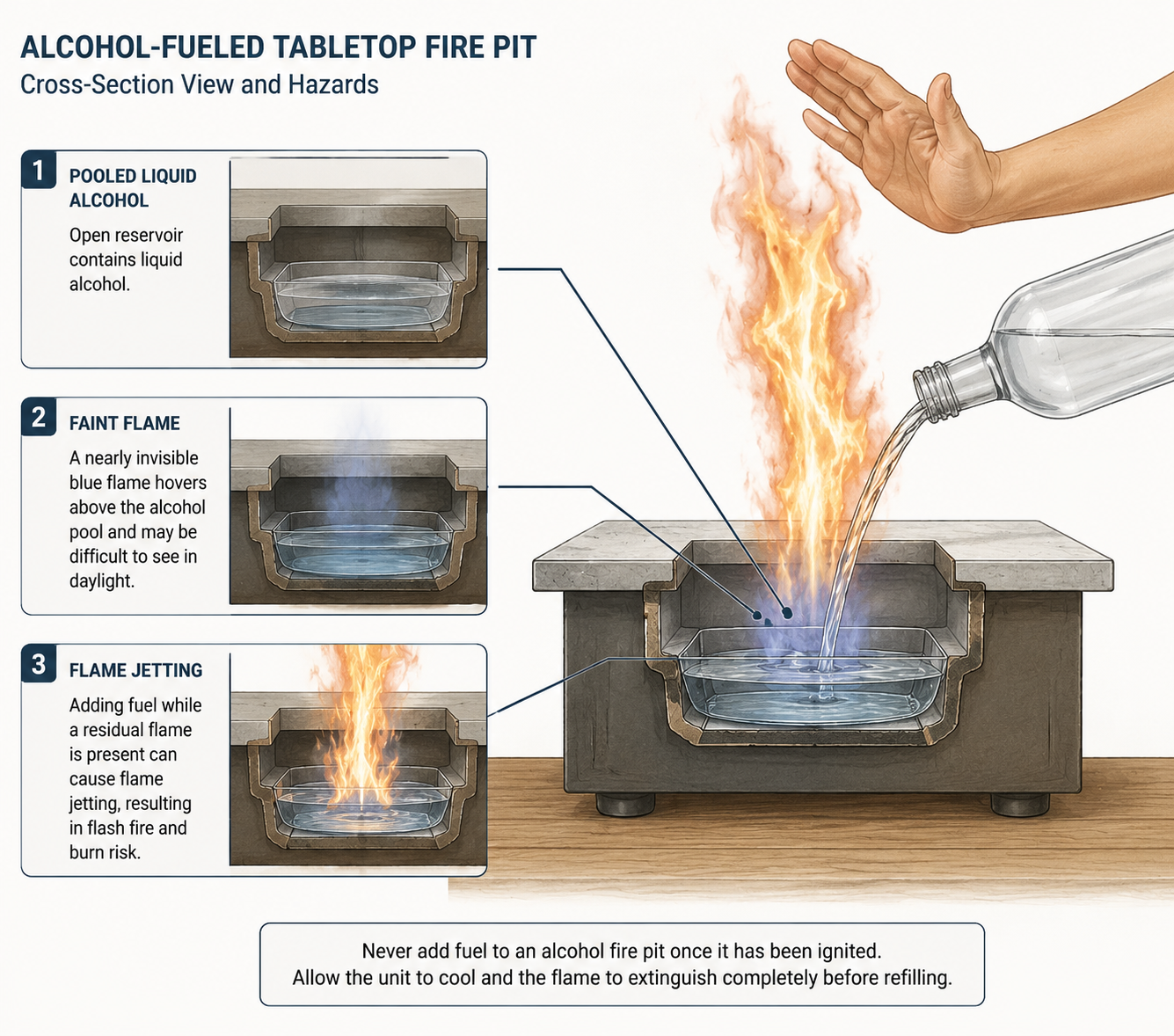
The recurring theory across these products is not merely that fire is dangerous. It is that an open-reservoir, pooled-ignition design creates a particular refueling hazard. Liquid alcohol remains in or is poured into an open container; the flame can be difficult to see, particularly in daylight; a user may believe the flame is out; and added fuel can ignite suddenly, producing flame jetting toward the user's hand, face, torso, or nearby bystanders. The CPSC has described alcohol flame temperatures exceeding 1,600 degrees Fahrenheit and burn injuries occurring in less than one second.[2]
That sequence does a great deal of legal work. It explains why incident reports may look similar even when the brand names differ. It also explains why warning adequacy and causation will be fought on very specific terrain: what the label said about refueling, whether it addressed residual or invisible flame, whether instructions told the user to wait before adding fuel, whether the product design invited direct pouring into a reservoir, and whether the injury pattern is consistent with flame jetting rather than a spill, tip-over, or unrelated ignition source.
For intake lawyers, the mechanism points to documents that are worth collecting before the case is dressed up as a product liability complaint: the exact model, photographs of the reservoir and fuel container, purchase records, marketplace listings, archived product descriptions, instructions, warnings, fuel recommendations, witness accounts about refueling, lighting conditions, and medical records describing burn location and timing. For defense counsel, the same mechanism supplies the obvious pressure points: whether the product was actually involved, whether the user refueled contrary to instructions, whether another fuel was used, whether the flame was visible under the conditions present, and whether the claimed injury sequence matches the physical evidence.
The better cases will not be built by citing a recall notice and stopping there. Recall documents are often powerful exhibits because they compress hazard, chronology, product identification, and regulatory judgment into a form jurors and judges can understand. They are not, by themselves, proof of defect, causation, seller liability, or damages. The work remains product-specific and state-specific.
ASTM F3363-19 Gives the Defect Theory a Fixed Reference Point
The CPSC's December 2024 alert is unusually important because it does more than announce concern. It states that fire pits requiring pooled ignition of alcohol or other liquid fuels violate ASTM F3363-19, the Standard Specification for Unvented Liquid/Gel Fuel-Burning Portable Fire Features, and identifies pool fires and flame jetting as hazards addressed by that standard.[2][7]
That does not make ASTM F3363-19 an automatic liability finding. A voluntary standard is not a verdict form. Courts still apply the governing state's product liability law, and parties will dispute whether the standard applies to the exact product, whether the product was sold before or after relevant standard language, whether compliance or noncompliance caused the injury, and whether the standard is admissible for the purpose offered. Even so, a clear standard reference changes the practical posture of the case. It gives experts, lawyers, and courts a shared technical vocabulary for the alleged defect.
In a design defect claim, the pooled-ignition issue can support an argument that the product's architecture created an unreasonable refueling hazard. The plaintiff's expert will usually need to connect that architecture to the injury sequence and, depending on the jurisdiction, address feasible alternative design. The defense will test whether the hazard came from the design itself, from the way the product was used, from the fuel selected, or from conduct outside the product's intended or reasonably foreseeable use.
In a failure-to-warn claim, the factual package is narrower but no less demanding. The question is not whether a label said “flammable.” The useful questions are whether the warning addressed invisible residual flame, prohibited refueling while warm or burning, explained flame jetting in terms a lay user would understand, appeared where a user would see it before pouring fuel, and matched the way the product was marketed for tabletop, patio, or indoor-adjacent use. Warning adequacy will also interact with causation: the injured user must usually show that a different or stronger warning would have changed behavior under the applicable state-law standard.
Strict liability, negligence, and negligence per se theories may draw from the same facts but do different work. Strict liability focuses attention on the condition of the product when it entered the stream of commerce. Negligence focuses on what the manufacturer, importer, retailer, or marketplace knew or should have done in designing, sourcing, labeling, listing, or continuing to sell the product. Negligence per se depends on jurisdiction-specific treatment of statutes, regulations, and standards; ASTM noncompliance may be highly useful evidence, but counsel should not assume every court will treat a voluntary standard as a per se rule of civil liability.
Who Gets Pulled Into the Chain
The CPSC materials and reported litigation identify a broad distribution chain: manufacturers and brand entities such as Colsen, Furmia, Suzhou Tengli, Rozato, and Houswise; importers including Gordon Companies/Northlight; retailers including Five Below, Macy's, Target, Walmart, and Wayfair; and online marketplace defendants including Amazon.[1][3][4][5][6][8]
That defendant map is where many claims become harder than the recall chronology suggests. Seller-status defenses, marketplace immunity arguments, indemnity relationships, foreign manufacturer service issues, retailer knowledge, and state statutes limiting nonmanufacturing seller liability can reshape a case before anyone reaches the merits of flame jetting. A plaintiff who can identify the product but not the seller may have a very different case from a plaintiff with a purchase record, archived listing, instruction booklet, and packaging tying the unit to a specific importer or retailer.
Online marketplace cases require particular care. The legal question is not simply whether a consumer clicked “buy” on a platform. Courts may examine who listed the product, who stored it, who shipped it, who processed payment, who controlled warnings on the page, who had the ability to remove the listing, and how the governing state's product liability law defines a seller or distributor. The reported tabletop fire pit cases show Amazon being named, but naming a marketplace is not the same as establishing marketplace liability.[8]
Where the Framework Is Being Tested
The litigation has not yet become a centralized tabletop fire pit MDL. As of Q3 2026, the materials reviewed identify cases proceeding individually across districts, with no JPML consolidation for alcohol-fueled tabletop fire pit claims. That point is worth stating plainly because the repeated fact pattern can make the docket look more mature and coordinated than it is. The MDL label should not be borrowed from unrelated recall litigation.
The early federal trial posture is nevertheless meaningful. Hominski v. Amazon.com Services LLC in the Southern District of Florida was reported as a bellwether trial scheduled for March 2026, while Little v. Amazon.com Services LLC in the Southern District of Texas has been reported for trial in July or August 2026. Thauberger v. Amazon.com Services LLC in the District of Colorado and multiple state-court filings round out the developing picture.[8][9][10]
Those trials may influence valuation and defense posture, but they should not be treated as universal predictors. State law will vary. Product models will vary. The warning language, sales channel, incident sequence, and available physical evidence will vary. A defense verdict in one refueling case would not erase the CPSC chronology; a plaintiff verdict would not prove every alcohol fire pit claim. The useful signals will be more granular: expert admissibility rulings, marketplace-liability rulings, warning-causation findings, comparative fault treatment, and how jurors respond to the invisible-flame and ASTM evidence.
Limitations Counsel Should Keep in View
Statutes of limitation are a threshold issue, but the reliable generalization is modest: personal injury limitations periods commonly fall in the two-to-four-year range and vary by state.[11] Accrual, discovery rules, tolling, minority, death claims, warranty theories, and repose periods require jurisdiction-specific verification. A 2024 injury, a 2025 recall, and a 2026 intake date may point in different directions depending on the state and claim pleaded.
Settlement values are even less suitable for shortcut treatment. The reviewed materials do not provide reliable, publicly attributed settlement data specific to alcohol-fueled tabletop fire pit burn cases. General burn-injury ranges from other contexts should not be imported as if they were fire pit settlement benchmarks. The more useful valuation work, at this stage, is conventional and evidence-heavy: burn depth, grafting, scarring, disfigurement, functional loss, hospitalization, wage loss, future care, venue, comparative fault, defendant solvency, insurance, and the strength of product identification.
Secondary reporting also has limits. Some litigation information is available through legal news coverage and law-firm summaries rather than complete public-record review in the materials considered here. Those sources are useful for docket orientation, but pleadings, orders, scheduling notices, and party filings should be checked directly before counsel relies on a trial date, defendant list, or allegation.
A Bounded View as of Q3 2026
The 2024–2026 CPSC wave has given alcohol-fueled tabletop fire pit claims a coherent liability architecture even without centralized multidistrict litigation. The recurring open-reservoir design, invisible or difficult-to-see flame, flame jetting during refueling, extreme burn speed, and ASTM F3363-19 reference are the facts that tie the separate brand actions together. They are also the facts most likely to matter in expert work, warnings analysis, seller-chain mapping, and trial presentation.
The disciplined work is still case-by-case. Product identification comes first. The CPSC action must be classified accurately as a recall or a warning. The defendant chain must be traced through manufacturer, importer, retailer, and marketplace roles. State law must be checked before assuming strict liability, negligence per se, nonmanufacturing seller exposure, or marketplace liability. The first federal trials may supply important signals, but the strongest files will be the ones built from source documents, physical evidence, warnings, purchase records, incident proof, medical documentation, and careful causation analysis.
This article is a legal research reference, not legal advice. Practitioners should verify primary sources, court dockets, product documents, and state-specific law independently before relying on any point in active litigation.
References
- Colsen Recalls Fire Pits Due to Serious Burn and Flame Jetting Hazards; Risk of Serious Injury or Death, CPSC.gov, October 2024, link
- CPSC Warns Consumers to Immediately Stop Using Alcohol or Other Liquid Burning Fire Pits That Require Pooled Ignition, CPSC.gov, December 2024, link
- Five Below Recalls Tabletop Fire Pits Due to Fire and Burn Hazards; Risk of Serious Injury or Death, CPSC.gov, September 2025, link
- CPSC Warns Consumers to Immediately Stop Using Rozato Tabletop Fire Pits Due to Serious Burn and Flame Jetting Hazards; Risk of Serious Injury or Death, CPSC.gov, April 2026, link
- CPSC Warns Consumers to Immediately Stop Using Northlight Tabletop Fire Pits Due to Serious Burn and Flame Jetting Hazards; Risk of Serious Injury or Death, CPSC.gov, May 2026, link
- CPSC Warns Consumers to Immediately Stop Using Houswise Tabletop Fire Pits Due to Serious Burn and Flame Jetting Hazards; Risk of Serious Injury or Death, CPSC.gov, July 2026, link
- ASTM F3363-19 Standard Specification for Unvented Liquid/Gel Fuel-Burning Portable Fire Features, ASTM International, link
- Fire Pit Makers Accused of Inadequate Flame-Jetting Warnings, Bloomberg Law, link
- Tabletop Fire Pit Lawsuits, AboutLawsuits.com, link
- Tabletop Fire Pit Injury Lawsuit Analysis, Louthian Law Firm, link
- Fire Pit Injury Lawyer, Langley Still & Foss, link
Comments
Join the discussion with an anonymous comment.