
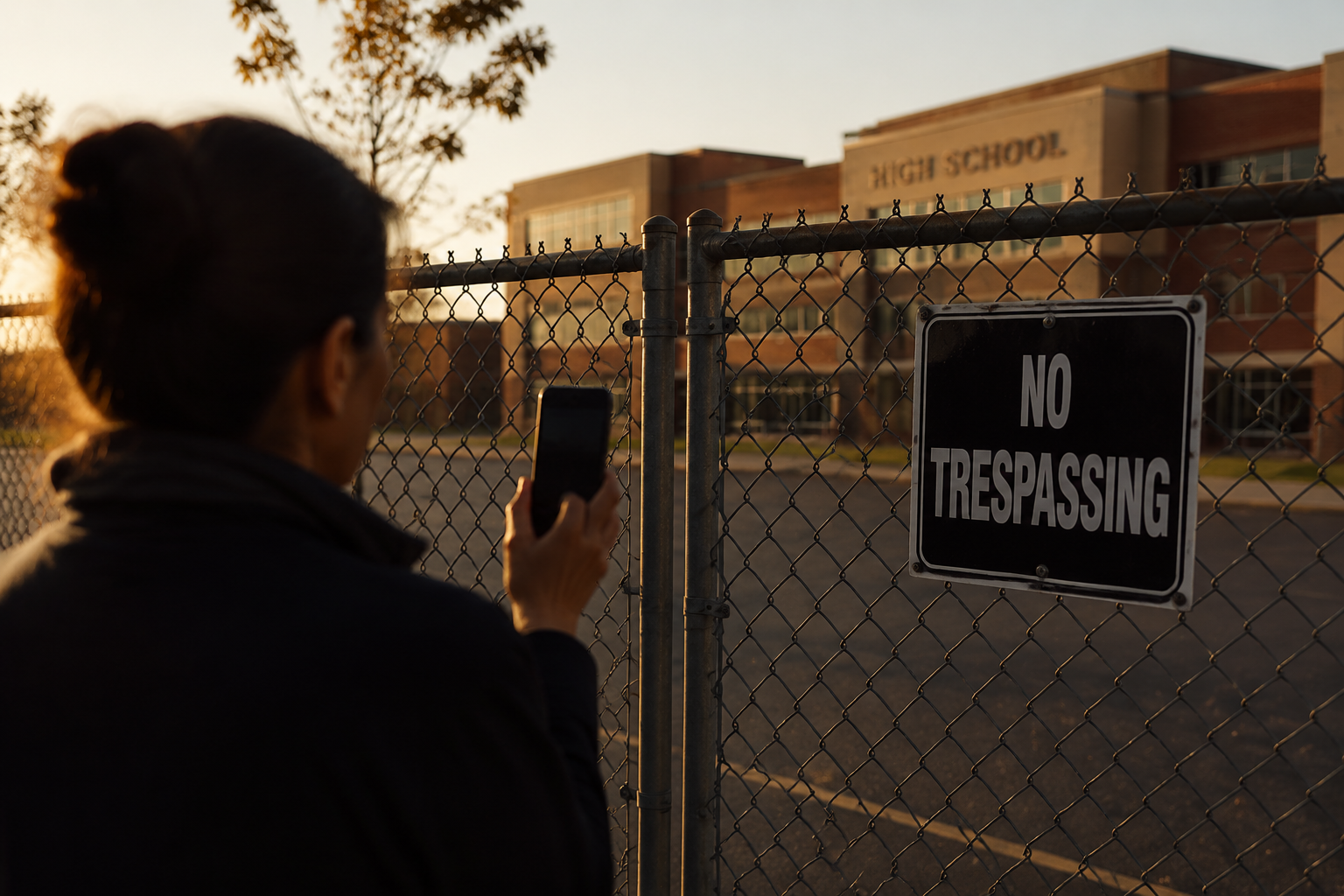
The latest case involving a parent banned from school property over Facebook posts begins in the familiar register of a local school fight: a parent posts jokes on Facebook, school officials read them as offensive and disruptive, and the district responds by keeping the parent off school property. What makes Jones v. Jenkins Independent Schools worth attention is the federal court’s immediate boundary line. On July 16, 2026, an Eastern District of Kentucky judge preliminarily enjoined the district’s ban, holding that Facebook posts that were “not threatening, obscene, or defamatory” could not be used as the basis for retaliation against the parent.[1]
That ruling does not make Jones final law. It is a preliminary injunction, not a judgment after trial, and it does not bind other courts as circuit precedent. But it is the cleanest recent example of the problem now appearing across federal school-speech litigation: public school officials may regulate access to school property for safety, order, and event management, but they are on much thinner ice when the reason for exclusion is the viewpoint, tone, or embarrassment caused by a parent’s off-campus social media criticism.
The line Jones draws
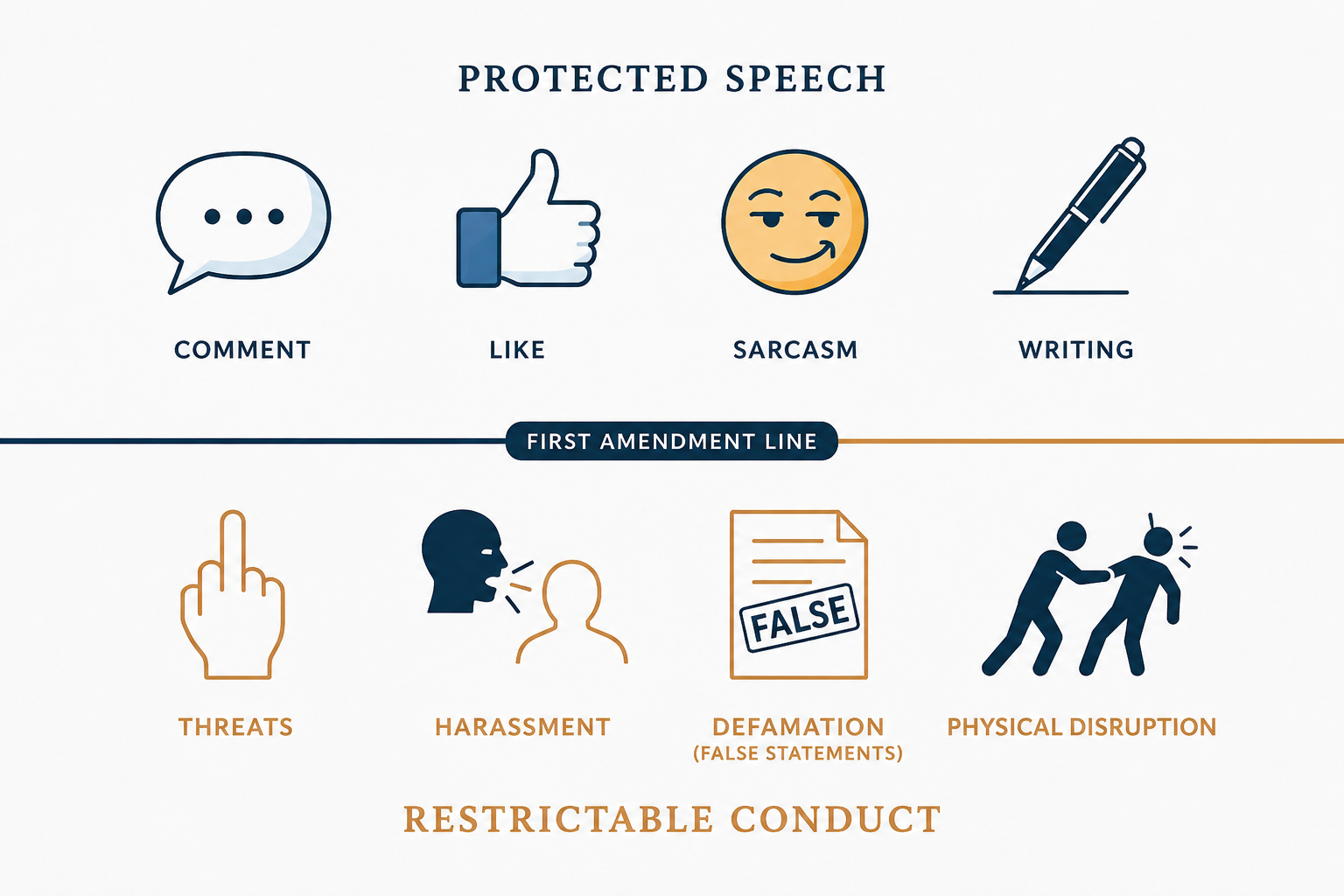
Jones involved a parent who was banned from all Jenkins Independent Schools property after Facebook posts about student athletes that the court characterized as joking rather than threatening, obscene, or defamatory.[1] That distinction matters. The First Amendment does not require school districts to tolerate threats, targeted harassment, true defamation, or conduct that materially interferes with access and safety. But a public institution does not get to convert dislike of speech into a trespass theory simply because the speaker is a parent rather than a student.
The reported posture also matters. The court granted preliminary relief, which requires an early assessment of likely success and irreparable harm, not a complete merits record. Still, the court’s framing was direct: if the posts fall outside the familiar unprotected categories and the district’s action is tied to the content of those posts, the ban looks retaliatory.[1] That is a serious problem under 42 U.S.C. § 1983 because the defendant is not merely moderating a conversation; it is using state authority to exclude a critic from public property.
The result is not that every parent gets unconditional access to every school space. A school building during the instructional day is not the same thing as a sidewalk, a board meeting, or a public athletic event. But Jones shows why the reason for the restriction has to be more than institutional irritation. If the record shows a content-based response to protected Facebook posts, the district has to defend a constitutional injury, not just an access decision.
Hartzell makes vague civility rules the problem
Hartzell v. Marana Unified School District gives the doctrine more appellate weight. In March 2025, the Ninth Circuit held unconstitutional a district policy barring “offensive or inappropriate” speech, after a parent was indefinitely banned for critical advocacy.[2] The Supreme Court denied certiorari on October 14, 2025, leaving the Ninth Circuit ruling in place without turning it into national precedent.[3]
The danger in a phrase like “offensive or inappropriate” is not hard to see. It has no stable limiting principle when applied to parental criticism of school officials. One administrator’s inappropriate email is another parent’s protected accusation of mismanagement. One board member’s offensive post is another family’s attempt to organize opposition. In Hartzell, the constitutional defect was not merely that the district made a harsh choice in one dispute; it was that the policy itself invited punishment of speech because of its viewpoint or tone.[2]
That is the drafting lesson school districts should take seriously. A policy aimed at conduct can name conduct: threats, harassment, obstruction, refusal to leave a restricted area, disruption of an event, or violation of neutral access rules. A policy aimed at feelings tends to name feelings: offensive, inappropriate, disrespectful, uncivil. Hartzell shows why the latter vocabulary becomes dangerous when attached to exclusion from school property.
McElhaney rejects the handbook override
McElhaney v. Williams, decided by the Sixth Circuit in August 2023, is less social-media-centered than Jones but structurally important. The case involved a parent who was banned from softball games after texting a coach about playing time. The Sixth Circuit reversed, holding that school policies or informational materials could not override a parent’s constitutional right to criticize school officials in non-threatening terms.[4]
The point is not that every athletic-event dispute has constitutional dimensions. Many do not. Sideline conduct can become disruptive. A parent can be removed for refusing to comply with neutral event rules. But McElhaney is important because it rejects a common administrative move: treating a handbook, conduct sheet, or participation policy as if it can contract around the First Amendment. Public schools do not acquire a general power to punish protected criticism by telling parents in advance to be positive, respectful, or supportive.
Taken with Hartzell, McElhaney supplies the appellate structure that Jones now applies in a more direct Facebook-ban setting. The Ninth Circuit decision attacks vague speech restrictions on their face. The Sixth Circuit decision rejects the idea that school-issued behavioral expectations can nullify protected criticism. Jones then addresses the now-common fact pattern: off-campus social media posts followed by a property ban.
| Case | Court posture | Speech or conduct at issue | School response | Constitutional significance |
|---|---|---|---|---|
| Jones v. Jenkins Independent Schools | Eastern District of Kentucky preliminary injunction, July 16, 2026 | Joking Facebook posts about student athletes, described by the court as not threatening, obscene, or defamatory | Ban from all school property | A content-based property ban tied to protected Facebook posts likely violates the First Amendment |
| Hartzell v. Marana Unified School District | Ninth Circuit decision, March 2025; certiorari denied October 14, 2025 | Critical parental advocacy | Indefinite ban under policy barring offensive or inappropriate speech | Vague civility language can be facially unconstitutional when used to punish viewpoint |
| McElhaney v. Williams | Sixth Circuit decision, August 2023 | Parent texts criticizing coach over softball playing time | Ban from softball games | Handbooks and informational sheets cannot override protected parental criticism |
Where schools still have room to act
The hard cases do not disappear because Jones, Hartzell, and McElhaney favor parents on these facts. School property is not one constitutional forum. Access during the school day, attendance at athletic events, participation in board meetings, and presence at other public events can carry different rules. A Second Circuit forum analysis described the distinction in practical terms: restrictions on school-day property access may be permissible when tied to disruptive conduct, while public events may be treated as limited public forums where restrictions must be viewpoint neutral.[5]
That distinction keeps the doctrine from becoming cartoonish. A parent who threatens staff, follows students, blocks entrances, refuses to leave a restricted area, or repeatedly disrupts a meeting is not in the same position as a parent who posts a sarcastic complaint online from home. The First Amendment question turns on why the district acted and how the restriction is built. A temporary, conduct-based restriction tied to documented safety concerns is one thing. An indefinite, property-wide ban imposed after protected criticism is another.
The unsettled piece is Tinker. The substantial-disruption standard developed for student speech does not map neatly onto adult parent speech, especially when the speech occurs off campus on social media. Courts may still consider the special characteristics of the school environment, but the current parent-ban cases do not support the broad proposition that administrators can invoke disruption as a password. They need evidence, a proper forum analysis, and a restriction that does not punish viewpoint.
The social media account cases are related, not controlling
The Supreme Court’s March 2024 decisions in Lindke v. Freed and O’Connor-Ratcliff v. Garnier address a neighboring problem: when a public official’s social media activity counts as state action. The Court adopted a two-part test requiring that the official have actual authority to speak on the government’s behalf and that the official purport to exercise that authority in the challenged social media activity.[6]
That framework matters when school board members block critics or delete comments from accounts that blend personal and official functions. On remand in May 2025, the Ninth Circuit found that a school board president violated the First Amendment under the Supreme Court’s state-action test.[7] But those cases should not swallow the property-ban question. Blocking a parent from a Facebook page and banning a parent from school grounds are different state actions, even if both may begin with criticism that officials would rather not see.
Pending disputes are adding viewpoint facts
Pruitt v. Grosse Pointe Public Schools, filed in 2025 and still pending, shows where the next round of disputes may go. According to the complaint and media reporting, the parent was banned after recording a classroom pride flag and posting video, adding a viewpoint-discrimination theory to the familiar access-ban pattern.[8] Because there is no substantive ruling yet, Pruitt is not evidence of what the law is. It is evidence of what plaintiffs are now pleading.
That is not a small point. The strongest parent claims are not built on a generic right to enter school property whenever they wish. They are built on retaliation: the school allowed access until the parent expressed a disfavored view, then imposed a restriction without a threat, harassment finding, defamation finding, or documented disruption sufficient to justify the breadth of the ban. If Pruitt develops in that direction, it will sit naturally beside Jones, Hartzell, and McElhaney. If the record instead shows conduct-based safety concerns, the analysis may narrow quickly.
Damages exposure is not theoretical
The older Marcel Cyr settlement in Vermont is not a perfect social-media analog. It predates the current Facebook-post wave and involved in-person board-meeting conduct rather than the off-campus online speech at issue in Jones. Its value is narrower: it shows that property-ban disputes can become damages disputes. Cyr’s case settled for $147,500 after First and Fourteenth Amendment claims in a school-property-ban context.[9]
For districts, the litigation risk is not limited to losing access-control discretion going forward. A § 1983 claim can seek injunctive relief, damages, and attorneys’ fees. The broader the ban, the vaguer the rule, and the thinner the evidence of threat or disruption, the more the school’s position starts to look like retaliation rather than administration.
The practical legal judgment
The current federal materials do not create a single national rule in the way a Supreme Court merits decision would. Hartzell binds the Ninth Circuit. McElhaney binds the Sixth Circuit. Jones is an early district-court injunction. Pruitt is pending. The social media account cases answer a state-action question that only partly overlaps with property bans.
Even with those limits, the direction of the law is not subtle. A public school district is on much safer ground regulating threats, harassment, defamation, physical disruption, restricted-area access, and event logistics than punishing a parent’s critical Facebook content. When the speech is non-threatening, non-harassing, non-obscene, and non-defamatory, a property-wide or indefinite ban invites exactly the kind of First Amendment retaliation claim that federal courts have been willing to take seriously.
References
- Jones v. Jenkins Independent Schools coverage, Kentucky.com, July 2026
- Hartzell v. Marana Unified School District alert, AALRR, March 2025
- Hartzell v. Marana Unified School District, SCOTUSblog, October 2025
- Sixth Circuit Sides with Parent in Free Speech Case, Ennis Britton, August 2023
- Education Law Notes forum analysis, Pullman & Comley
- Supreme Court rules on when public officials can block critics on social media, SCOTUSblog, March 2024
- School board social media blocking update, Franczek, May 2025
- Pruitt v. Grosse Pointe Public Schools coverage, FOX 2 Detroit, 2025
- School district settles lawsuit over ban from board meetings, ABA Journal
Comments
Join the discussion with an anonymous comment.