
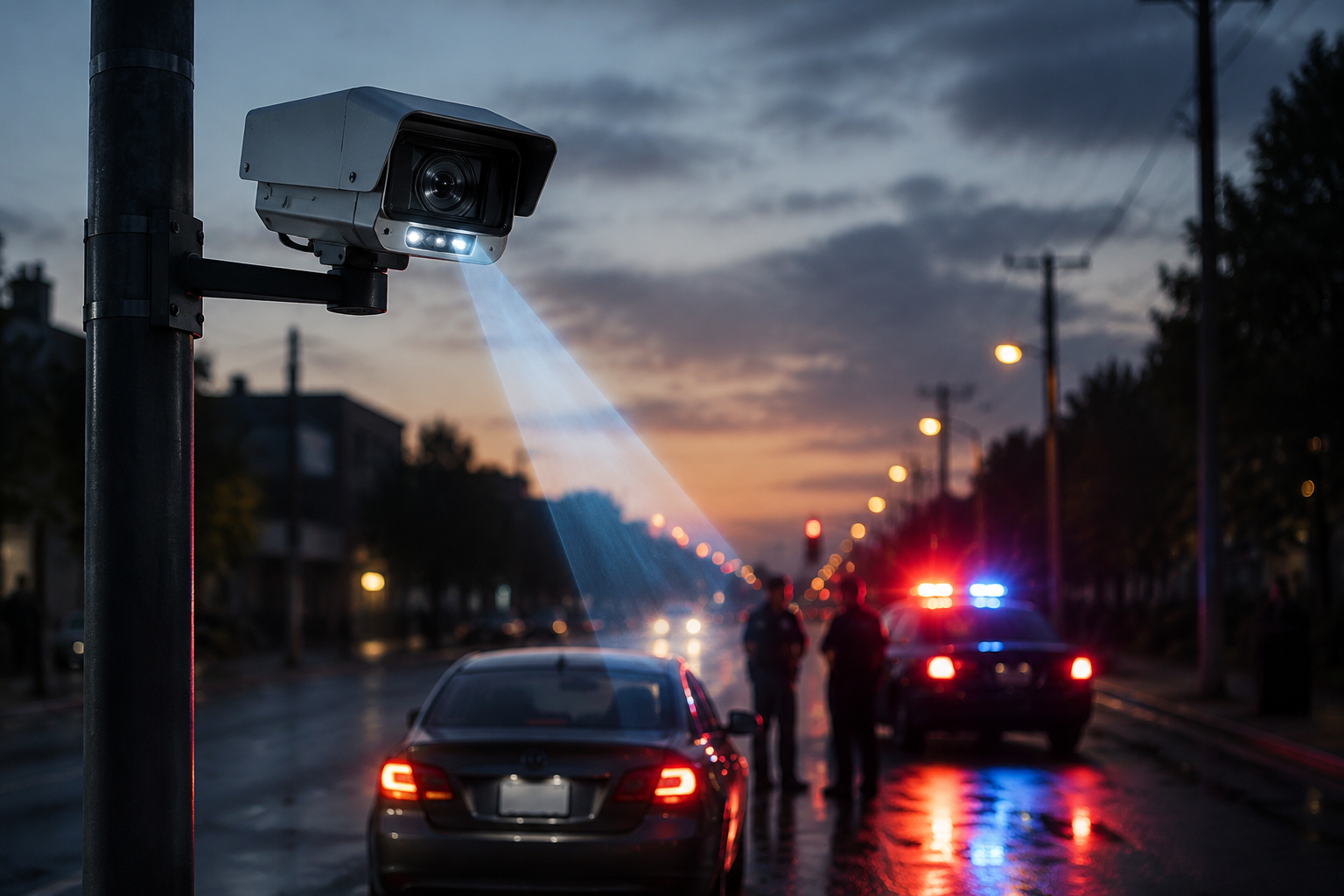
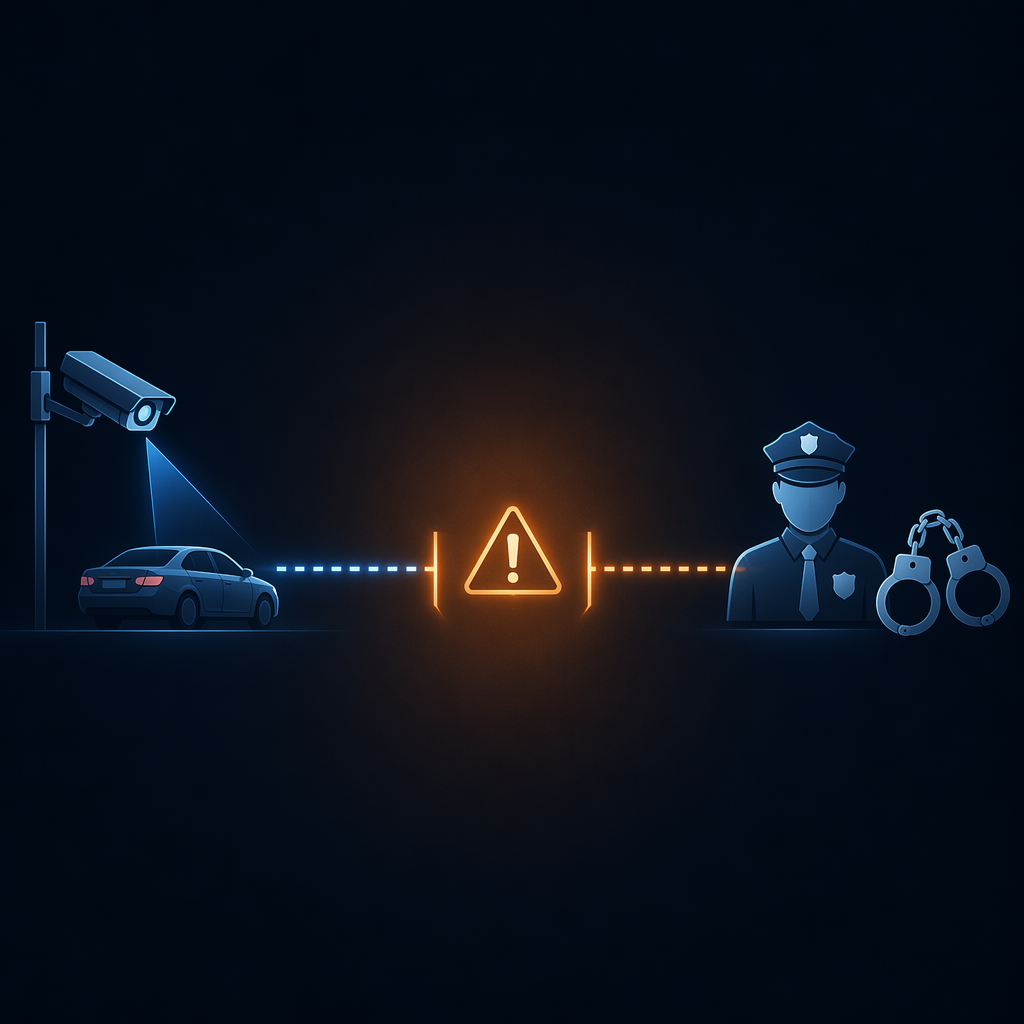
The legal problem in a Flock license plate reader error case usually begins in a narrow interval: an automated hit appears, officers decide whether to treat it as probable cause, and an ordinary traffic encounter becomes an armed detention. In the reported matters now driving municipal exposure, the expensive act is not the camera taking a bad read by itself. It is the decision to move on the person before anyone independently checks the plate, the state, the vehicle, and the surrounding facts.
Business Insider reported in March 2026 that at least a dozen documented Flock misread incidents had led to armed stops, K9 attacks, or jail time.[1] The public settlement record remains small, but it is already enough to make the risk concrete: $35,000 in the Toledo Upchurch matter involving a K9 bite, $45,000 in Burkleo, $49,500 in Hofer, $495,000 in Green, and $1.9 million in the Aurora Gilliam matter involving an unarmed family.[1][2][3] Those figures should not be treated as averages, forecasts, or a damages schedule. They do show that cities are paying real money for a repeatable operational failure.
The recurring fact is the unchecked hit
The documented cases do not all look alike. Some involve an allegedly stolen vehicle alert. Some involve the wrong state being attached to an otherwise similar plate. Some involve officers who encountered a family, a driver on the road, or a person later forced to explain why the machine-readable accusation was wrong. The common legal thread is simpler than the factual variety: plaintiffs allege that officers escalated before verifying whether the alert actually matched the vehicle in front of them.
That distinction matters for municipal defense. A city defending an ALPR stop is not usually trying to prove that a camera can never misread a plate. It is trying to prove that the officer response to the alert was reasonable. If the field record shows no independent confirmation before guns, handcuffs, a canine deployment, jail booking, or a high-risk stop, the case becomes harder to defend even if the system is generally useful.
The settlements sit against that operational record. Upchurch settled for $35,000 after a Toledo incident involving a K9 bite.[2] Green settled for $495,000 after litigation that produced a Ninth Circuit duty-to-verify analysis.[3][4] Hofer and Burkleo settled for $49,500 and $45,000, respectively.[3] Gilliam, the Aurora matter involving an unarmed family, settled for $1.9 million.[1][3] Different facts, different jurisdictions, different dollar amounts; the same verification gap keeps reappearing.
Green supplies the verification frame
Green v. City and County of San Francisco is the case municipal lawyers should keep closest to the incident report, because it does not treat the ALPR alert as a magical probable-cause generator. The Ninth Circuit held in 2014 that officers could not rely solely on an ALPR hit when the system was known to produce frequent errors, and that they had an affirmative duty to verify before taking enforcement action.[4]
That duty is not a generalized objection to automated policing. It is a Fourth Amendment reasonableness rule applied to a known failure mode. If the alert says one thing and the vehicle, plate, state, or dispatch confirmation says another, the Constitution does not reward officers for skipping the part of the job that would have revealed the mismatch.
Qualified immunity turns on that same practical point. In a close case, an officer may argue that the law did not clearly prohibit reliance on a particular technology under particular circumstances. Green narrows that argument where the officer had reason to know that ALPR systems can produce false hits and where verification was available before escalation.[4] The question becomes less abstract: what did the officer know, what could the officer check, how long would the check have taken, and what coercive step happened before the check was made?
Three questions should not be blurred
ALPR litigation often gets muddled because three distinct questions are treated as one. They are related, but they do different work in a Section 1983 case.
| Question | What it actually decides |
|---|---|
| Can ALPR systems make errors? | Foreseeability. If errors are known, a city has less room to claim blind reliance was reasonable. |
| May an officer rely on a hit without checking it? | Fourth Amendment reasonableness and qualified immunity. This is where Green matters most. |
| When is the municipality responsible? | Monell exposure. The issue is whether policy, training, supervision, or custom caused the unconstitutional stop. |
The error-rate evidence belongs mostly in the first box. IPVM’s 2021 independent test, as reported by Business Insider and the Electronic Frontier Foundation, found that Flock misidentified the issuing state for approximately 1 in 10 plates.[1][3] A Brennan Center-cited Vallejo randomized controlled trial reported ALPR hit misread rates of 35% to 37%.[5] Those numbers are not universal accuracy benchmarks. The IPVM test is from 2021, Flock has blocked subsequent testing according to cited reporting, and the Vallejo figure is a single-city RCT. But for notice and foreseeability, they are hard to ignore.
The second box is where many incident reports become lawsuit exhibits. If officers know that state misreads, plate misreads, and database problems can occur, a court may ask why no one checked the basics before escalating. A stolen-vehicle hit on an out-of-state plate, for example, is not self-validating if the patrol car is behind a different state’s plate or a visibly different vehicle. The verification step is not bureaucratic polish; it is the act that separates a lead from a seizure.
The third box is municipal liability. Under Monell v. Department of Social Services, a municipality is not vicariously liable under Section 1983 simply because an employee committed a constitutional violation. The plaintiff must connect the violation to a municipal policy, custom, failure to train, or other actionable municipal decision.[6] Repeated ALPR misread stops can matter here because they may turn a one-off officer mistake into evidence that the city knew its workflow was unsafe and did not correct it.
What the settlements can and cannot prove
A settlement is not a verdict, and it is not an admission unless the agreement says so. Municipalities settle for many reasons: litigation risk, defense costs, public pressure, witness problems, insurance considerations, and the possibility that a jury will respond strongly to an innocent person detained at gunpoint or bitten by a police dog. The reported Flock-related settlement figures therefore should be used carefully.
- They do support the conclusion that wrongful ALPR stops have produced material municipal payouts.
- They do not establish an average case value.
- They do not prove that every Flock alert is unreliable.
- They do make it harder for a city to say the failure-to-verify problem is merely theoretical.
The difference between a $35,000 settlement and a $1.9 million settlement is not just arithmetic. It reflects fact sensitivity: level of force, who was detained, duration, injury, public record, jurisdiction, and the clarity of the verification failure. For risk managers, the lesson is not that every bad hit carries seven-figure exposure. It is that once officers convert a machine alert into armed control of a person, the damages analysis no longer belongs to the vendor’s accuracy sheet.
Qualified immunity is weakest where verification was easy
In the ALPR context, qualified immunity will often turn on the facts that appeared in the thirty seconds before escalation. Did the officer compare the plate characters? Did the officer confirm the state? Did dispatch check the underlying warrant, stolen-vehicle report, or database entry? Did the make, model, color, or vehicle type match? Did the officer have time to verify before ordering occupants out at gunpoint?
Green makes those questions legally significant because it frames verification as an affirmative duty when reliance on an ALPR hit is known to be error-prone.[4] The easier the check, the less attractive the immunity argument. Courts do not require officers to perform impossible forensic work on the roadside. They are more likely to ask why the available comparison was skipped.
That is also why the phrase “the system alerted” should make a municipal lawyer look for the next sentence. The defensible sentence is not that the officer trusted the alert. It is that the officer treated the alert as a lead, performed a documented confirmation step, and escalated only after the facts matched.
Monell exposure grows when the miss is no longer isolated
For the municipality, the hardest case is not necessarily the first bad stop. It is the later one, after the city has incident reports, claims, vendor materials, training records, or public examples showing that unverified ALPR hits can lead to unconstitutional detentions. At that point, policy silence starts to look less like oversight and more like municipal tolerance of a known risk.
Monell does not make a city liable every time an officer makes a mistake. But a plaintiff can use repeated incidents to argue that the city failed to train officers on verification, maintained an inadequate ALPR policy, or allowed a custom of treating hits as commands rather than leads.[6] The fact pattern is especially uncomfortable where the written policy says “verify” but the field practice shows officers moving directly from alert to coercion.
That last point matters because better policy language alone does not defend the stop. A policy that requires confirmation is useful only if training, supervision, dispatch workflow, body-camera review, and discipline make the requirement real. A plaintiff’s lawyer will not stop at the policy manual. The request will reach CAD notes, radio traffic, ALPR audit logs, officer training rosters, prior complaints, and every remedial memo that should have existed after an earlier mistake.
Broader ALPR surveillance cases set outer boundaries, not the core rule
The current ALPR constitutional landscape is not limited to wrongful stops. In Schmidt v. Norfolk, the Eastern District of Virginia first denied a motion to dismiss in February 2025 after finding a plausible Fourth Amendment violation from Norfolk’s 176-camera ALPR network, then in January 2026 found the cameras constitutional.[7] The conflicting rulings show uncertainty over when broad camera coverage becomes a search or otherwise violates constitutional limits.
Commonwealth v. McCarthy points in the same direction without deciding every deployment question. The Massachusetts Supreme Judicial Court recognized in 2020 that “with enough cameras in enough locations,” ALPR monitoring could cross a Fourth Amendment line.[8] That principle matters for municipalities considering dense networks, long retention periods, or regional data sharing.
Those cases should not distract from the more immediate stop-and-seizure problem. A city can win a broad surveillance challenge and still face exposure if officers use a specific alert unreasonably. Network constitutionality and roadside verification are separate defenses. The former asks whether the system may be deployed; the latter asks whether this person should have been seized on this alert.
Procurement risk is a separate pressure point
The ACLU’s July 2, 2026 report alleging a pattern of Flock misrepresentations to city councils belongs in the risk file, but it should not be confused with the main Section 1983 stop theory.[9] Misrepresentation allegations may become relevant to procurement diligence, council approval, vendor oversight, or negligent procurement arguments. They do not by themselves prove that a particular stop violated the Fourth Amendment.
Still, procurement records can become useful evidence once a wrongful detention occurs. If a city was told the system was effectively foolproof, that may explain why officers were undertrained. If a city received warnings about false hits and did not build verification into policy and training, that may support notice. Either way, the procurement file is no longer just a purchasing document once the city is defending what officers did with the alert.
The defensibility test is operational
For a jurisdiction using Flock or a similar ALPR system, the better risk question is not whether the vendor can describe high system performance in general terms. The question is whether the city can prove, after a bad stop, that officers were trained and required to verify hits before coercive action.
A defensible record usually needs more than a sentence in a policy manual. It needs a workflow that tells officers when an alert is only a lead, what must be checked before a felony stop, who confirms the underlying database information, how mismatched state or vehicle information is handled, and how supervisors review incidents where an ALPR hit led to force, detention, arrest, or a complaint.
The documented record is still limited. Settlements are not verdicts. The IPVM and Vallejo figures are not uniform industry benchmarks. Flock is the named technology in the reported incidents, but the liability problem is not that one vendor is uniquely defective. The problem is that ALPR fallibility is known enough that unverified armed enforcement is legally dangerous. Policy silence on that point is becoming difficult to defend.
References
- Business Insider March 2026 investigation on Flock misread incidents, Business Insider, March 2026.
- WTOL report on Upchurch Toledo K9 bite settlement, WTOL.
- Electronic Frontier Foundation reporting on Flock ALPR wrongful detention settlements, Electronic Frontier Foundation.
- Green v. City and County of San Francisco, U.S. Court of Appeals for the Ninth Circuit, 2014.
- Brennan Center discussion of Vallejo ALPR randomized controlled trial, Brennan Center for Justice.
- Monell v. Department of Social Services, U.S. Supreme Court.
- Schmidt v. Norfolk, U.S. District Court for the Eastern District of Virginia, 2025-2026.
- Commonwealth v. McCarthy, Massachusetts Supreme Judicial Court, 2020.
- ACLU July 2, 2026 report on alleged Flock misrepresentations to city councils, American Civil Liberties Union, July 2, 2026.
Comments
Join the discussion with an anonymous comment.