
Published July 18, 2026.
Two rulings issued in the same week of January 2026 gave police departments and municipal lawyers a tempting headline: warrantless Flock Safety license-plate queries survived Fourth Amendment challenges. That headline is too clean. The rulings did not bless every automated license plate reader deployment, and they did not answer what happens when a city’s camera grid grows dense enough, retains enough data, or shares broadly enough that a local traffic-facing tool begins to resemble a regional movement database.
That is the practical state of the Flock Safety privacy backlash and its legal implications in Q3 2026: many courts are distinguishing Flock’s fixed cameras from the cell-site location records at issue in Carpenter v. United States, but the distinction depends heavily on implementation facts. Carpenter held that the government’s warrantless acquisition of 127 days of cell-site location information was a Fourth Amendment search because the aggregate data gave police a “comprehensive chronicle” of the suspect’s movements.[1] Flock litigation is now testing how far that reasoning travels when the data comes from cameras pointed at public roads rather than phones communicating with towers.
The Federal Question Starts With Aggregation, Not With the Camera
A single camera observing a single plate at a single intersection is the easy case for the government. Public roads have never been treated as private spaces in the ordinary sense, and courts have long permitted officers to observe what is exposed to public view. The harder question is whether automated collection across many fixed locations, stored for later search, changes the constitutional character of those observations.
Flock’s public Fourth Amendment argument leans into that distinction. The company describes its system as a network of fixed-location cameras that capture “point-in-time observations,” not continuous cell-phone tracking, and emphasizes its 30-day retention policy as materially shorter than the 127 days involved in Carpenter.[2] That is not a neutral description of the legal baseline; it is the vendor’s litigation-adjacent theory. But it matters because courts that uphold warrantless use are accepting much of the same structure: fixed place, shorter retention, less continuity.
The company also says that at least 30 courts have upheld warrantless ALPR use.[2] That figure should be handled as Flock’s own claim, not an independently audited count. It is still useful as a signal of where many trial-level decisions are landing, but it does not settle the constitutional question, especially where the record concerns a particular city’s deployment rather than a generalized ALPR concept.
Why Norfolk Matters, and Why It Does Not End the Analysis
Schmidt v. Norfolk is the early-2026 decision municipal counsel will be asked about first. On January 27, 2026, a federal judge upheld Norfolk’s 176-camera Flock deployment, reasoning that fixed cameras capturing plate images at discrete moments were meaningfully different from the continuous cell-site location tracking in Carpenter.[3] The deployment size is important. So is the court’s framing. The ruling did not say that automated license plate databases are categorically outside the Fourth Amendment; it treated the record before it as insufficiently comparable to Carpenter’s long-term, comprehensive cell-phone tracking.
The caveat in Norfolk is the line lawyers should not skip. The judge expressly flagged that the constitutional calculus could shift as camera density increases.[3] That is the kind of reservation that later courts use to distinguish a case after everyone in procurement has already quoted the favorable part. A 176-camera deployment in one jurisdiction may not tell a court what to do with a denser grid, a different geography, a longer practical retention period, or a broader sharing configuration.
Two days later, a Washington state court in Simonson reached the same general result, adding to the current weight of authority favoring warrantless use under the deployments before those courts.[4] Simonson matters less because it supplies a new theory than because it shows the pro-warrantless reasoning hardening into a pattern: judges are separating fixed ALPR hits from the persistent, phone-based tracking that concerned the Supreme Court in Carpenter.
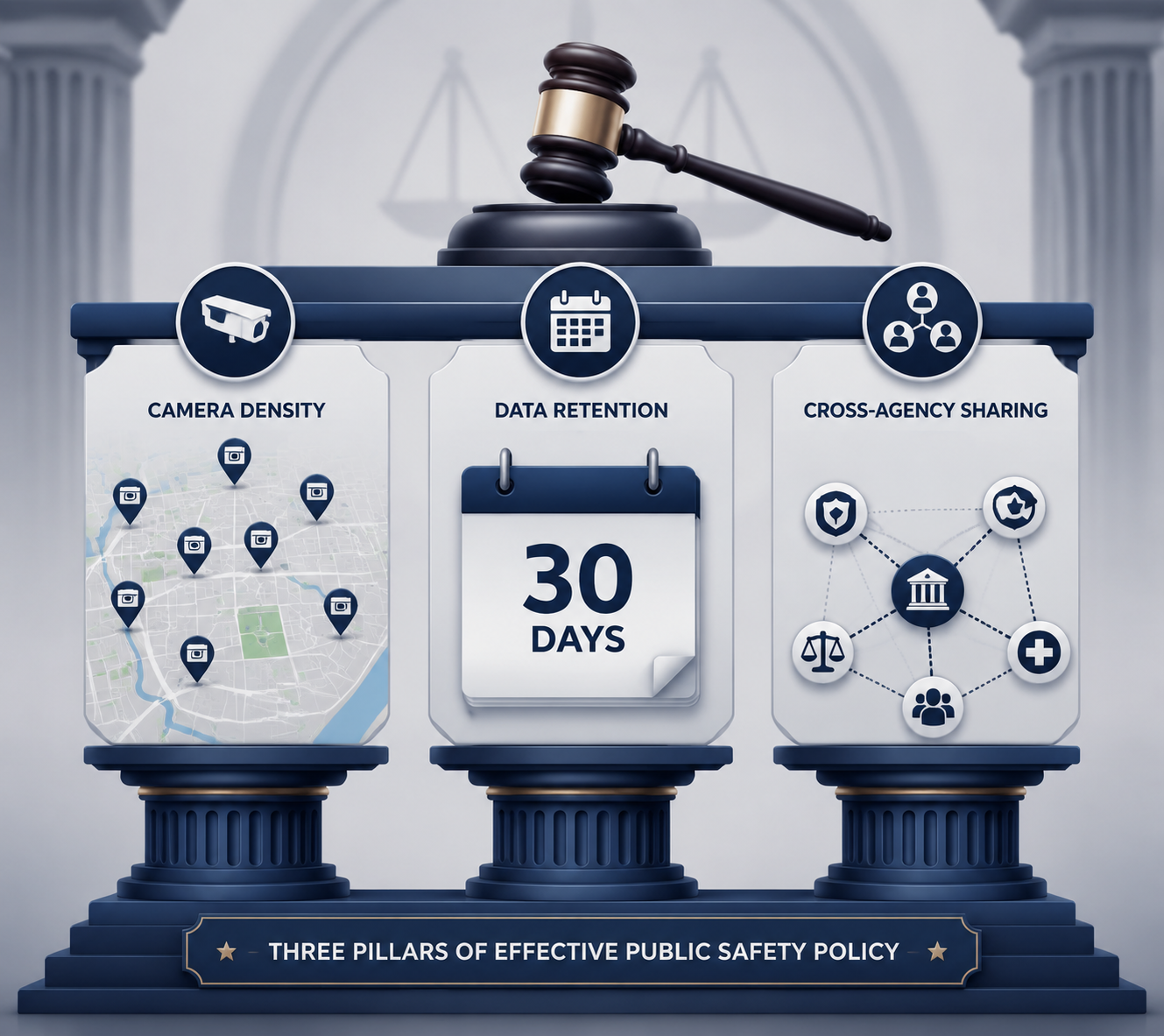
| Issue | Why It Changes the Legal Posture |
|---|---|
| Camera density | A sparse deployment looks more like discrete public-road observation; a dense grid makes it easier to argue that the system reconstructs routine travel. |
| Retention | Flock points to 30-day retention as shorter than Carpenter’s 127 days, but retention still determines how far police can look backward. |
| Cross-agency lookup | Local collection takes on a different character if default or enabled sharing lets outside agencies search the same historical plate data. |
The Norfolk and Simonson rulings therefore give prosecutors useful authority, but not a national rule. They answer the question presented on particular records. They do not resolve whether a denser or more widely shared deployment becomes the kind of aggregated surveillance Carpenter warned about.
Bell Keeps the Other Side of Carpenter Alive
The contrary pressure point is Bell, where a court found that vehicle fingerprinting through pervasive camera surveillance likely violated the Fourth Amendment.[5] Bell prevents the current landscape from being reduced to a one-direction trend story. It treats the problem less as a camera-on-a-road issue and more as a system-design issue: when surveillance is pervasive enough to identify and follow a vehicle over time, the constitutional analysis begins to look different.
That distinction matters because “license plate reader” is an imprecise label. A cruiser-mounted reader used during patrol, a handful of fixed cameras at ingress points, and a citywide network with searchable historical data all carry the same shorthand name. Courts are increasingly being asked to decide whether the Fourth Amendment turns on the method of capture, the resulting database, or both.
Academic commentary has made the same point in a more formal register. A North Carolina Journal of Law & Technology student note analyzing Flock cameras frames the constitutional concern around aggregation and the ability of networked ALPR systems to reveal movement patterns, rather than around the isolated visibility of a plate on a public road.[6] That does not override the trial-court rulings, but it gives defense counsel and civil litigators a vocabulary for explaining why the implementation details are not peripheral.
San Jose Shows Why State Constitutional Law May Matter More Than the Federal Trend
The San Jose litigation is the case to watch for a different reason. Filed by the EFF and ACLU in November 2025, the challenge targets San Jose’s alleged 474 Flock cameras and 3.9 million warrantless searches.[7] Those numbers make the scale issue concrete. A court does not have to imagine a hypothetical dense network; the complaint alleges a city deployment large enough to make “camera density” a factual centerpiece.
The lawsuit also presses California’s state constitutional search-and-seizure clause as an independent basis for requiring warrants.[7] That separation is important. Even if federal courts continue to distinguish Carpenter and uphold many warrantless ALPR searches under the Fourth Amendment, a state constitution can supply broader privacy protection. For practitioners, that means the federal answer may be only the first answer.
This is where the usual national framing can mislead. A police department may be reading Norfolk and Simonson as procurement comfort. A city attorney in California has to read San Jose as a state-law warning. A defense lawyer in another state has to ask whether local constitutional doctrine, statutes, retention rules, or municipal policies create a different route than Carpenter alone.
Sharing Toggles Are Not Administrative Details
The least theatrical part of an ALPR contract may become the most important constitutional fact. Flock’s National Lookup and Statewide Lookup features concern whether agencies can search beyond their own local camera feeds. If those settings are enabled by default or widely used, a local camera program can become part of a broader movement-tracking apparatus.
That does not automatically make every query a search under the Fourth Amendment. But it changes the record. The government’s argument is strongest when it can describe a narrow, local, fixed-camera hit connected to a specific investigation. The challenge becomes sharper when the query reaches historical records across jurisdictions, especially if the requesting agency did not collect the data and the driver had no practical way to know that ordinary travel was being pooled into a searchable law-enforcement network.
Congressional attention has moved in the same direction. In August 2025, Representatives Raja Krishnamoorthi and Robert Garcia announced investigation letters concerning the use of Flock’s ALPR technology.[8] In November 2025, Senator Ron Wyden and Representative Krishnamoorthi asked the Federal Trade Commission to investigate Flock-related privacy and data-sharing concerns.[9] Those letters do not decide suppression motions, but they show that the dispute has moved beyond individual criminal cases and into oversight of the network’s operating model.
The Pending Federal Appellate Track
The Fourth Circuit appeal brought by the Institute for Justice could become the first federal appellate decision to squarely address the Fourth Amendment status of Flock-style ALPR surveillance.[4] That matters because much of the present map is trial-court terrain. Trial rulings can influence city policy quickly, but they do not provide the same stabilizing authority as a federal appellate opinion.
Even an appellate ruling, however, may not answer every deployment question. A decision that approves a particular network based on fixed cameras and 30-day retention may leave open what happens with greater density or broader sharing. A decision that finds a search may still turn on pervasive coverage or the nature of the query. Carpenter itself is doing so much work in this debate because it did not announce a simple rule for all location data; it identified a constitutional problem in the government’s acquisition of a deep historical record.
What the Patchwork Means in Q3 2026
As of Q3 2026, the legal implications of the Flock Safety privacy backlash are not captured by asking whether ALPRs are “public” or “private.” Courts are instead sorting through how a particular system is built and used. Norfolk’s 176 cameras, San Jose’s alleged 474 cameras, Flock’s 30-day retention claim, and cross-agency lookup settings are not side details. They are the facts that decide whether a court sees ordinary observation or aggregated location surveillance.
The current federal trend favors warrantless use under many existing deployments, especially where judges accept the fixed-location, point-in-time distinction from Carpenter. Serious contrary arguments remain alive through Bell, San Jose, and the Fourth Circuit track. The unresolved questions cluster around density, retention, and sharing—the same operational settings that often receive the least public attention when a city first buys the cameras.
References
- Carpenter v. United States, Supreme Court of the United States, June 22, 2018.
- Automated License Plate Readers and the Fourth Amendment, Flock Safety.
- Schmidt v. Norfolk ruling coverage, Courthouse News Service, January 27, 2026.
- Simonson ruling analysis, EPIC, January 29, 2026.
- Vehicle Fingerprinting Through Pervasive Camera Surveillance Likely Violates Fourth Amendment, Court Finds, EPIC.
- Student note on Flock cameras, North Carolina Journal of Law & Technology.
- EFF/ACLU San Jose complaint investigation report, Electronic Frontier Foundation, November 2025.
- Congressional investigation letters concerning Flock ALPR technology, House.gov, August 2025.
- Wyden/Krishnamoorthi FTC letter concerning Flock privacy and data-sharing practices, Senate.gov, November 2025.
Comments
Join the discussion with an anonymous comment.