
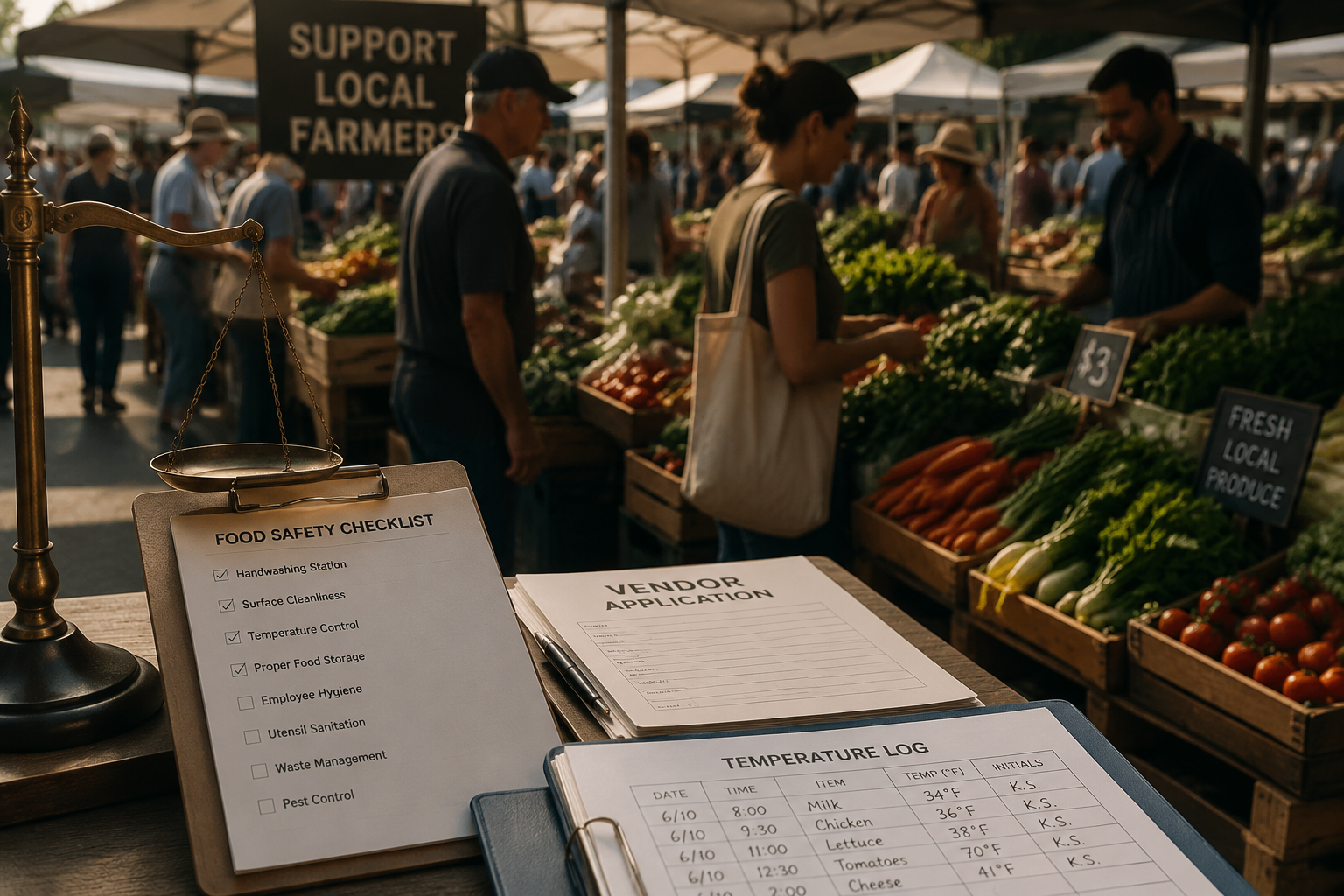
After a foodborne illness outbreak is traced to a farmers market, the first legal question is usually asked too broadly: is the market liable? That wording hides the work. A vendor who sold the food, a farm that grew it, a processor that handled it, a market association that admitted the vendor, and a municipality that hosted the site do not all stand in the same legal place. The seller track is usually strict product liability. The organizer track is usually negligence. The documents that sort those tracks are not dramatic: vendor applications, market rules, insurance certificates, inspection records, temperature logs, complaint notes, stall assignments, and whatever emails show who knew what before someone became ill.
That distinction matters because the available outbreak data does not support treating farmers markets as a dominant foodborne illness source. Farmers Market Coalition, citing CDC data, reported only four documented foodborne illness outbreaks traced to farmers markets between 2008 and 2014, all involving relatively few people; in the same period, the commercial supply chain produced 68 large multi-state outbreaks, and restaurants accounted for more than half of all foodborne illness cases in the cited CDC data. [1]
That number should steady the analysis, not end it. It is a narrow 2008-2014 comparison, not a comprehensive national tally through Q3 2026. The searched materials did not identify a comparable farmers-market-specific national count for 2015-2026. Foodborne illness remains a major national burden: CDC estimates cited in FDA's 2024 CORE annual report put overall U.S. foodborne illness at 48 million illnesses, 128,000 hospitalizations, and 3,000 deaths each year. [2] The point is proportion, not comfort. Severe cases can be devastating even when the retail setting is not frequently represented in documented outbreak data.
The Two Tracks: Seller Liability and Organizer Negligence
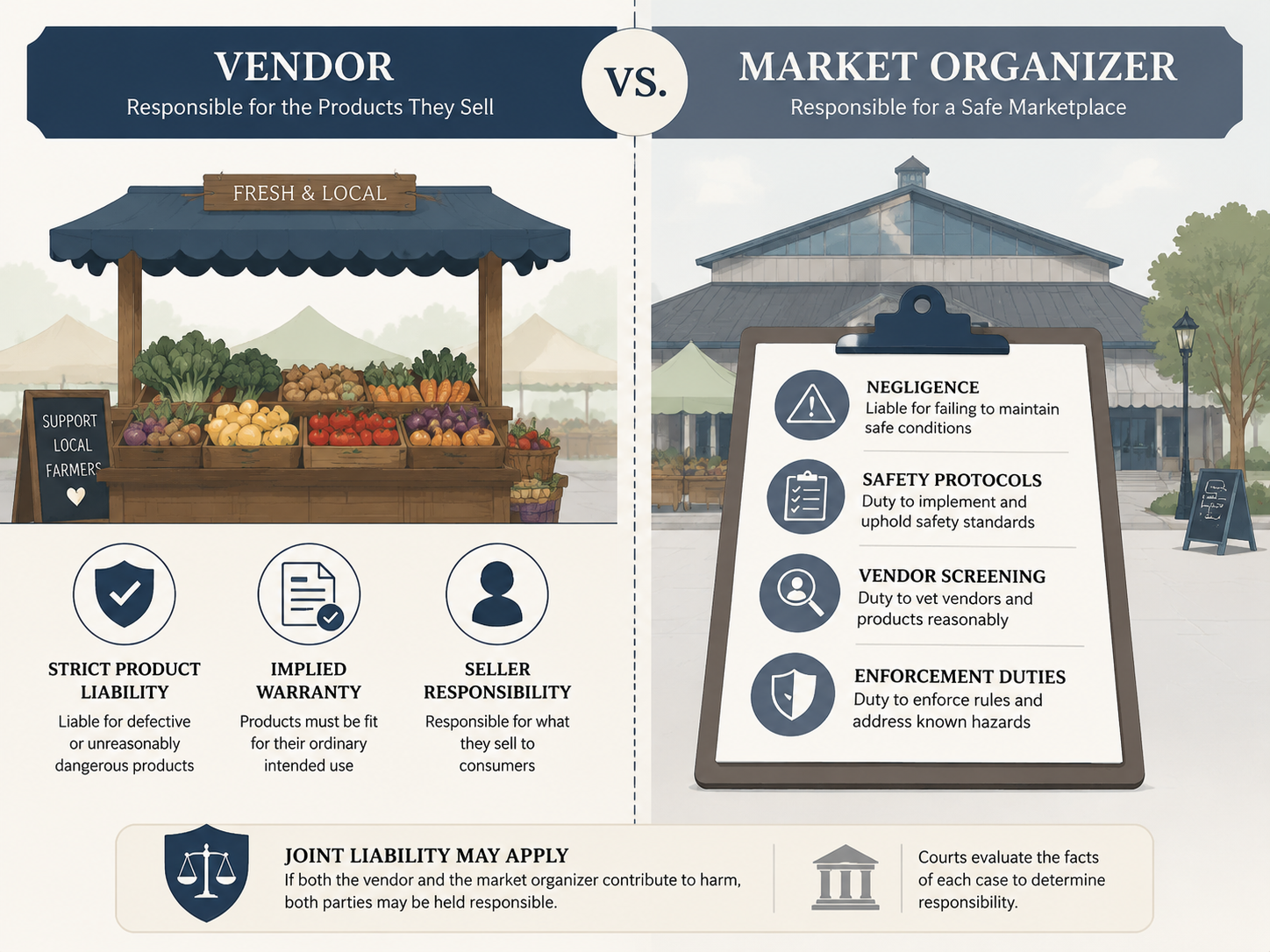
| Potential defendant | Usual legal theory | What the plaintiff must focus on |
|---|---|---|
| Vendor, farmer, processor, or distributor | Strict product liability and implied warranty | The food was defective or unreasonably unsafe, the defendant was in the chain of distribution, and the food caused the illness |
| Market organizer, association, or municipal host | Negligence | The organizer owed a duty, breached that duty through inadequate rules, screening, monitoring, or enforcement, and the breach caused the injury |
| Multiple parties in the chain | Joint and several liability where available | One defendant may be pursued for the full damage amount if the law and facts place that party in the responsible chain |
For vendors, the plaintiff does not necessarily need to prove careless conduct. Product liability law can attach because the vendor sold a defective food product that caused harm. A 2023 Cambridge University Press study summarizes the strict product liability and implied warranty framework in foodborne illness litigation: sellers and distributors of defective products may face liability without proof of fault, and breach of the implied warranty of merchantability can apply when food is not fit for ordinary consumption. [3]
For organizers, fault comes back into the room. A market's name on the banner does not automatically make it the legal seller of every tomato, sandwich, jar of salsa, or cut melon sold under the tents. The negligence inquiry asks what the organizer undertook to do and whether it did that work reasonably. Did the market require licenses where applicable? Did it review permits before allowing prepared-food sales? Did it have rules for sampling, handwashing, refrigeration, animals, or wastewater? Did it enforce those rules, or did it merely copy them into a vendor packet once a year?
Why Vendors Usually Face the Cleaner Claim
The vendor claim is cleaner because the vendor's role is concrete. The plaintiff bought food from a specific stall, consumed it, became ill, and, if the investigation supports it, connects that illness to the product. In a recognized outbreak, that connection may be built from epidemiology, lab testing, traceback, purchase records, interviews, and timing. Outside an outbreak, the same claim becomes harder: many pathogens have incubation periods that leave room for meals at home, restaurants, workplaces, schools, or other retailers.
Strict liability is blunt by design. If the vendor sold the defective food and causation is proven, the vendor's careful habits may not dispose of the claim. A small farmer may have sanitized bins, iced greens, trained staff, and followed the market's sampling rules. Those facts may matter to insurance, comparative fault arguments, punitive damages exposure, regulatory posture, or indemnity disputes. They do not transform a strict-liability case into a negligence-only case.
The implied warranty theory moves in the same practical direction. Food sold for eating carries an expectation that it is fit for that ordinary use. When the alleged defect is a pathogen that made the buyer sick, the warranty claim often travels alongside strict product liability rather than changing the factual center of the case.
Joint and several liability can sharpen the consequences. University of Maryland AgRisk explains that every party in the chain of distribution, including farmer, processor, and market, may be potentially liable for the full amount of damages under that doctrine. [4] The practical result is that a plaintiff may pursue the party with insurance, records, or a continuing business presence, even if other actors also touched the product. Counsel then has to separate plaintiff-facing exposure from contribution, indemnity, and contractual risk shifting among defendants.
Organizer Liability Turns on Control, Not Proximity
A farmers market organizer may feel close to every sale because it recruited the vendors, arranged the site, advertised the event, assigned stalls, and collected fees. Proximity is not the same as operational control over the food. The negligence case against an organizer needs a bridge from the organizer's conduct to the contamination or illness: a missing rule, a known hazard, an ignored complaint, a vendor admitted without required paperwork, or a safety policy that existed only on paper.
The stronger organizer claim is not simply that unsafe food was sold at the market. It is that the organizer created or tolerated conditions that made the sale of unsafe food more likely. A prepared-food vendor without appropriate temperature control may raise different questions than a produce vendor selling whole, uncut vegetables. A market that requires proof of permits but never reviews them stands differently from one that verifies permits, records expiration dates, and excludes noncompliant vendors. A municipal sponsor that only provides a parking lot stands differently from a city department that writes the food rules, supervises operations, and receives prior complaints.
This is where market rules become evidence rather than decoration. Rules can help show reasonable care when they match the risk and are enforced. They can also become a plaintiff's exhibit when the market promises controls it does not perform. A vendor handbook requiring cold-holding checks is useful only if someone knows who checks, when checks occur, what happens after a failed check, and where the records are kept.
Municipal clients require particular care. A city may have governmental immunities, notice requirements, contractual defenses, or charter-specific protections not addressed by the general foodborne illness materials. But those defenses do not answer the first factual question. The first question remains what the city actually did: host, lease, sponsor, regulate, inspect, manage, or merely approve use of public space.
The Short Supply Chain Cuts Both Ways
Farmers markets are often described as simpler because the food moves through fewer hands. The Farmers Market Legal Toolkit describes a farmers market supply chain as having only two steps, compared with many steps in commercial channels. [5] That simplicity has two legal consequences that point in opposite directions.
First, traceback may be easier once a cluster exists. If three households report illness after buying the same product from the same Saturday stall, investigators and lawyers may have fewer warehouses, brokers, repackers, processors, and retailers to examine. Receipts, market attendance records, credit-card data, social media posts, and vendor harvest logs may quickly narrow the inquiry.
Second, the shorter chain may mean fewer possible contamination points. That does not make the food safe by legal presumption, and it does not defeat a strict-liability claim if the product was contaminated. It does affect how counsel evaluates alternative causes. In a long commercial chain, contamination may have occurred at the field, wash line, cooling facility, processing plant, distribution center, retailer, restaurant kitchen, or home. In a direct-market chain, the factual map may be shorter, but the remaining nodes receive more attention.
The paradox is important for both plaintiffs and defendants. A short chain can make a good outbreak case easier to prove. It can also make weak individual attribution harder to inflate, because there are fewer places to hide speculation. Counsel should resist turning supply-chain simplicity into either a defense slogan or a plaintiff shortcut.
Causation Is Often the Case
Many farmers market liability conversations spend too much time on abstract duty and not enough on proof. Foodborne illness claims are built or lost on causation. A plaintiff who ate at five places during the relevant incubation window needs more than a memory of buying local greens. A vendor who handled the suspected product carefully still faces exposure if lab and epidemiologic evidence tie the product to the illness. A market organizer with tidy rules may still have a problem if records show repeated nonenforcement against the implicated vendor.
The strongest causation evidence tends to come from recognized outbreak work: multiple illnesses with a common exposure, pathogen matching, public health interviews, purchase histories, leftover product testing where available, and traceback records. A single claimant can still have a claim, but the evidentiary burden is different. Lawyers advising vendors or organizers should not treat every complaint call as litigation-grade proof, yet they also should not dismiss early complaints before preserving records.
This is the point where market management habits matter before any lawyer arrives. If the market cannot identify which vendors attended on a given date, which products they were approved to sell, or whether a prepared-food vendor had current permits, the organizer has made the causation fight messier. That does not create liability by itself. It does make defense counsel reconstruct the ordinary operation from fragments, and fragments are expensive.
Defenses Matter, but They Are Not the Spine
The standard defenses in foodborne illness civil liability should be reviewed early but kept in proportion. University of Maryland AgRisk identifies assumption of risk, contributory negligence, product misuse or mishandling, sealed-container defenses, and compliance with relevant standards among the defenses that may arise. [4] Their value depends heavily on the product and the timeline.
- Assumption of risk may matter where a consumer knowingly chose a plainly risky condition, but ordinary farmers market shopping does not imply consent to pathogenic contamination.
- Contributory or comparative negligence may matter if post-sale handling plausibly caused or worsened the problem, such as leaving temperature-sensitive food unrefrigerated.
- Misuse or mishandling is fact-sensitive and usually requires a credible alternative contamination or growth pathway after sale.
- A sealed-container defense may help a retailer-like defendant that sold a product without altering it, depending on state law and the defendant's role.
- Compliance with food safety standards is useful evidence for a negligence defense, but it does not necessarily defeat strict product liability if the food was defective and causation is proven.
Statutes of limitation also vary by state, with foodborne illness claims typically falling somewhere in a one-to-six-year range. That window affects intake, preservation, and notice strategy, but it does not change the basic split between seller liability and organizer negligence.
What the Outbreak Data Should and Should Not Do
The four documented farmers-market-linked outbreaks from 2008 to 2014 are a useful correction to loose risk talk. [1] They do not prove that farmers markets are inherently safe, that later outbreaks did not occur, or that a particular claimant cannot prove causation. They do suggest that counsel should be cautious before pricing organizer risk as though farmers markets commonly generate large national foodborne illness litigation.
The national foodborne illness burden numbers have a different role. They show scale: foodborne illness is not a marginal public health problem. [2] They do not identify farmers markets as a major source in the materials reviewed for this article. Conflating national burden with market-specific frequency is how small vendors end up treated as if every folding table needs a corporate compliance department.
The same caution applies to broader product liability research. The 2023 Cambridge study examined foodborne illness and product liability across the United States and the 1998-2018 period, including findings about strict liability and punitive damages in relation to reported illness rates. [3] It was not disaggregated by farmers market retail channel in the materials provided. It supports the general legal framework; it should not be overstated as proof about farmers-market-specific effectiveness or frequency.
A Limited Signal from Louie v. Sprouts Farmers Market
Louie v. Sprouts Farmers Market is worth noting, but only with its limits attached. The National Agricultural Law Center's local food systems case law index describes a March 2025 Eastern District of Pennsylvania decision holding that a customer lacked standing to sue for punitive damages after alleged foodborne illness from a market-purchased sandwich. [6] The case signals that plaintiffs may face threshold barriers in some foodborne illness litigation.
It should not be made to carry more weight than it can bear. Sprouts Farmers Market Inc. is a national grocery chain, not a traditional outdoor farmers market. The decision is a federal district court ruling and may not bind courts elsewhere. Its value for lawyers advising actual farmers market organizers is therefore modest: useful as a reminder to examine standing and damages theories, not as a broad rule about market liability.
Counsel's Document Checklist After a Market-Linked Illness
Once an illness is reported, the first job is preservation, not reassurance. For a vendor, that means product records, batch or harvest information, supplier records, ingredient labels, refrigeration logs, sales records, communications with the market, and any remaining product. For an organizer, it means the vendor file, rules in effect on the relevant date, enforcement notes, stall map, attendance records, incident reports, complaints, inspection communications, and insurance documents.
The next job is classification. Was the client a seller, a premises host, a rulemaker, a sponsor, a regulator, or some combination? Did it touch the product, approve the product category, inspect food handling, or merely rent space? Did it have authority to remove the vendor, and did it ever use that authority? Those answers determine whether the client belongs near the strict-liability chain, the negligence analysis, or both.
Attorneys working on a current Cyclospora-related market matter may also want the companion discussion of farmers market vendor liability after a Cyclospora outbreak, which applies the same seller-focused framework to a specific outbreak setting.
The Practical Liability Conclusion
Foodborne illness liability claims tied to a farmers market should begin with a disciplined split. Identify the seller and test causation under strict product liability and implied warranty. Then separately examine the organizer's rules, screening, monitoring, enforcement, and actual authority under negligence principles. Do not merge those questions just because the illness was reported as market-linked.
The available data keeps the risk in scale: documented farmers-market-linked outbreaks in the cited national comparison were rare, while foodborne illness overall remains serious. [1][2] That combination is why counsel should avoid both easy assurances and insurer-driven overreach. The documents that decide the organizer's position are usually mundane. If they show reasonable rules, real screening, and consistent enforcement, the organizer may remain adjacent to the claim. If they show assumed control without follow-through, the organizer has moved closer to being a defendant.
References
- FMC Perspective: Food Safety at Farmers Markets, Farmers Market Coalition.
- CORE 2024 Annual Report, U.S. Food and Drug Administration, 2024.
- Foodborne Illnesses and Product Liability in the U.S., Cambridge University Press, 2023.
- Understanding Foodborne Illness Civil Liability, University of Maryland AgRisk.
- Food Related Illnesses, Farmers Market Legal Toolkit.
- Local Food Systems Case Law Index, National Agricultural Law Center.
Comments
Join the discussion with an anonymous comment.